
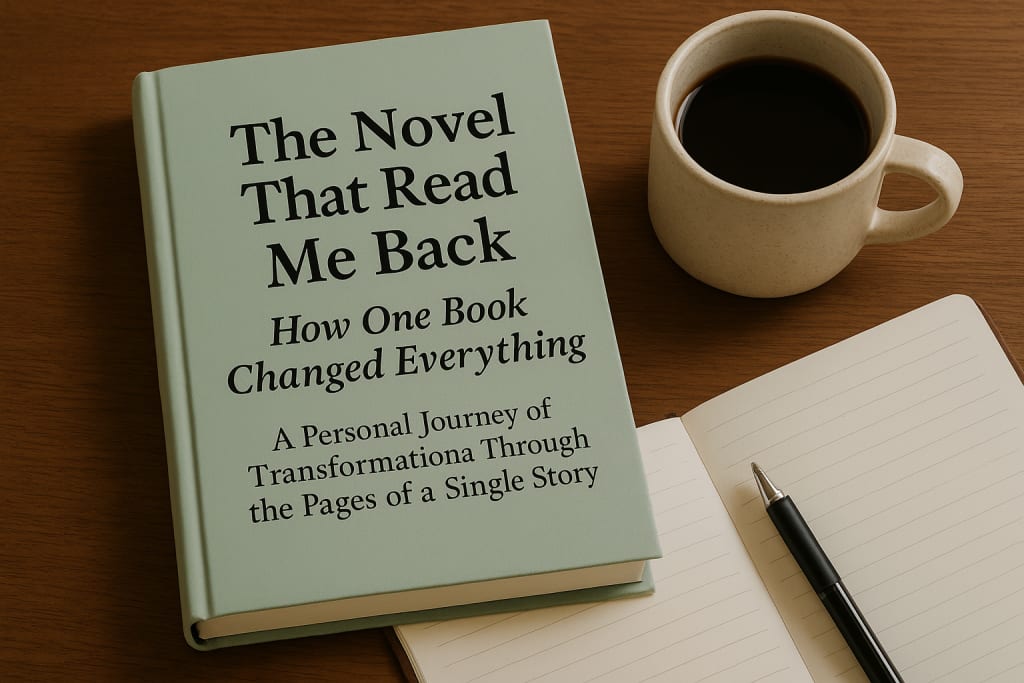
The Novel That Read Me Back: How One Book Changed Everything
A Personal Journey of Transformation Through the Pages of a Single Story
Introduction
Have you ever read a book that felt like it knew you? As if the characters had lived your life, and the words were whispering truths you hadn’t yet found the courage to say out loud? For many of us, reading is an escape — a break from the pressures and routines of daily life. But every now and then, a novel comes along that doesn't just entertain or inform. It sees you. It reads you back. This is the story of how one such book changed the way I saw myself, my past, and the world around me.
The Accidental Discovery
I wasn’t looking for anything special that day. It was a regular afternoon at a used bookstore — dusty shelves, quiet music playing, and the comforting smell of old paper. I was just browsing to pass the time. Then I saw it. A worn paperback with a cover that didn’t stand out, but the title caught my eye. It felt oddly familiar, though I had never heard of it before.
Out of curiosity, I picked it up and started reading the first few lines. Within minutes, something inside me shifted. The voice of the narrator echoed my own thoughts — ones I’d never dared to say out loud. I bought it without hesitation, not realizing that I had just invited a life-changing journey into my hands.
The Mirror in the Pages
As I read further, I felt a strange connection to the main character. Their fears, regrets, hopes, and silent battles felt eerily similar to mine. It was as though the author had looked into my memories, my heartbreaks, and the questions I kept buried. Every chapter held a mirror to a part of me I had either ignored or misunderstood.
The book didn't offer easy answers or magical solutions. Instead, it gave me language for my confusion and comfort for my pain. It didn’t tell me what to think or how to feel. It simply told a story — but in doing so, it helped me start rewriting my own.
Facing the Past
One of the most powerful parts of the novel was how the character had to confront their childhood — not in a dramatic way, but in quiet, painful reflections. Memories of lost friendships, broken promises, and moments of shame surfaced in the story and, in turn, surfaced in me. I found myself crying at scenes that weren’t even sad on the surface, because they reminded me of things I had buried deep.
Until then, I hadn’t realized how much I was still carrying from my past. Reading those pages helped me realize that healing doesn’t always come in big moments. Sometimes, it starts with understanding — the gentle kind that says, “It’s okay to feel this. You’re not alone.”
Learning to Listen to Myself
Another major shift that came from reading the book was learning to listen to my inner voice. The main character often ignored their instincts or silenced their own needs in order to please others — something I had done most of my life. Seeing the consequences of that pattern in the story helped me reflect on how often I had done the same.
The book encouraged me, indirectly, to stop waiting for permission to be myself. I started journaling more, spending time alone without distractions, and asking myself honest questions. “What do I really want?” “What am I afraid of?” “Who am I when I’m not trying to impress anyone?”
For the first time, I wasn’t afraid to hear the answers.
Opening My Heart Again
One of the most beautiful things about the novel was its theme of connection — not perfect love stories or fairy-tale friendships, but real, messy, vulnerable relationships. The characters had to work through misunderstandings, forgive each other, and learn how to stay even when it was hard.
This reminded me of relationships I had walked away from or ones I had guarded myself against. I had built walls around my heart, believing it was safer that way. But the book showed me that true connection requires risk. It requires showing up, even when we’re scared.
I began reaching out more — not just to others, but also to myself. I started expressing how I felt, not just what I thought people wanted to hear. Slowly, I saw my relationships deepen. The people who mattered stayed, and I realized that vulnerability was not weakness — it was the doorway to real intimacy.
Why This Book Was Different
I’ve read many books in my life, and several of them have touched me. But this one was different. It felt alive. It wasn’t just telling a story — it was telling my story in a way I hadn’t been able to before. It helped me see that we all carry invisible stories within us, and sometimes we need someone else’s words to bring them to light.
The novel gave me hope. Not in a loud or flashy way, but in a soft, steady whisper: “You’re not broken. You’re becoming.”
Conclusion: When a Book Becomes a Friend
Books are powerful. They can open worlds, challenge beliefs, and spark dreams. But some books go even deeper — they don’t just change what you know, they change who you are. The novel that read me back became a kind of friend. It sat with me in silence, cried with me in the dark, and helped me find pieces of myself I didn’t know were missing.
If you’ve ever found a book like that, you’ll understand what I mean. If you haven’t yet, keep reading. One day, you’ll turn a page and feel it — that quiet gasp of recognition, that sense of being seen. And when you do, let it in. Because sometimes, the stories we need most are the ones that show us our own.
About the Creator
Idea hive
Article writer and enthusiast sharing insight and knowledge on nature, human behavior, technology, health and wellness, business, culture and society and personal development.
Rachel Reviews: Lakefront Wolves by Joseph Deegan
Meet Finn. He's an 18 year old kid who has potential. He's bright with great school scores and he's also an athlete, a footballer of some prowess. He has it all going for him, it would seem, and yet, he's determined to send what could be a well-planned, stable existence firmly off the rails. He drinks, he smokes, he takes drugs, he has violent tendencies and he's in danger of losing not only his mind but all that he holds dear.
By Rachel Deeming8 days ago in BookClub
Bomb Scare
It was 2027, and the world never thought it would happen. A missle hit the United States, but it wasn't where they had anticipated. A little town in the northeast was hit by a missile strike, they didn't know why, and they didn't know exactly where it hit, but they did know it was a coastal community, somewhere between Maine and Delaware.
By Gregory Payton3 days ago in Fiction


Comments
There are no comments for this story
Be the first to respond and start the conversation.