
The Economic Policy of Online Media: Manufacture of Dissent
book review

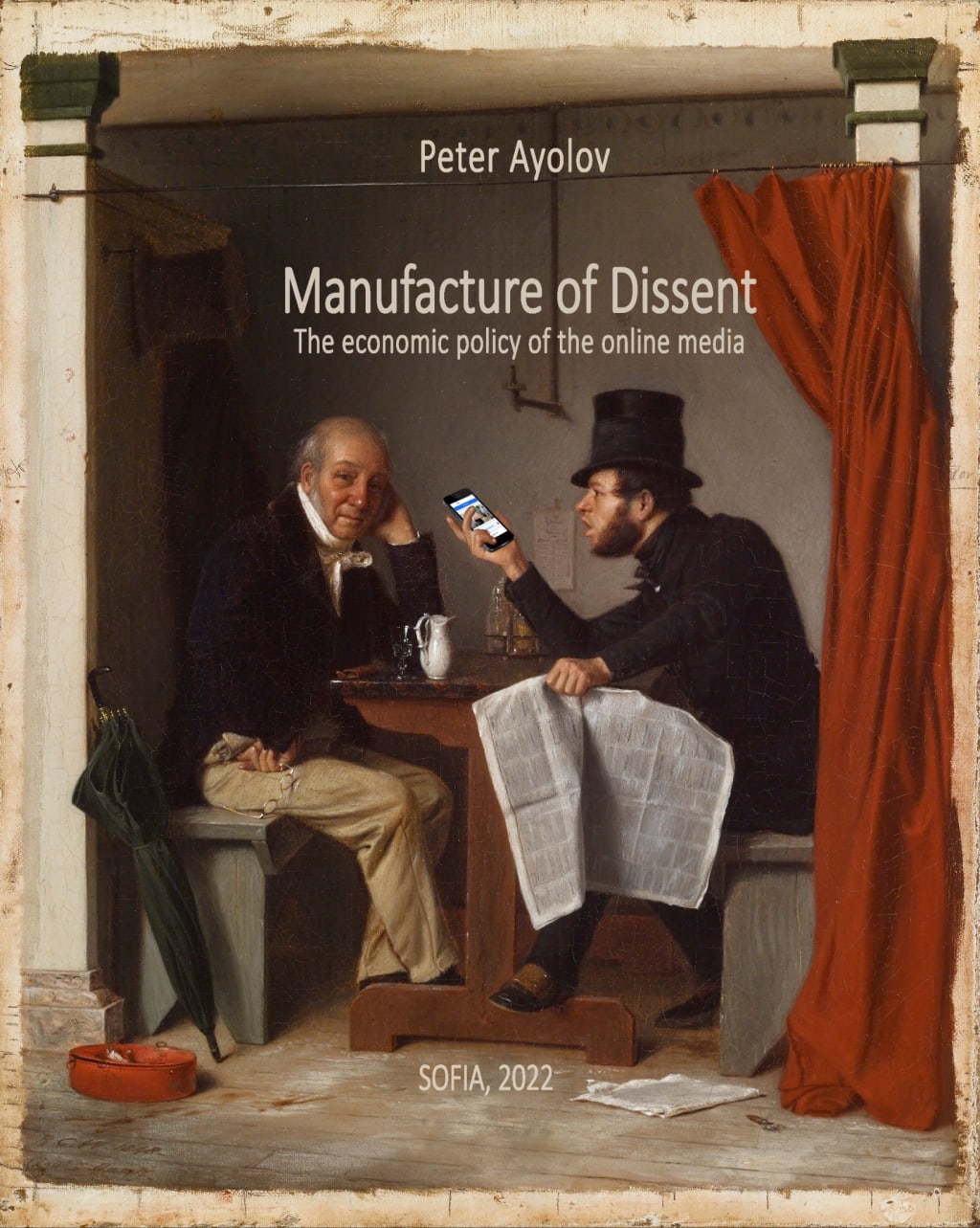
Peter Ayolov’s The Economic Policy of Online Media: Manufacture of Dissent is best read as a political economy of attention written from inside the contemporary media machine: a study of how dissent is not simply reported, represented, or ‘allowed’, but produced as a monetisable output of platform capitalism. The book’s organising intuition is both simple and unsettling. In the online environment, conflict is not a malfunction of communication; it is a business model. What appears to users as spontaneous outrage, grassroots polarisation, or organic ‘culture war’ is, at scale, a routinised industrial process—engineered through incentives, metrics, and infrastructures that reward emotional volatility and punish slow, careful public reasoning.
The book’s strongest contribution lies in its insistence that ‘dissent’ has become a measurable commodity. Ayolov treats digital platforms not as neutral intermediaries but as market-making institutions that shape what can be said, what is seen, and what is rewarded. Likes, shares, comments, watch time, click-through rates, and algorithmic amplification do not merely track public interest; they manufacture it. In this framework, the central product is not content but reaction, and the central scarce resource is not information but attention. Online media organisations adapt accordingly: editorial decisions bend toward the performative, the incendiary, and the identity-confirming, because these are the forms of speech most compatible with the revenue logic of platforms.
A key achievement of the book is its clear mapping of how economic incentives travel through the media ecosystem. Ayolov shows how platform monetisation pulls publishers into a permanent competitive escalation: speed over verification, intensity over nuance, repetition over discovery, personality over institution. The result is an ecology where outrage is rational. That is, even when participants experience the environment as morally exhausting or socially corrosive, the system continues because the incentives are aligned. The book persuades precisely because it does not reduce this dynamic to conspiracy in the vulgar sense; it frames it as structural, systemic, and therefore resilient.
The concept of ‘manufacture of dissent’ functions as both diagnosis and theory. It proposes that contemporary dissent is frequently shaped to be safe for the system that profits from it: loud enough to generate engagement, fragmented enough to prevent coordination, and cyclic enough to remain indefinitely renewable. In this respect the book is particularly sharp on the difference between genuine opposition and profitable antagonism. What looks like rebellion online can be a form of managed volatility—a sequence of predictable moral dramas that keep audiences emotionally invested while leaving the underlying infrastructure untouched. Dissent becomes a style, a genre, even a platform identity, and in that transformation it risks losing its capacity to produce real alternatives.
Ayolov’s writing is at its best when it connects the micro-level mechanics of platforms with the macro-level consequences for democratic life. The book repeatedly returns to one core idea: when the public sphere is reorganised around monetised attention, the normative ideals of journalism—verification, proportionality, contextualisation, and responsibility—become competitive disadvantages. This does not mean that truth disappears; it means truth becomes expensive, slow, and structurally disfavoured. In the long run, the public’s sense of reality becomes less a shared world than a set of competing narrative bubbles whose boundaries are maintained by affect and identity rather than argument.
One of the book’s most compelling strands is its implicit sociology of the online self. Even without turning the study into a purely psychological account, Ayolov captures how people are pushed toward performative speech. Platforms reward not just what one believes, but how one signals belonging. Users learn to speak in ways that maximise visibility, and political language begins to resemble branding: compressed, moralised, polarised, and optimised for reaction. In this setting, identity does not merely express politics; it becomes the carrier of politics, and disagreement becomes a threat to the self rather than a dispute about the world.
If the book has a limitation, it is that the very scale of its critique invites the reader to ask for more operational detail on remedies: not moral advice, but structural counter-incentives. Regulation, alternative funding models for journalism, platform design changes, and educational interventions are all imaginable responses, but a theory of manufacture implicitly demands a theory of demanufacture—how to interrupt the circuits of profitable antagonism without simply replacing them with a different managerial ideology. The book points firmly in that direction, but a reader may still want a more explicit programme.
Even so, The Economic Policy of Online Media: Manufacture of Dissent is a serious and timely intervention. It does not ask the reader to romanticise a pre-digital golden age, nor does it reduce the crisis to bad actors or gullible audiences. Its argument is colder—and therefore more convincing: media systems do what they are paid to do, and platforms are built to monetise attention at scale. If the outcome is polarisation, moral panic cycles, and a degraded public language, that is not an accidental by-product; it is the logical consequence of the current economic design. Ayolov’s book is valuable because it makes that design visible, and because once it is visible, it becomes harder to keep mistaking manufactured dissent for democratic vitality.
About the Creator
Peter Ayolov
Peter Ayolov’s key contribution to media theory is the development of the "Propaganda 2.0" or the "manufacture of dissent" model, which he details in his 2024 book, The Economic Policy of Online Media: Manufacture of Dissent.
Keep reading
More stories from Peter Ayolov and writers in BookClub and other communities.
My New Book is Finally Here
My poetry collection Beautiful and Brutal Things is done. It's actually done and finally published over 270 pages. Over a year of my life went into this book. More than a year, really. Long days at my computer, sometimes seven days a week because I couldn't stop even when I probably should have. Then two months of editing that felt harder than the writing itself. But it's finished, and I'm still standing, and the book is real.
By Tim Carmichael10 days ago in BookClub
7 Books That Are Easy To Read But Still High Quality
When we talk about easy-to-read books, many people mistakenly assume we’re talking about shallow stories, oversimplified ideas, or forgettable prose. We couldn’t disagree more. Some of the most high-quality books ever written are also the most accessible. They respect the reader’s time, guide us with clarity, and still leave a lasting intellectual or emotional impact.
By Diana Meresc4 days ago in BookClub




Comments
There are no comments for this story
Be the first to respond and start the conversation.