
The Dark Truth About Sex in the Middle Ages
Why You Wouldn’t Survive the Medieval Bedroom

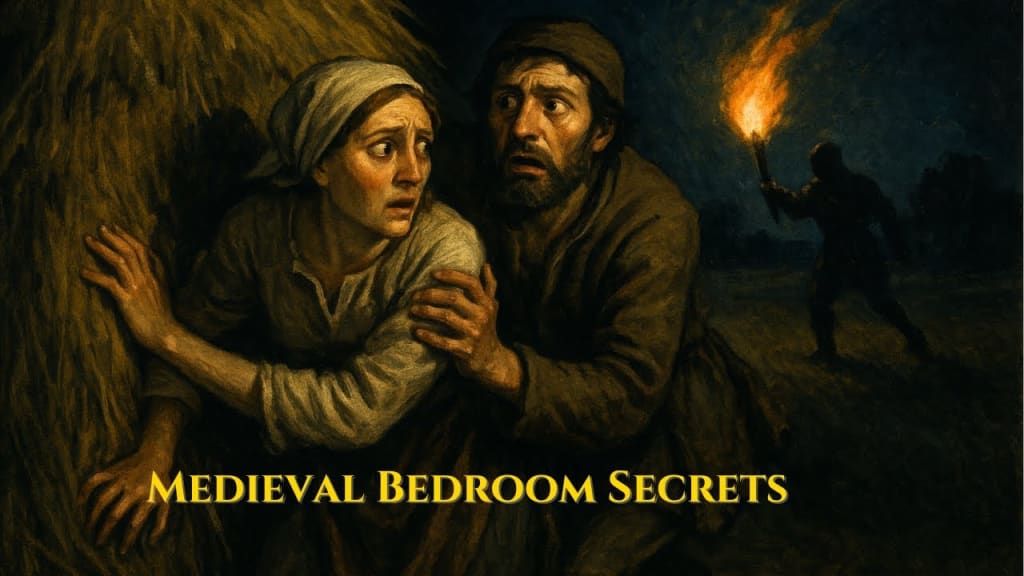
- 🚪 Forget Romance. Forget Privacy. Welcome to the Middle Ages.
Imagine a world where privacy doesn’t exist, romance is discouraged, and pleasure is treated like a crime.
This isn’t the plot of some dark dystopian movie.
This was real life — for millions of people — in medieval Europe.
Welcome to a time when the most natural human acts were cloaked in fear, guilt, and shame.
A world ruled not just by kings and queens, but by the unyielding hand of the Church — even in the bedroom.
And by the end of this, you’ll be thanking your lucky stars you were born when you were.
⛪ The Church Controlled Everything — Even the Bedroom
In the Middle Ages, the Church wasn’t just a place of worship.
It was the supreme authority — a powerful institution that dictated how people lived, how they ate, how they dressed… and yes, how and when they had sex.
Sex wasn’t a private affair.
It was heavily regulated, monitored, and morally policed.
Pleasure? Sin.
Passion? Dangerous.
Love? Only if it made babies.
Married couples were only allowed to have sex during certain days of the week — and even that came with restrictions.
You couldn’t do it on Sundays.
Or on Thursdays.
Or Fridays.
Or the night before a religious feast.
Which, by the way, was nearly half the calendar year.
Some theologians even published guides listing “forbidden days” for intercourse.
Romance wasn’t just discouraged.
It was controlled, timed, and constantly shadowed by guilt.
🛏️ Privacy? What’s That?
Let’s talk about privacy. Or rather — the complete lack of it.
The typical medieval home was small, cramped, and filled with people.
Bedrooms were a luxury.
Beds were often shared — not just between husband and wife, but with children, extended family members, even servants.
And if you were lucky enough to sneak in a private moment… where would you even go?
Some couples turned to the fields, barns, or alleyways.
Others — believe it or not — found dark corners of churches or even cemeteries to be the only places to escape prying eyes.
And royalty?
Well, kings had no privacy either.
Their marriages were political, and their sexual performance was expected to be witnessed — to ensure legitimacy of heirs.
One infamous example?
Peter the Great of Russia had a specially built “viewing bed”, where his intimate acts could be observed by trusted courtiers.
That bed still exists — in the Hermitage Museum.
Romance? Gone.
Privacy? A fantasy.
🩸 Condoms Were Real — and Horrifying
Think contraception is a modern concept?
Think again.
Condoms did exist in the Middle Ages.
But they were far from what you’d call safe — or hygienic.
They were made from animal intestines, linen, or even bladders.
And the worst part?
They were washed and reused — sometimes by multiple people.
Yet, using them was considered a mortal sin by the Church.
So, you were left with a choice:
Risk pregnancy… or risk your soul.
😈 Sex = Sin
The Church’s stance on sex was clear: it was inherently sinful, only to be endured for the sake of reproduction.
Enjoying it?
That meant you were giving in to temptation — a dangerous path straight to hell.
Even the positions mattered.
The missionary position was deemed “acceptable.”
Anything else — especially if it placed the woman on top — was labeled as “unnatural” or even demonic.”
Women were viewed as passive vessels — there to carry a man’s seed.
Yet, they were blamed for arousing lust.
If a man sinned? It was probably the woman’s fault for being too alluring.
👻 Virginity Could Be “Restored” in Heaven?
Here’s one of the strangest beliefs of all:
A woman named Margery Kempe, a mother of fourteen children, claimed she had visions of Christ, who told her she’d be a virgin again in heaven.
Why?
Because despite her physical life, she kept a pure heart.
This wasn’t satire. This was accepted spiritual logic at the time.
🌈 What About Homosexuality?
Same-sex attraction existed — of course it did.
But the word “gay” didn’t exist.
And the consequences? Severe.
Caught engaging in homosexual acts?
You could be burned alive, hanged, or tortured.
All in the name of “purity.”
⚰️ Death by Too Much (or Too Little) Sex
Believe it or not, medieval doctors believed that sex was necessary for health — but only in moderation.
Too much sex? They said it could kill you.
But not enough sex?
That could be just as dangerous.
They believed both men and women had to release bodily fluids or suffer physical and mental consequences:
Headaches, anxiety, hallucinations, and even death.
One bizarre case?
Louis VI of France was believed to have died of celibacy during the Crusades.
Yes — celibacy. Apparently, that was fatal.
🧠 It Wasn’t Just About Sex — It Was About Control
When you peel back all the rules, restrictions, and punishments, it becomes clear:
This wasn’t just about morality.
It was about control.
Control over bodies.
Control over desires.
Control over minds.
Sex in the Middle Ages wasn’t an act of love.
It was a minefield of rules, a source of guilt, and a way to control populations through fear.
🌎 Aren’t You Glad You Live Now?
So, the next time you’re frustrated by modern dating apps...
Or annoyed by awkward conversations...
Or overwhelmed by romantic expectations...
Remember this:
At least you’re not being stoned for who you love.
You’re not sharing your bed with five other people.
You’re not confessing to a priest because you enjoyed being intimate.
And no one is telling you that passion is a path to hell.
So, yes — our world isn’t perfect.
But when it comes to love, pleasure, and privacy?
We’ve come a long way from the Middle Ages.
And for that,
We should all be thankful.
About the Creator
Keep reading
More stories from Yasir Hamid and writers in BookClub and other communities.
You Can Kill a Man, But Not His Ideas – The Story of Che Guevara
"You can kill me, but you can never kill my ideas." With these final words, Che Guevara looked death in the eye. Even in his last moments, he screamed out what he believed in—that revolutions don’t die with people. They live on through their ideas.
By Yasir Hamid 7 months ago in BookClub
My New Book is Finally Here
My poetry collection Beautiful and Brutal Things is done. It's actually done and finally published over 270 pages. Over a year of my life went into this book. More than a year, really. Long days at my computer, sometimes seven days a week because I couldn't stop even when I probably should have. Then two months of editing that felt harder than the writing itself. But it's finished, and I'm still standing, and the book is real.
By Tim Carmichael3 days ago in BookClub
Hildegard von Bingen
Light, Intellect, and Authority in the Medieval World Hildegard von Bingen stands as one of the most extraordinary intellectual figures of the Middle Ages, a woman whose range of achievement resists narrow definition. Born in 1098 in the Rhineland region of what is now Germany, Hildegard entered a world shaped by monastic reform, theological debate, and emerging centers of learning. From this environment emerged a thinker whose influence reached far beyond the walls of any cloister. Across a long life, Hildegard produced visionary theology, original sacred music, works of natural history and medicine, and a vast body of correspondence that circulated among the most powerful religious and political leaders of the twelfth century. Recognition during life was not limited to local admiration but extended across the Holy Roman Empire and into the highest ranks of the medieval Church.
By Marcus Hedare4 days ago in BookClub




Comments
There are no comments for this story
Be the first to respond and start the conversation.