
You Can Kill a Man, But Not His Ideas – The Story of Che Guevara
Che Guevara: The Man Who Dared to Fight the World

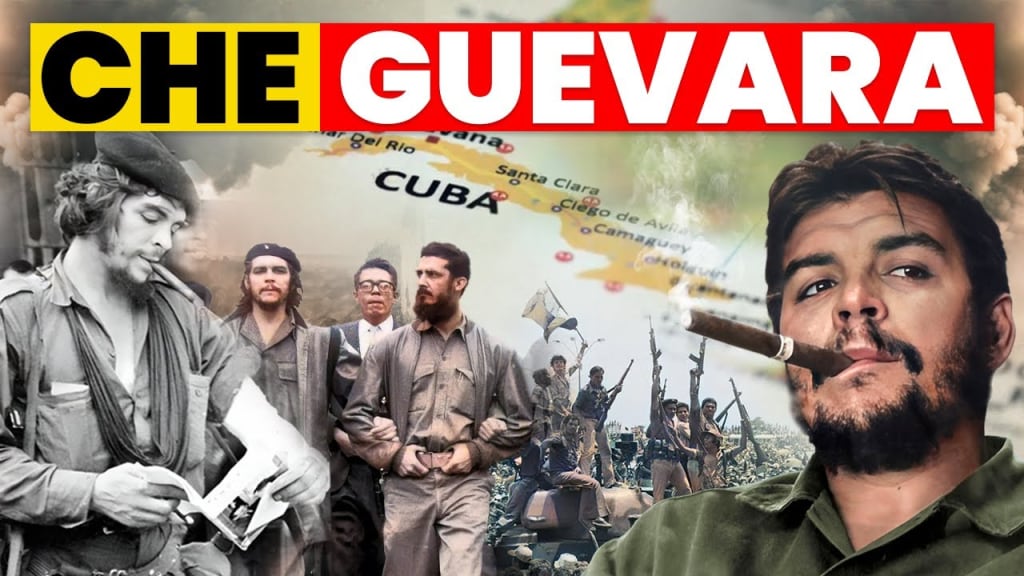
"You can kill me, but you can never kill my ideas."
With these final words, Che Guevara looked death in the eye. Even in his last moments, he screamed out what he believed in—that revolutions don’t die with people. They live on through their ideas.
At just 40 years old, Che left behind not just a legacy, but a fire. A fire that continued to burn for decades after his death.
Che wasn't always a revolutionary. He was born as Ernesto Rafael Guevara on June 14, 1928, in Rosario, Argentina, to a middle-class family. He was the eldest of five children and never had to worry about money. His family had a huge library with over 3,000 books—and Che read almost all of them.
As a child, Che suffered from severe asthma. But that never stopped him. He grew up to be an athlete, a chess player, a swimmer, and even a rugby player. He also had a deep interest in poetry, science, and politics.
By the time he entered medical school at the University of Buenos Aires in 1948, Che was already deeply curious about the world. During his studies, he went on two long journeys across Latin America—first on a bicycle, then on a motorcycle. These trips would change his life forever.
He saw poverty up close. Families sleeping on roads, children crying from hunger, and workers breaking their backs for pennies. He wrote about these experiences in a diary, which later became the bestselling book The Motorcycle Diaries—and a popular film as well.
These trips woke something inside him. He realized that medicine wasn’t enough. He didn’t want to treat the poor—he wanted to change the system that made them poor in the first place.
So, Che joined revolutionary movements.
His first attempt was in Guatemala, where he witnessed a CIA-backed coup that removed a democratically elected socialist president. This opened Che’s eyes to how America used its power to suppress leftist governments around the world.
Soon after, Che moved to Mexico, where fate brought him face-to-face with Fidel Castro and his brother Raúl. They were planning a revolution in Cuba to overthrow the U.S.-backed dictator Fulgencio Batista. Che joined their cause.
In 1956, Che and 81 other revolutionaries set sail to Cuba. Most of them were killed in battle. Che survived and hid in the Sierra Maestra mountains with a handful of fighters. There, he trained local peasants, built schools, opened clinics, and taught literacy. He also became a military leader, expert in guerrilla warfare.
After two years of fighting, Che and Castro finally overthrew Batista. In 1959, Castro became the leader of Cuba—and Che became his right-hand man.
But the story didn’t end there.
Che was now in power. And power tested him.
He was made head of the National Bank of Cuba and later the Minister of Industries. He nationalized American businesses, redistributed land, and pushed hard for education and equality.
But Che believed in absolute discipline. He executed those he suspected of betraying the revolution—often without trial. He didn’t tolerate disobedience. To him, Communism wasn’t just an ideology—it was the only way to live.
In time, Che began clashing with the Soviet Union as well. He didn’t like their growing bureaucracy and soft approach toward America. And he worried that Cuba was becoming too dependent on Soviet support.
So, once again, Che left everything behind.
This time, he went to Congo, and later to Bolivia, to spread revolution. But things didn’t go as planned. His forces were weak, untrained, and lacked local support. And this time, the CIA was watching.
On October 8, 1967, Che was captured in Bolivia. He was wounded and taken to a schoolhouse. The next morning, he was executed by Bolivian soldiers trained by the CIA. His last words to the executioner were:
"Shoot, coward. You are only going to kill a man."
They cut off his hands to prove his identity. But what they couldn't cut off—were his ideas.
Che Guevara was many things: a doctor, a poet, a soldier, a leader, and a revolutionary. Some call him a hero, others call him a terrorist. But one thing is certain—he changed history.
Even today, 50+ years after his death, his image remains a symbol of rebellion, resistance, and revolution. His life is a reminder that one man, armed not with weapons but with fierce conviction, can shake the world.
About the Creator
Keep reading
More stories from Yasir Hamid and writers in BookClub and other communities.
The Lantern Girl
The first time Aarav saw her, she was walking through the fog with a lantern in her hand. It was a rainy evening in the remote village of Devka. Aarav, a travel writer, had rented a cottage near the forest for solitude. He’d heard tales of the forest being haunted, but he dismissed them as village folklore—until he saw her.
By Yasir Hamid 8 months ago in BookClub
My New Book is Finally Here
My poetry collection Beautiful and Brutal Things is done. It's actually done and finally published over 270 pages. Over a year of my life went into this book. More than a year, really. Long days at my computer, sometimes seven days a week because I couldn't stop even when I probably should have. Then two months of editing that felt harder than the writing itself. But it's finished, and I'm still standing, and the book is real.
By Tim Carmichael2 days ago in BookClub
Stars, Scandals & Sirens
Welcome to The Chapter Café, where every story unfolds like the pages of a gripping novel—and today’s menu is anything but ordinary. We’re serving up a bold blend of true crime and celebrity biographies, a literary tasting that pairs red-carpet glamour with the grit of real-life investigations.
By Kristen Barenthaler4 days ago in BookClub




Comments
There are no comments for this story
Be the first to respond and start the conversation.