
THE CARTOGRAPHER OF IMPOSSIBLE THINGS
THE CARTOGRAPHER OF IMPOSSIBLE THINGS

THE CARTOGRAPHER OF IMPOSSIBLE THINGS
The morning the mapmaker found a new ocean in his sock drawer, he decided he’d had quite enough of reality behaving itself.
Marlen Quist had been Brackenford’s official cartographer for thirty-two years, and in that time he had charted forests that grew sideways, rivers that looped back to their own sources out of sheer stubbornness, and a mountain rumored to move three meters to the left whenever nobody was looking. He considered himself unflappable. Yet when he reached into his drawer for a matching pair of socks and instead felt the unmistakable push-and-pull of tides, he stared down into the swirling blue and muttered, “Oh, for heaven’s sake.”
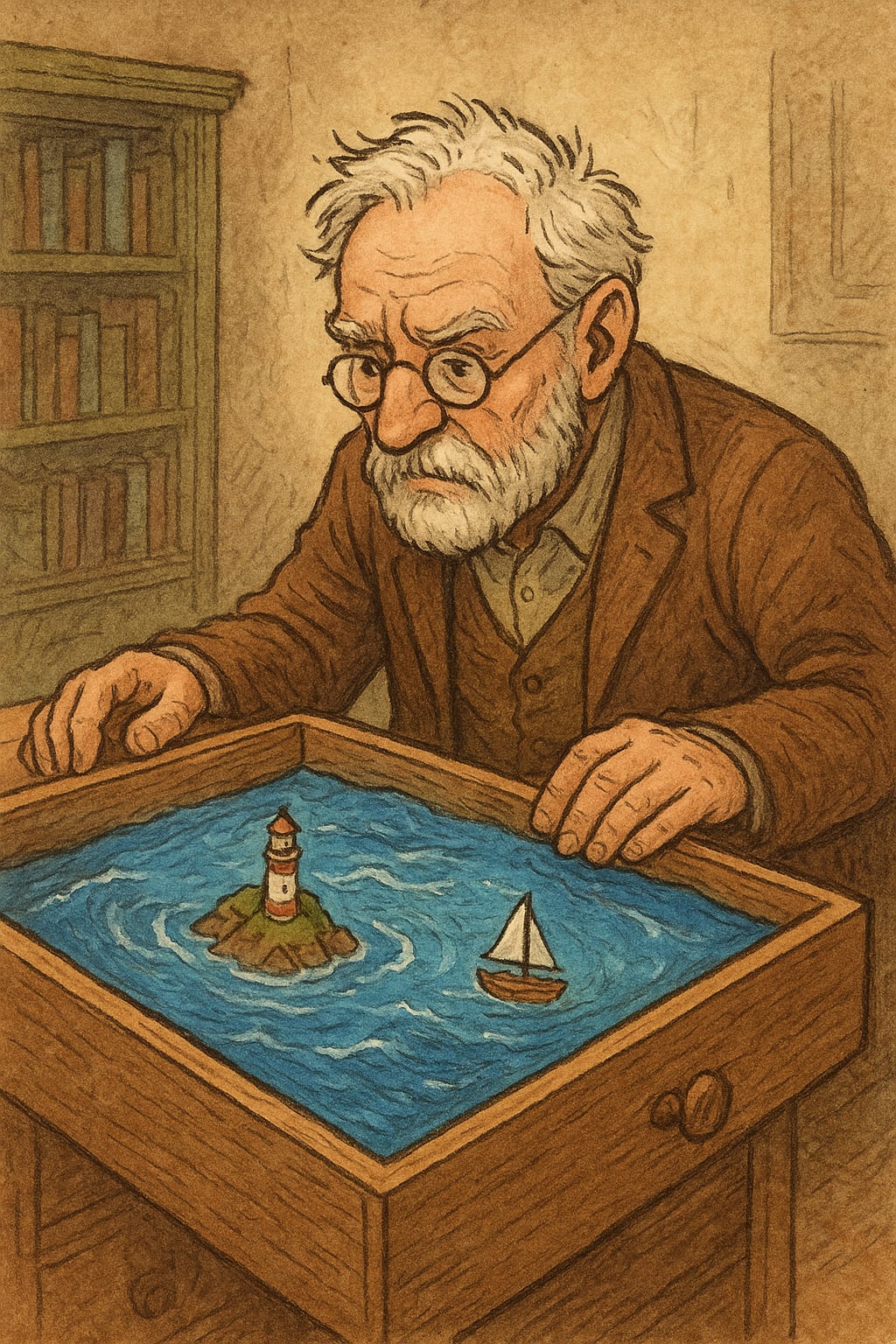
The ocean was perhaps the size of a soup bowl, but definitely an ocean—complete with white-crested waves, drifting kelp, and a tiny lighthouse perched on a rocky island no larger than his thumb. He knelt beside the drawer, peering in as a miniature foghorn sounded so softly he thought at first it was his stomach.
“Hm,” he said. “Not on any of my charts.”
He closed the drawer, waited a moment, then opened it again. The ocean was still there, as though daring him to acknowledge it.
Marlen sighed. “Very well. If you insist.”
He gathered his field kit—compass, sextant, magnifying glass, a notebook made of weatherproof vellum—and tucked the sock drawer under his arm like a briefcase. Then he set out into town to determine who, precisely, had installed an unsanctioned body of water in his furniture.
The first person he visited was Elvira Thatch, the town librarian and unofficial expert on strange goings-on. She wore spectacles thick enough to double as emergency windows and had an encyclopedic knowledge of everything from ancient lore to the Mayor’s shoe size. She inspected the drawer with scientific reverence.
“Marlen,” she said, “this is a Class-Four Pocket Ocean. Very unstable. They form when boundaries between what is and what ought to be become thin. Have you been rearranging reality again?”
“I moved my furniture two days ago,” Marlen admitted.
“There you have it. Never move a drawer that has accepted its place in the universe.”
“Can we fix it?”
Elvira drummed her fingers on the desk. “Not directly. But you can chart it. Once a place is mapped, it becomes accountable. Cartography stabilizes existence. Give it coordinates, give it context, and the universe usually falls back in line.”
“Charting a sock-drawer ocean,” Marlen said. “This is a new low or a new high. I can’t yet tell.”
“Both!” Elvira replied cheerfully.
Marlen thanked her and carried the drawer to the town square, where he found a bench shaded by the ever-blooming lime tree. He settled himself, placed the drawer on his lap, and began sketching. The miniature lighthouse rotated its beam in polite acknowledgment.
As he charted, something peculiar happened: the ocean began to react. Each line he drew seemed to deepen the water, add a new current, or brighten the lighthouse’s glow. When he outlined the horizon, a tiny ship appeared—no larger than a matchstick—tacking back and forth under an impossibly crisp white sail. Marlen leaned closer.
“Hello there!” he called softly, unsure if communication was possible or wise.
To his astonishment, a speck-sized figure on deck waved back.
Marlen smiled. He continued mapping, cross-referencing the currents with the drawer’s grain and marking the nautical hazards near the handle. Hours passed. The lime tree's blossoms fell around him, gathering in pale green drifts, but he didn’t notice. He was absorbed in his work in a way he hadn't been for years.
It wasn’t until a shadow fell over him that he looked up. A tall man in a coat stitched with constellations stood there, hands clasped behind his back. Marlen recognized him immediately: Orion Loame, Inspector of Improbabilities, tasked with ensuring the world’s stranger elements didn’t get out of hand.
“I’ve been hearing rumors,” Orion said, “that you’ve discovered an unauthorized ocean.”
Marlen gestured to the drawer. “I was just documenting it.”
Orion knelt, studying the tiny waves. “Fascinating. Have you identified its source?”
“Not yet.”
“Pocket Oceans rarely appear without cause.” Orion tapped the side of the drawer. “The universe doesn’t misplace water for fun. There’s meaning to it. Something you’ve neglected. Something calling for attention.”
Marlen frowned. He lived alone. Had no children. Had few hobbies beyond exploring and drawing. He was meticulous about his commitments. What could he have possibly neglected?
He looked down at the little ship again. It was now circling the island, sending up puffs of celebratory smoke. He felt a warmth in his chest—a gentle pull, like a tide.
“I think,” Marlen said quietly, “I’ve forgotten how to wonder.”
Orion raised an eyebrow. “Explain.”
Marlen closed his notebook. “When I was young, I mapped for adventure. I believed that every unexplored corner of the world was waiting just for me. But over time, the maps became routine—jobs, not journeys. Maybe the universe grew bored of my boredom. Maybe it decided to remind me that the unknown is still out there. Even if it’s in my furniture.”
Orion’s expression softened. “The universe favors those who pay attention. If this ocean is a reminder, perhaps you should follow where it leads.”
“Follow?” Marlen laughed. “It’s pocket-sized.”
“Size is rarely the point.”
Orion stood, tipping his starry hat, and walked away, vanishing into a shimmer of dust.
Marlen looked again at the ocean.
The ship had stopped beside the shore, lowering a rope ladder made of the finest thread of light. The minuscule sailor—a figure no taller than a sugar grain—looked up expectantly.
“You can’t be serious,” Marlen whispered.
But the invitation tugged at him. Not physically, but deeply. He felt the ache of long-unanswered curiosity.
“Well,” he said eventually, “if I don’t at least try, I’ll never hear the end of it.”
He placed a fingertip on the edge of the drawer. The world lurched. The lime blossoms rose around him in a spiral. The ocean widened, expanded, unfurled. Before he knew it, he stood knee-deep in warm surf, full-sized, facing the lighthouse on the rocky island. The tiny sailor was now a person his height, grinning broadly.
“Welcome!” the sailor said. “We’ve been waiting.”
“For what?”
“For the cartographer of impossible things.”
Marlen took a breath of salt air and laughed. “Of course you have.”
He looked back. The drawer was nowhere in sight. Only the vast horizon remained.
And for the first time in decades, he stepped forward—into wonder.
About the Creator
zakir ullah khan
poetry blogs and story Year Vocal Writing Skill
Keep reading
More stories from zakir ullah khan and writers in BookClub and other communities.
On a fogThe Lantern at the Edge of the World
On a fogThe Lantern at the Edge of the World The first time Elira noticed the lantern, she thought it was a trick of the dawn—some glint of sunlight snagged on the cliffs at the edge of the world. She had lived her whole life in the village of Colwain, where the sea roared below and clouds drifted so low they brushed the tips of chimneys. People there spoke of the horizon not as a place but as a threshold, a line one crossed only once, for better or worse.
By zakir ullah khan3 months ago in BookClub
Rachel Reviews: Lakefront Wolves by Joseph Deegan
Meet Finn. He's an 18 year old kid who has potential. He's bright with great school scores and he's also an athlete, a footballer of some prowess. He has it all going for him, it would seem, and yet, he's determined to send what could be a well-planned, stable existence firmly off the rails. He drinks, he smokes, he takes drugs, he has violent tendencies and he's in danger of losing not only his mind but all that he holds dear.
By Rachel Deeming11 days ago in BookClub
The Anti-Language Divide
Divided Tongues, Divided Worlds: A Review of The Anti-Language Divide The Anti-Language Divide, the third part of Volume I in THE MISCOMMUNICATION TRILOGY, marks a decisive deepening of Peter Ayolov’s broader inquiry into the decay, distortion, and fragmentation of contemporary communication. If the earlier parts of the volume analyse the structural obsolescence of language and the conspiratorial nature of speech as coalition-building, this book turns inward to examine a subtler and more insidious phenomenon: the proliferation of anti-languages within shared linguistic space. It is here that the trilogy’s philosophical ambition becomes most explicit.
By Peter Ayolov7 days ago in BookClub


Comments
There are no comments for this story
Be the first to respond and start the conversation.