
On a fogThe Lantern at the Edge of the World
On a fogThe Lantern at the Edge of the World

On a fogThe Lantern at the Edge of the World
The first time Elira noticed the lantern, she thought it was a trick of the dawn—some glint of sunlight snagged on the cliffs at the edge of the world. She had lived her whole life in the village of Colwain, where the sea roared below and clouds drifted so low they brushed the tips of chimneys. People there spoke of the horizon not as a place but as a threshold, a line one crossed only once, for better or worse.
Elira never believed such things. She was young, sharp-minded, and entirely uninterested in legends—until the morning she saw the lantern flicker exactly where no light should ever be.
It hung, impossibly, beneath the last outcrop of rock, swaying as though held by an unseen hand above the endless drop into mist. Curious and slightly irritated—because the world should obey rules—Elira packed a rope, a hammer, and a small loaf of barley bread, and made her way toward the cliffs.
The path wound between towering slate formations. Wind groaned through them like the breath of some old beast, and gulls circled overhead, their cries thin and frantic. When she reached the cliff’s edge, Elira knelt and peered over.
The lantern was still there.
It was made of bronze, or something very much like bronze—old metal kissed by too many storms. Its glass panels glowed with a soft, honey-colored light. It swung gently as if greeting her.
“This isn’t normal,” Elira muttered, which was her preferred way of acknowledging anything extraordinary.
She hammered an iron spike into the stone, looped her rope through it, and began her descent. Her boots scraped the rough cliff face. The ocean below churned like a cauldron of ink and thunder, but Elira kept climbing, one hand after another, until she was level with the lantern.
The moment her fingers brushed its handle, the world went silent.
Not quieter—silent. The wind froze mid-howl. The gulls hung like paint splatters in the sky. Even the sea, vast and furious, became still glass.
Elira swallowed. “Well… that’s worse.”
A voice spoke behind her. She nearly lost her grip on the rope.
“Most people don’t touch it.”
Elira twisted around. A stranger perched easily on the cliff above her—tall, wearing a long coat the color of midnight rain. His hair was silver not with age but with something like starlight itself. His eyes, oddly calm, regarded her as if she were an unusual type of bird.
“It was glowing in the wrong place,” Elira said defensively. “Someone had to check.”
“It glows in the right place,” the stranger replied. “You simply didn’t know the rules.”
Elira gritted her teeth. She greatly disliked being told she didn’t know the rules—especially by someone who clearly wasn’t from Colwain. “And what rules are those?”
“That lantern marks the line between what has been and what might yet be. It’s a boundary. A hinge.” His gaze drifted to her hands. “And now that you’ve touched it, you can’t unring the chime.”
“That’s not how chimes work.”
He almost smiled. “No. It isn’t.”
Elira steadied herself and reached again for the lantern. “What happens if I take it?”
The stranger’s expression flickered—pity? amusement? “If you remove it, the boundary moves. And if the boundary moves, so does everything tied to it.”
“And what’s tied to it?”
“Colwain,” he said. “Your home. Your memories. Your entire life.”
Elira hesitated. Wind had not yet resumed, but she sensed the weight of it just beyond the stillness, waiting. “You’re saying the lantern is holding reality in place,” she said slowly.
“Yes.”
“That sounds ridiculous.”
“It generally does.”
She looked down at the lantern again. “Has anyone ever moved it?”
“Yes.”
“What happened?”
His eyes, which had been calm, darkened. “Everything they knew became something else. Their mother’s face. The shape of their own name. The history of the land beneath their feet. Reality rearranged itself to account for the shift. Some things vanished entirely.”
“Did they… fix it?”
“No one fixes the edge once it’s moved,” he said softly. “They simply learn to live on the new one.”
Elira’s fingers tightened around the metal frame. Part of her wanted to climb back up immediately. Another part—stronger—burned with fierce curiosity.
“What if I just lift it for a moment?” she asked.
The stranger sighed. “That is what everyone says.”
But he didn’t stop her.
Elira drew a breath and lifted the lantern free.
The moment she did, the world shattered.
Not in a violent, explosive way—no. It came apart gently, like parchment peeling in thin curling strips. The sea dissolved into threads of color. The cliffs bowed inward as though exhaling. The sky blinked.
Elira felt herself unmoored. Weightless. Unwritten.
And then everything snapped back.
The wind roared again. Gulls screeched overhead. The sea surged beneath her. But the cliff she clung to was not the cliff she had descended.
Its stone was smoother. Darker. Older. The ropes she held were braided with red fibers that hadn’t been there before.
“Elira!” someone shouted above.
She startled. The voice was familiar—but not quite familiar. She climbed quickly, heart pounding.
A young woman leaned over the cliff edge to help her up. She had Elira’s mother’s eyes—but not her mother’s face. Her hair was braided in a style Elira had never seen. She grabbed Elira’s arm.
“Honestly, you shouldn’t wander so close to the Verge,” the woman said. “Master Corren told you not to test the edge again.”
“Master… who?” Elira whispered.
The stranger with starlit hair had vanished.
Elira’s breath caught. Her village—if this was Colwain—looked different. The roofs were steeper. The tide walls carved with symbols she didn’t recognize. The people walking the paths wore crimson sashes instead of blue ones. Even the air felt changed.
The woman frowned at her. “Are you hurt?”
Elira looked down.
The lantern was no longer in her hand.
In its place was something else—something that looked like a folded bronze key, warm and humming, as though waiting to be used.
“No,” Elira said softly. “I’m… not hurt.”
But her world was gone. Rearranged. Shifted.
And she was standing on the edge of something new, holding a key that did not yet know what it opened.
A slow, sharp thrill rose in her chest.
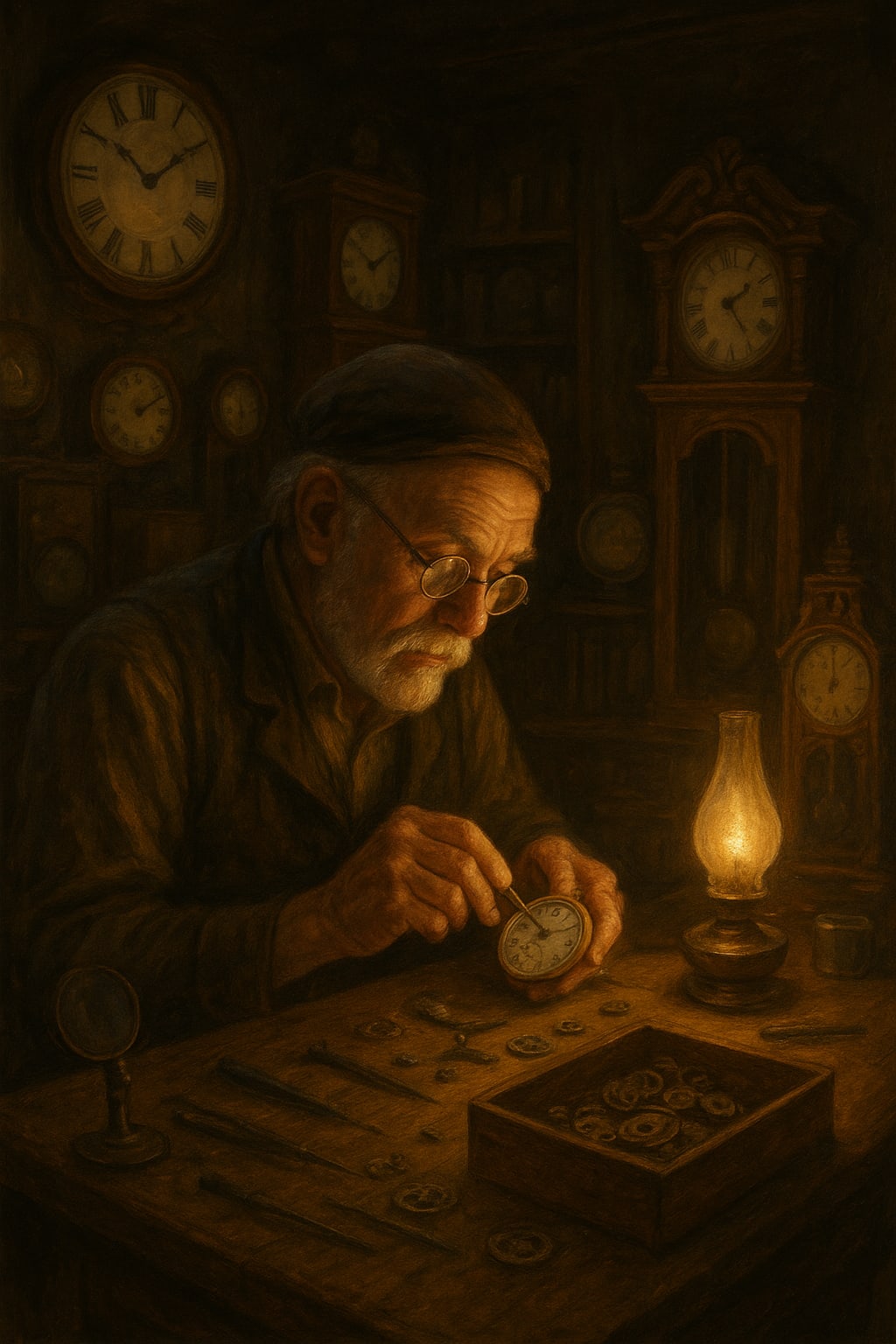
“Actually,” she said, lifting the strange bronze object, “I think I’m exactly where I need to be.”gy evening in the quiet town of Wrenford, a faint clicking noise echoed down Hollow Street. Most people avoided the narrow lane—it felt too still, too watchful. But inside a cramped little shop whose sign read “Timely Wonders”, an old clockmaker named Bramwell Finch worked with unusual purpose.
Bramwell wasn’t like other craftsmen. He didn’t simply fix clocks—he listened to them. Each ticking device, from tiny pocket watches to towering grandfather clocks, whispered secrets to him. Most were mundane: forgotten appointments, old heartaches, mishandled seconds. But tonight, a new whisper reached him.
A brass pocket watch—one he had never seen before—lay on his workbench. It had simply appeared there, still warm, as though someone had placed it in his hands moments ago. When Bramwell touched it, the watch’s hands spun wildly before stopping at midnight.
And then it spoke.
Not in words, but in a vision:
A black cat perched on a rooftop.
A lantern swinging in a storm.
A tower clock striking thirteen.
And a girl in a blue coat…vanishing.
Startled, Bramwell shoved his spectacles up his nose. “Well, that’s new,” he muttered.
Unable to ignore whatever the watch was trying to show him, he stepped outside, following its quiet, steady pull. The fog curled around him like curious fingers. Minutes later, he found the black cat exactly where the vision had shown—glaring at him with golden, knowing eyes.
“Right, so you’re the guide,” Bramwell said.
The cat meowed impatiently and trotted away.
They traveled through twisting alleys until the storm arrived—out of nowhere, as though stitched into the sky by invisible hands. Lightning split the clouds, illuminating an old tower clock. Bramwell gasped as its gears groaned to life…and struck thirteen.
A soft cry came from the base of the tower.
There stood the girl in the blue coat—transparent, fading, as though time itself were forgetting her.
“Help…” she said. “I’m stuck.”
Bramwell wound the mysterious pocket watch. “Hold on.”
The watch glowed. The tower clock answered. Time reversed in a great shuddering wave, pulling the girl back into the world with a gasp.
She blinked at Bramwell. “Who are you?”
He smiled faintly. “Just someone who listens to clocks.”
The pocket watch cooled in his hands. Its task was done. The fog lifted. And with the black cat weaving around his legs, Bramwell headed back to Hollow Street—back to his shop, where time and secrets waited for him to hear them.
About the Creator
zakir ullah khan
poetry blogs and story Year Vocal Writing Skill
Keep reading
More stories from zakir ullah khan and writers in BookClub and other communities.
My New Book is Finally Here
My poetry collection Beautiful and Brutal Things is done. It's actually done and finally published over 270 pages. Over a year of my life went into this book. More than a year, really. Long days at my computer, sometimes seven days a week because I couldn't stop even when I probably should have. Then two months of editing that felt harder than the writing itself. But it's finished, and I'm still standing, and the book is real.
By Tim Carmichael2 days ago in BookClub
7 Dystopian Books You Must Read In 2026
In an era where society constantly wrestles with technological advances, political unrest, and environmental crises, dystopian literature offers a mirror to our present and a cautionary glimpse of the future. These books are more than just stories—they challenge our beliefs, provoke critical thinking, and explore the fragility of civilization. Below is a list of 7 dystopian books you must read in 2026.
By Diana Meresc6 days ago in BookClub



Comments
There are no comments for this story
Be the first to respond and start the conversation.