
The Ballad of Songbirds and Snakes by Suzanne Collins
Book Review!

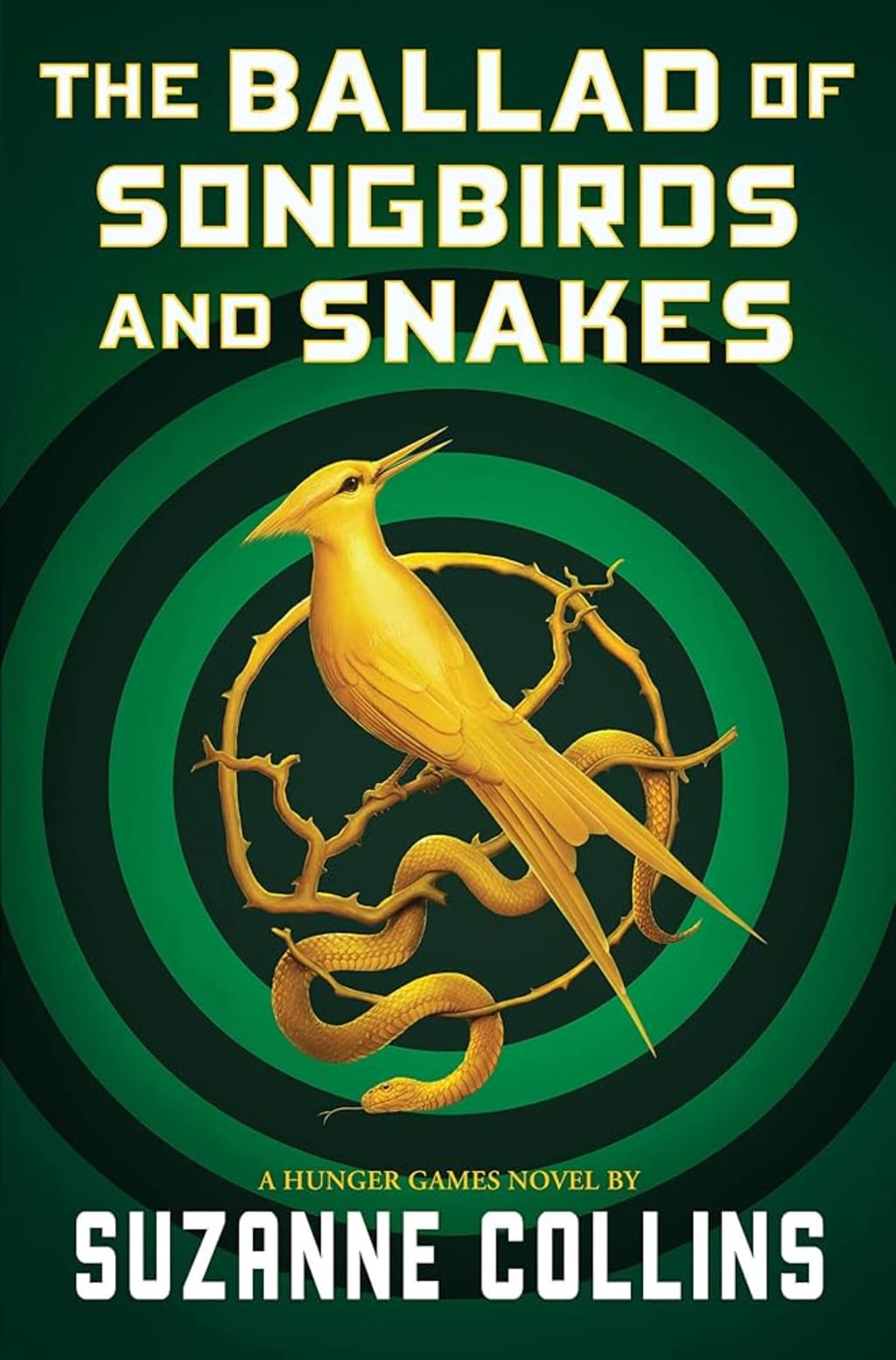
I’m a big fan of the Hunger Games series. So of course, I was really looking forward to reading this prequel about Coriolanus Snow’s past, and the book didn’t disappoint. It’s not perfect, by any means, but the interesting concepts, powerful moments, and solid character depictions/developments throughout the novel deeply impressed me and made the book worth reading.
I really liked experiencing the events of the story through Coriolanus’s eyes. We see the constantly changing facades he puts on around other people, to the point where we as the readers know him so much better than anyone else does, and that’s a scary thing straight off the bat. His falsely calm, self assured exterior is intriguing and even quite eerie at times, even from the start.
He’s a great character because there’s so much to him; there’s so much he shows and so much he hides. He’s confusing and desperate, insecure and angry, calculated and cold, selfish yet so very capable of love. His feelings and actions war against each other in a way that can be seen as hypocritical, but I think are also very human.
I thought him choosing the path of his father rather than that of his mother was extremely telling and purposefully crafted by Collins. The world is cruel and chaotic, and in order for order to be upheld, he was willing to become a monster—all for his own comfort and capability to control his circumstances and the circumstances of those around him. He was a remarkably fascinating character and a great “antagonist” in his own story.
I also liked Lucy Gray, though admittedly not as much as Katniss in the original series or even as much as Coriolanus. I thought (and hoped) we might get a glimpse of the world through her eyes some point in the novel, but we never do. I guess this is to cement her furthermore as a mystery, which I understand, but I do wish we got just a little more from her other than her quirkiness and her devotion to her family and passion for music. At times, it almost feels like her role in the story is to solely be the mystery. She’s the enigma, the songbird, the passionate, beautiful thing that haunts Coriolanus even after snow has landed on top, and that’s given more prominence than it is for her to be her own person/character.
She is her own character for sure in many respects, but I think seeing her only through Coriolanus’s eyes limits our perception of who she truly was, and probably wasn’t the choice I would have made. Alas, this is not my book. And I get it, it’s his story.
That being said, I admire the way Collins gives Lucy her own different kind of strength. In the face of death, Lucy Gray perseveres. She is alight with passion, charm, wisdom, and sweet deception. She is a fire that cannot be stomped out, and her displays of courage and power through music and cleverness were great to read. She is a performer in every sense of the word, and I gained a great intrigue and respect for her due to the way she chooses to utilize her strengths and escape from Coriolanus while she can. I also, of course, adore the parallels we can draw between her and Katniss.
I do think the scene near the end, with Snow chasing down Lucy Gray in the woods in their own utopia turned messed up little Hunger Games, was particularly great and terrifying and very well written, but it did feel a little rushed to get there. And that’s my main criticism of the book: the pacing.
This is probably the longest book in the series, and though it’s incredibly detailed and uniquely crafted with incredible world-building and good characters, it can also feel its length. After the Hunger Games ends and Lucy Gray is declared victor, the book becomes a bit of a slog. Snow’s Peacekeeper days, especially the early ones, absolutely drag and are pretty boring to read. I put this book down for a while due to how I was reading ten, fifteen, twenty, even potentially thirty pages and nothing was happening; no plot was being developed. It was just Coriolanus being sad or worried, having dinner, going to sleep, and spending time with his boring, insignificant bunkmates—except the one who liked the birds, he was cool.
Once Sejanus joins him, things pick up a bit, but it isn’t really until Lucy Gray comes back around again that the story really picks up again, and that’s a big chunk of the novel—probably around 100 pages.
There’s also a lot of characters. A lot. I understand Coriolanus is around a lot of people at his time in the Capitol and in District Twelve, but too much time spent on too many new names is bound to confuse and throw off readers. There were Coriolanus’s classmates and their tributes in the Games, which were already a lot to remember. There’s also Lucy Gray’s bandmates, and the Peacekeepers, and the rebels, the teachers at the Academy, the recurring families of several characters, average Capitol and District civilians, the mayor and his daughter—it’s a lot, and while some of them are interesting, a lot of time is spent with a lot of characters we don’t really know or care about. I think taking a few out could have done the novel some good.
I have only one more gripe, and I lied because this is actually my biggest complaint since it pissed me off so much: Coriolanus and the damn mockingjays.
The rest of the symbolism throughout this book is very clever, and it takes its time simmering before it shines through in just the right moments. I love Suzanne Collins for that; the woman can craft one hell of a symbol like the best of them. For the symbolism of the mockingjays though, and pretty much only the mockingjays in this book, this is not the case. All subtlety just goes straight out the window.
Collins makes it so abundantly clear that Coriolanus hates these damn birds every time they tweet out their rebellious little songs, to the point where I was almost rolling my eyes reading about the power of his discomfort. It’s that thing authors (especially YA authors) do where they think that unless they’re super obvious about something, we won’t get it; I promise you, guys, a lot of us will. It’s such an important piece of symbolism, what the mockingjays represent in this world—resistance and freedom, something birthed anew and away from the Capitol—and a significant part of his character—showcasing his desperation for control—that it was just silly to have him mentally reacting to these things like a child instead of the incredible antagonist he is and will become. It was so, so out of character.
Coriolanus is a liar by nature. He’s calm and collected, almost robotic, even in the face of what he deems disastrous to him. It should have been made evident that as much as he hated them and their uncontrolled, unmonitored existences, as much as they killed him inside to have to witness having their freedom, he could still be calm and controlled around them until he couldn’t be (Lucy Gray’s disappearance). It would have made the metaphor all the more powerful, I think. Instead, it was just jammed down our throats that he despises the freedom of these creations that were able to break away from Capitol control.
Yes, we remember Katniss. We remember the name of the third installment of the series, I assure you. We absolutely remember the significance of the mockingjays. It feels a bit like undermining the readers’ intelligence, to have such repetitive stressing that he really, really hates the mockingjays. It’s still a solid piece of symbolism, but I really wish it had been more subtle.
Overall, I really enjoyed this book. I saw a fellow Goodreads reviewer mention that the tone is oddly goofier than that of the rest of the series, and I agree. It’s such a strange, scary, and absurd world, the Capitol, and it makes their desire to control the Districts even more frightening. It is also much more philosophical, discussing topics such as human nature and the potentiality for violence.
Coriolanus tows the line between slightly sympathetic and full-on antagonistic for the perfect amount of time before he succumbs to his choice and becomes a true villain. He was terrifying to enter the mind of—yet once you’re in, it’s so very hard to leave.
Another solid and creative literary success for Collins! I’d rate it 3.5/5 stars.
Greatly anticipating the next one!
About the Creator
angela hepworth
Hello! I’m Angela and I enjoy writing fiction, poetry, reviews, and more. I delve into the dark, the sad, the silly, the sexy, and the stupid. Come check me out!
Reader insights
Outstanding
Excellent work. Looking forward to reading more!
Top insights
Heartfelt and relatable
The story invoked strong personal emotions
On-point and relevant
Writing reflected the title & theme
Keep reading
More stories from angela hepworth and writers in BookClub and other communities.
The Unrivaled Art in Vinland Saga
Vinland Saga is one of the most popular seinen anime/manga of all time. It tells the story of Thorfinn, a young boy whose warrior-turned-pacifistic father is killed by vikings. Overtaken by rage and a desire for vengeance, Thorfinn joins Askeladd, his father’s killer, and his crew of vikings to make himself stronger, eventually strong enough to kill the man who took his father away from him.
By angela hepworthabout a year ago in BookClub
7 Books You’ll Finish Faster Than You Expect
In a world overflowing with content, time has become our most precious currency. We all want books that inform us, move us, and stay with us—but without demanding weeks of slow progress or mental exhaustion. That’s where this carefully curated list comes in.
By Diana Merescabout 20 hours ago in BookClub
Center Stage with Paul Stewart
*** I'm keen to republish the interviews I did for my series with Vocal creators. It's been a few years and I thought it might be nice to revisit these wonderful conversations. I'll be releasing them one at a time for a few weeks/months.
By Heather Hubler5 days ago in Interview



Comments (5)
Ooh I remember reading this book, it was great. Loved your review x
Oooo I got to check this out! This review convinced me! 😆💌🌟
I am a definite fan of the series too, and of Collin’s developmental depth. Checking this out!
Amazing review
Collins is incredible! Thank you for sharing this review.