

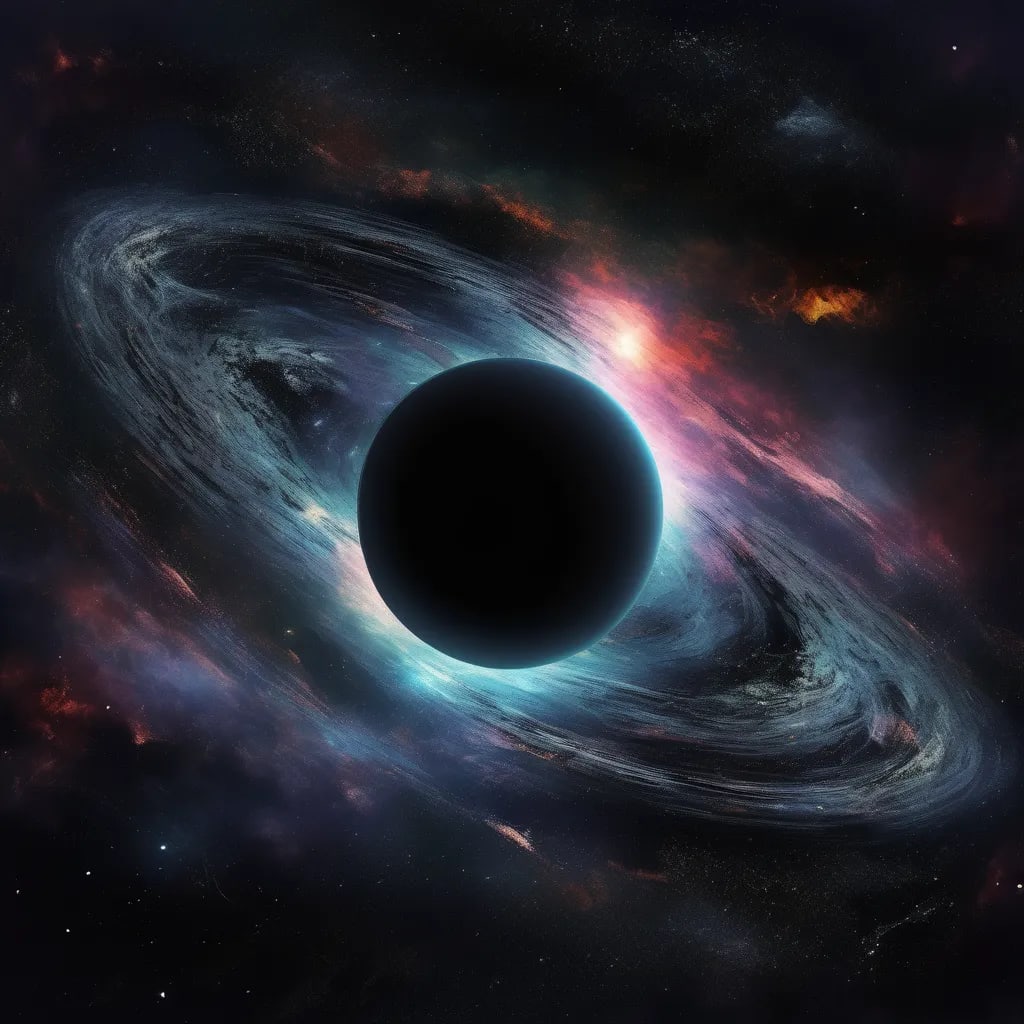
In the far reaches of the cosmos, beyond the most distant galaxies, there exists something far more terrifying than empty space—a void so deep, so dark, and so vast that it defies comprehension. This void is not merely the absence of stars or matter, but a region of pure emptiness, a realm where the very fabric of space and time appears to unravel. It’s a darkness so profound that even light seems reluctant to enter, and what lies within has long been a mystery, untouched by human exploration or understanding.
This void is not a typical cosmic feature. It is an anomaly, a gaping scar in the universe itself, where the rules of physics seem to twist and bend. What we know about the universe tells us that space should be filled with stars, galaxies, and clusters of matter, stretching endlessly in every direction. Yet, in some regions, particularly within the largest cosmic voids, there are gaps hundreds of millions of light years across where almost nothing exists. These voids are among the most unsettling and least understood phenomena in the universe.
One such void, known to scientists as the Boötes Void, is particularly haunting. Spanning roughly 330 million light years across, it contains almost no galaxies—only a few scattered stars lost in an ocean of blackness. The scale of this emptiness is difficult to grasp. The average galaxy cluster contains thousands of galaxies, teeming with stars and planets. Yet here, in the Boötes Void, there are almost none. It’s as if this region of the universe has been deliberately wiped clean, leaving behind only an abyss where nothing has dared to form.
The darkness of these voids is not just a visual phenomenon. There is a deeper, more unsettling aspect to them. To astronomers, the voids are places where the influence of dark matter and dark energy becomes palpable. Dark matter, the invisible substance that makes up most of the universe’s mass, exerts its influence here in ways we cannot fully understand. But it’s dark energy, the mysterious force accelerating the expansion of the universe, that seems to dominate these regions. Some scientists theorize that these voids could be pockets where dark energy is particularly strong, pushing away matter and light, creating an ever-expanding zone of emptiness.
What makes these voids truly terrifying is their effect on the mind. It is one thing to contemplate the vastness of space, but it is another to face the sheer isolation and silence that these voids represent. In most regions of space, stars serve as points of reference, guiding explorers and giving a sense of orientation. In a cosmic void, however, there is nothing. No stars, no light, no sense of direction—only an endless, featureless blackness stretching in every direction. The human brain, accustomed to structure and boundaries, struggles to comprehend such an environment. It is the ultimate form of isolation, a place where the very concept of space becomes distorted, and time itself seems to slow down.
Imagine being suspended in such a void, far from the nearest star or galaxy. There is no light to guide you, no planets to land on, no signals to send or receive. It is a silence so profound that even the hum of the cosmos disappears, leaving behind only the oppressive weight of the dark. In these regions, the fabric of reality feels thin, as if at any moment, the boundaries of space could tear, revealing something older and more malevolent hiding just beyond the veil.
Some theorists suggest that these voids might hold remnants of ancient, pre-universal forces—entities or energies that predate the Big Bang. According to this line of thought, the voids could be remnants of a time before our universe, pockets of a previous cosmos that was erased and replaced by the one we now inhabit. If this is true, then these voids might be the last traces of a forgotten reality, where the laws of physics no longer apply and where something darker than dark matter still resides, waiting, observing.
Moreover, there are those who speculate that the voids are not simply empty, but actively hostile. Instead of being passive regions of nothingness, they may be zones of space that repel matter, pushing away galaxies and stars, forcing the universe to expand faster in their presence. This theory suggests that the voids could be growing, swallowing up surrounding matter over billions of years, until they consume everything, leaving only vast stretches of darkness behind.
What lies at the heart of these voids remains unknown. Unlike black holes, which we can observe indirectly through their interaction with nearby matter, voids offer no such clues. They are silent, unobservable regions where even light seems to fade into nothingness. Their boundaries are hard to define, and their interiors impossible to explore with current technology. As we gaze into these regions of space, we are left with more questions than answers.
Yet, perhaps the most disturbing aspect of these cosmic voids is their implication for the future. As the universe continues to expand and dark energy grows in influence, some physicists predict that these voids will become more common, spreading throughout the cosmos until they dominate the structure of the universe. In this future, galaxies will be so far apart that they will disappear from each other's view. The night sky will become blacker and emptier, with fewer stars to illuminate the heavens. Eventually, all matter could be swallowed by the voids, leaving only darkness—an empty, silent universe, where time itself may cease to have meaning.
In the end, the voids remind us of the fragile nature of existence. The universe we know, filled with light, stars, and life, is temporary—a brief flicker in the infinite blackness of space. These dark, silent regions are the true nature of the cosmos: a place of endless, indifferent emptiness. And as we peer into these voids, we confront not only the limits of our knowledge but also the terrifying realization that in the grand scheme of things, the universe is far darker and emptier than we ever imagined.
In the heart of the void, where light dares not venture, something ancient stirs, waiting patiently for the universe to forget it ever existed.
About the Creator
Cosmic Dread
A cosmic horror writer. I blend real science with chilling possibilities, exploring the terrifying forces of the universe—black holes, rogue planets, and cosmic horrors lurking in the cold void of space.
Keep reading
More stories from Cosmic Dread and writers in BookClub and other communities.
The Abyss of Jupiter
Jupiter, the largest planet in our solar system, has long been a source of awe and fear. Its swirling clouds and raging storms, including the infamous Great Red Spot, make it a planet of chaos and power. But there is something far more sinister lurking within Jupiter—a mysterious hole, a cosmic anomaly that defies explanation and chills the soul. This is not a simple crater or a passing disturbance; it is an abyss, an incomprehensible void, and its presence raises terrifying questions about the nature of the planet and the horrors that might lie within.
By Cosmic Dreadabout a year ago in BookClub
My New Book is Finally Here
My poetry collection Beautiful and Brutal Things is done. It's actually done and finally published over 270 pages. Over a year of my life went into this book. More than a year, really. Long days at my computer, sometimes seven days a week because I couldn't stop even when I probably should have. Then two months of editing that felt harder than the writing itself. But it's finished, and I'm still standing, and the book is real.
By Tim Carmichael3 days ago in BookClub
Valentine in Montréal
Don't be fooled by the title. The story is actually very interesting: My name is Valentine. I am twenty-three years old and I work at a little store at Berri-UQAM métro. I am very ordinary-looking and Barney, who works the same shift as me at the store, says I do not know how to dress. I have been working there for four years, and I have never missed a day. This is why sometimes I seem familiar to people, even though they can't place me.
By Kendall Defoe 6 days ago in BookClub



Comments
There are no comments for this story
Be the first to respond and start the conversation.