
Roots of the Cosmos: The World Tree Explained
A Journey Through Global Mythology, Sacred Symbolism, and Modern Occult Thought

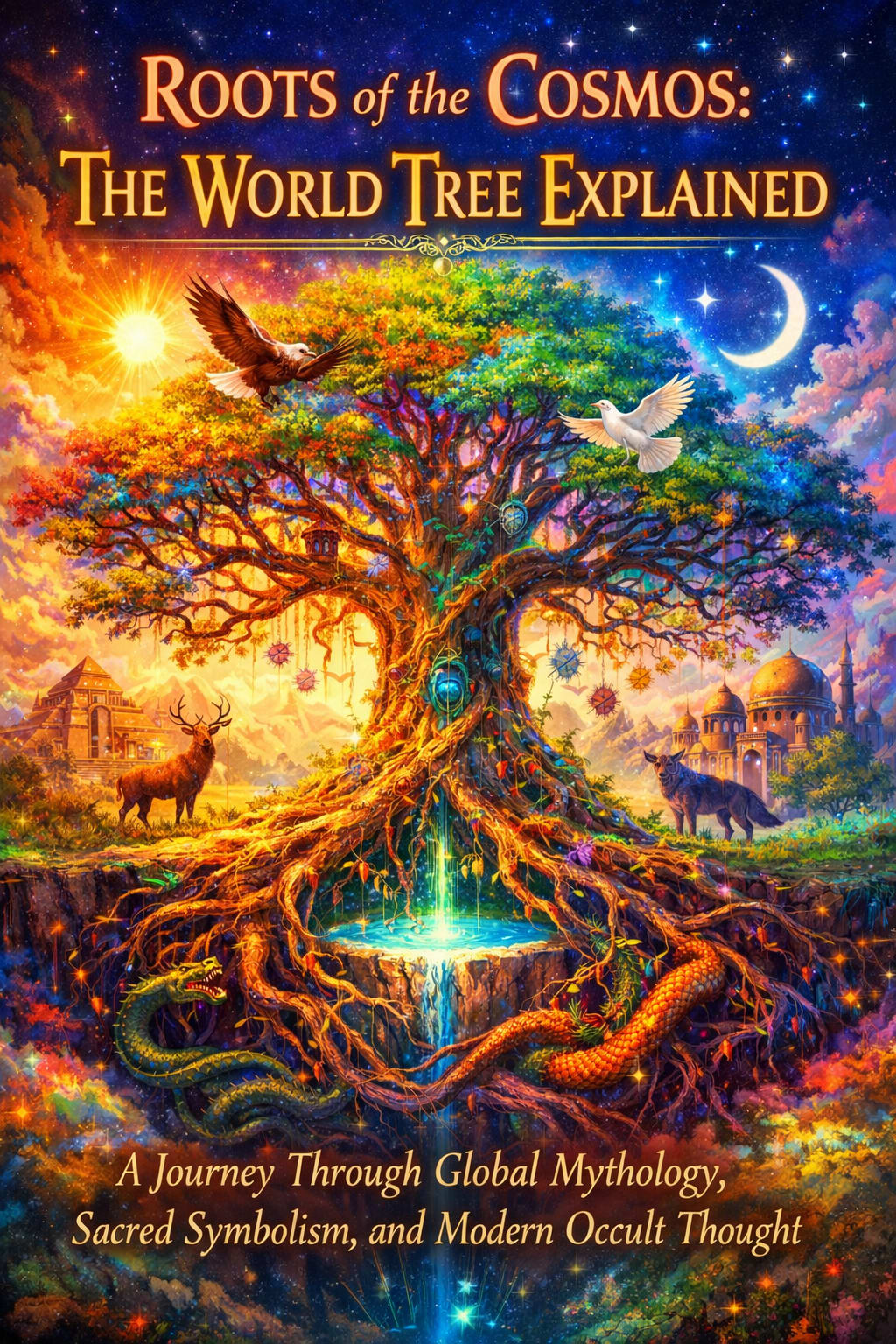
The Tree at the Center of Everything
Across civilizations separated by oceans, centuries, and languages, a single image emerges with striking consistency. A vast tree stands at the center of existence, neither planted nor cultivated, but inherent to the structure of the universe itself. Its roots descend into unseen depths where memory, death, and origin reside. Its trunk rises through the visible world, providing stability, continuity, and presence. Its branches extend into the heavens, touching realms associated with divinity, fate, and cosmic order. This image is now commonly described as the World Tree, a symbol through which ancient cultures articulated the architecture of reality.
The persistence of this image is not accidental. Trees were among the largest, longest-living organisms known to early societies. A single tree could outlast generations, survive storms, regenerate after injury, and mark sacred spaces through sheer presence. Observed closely, a tree embodies time made visible. Growth rings preserve history. Roots respond to unseen forces beneath the soil. Branches follow light, season, and wind. These observable qualities made the tree an ideal model for understanding existence as layered, interconnected, and alive.
The World Tree functions as more than metaphor. In many traditions, it serves as a cosmological framework, explaining how different levels of reality coexist and interact. Sky, earth, and underworld are not separate creations but interdependent domains bound by a central structure. The World Tree holds these realms together, allowing movement, communication, and influence between them. This structure reinforces an ancient worldview in which existence operates as a unified system rather than a collection of isolated parts.
Within this framework, life is understood as cyclical rather than linear. Roots decay, nourish soil, and give rise to new growth. Branches bear leaves, shed them, and renew them again. The death of one part ensures the survival of the whole. This natural process informed early philosophical ideas about mortality, rebirth, and continuity. The World Tree expresses an understanding that destruction and creation are not opposites but phases of the same process.
The symbol also carries ethical and spiritual weight. Balance is essential. Damage to roots weakens the entire structure. Excessive growth without grounding leads to collapse. Many mythologies emphasize threats to the World Tree, creatures that gnaw at its roots, storms that threaten its stability, or cycles in which it must endure suffering to ensure renewal. These narratives reflect an understanding of cosmic order as something that requires care, responsibility, and awareness.
The World Tree appears wherever societies sought to understand humanity’s place within a vast and often unpredictable universe. It offers orientation rather than answers, structure rather than doctrine. By placing existence within a living system, this symbol affirms connection over separation and continuity over finality. The image endures because it speaks in a language older than writing, grounded in observation, experience, and the natural rhythms of the world itself.
The World Tree as a Cosmological Structure
At its most fundamental level, the World Tree expresses vertical order, a way of organizing existence that appears repeatedly in ancient cosmologies. Reality was not imagined as a flat or uniform space, but as a layered structure composed of distinct yet interconnected realms. Above lay the sky, associated with celestial forces, divine authority, or cosmic law. At the center stood the earthly realm, where human life unfolded within the rhythms of nature. Below extended a hidden domain linked to ancestors, spirits, and the processes of decay and renewal. The World Tree provided the structure that unified these realms into a single, coherent system.
This vertical arrangement reflects early attempts to understand the relationship between visibility and mystery. The sky was observable yet unreachable, the earth immediate and tangible, and the underworld unseen but deeply influential. Rather than existing in isolation, these realms interacted continuously. Weather descended from above, fertility rose from below, and human ritual acted as a mediating force between the two. The World Tree served as the symbolic conduit through which these exchanges occurred.
Scholars often describe this structure as the cosmic axis, a central organizing principle that gives meaning to space and direction. Many cultures expressed this axis through different forms. Mountains functioned as natural pillars linking earth and sky. Sacred poles marked ritual centers. Ladders, ropes, and stairways appeared in myths as paths of ascent and descent. The tree, however, held a unique position among these symbols because it embodied life itself. Unlike stone or constructed monuments, a tree grows, adapts, and responds to its environment.
This living quality allowed the World Tree to represent time as well as space. Seasonal cycles were visible in the shedding of leaves and the return of growth. Injury did not always result in death, as trees often healed and continued to thrive. Longevity far beyond the human lifespan gave trees an aura of endurance and wisdom. These traits reinforced the idea that the universe was not static but dynamic, governed by rhythms rather than fixed states.
Each part of the tree carried specific symbolic meaning. Roots extended into darkness, anchoring the structure while drawing nourishment from unseen depths. These roots came to represent origin, ancestry, memory, and the hidden forces that sustain existence. The trunk stood as the realm of balance and stability, a place of intersection where different influences converged. It symbolized presence, continuity, and the lived experience of the world. Branches reached outward and upward, expressing expansion, aspiration, and contact with higher realms. Leaves and fruit embodied renewal, knowledge, and the transmission of life across generations.
When ancient cultures sought to explain the structure of the cosmos, the tree offered a model that was both observable and profound. It demonstrated how order could emerge from growth, how stability could coexist with change, and how every visible form depended upon unseen foundations. The World Tree did not impose meaning upon the universe; it revealed meaning already present in the natural world.
Deep History of the World Tree Motif
Evidence from archaeology, anthropology, and comparative mythology indicates that the World Tree motif emerged long before the development of written language. Early human communities left behind visual records in the form of rock art, carved stones, and ritual objects that display vertical symbols resembling trees or poles. These figures are frequently accompanied by animals, birds, serpents, and celestial markings, suggesting a symbolic relationship between the natural world and unseen realms. The widespread appearance of these images across distant regions points toward independent cultural development rather than shared origin or diffusion.
Such early representations appear in areas as varied as Northern Europe, Central Asia, the Americas, and parts of Africa. The recurrence of similar structures within unrelated cultures suggests that the image arose from common human experiences rather than inherited mythology. Trees dominated prehistoric landscapes, provided shelter and food, and marked seasonal change. Their physical presence and ecological importance made them natural candidates for spiritual significance. Over time, these practical associations expanded into symbolic systems that framed trees as mediators between different layers of existence.
In hunter-gatherer societies, ritual life often revolved around particular trees or forested areas regarded as sacred. These locations functioned as gathering places for communal rites, storytelling, and seasonal observances. Archaeological findings and ethnographic records describe offerings placed at the base of trees, including food, tools, and symbolic objects. Drumming, chanting, and dance were commonly performed beneath branches, reinforcing the perception of the tree as an active participant in ritual rather than a passive backdrop.
Visionary practices further strengthened this relationship. Accounts from Indigenous cultures describe altered states achieved through prolonged meditation beneath trees, ritual fasting, or repetitive movement around the trunk. In some traditions, shamans physically climbed trees or ceremonial poles as part of initiation rites, symbolically ascending through layers of the cosmos. These practices treated the tree not as an abstract symbol but as a functional threshold through which communication with spirits, ancestors, or divine forces became possible.
With the development of agriculture and settled communities, the symbolic role of the World Tree expanded alongside increasingly complex social structures. Trees became associated with fertility, seasonal cycles, and the continuity of life across generations. As writing systems emerged, oral traditions were codified into mythic narratives that preserved earlier cosmological ideas. Stories described primordial trees that existed before the formation of the world, trees that held the sky aloft, or trees whose collapse would signal the end of cosmic order.
These myths served a dual purpose. They preserved ancient spiritual frameworks while adapting them to new religious and political systems. Kings traced authority to sacred trees. Temples were built near groves. Laws and oaths were sworn beneath branches believed to witness truth. Through these evolving narratives, the World Tree remained a central organizing symbol, bridging humanity’s earliest spiritual instincts with the structured belief systems of later civilizations.
The World Tree in Norse Cosmology
Among surviving mythological systems, Norse tradition offers one of the most elaborate and internally consistent visions of the World Tree. This structure is known as Yggdrasil, an immense ash tree that holds the entirety of existence within its form. Norse cosmology describes nine distinct worlds arranged along Yggdrasil’s roots, trunk, and branches, forming a living map of reality rather than a static diagram. These worlds include realms of gods, humans, giants, the dead, and primordial forces, all sustained by the same cosmic structure.
Yggdrasil is described as standing at the center of the cosmos, yet its roots extend into distant and dangerous places. One root reaches a well associated with wisdom and sacrifice, another descends into a realm of cold and decay, and a third anchors the tree in the domain of divine law and fate. These roots do not merely support the tree physically. Each root represents a different principle that sustains existence, such as knowledge, mortality, and cosmic order. The placement of these roots emphasizes that stability depends on forces that are often hidden or difficult to confront.
The tree is populated by a wide range of beings whose actions affect its condition. A dragon gnaws constantly at the roots, symbolizing erosion, entropy, and the inevitability of decay. Serpents coil below, reinforcing the presence of destructive and transformative forces beneath the surface of the world. A great eagle perches in the upper branches, representing awareness and oversight from above. A squirrel runs along the trunk, carrying messages between the eagle and the dragon, embodying the constant movement of information, conflict, and consequence throughout the cosmos.
Beneath Yggdrasil lie sacred wells that govern memory, fate, and knowledge. One well is associated with wisdom gained through sacrifice, including the loss of physical sight in exchange for deeper understanding. Another well is tended by female beings who shape destiny itself, weaving the threads of past, present, and future. These wells sustain the tree by nourishing its roots, reinforcing the idea that existence is upheld by remembrance, law, and the acceptance of limitation.
The gods themselves rely on Yggdrasil for order and continuity. Regular assemblies take place near its base, where disputes are settled and cosmic balance is maintained. Even divine authority does not exist independently of the tree. This dependence reflects a worldview in which power is relational rather than absolute. No being, regardless of status, stands outside the structure of the cosmos.
Unlike many later religious systems that emphasize eternal perfection, Norse cosmology acknowledges fragility at the heart of existence. Yggdrasil endures suffering. Its bark is damaged. Its roots are threatened. The health of the tree fluctuates in response to the actions of those who inhabit the worlds it supports. This vulnerability introduces a stark philosophical perspective. Order must be preserved through effort. Neglect invites collapse. Renewal follows destruction, but only after loss.
The fate of Yggdrasil is inseparable from the fate of the cosmos itself. Prophetic traditions describe a time when the tree will tremble, its branches shaking as the old order dissolves. Yet even in this vision of destruction, survival is implied. From the shelter of the tree, new life emerges to repopulate the world. This cycle affirms a central Norse belief that endings are not final. Transformation is inevitable, and continuity persists through change.
Through Yggdrasil, Norse cosmology presents the World Tree as a living system shaped by tension, responsibility, and endurance. Stability is achieved not through permanence, but through resilience. The tree stands not as an unchanging monument, but as a testament to a universe that survives precisely because it can suffer, adapt, and renew.
World Trees of Central Asia and Siberia
Across the vast regions of Central Asia and Siberia, the World Tree occupies a central place within shamanic cosmology. Among Turkic, Mongolic, and various Siberian peoples, this tree is understood not as an abstract symbol but as a functional structure that organizes the universe and enables movement between its layers. Often described as standing at the exact center of the world, the tree anchors the land, supports the sky, and extends its roots into hidden realms beneath the earth.
In these traditions, the cosmos is commonly divided into multiple vertical levels. The upper world contains celestial beings, ancestral spirits, and forces associated with order and light. The middle world corresponds to the visible landscape of humans, animals, and daily life. The lower world is associated with spirits of illness, death, and transformation. The World Tree connects these realms through a vertical pathway, allowing communication and travel between them. Branches are frequently numbered, with seven, nine, or twelve levels of the sky appearing in different cultural systems. Each level is associated with specific spirits, challenges, or forms of knowledge.
The World Tree is closely tied to shamanic initiation and practice. Ethnographic records describe ritual trees, carved poles, or constructed wooden pillars used during ceremonies. These structures often feature carved notches or steps that represent the levels of the cosmos. During initiation rites, an apprentice shaman symbolically climbs the tree, reenacting a mythic journey through the worlds. This ascent is understood as a process of spiritual dismemberment and reconstruction, reflecting the belief that wisdom is gained through transformation rather than instruction alone.
During ritual trance, shamans are believed to travel along the World Tree itself. Drumming plays a critical role in this process, as rhythmic sound alters perception and supports sustained visionary states. Chanting and repetitive movement further anchor the experience. Within these altered states, the tree is not visualized as a metaphor or teaching aid. It is encountered as a real and navigable structure within the spiritual environment. Encounters with spirits occur at specific points along its trunk or branches, each location governed by its own rules and dangers.
Animals frequently accompany the World Tree in these traditions. Birds perch in its upper branches, symbolizing access to the sky realms. Hoofed animals or bears appear near the trunk, representing strength and mediation between worlds. Serpents and other chthonic creatures inhabit the roots, embodying the powers of decay, illness, and rebirth. These beings are not symbolic decorations but active participants in shamanic journeys, capable of granting aid or inflicting harm depending on the practitioner’s discipline and knowledge.
This version of the World Tree places strong emphasis on experiential knowledge. Authority does not arise from scripture or hierarchy but from personal encounters within the spiritual landscape. A shaman’s credibility is established through successful journeys, healing practices, and demonstrated relationships with spirits. The tree is learned through climbing, not through description. Knowledge is earned through risk, endurance, and direct confrontation with the unknown.
The influence of this model extends far beyond its original cultural context. Later esoteric systems adopted the idea of spiritual ascent through structured stages, often framed as levels, spheres, or paths. While these later interpretations became more symbolic and abstract, the underlying logic remains consistent. Growth requires movement. Understanding requires passage through difficulty. Transformation occurs through engagement rather than observation.
Within Central Asian and Siberian traditions, the World Tree stands as a living route through reality itself. It affirms that the universe is navigable, structured, and responsive to disciplined effort. The tree does not offer safety or certainty. It offers access. Those who climb it must do so with respect, preparation, and the willingness to be changed by the journey.
The World Tree in Mesoamerican Traditions
Mesoamerican civilizations developed some of the most intricate and symbolically rich representations of the World Tree, integrating cosmology, ritual practice, political authority, and timekeeping into a single coherent structure. Among the Maya in particular, the World Tree functioned as the central organizing principle of the universe, standing at the intersection of sky, earth, and underworld. This tree was not imagined as an abstract concept but as a sacred presence that ordered both the physical landscape and the metaphysical structure of existence.
In Mayan cosmology, the World Tree stands at the center of the world and is aligned with the four cardinal directions. Each direction carries a specific color, a group of associated deities, and a distinct cosmological function. The east is commonly linked with the color red and the rising sun, representing birth and renewal. The north is associated with white and ancestral authority. The west corresponds with black and the descent of the sun into the underworld. The south is tied to yellow and growth or abundance. At the center stands the World Tree itself, often depicted as green or blue-green, symbolizing life, vitality, and cosmic balance.
Artistic representations of the World Tree appear throughout Mesoamerican material culture, including carved stelae, painted codices, temple reliefs, and ceremonial architecture. The tree is frequently depicted as a ceiba, a towering species native to the region that dominates the surrounding landscape. Its immense height and wide-spreading roots made it a natural model for a structure that connected all realms of existence. In iconography, the trunk often emerges from the jaws of an underworld creature, reinforcing the idea that life rises from death and darkness.
Birds commonly appear perched at the top of the World Tree, representing celestial authority and divine oversight. These birds are often associated with solar deities or rulership, linking cosmic order to political legitimacy. Serpents coil around the trunk or emerge from the roots, embodying earth power, fertility, and ancestral presence. In Mesoamerican thought, serpents functioned as mediators between worlds, capable of movement across land, water, and spiritual space. Their presence on the World Tree emphasizes continuity between realms rather than separation.
The World Tree also plays a crucial role in structuring time. Mesoamerican calendars were not merely systems for counting days but sacred frameworks that aligned human activity with cosmic cycles. The positioning of the World Tree at the center of the universe reflects the belief that time itself is anchored in sacred space. Ritual cycles, agricultural observances, and royal ceremonies were all coordinated through this cosmological model. Kings were often portrayed as embodiments or guardians of the World Tree, reinforcing their role as mediators between the human and divine worlds.
Unlike traditions that focus primarily on vertical ascent, Mesoamerican cosmology places equal emphasis on horizontal alignment. Stability depends upon correct orientation in all directions as well as balance between realms. If alignment falters, disorder follows in the form of drought, disease, or political collapse. The World Tree ensures that sky, earth, underworld, and the four directions remain in proper relationship to one another.
Through this system, the World Tree becomes a living instrument of harmony. It aligns space, regulates time, and legitimizes authority. Its imagery communicates a worldview in which balance is achieved through precise relationship rather than dominance. The Mesoamerican World Tree stands as one of the clearest expressions of cosmology rendered visible, where art, ritual, and governance converge into a single sacred structure.
Sacred Trees in South and East Asia
In South Asian philosophical and religious traditions, the image of the cosmic tree takes on a distinctive and conceptually sophisticated form. Rather than rising from earth to sky, the tree is often described as inverted, with its roots extending upward into the divine or absolute realm and its branches descending into the material world. This image appears prominently in classical Indian texts and reflects a metaphysical understanding in which ultimate reality exists beyond physical perception, while the visible world is a dependent expression rather than an originating source.
This inversion conveys a fundamental philosophical principle. The material world is not self-sustaining. Existence flows downward from a higher, unseen origin. Sensory reality, though tangible, is transient and impermanent, while the source from which it arises is eternal and unchanging. The inverted tree thus functions as a visual teaching tool, communicating complex ideas about illusion, attachment, and the nature of truth in a form accessible to both scholars and practitioners.
The sacred fig tree, known in various traditions as the Ashvattha or Bodhi tree, holds a central position within this symbolic framework. In Hindu philosophy, the Ashvattha is described as a cosmic structure whose leaves are associated with sacred knowledge and revealed sound. Its roots are said to rest in the eternal, while its branches spread throughout the world of form. Cutting attachment to the branches is often presented as a metaphor for liberation from illusion and cyclical rebirth.
In Buddhist tradition, the Bodhi tree represents awakening through insight rather than divine intervention. Enlightenment narratives place the moment of realization beneath its branches, emphasizing stillness, discipline, and direct perception of reality as it is. The tree becomes a witness rather than an actor, reinforcing the idea that transformation arises from understanding rather than external force. Tree imagery in Buddhist texts frequently reinforces themes of interdependence, impermanence, and the interconnected nature of all phenomena.
Ritual practices throughout South Asia continue to reflect these ideas. Sacred trees are circumambulated, honored, and preserved as living embodiments of cosmic order. Offerings are made not to the tree as an object, but to the principles it represents. Longevity, fertility, and protection are commonly associated with these trees, reflecting the belief that alignment with cosmic truth sustains life in all its forms.
In East Asian traditions, sacred trees play a related but distinct role. Rather than emphasizing inversion or metaphysical hierarchy, these systems focus on harmony, balance, and continuity within the natural world. Trees are often associated with longevity, resilience, and moral cultivation. Pine, plum, and peach trees appear repeatedly in art and literature as symbols of endurance, renewal, and immortality.
Ancestral reverence is closely tied to sacred trees in East Asian cultures. Trees are planted near graves, temples, and village centers to honor lineage and continuity. These trees serve as living markers of memory, linking past generations with the present. Rather than functioning as pathways of ascent, sacred trees in this context anchor communities within natural and cosmic rhythms.
Philosophical systems emphasize alignment rather than transcendence. The goal is not escape from the world but harmony within it. Seasonal cycles, balance between opposing forces, and respect for natural order take precedence. Sacred trees embody these values through their steady growth, adaptability, and long presence within the landscape.
Across South and East Asia, sacred trees express a shared understanding that existence is sustained by forces beyond immediate perception. Whether presented as inverted cosmological structures or as symbols of harmony and longevity, these trees articulate a worldview grounded in balance, restraint, and reverence for the unseen foundations of life.
The World Tree in Abrahamic and Mystical Thought
Within early Hebrew scripture, trees occupy a central and formative role in the narratives of creation. Two particular trees are highlighted at the heart of these stories: the Tree of Life, which grants vitality and sustenance, and the Tree of Knowledge, which confers understanding, awareness, and the capacity to discern good from evil. These trees operate on multiple symbolic levels. They are not merely allegorical devices for moral instruction. They encode complex concepts relating to mortality, consciousness, ethical responsibility, and the divine structure of reality. Their presence emphasizes that life, knowledge, and spiritual responsibility are intertwined and inseparable.
The symbolism of these trees evolves significantly in Jewish mystical thought, particularly within the tradition known as Kabbalah. Here, the Tree of Life is transformed into a structured diagram composed of ten interconnected nodes, called sephiroth, linked by twenty-two pathways. Each node represents a facet of existence, a quality of consciousness, or a stage in ethical and spiritual refinement. The diagram functions as both a cosmological framework and a guide for personal development, illustrating how divine energy flows from the infinite source into the manifested world. The interconnections highlight the interdependence of all aspects of being, suggesting that ethical and spiritual growth cannot occur in isolation.
In this mystical context, the World Tree no longer serves primarily as a description of spatial or physical cosmology. Instead, it becomes a map of consciousness. Each sephirah represents a step in the development of self-awareness, understanding, and alignment with divine principles. Ascending the tree signifies a process of inner transformation, integrating intellect, morality, and spiritual insight. Ethical behavior and contemplation are as critical as theoretical knowledge; the diagram emphasizes that spiritual ascent is experiential and dynamic.
The Tree of Life also provides a language for understanding complex philosophical and theological ideas. Concepts such as unity, multiplicity, divine emanation, and human responsibility are encoded within its structure. Its pathways illustrate both the potential for progression and the obstacles encountered along the path of growth. This system invites careful study, reflection, and ethical practice rather than passive observation, encouraging practitioners to engage actively with the symbolic and spiritual principles it represents.
Through this development, the Abrahamic tradition demonstrates a profound shift in the use of the World Tree motif. From a narrative anchor for creation myths, the tree becomes a model for understanding consciousness, ethical responsibility, and the flow of divine energy. It bridges the outer world of phenomena and the inner world of spiritual experience, presenting a vision of existence in which knowledge, life, and ethical alignment are inseparable. The tree’s significance lies not in its physical depiction but in its function as a living map for growth, understanding, and transformation.
Key Symbols of the World Tree
Across cultures and continents, the World Tree is rarely depicted in isolation. It exists as part of a symbolic ecosystem in which every element contributes to its meaning and function. Certain symbols appear with remarkable consistency, reflecting shared human attempts to articulate the structure of existence, the flow of life, and the interaction between visible and invisible realms. These recurring motifs convey both practical observation and metaphysical insight, transforming the tree from a simple natural object into a living cosmological system.
Birds are among the most prevalent symbols associated with the World Tree. Their placement in the upper branches reflects the sky’s openness and the capacity for awareness beyond the immediate world. Birds frequently symbolize celestial oversight, prophecy, or spiritual insight, serving as messengers between realms. In Norse mythology, the eagle perched atop Yggdrasil watches over the nine worlds, observing and transmitting knowledge. In Mesoamerican depictions, birds in the treetop often signify solar authority, divine presence, or cosmic balance. Across traditions, the flight and song of birds reinforce the idea that the upper branches connect humans to forces beyond ordinary perception, offering both guidance and warning.
Serpents, dragons, or other chthonic creatures commonly inhabit the roots or coil along the trunk, representing the hidden, transformative forces of the earth. These beings embody renewal, ancestral memory, and the latent power of nature. In Siberian and Central Asian shamanic traditions, serpents guard access to lower realms, mediating between life and death. In Mesoamerican art, serpents emerge from the roots or ascend the trunk, symbolizing fertility, continuity, and cycles of destruction and creation. The presence of these creatures conveys that the base of existence is neither inert nor passive; it is active, potent, and capable of influencing all layers of the cosmos.
Wells, springs, or other water sources located at the roots are also recurrent. They symbolize memory, fate, wisdom, and the nourishment of life. In Norse cosmology, wells such as Urðarbrunnr beneath Yggdrasil contain the waters of destiny, sustaining both the tree and the worlds it supports. Water at the roots emphasizes the unseen currents that maintain existence. These elements suggest that knowledge, insight, and cosmic stability arise from forces below the surface, reinforcing the theme that what is hidden is as vital as what is visible.
Numbers hold particular significance when associated with the World Tree. Recurrent use of numbers such as three, seven, or nine indicates cosmic order and structural patterning. In Norse mythology, nine worlds are attached to Yggdrasil; in Mesoamerican cosmology, sacred trees often align with four cardinal directions plus a center, creating a fivefold structure, while other numbers appear in ritual cycles. Numbers convey rhythm, proportion, and hierarchical relationships, offering a framework that organizes the cosmos in a comprehensible and repeatable manner. They provide a quantitative structure to what is otherwise a deeply qualitative and symbolic representation.
Animals along the trunk or within the tree often represent interaction between realms and the flow of life across levels of existence. Squirrels, deer, and other creatures frequently appear in mythic narratives, acting as messengers, intermediaries, or embodiments of natural processes. Their movement along the tree demonstrates that the vertical axis is not static; it is dynamic and responsive. Each animal’s behavior carries symbolic weight, illustrating relationships among forces, consequences of action, and the interconnectedness of all life.
Collectively, these symbols transform the World Tree from a static image into a living, interactive system. Birds, serpents, water, numbers, and animals reinforce the concept that each part of the cosmos participates in a continuous exchange of energy, influence, and meaning. The tree embodies the principle that existence is an interwoven web rather than a collection of separate entities. Through these symbols, the World Tree communicates both observable truths about the natural world and profound metaphysical insights into the structure, function, and order of reality itself.
Transition Into Modern Occultism
The World Tree’s symbolic power did not remain confined to ancient myth or indigenous cosmology. During the nineteenth and twentieth centuries, a resurgence of interest in mythology, mysticism, and comparative religion brought the image into modern occult and esoteric systems. Scholars began to examine ancient texts, folk practices, and shamanic traditions, identifying recurring structures and motifs across widely separated cultures. These studies provided the foundation for reinterpretation by occult practitioners seeking unified frameworks for spiritual development, consciousness exploration, and metaphysical understanding.
In modern esoteric thought, the World Tree became less a literal cosmic structure and more a map of spiritual ascent. Its roots, trunk, and branches were interpreted as stages of consciousness, moral refinement, and inner transformation. Initiation, once a social or shamanic practice, was now conceptualized as a progressive journey through levels of understanding. The ascent along the tree represented challenges to perception, mastery of inner faculties, and alignment of one’s ethical, emotional, and intellectual capacities. In this sense, the tree functions as a diagram of human development, demonstrating that the cosmos is mirrored within consciousness itself.
The adoption of the World Tree in ceremonial magic emphasized structure, discipline, and experiential learning. Ritual practices often mirror the tree’s verticality, moving participants symbolically from the material plane to higher states of awareness. Meditation, visualization, invocation, and symbolic gestures recreate the pathways of the tree, reinforcing the connection between inner work and outer ritual. The tree also serves as a tool for psychological insight, illustrating the interplay of conscious and unconscious forces, the integration of opposites, and the necessity of balance.
Modern mystical systems frequently highlight the dynamic tension inherent in the World Tree. Ascending too rapidly without proper grounding risks disorientation, while remaining static inhibits growth. Regression is understood as a natural and instructive phase, reflecting the cycles of decay and renewal observed in ancient myths. Each level of the tree carries specific challenges, analogous to trials faced by the self, echoing shamanic and mythic narratives in which progress requires courage, endurance, and adaptability.
Despite these reinterpretations, the World Tree in modern occultism does not discard its historical roots. The symbolism of roots, branches, and intermediary creatures retains meaning: roots connect to memory, wisdom, and unseen forces; branches reach toward insight, vision, and expanded awareness; intermediaries represent forces that mediate between different levels of experience. Modern frameworks preserve these ancient principles while making them accessible to contemporary spiritual inquiry, education, and practice.
Through ceremonial magic, mystical psychology, and esoteric study, the World Tree continues to function as a living framework. It is a tool for understanding the relationship between the inner self and the cosmos, illustrating that spiritual growth, ethical alignment, and conscious awareness are interconnected. The symbol has evolved from mythic geography into a versatile map for experiential learning, providing guidance for those navigating the complex terrain of consciousness, while maintaining a direct lineage to the ancient vision of a tree that connects all realms.
The World Tree in Literature and Modern Myth
The World Tree continues to hold a prominent place in contemporary literature, particularly within fantasy, speculative fiction, and modern mythmaking. Across these genres, tree-like structures are frequently used to depict the interconnectedness of multiple worlds, dimensions, or timelines. In such narratives, a central tree often functions as the axis upon which entire universes turn, reflecting the ancient concept of a unifying cosmic pillar. Its roots, trunk, and branches provide a structural framework for cause and effect, moral responsibility, and the relationships between distinct realms. This symbolism resonates because it draws upon a universal archetype while also offering the flexibility to explore imaginative realities beyond the physical world.
In multiverse narratives, the branches of the World Tree often represent divergent realities or alternate histories. The trunk serves as the structural core that maintains coherence among these worlds. Damage to the tree, whether through conflict, neglect, or external threat, frequently produces consequences across all connected realms. This mirrors ancient conceptions of cosmology, such as Yggdrasil in Norse myth, where the health of the tree directly affects the stability of the nine worlds. Similarly, in Mesoamerican traditions, improper alignment of sacred trees threatens harmony between sky, earth, and underworld. These narratives preserve the idea that central structures are vital and that the fate of interconnected systems depends on their integrity.
Modern adaptations of the World Tree often incorporate ecological and ethical themes. Growth and flourishing of the tree depend upon careful stewardship, wisdom, and moderation. Stories use this symbolism to explore human responsibility toward natural and social systems, emphasizing that neglect or abuse can have cascading consequences. The tree frequently serves as a repository of knowledge, ancestral memory, or sacred law, linking moral responsibility with ecological balance. These themes echo the oldest myths, while speaking directly to contemporary concerns about environmental sustainability and the interconnectedness of communities.
The World Tree also functions as a vehicle for character development. Climbs, descents, and encounters with creatures inhabiting the tree are commonly used as narrative devices to symbolize personal transformation, ethical decision-making, and confrontation with hidden aspects of the self. These journeys mirror shamanic practices described in Central Asian and Siberian traditions, in which ascent or descent along the tree facilitates spiritual insight. By translating this archetype into narrative form, modern literature reinforces the World Tree as both a cosmological and psychological model.
The continued presence of the World Tree in literature demonstrates the enduring power of this symbol. It functions as an axis that links worlds, a moral framework that guides action, and a reminder that the health of the whole depends on the care given to each part. Ancient lessons about interconnection, responsibility, and balance remain relevant, whether expressed in myth, ritual, or story. The World Tree provides a framework through which authors and readers can explore complex systems, ethical obligations, and personal growth, while maintaining continuity with its deep historical roots in human thought.
Recommended Readings: #commissionearned
This book provides a comprehensive exploration of Norse mythology with a particular focus on the central role of Yggdrasil, the World Tree. Terri Gallagher examines how the nine realms, from Asgard to Niflheim, are interconnected through this living cosmic structure, emphasizing both mythic narrative and symbolic meaning. Detailed accounts of gods, goddesses, and mythical creatures are presented alongside their relationships to Yggdrasil, showing how the tree functions as both axis and lifeline of the cosmos. The text also addresses the cyclical nature of Norse cosmology, highlighting themes of decay, renewal, and resilience that mirror the seasonal and existential rhythms of life. Stories of creatures gnawing at the roots, sacred wells, and the flight of birds provide insight into how the Norse understood the interdependence of forces above, within, and below the tree. Gallagher integrates historical context with mythic interpretation, allowing readers to understand how the World Tree served as a model for both spiritual and cultural order. This work is particularly relevant for exploring the historical and symbolic layers of the World Tree discussed in the blog, grounding abstract cosmological concepts in vivid narrative detail.
The Prose Edda: Norse Mythology by Snorri Sturluson, Edited and Translated by Jesse L. Byock
Snorri Sturluson’s Prose Edda is one of the most important primary sources for understanding Norse mythology and the role of Yggdrasil. This edition, edited and translated by Jesse L. Byock, provides clear commentary, historical context, and explanations of poetic references that make the text accessible to modern readers. The work describes the creation of the cosmos, the structure of the nine worlds, and the central importance of the World Tree in maintaining cosmic balance. Byock’s introduction explains the sociopolitical and cultural context of the Norse, allowing readers to see how Yggdrasil functioned both as myth and as a reflection of a worldview. The text delves into the roles of gods, giants, and other mythic beings in relation to the tree, illustrating the dynamic tension between order and chaos. Through its combination of mythic storytelling and interpretive commentary, this edition clarifies the enduring symbolism of the World Tree as both a physical and metaphysical axis. For readers of the blog, this book provides foundational insight into the Norse conceptualization of vertical cosmology, cyclical fate, and the interconnectedness of all realms.
The Essential Kabbalah: The Heart of Jewish Mysticism by Daniel C. Matt
Daniel C. Matt presents Kabbalah in an approachable yet profound manner, offering readers an in-depth look at the Tree of Life as a symbolic map of consciousness and divine energy. The book emphasizes the Tree’s role as a structure for spiritual and ethical development, translating complex mystical ideas into language that is both comprehensible and rich in nuance. Matt explores the sephiroth, the pathways between them, and the flow of divine emanation, demonstrating how the symbolic tree guides personal growth, moral refinement, and understanding of the cosmos. Historical context and commentary provide insight into how Kabbalistic thought evolved and its relationship to biblical narratives. The work also shows how the Tree of Life functions as a lens through which to interpret consciousness, meditation, and mystical experience. This book is directly relevant to the blog topic, illustrating the transition of the World Tree motif from mythic geography to inner spiritual structure. It provides a bridge between ancient symbolism and contemporary mystical practice.
The Zohar is the central text of Kabbalah, and this translation and commentary by Daniel C. Matt makes its profound mystical teachings accessible. The work explores the Tree of Life not only as a symbol of divine emanation but as a framework for understanding human experience, consciousness, and ethical responsibility. Matt’s commentary clarifies dense and often poetic passages, highlighting connections between sephiroth, the nature of creation, and the role of human participation in sustaining cosmic order. The text addresses themes such as illumination, balance, and transformation, illustrating how ascent along the tree corresponds to spiritual and moral refinement. Throughout, the World Tree is presented as both an archetypal model and a practical guide for contemplation and inner work. For the blog, this book exemplifies how ancient symbolic structures are reinterpreted in mystical thought to describe the inner workings of consciousness. The combination of translation and explanation makes it a vital resource for understanding the continuity of the World Tree motif in spiritual practice.
Practical Guide to Qabalistic Symbolism by Gareth Knight
Gareth Knight provides a detailed, methodical approach to understanding the symbolic and ritual applications of the Kabbalistic Tree of Life. The book emphasizes practical methods for using the tree as a framework for meditation, visualization, and ethical self-cultivation. Knight explores the sephiroth, their correspondences to elements, planets, and archetypal qualities, showing how the tree can be used to structure spiritual exercises and magical practice. The text situates the Tree of Life in historical context while demonstrating its ongoing relevance for modern esoteric work. Examples of ritual pathways, meditative exercises, and symbolic analysis allow readers to experience the tree as a dynamic, living structure rather than a static diagram. The book connects ancient mythic structures to contemporary spiritual exploration, illustrating the World Tree’s transformation from cosmic pillar to personal and mystical guide. For the blog, Knight’s work illuminates how the World Tree continues to serve as an instructive tool for understanding consciousness, balance, and inner transformation.
Paths of Wisdom by John Michael Greer
John Michael Greer’s Paths of Wisdom examines the philosophical, mystical, and practical dimensions of esoteric traditions, with particular attention to symbolic frameworks such as the World Tree. Greer emphasizes the universality of the tree motif, showing its presence in Celtic, Norse, Mesoamerican, and Jewish mystical thought. The book explores how these symbolic structures encode moral, ethical, and metaphysical guidance, linking spiritual growth with engagement in the material and cosmic world. Case studies and historical examples illustrate how the tree has been adapted across eras, from ancient shamanic practice to modern magical systems. Greer highlights the functional role of the tree as a tool for navigating stages of consciousness, initiation, and personal development. His work encourages readers to approach these symbols critically and experientially, reflecting the blog’s emphasis on research, observation, and engagement with primary sources. This book is particularly valuable for understanding how the World Tree motif persists in modern mysticism and occult practice.
Jacqueline Memory Paterson presents an encyclopedic survey of trees as sacred, symbolic, and medicinal entities across global traditions. The book combines mythology, folklore, and ethnobotanical knowledge, providing context for the World Tree within broader natural and cultural frameworks. Paterson examines how trees are represented as spiritual intermediaries, sources of wisdom, and conduits of cosmic forces, connecting mythic narrative to lived practice. The text includes detailed exploration of species associated with sacred meaning, ceremonial use, and healing, emphasizing how cultural beliefs about trees reflect human understanding of life, death, and interconnection. By situating the World Tree alongside practical, observable knowledge, the book bridges the gap between symbolic meaning and experiential engagement. It complements the blog by demonstrating how tree symbolism extends beyond cosmology into everyday spiritual, ecological, and ritual practice. Readers gain insight into how the World Tree motif resonates across cultures, combining myth, science, and practical wisdom in a holistic framework.
Why the World Tree Still Matters
The continued presence of the World Tree across cultures, disciplines, and historical periods reflects its enduring usefulness as a model for understanding reality. This symbol persists because it addresses complexity without reducing existence to isolated parts. Ancient societies used the World Tree to explain how seemingly separate realms, such as the heavens, the earth, and the unseen depths, remain functionally connected. That same structural logic remains relevant in a modern world shaped by specialization, compartmentalization, and fragmented systems of knowledge. The image of a single living structure that integrates multiple levels of existence provides coherence where division often dominates interpretation.
The World Tree also offers an ethical and philosophical lesson grounded in observation rather than abstraction. Trees grow slowly. Stability develops over time. Strength depends on deep roots and balanced growth. Cultures that preserved this symbol understood that expansion without foundation leads to instability, whether applied to societies, belief systems, or individual development. Mythic narratives consistently warn against imbalance, depicting worlds that falter when roots are neglected or branches grow unchecked. These stories function as instructional frameworks rather than moral allegories, demonstrating consequences through structure rather than doctrine.
In spiritual and intellectual traditions, the World Tree emphasizes the necessity of integration. Knowledge divorced from wisdom becomes destructive. Ascension without grounding results in disorientation. Ancient cosmologies embedded these principles into symbolic form, allowing generations to engage with complex ideas through imagery that remains accessible and adaptable. The recurring presence of guardians, animals, wells, and pathways within the tree reinforces the idea that progress involves interaction, restraint, and responsibility at every level. No realm exists independently. Every action reverberates throughout the whole.
The World Tree also speaks to ecological awareness long before modern environmental discourse emerged. Trees sustain life through interconnected systems of soil, water, air, and light. Mythological representations recognized this interdependence and elevated it to cosmic significance. Sacred groves, protected trees, and ritual offerings reflect an understanding that care for foundational structures ensures continuity. Contemporary concerns about ecological collapse echo these ancient insights, demonstrating that the symbolic language of the World Tree remains aligned with observable reality.
Ultimately, the World Tree endures because it provides a framework that honors complexity without confusion. It teaches that growth depends on memory, that transformation requires patience, and that stability emerges from balance rather than control. As a cosmological model, philosophical structure, and living metaphor, the World Tree continues to offer guidance for navigating layered systems of meaning. Its relevance lies not in nostalgia for ancient myth, but in its capacity to illuminate how interconnected structures function, endure, and fail.
Cultivating Knowledge With Discernment
The World Tree encourages inquiry rather than adherence. Its presence across mythological, philosophical, and spiritual traditions demonstrates how human cultures have long sought to understand complexity through shared symbolic language. Studying this motif reveals patterns that emerge independently across geography and time, suggesting that the image of a central, living structure reflects careful observation of nature, society, and consciousness rather than inherited dogma. Engagement with the World Tree deepens understanding by revealing continuity beneath apparent difference, allowing comparison without erasing cultural specificity.
Independent research remains essential for meaningful study. Public libraries offer free access to mythology collections, religious studies, folklore anthologies, and academic translations that provide historical grounding. Many libraries participate in interlibrary loan systems, allowing access to rare or specialized works without financial barrier. Digital collections maintained by universities, museums, and national archives make primary sources, manuscripts, and scholarly commentary available to the public. Open-access journals in anthropology, religious studies, and history further support informed exploration without cost.
Careful evaluation of sources strengthens understanding. Authorship, publication context, and scholarly intent deserve close attention. Popular retellings, academic studies, and spiritual interpretations each serve different purposes and should be approached accordingly. Comparing translations, consulting multiple interpretations, and tracing claims back to primary sources reduce distortion and oversimplification. Discernment protects against adopting conclusions unsupported by evidence or historical context.
Critical thinking transforms study into insight. Questioning assumptions, identifying symbolic language, and distinguishing metaphor from historical claim allows deeper engagement with complex material. The World Tree itself teaches this lesson through structure. Growth depends on balance, patience, and attention to foundation. Knowledge that develops without reflection lacks stability, while understanding cultivated through careful examination becomes resilient.
The World Tree remains a powerful reminder that learning does not follow a straight path. Discovery unfolds through exploration in multiple directions, connecting past and present, symbol and observation, imagination and evidence. Those who approach study with curiosity, patience, and discernment may find that the deepest roots of ancient cosmology continue to inform contemporary understanding in quiet and unexpected ways.
About the Creator
Marcus Hedare
Hello, I am Marcus Hedare, host of The Metaphysical Emporium, a YouTube channel that talks about metaphysical, occult and esoteric topics.
https://linktr.ee/metaphysicalemporium
Keep reading
More stories from Marcus Hedare and writers in BookClub and other communities.
Root & Ritual: A Guide to Green Witchcraft
The Whispering Path of Green Witchcraft Green witchcraft, often referred to as garden witchery, herbal magic, or nature-based craft, functions less as a codified system and more as a lived relationship with the natural world. Practice begins with attentiveness rather than instruction. Bare feet meeting soil, wind stirring branches, and water moving across stone offer lessons that cannot be learned through books alone. Knowledge develops through patience, observation, and repeated engagement with land and season. Magic emerges through familiarity and trust rather than spectacle.
By Marcus Hedare5 days ago in BookClub
7 Psychological Thriller Books You Need To Read In 2026
In the realm of literature, psychological thrillers occupy a unique space—stories that grip your mind, twist your emotions, and leave you questioning the nature of reality itself. Unlike traditional thrillers that rely solely on action or suspense, psychological thrillers delve into the human psyche, exploring obsession, manipulation, moral ambiguity, and the shadows lurking within the mind. For readers seeking heart-pounding tension and intellectual stimulation, the right book can be both an adrenaline rush and a profound reflection on human nature.
By Diana Meresc7 days ago in BookClub
Do You have a Support Network?
Life is harder when you’re on your own. Human beings are social creatures, and we usually feel better when we have support from a strong social network around us. For most people, it’s our families that hold us together like glue.
By Elizabeth Woodsabout 7 hours ago in Psyche



Comments
There are no comments for this story
Be the first to respond and start the conversation.