
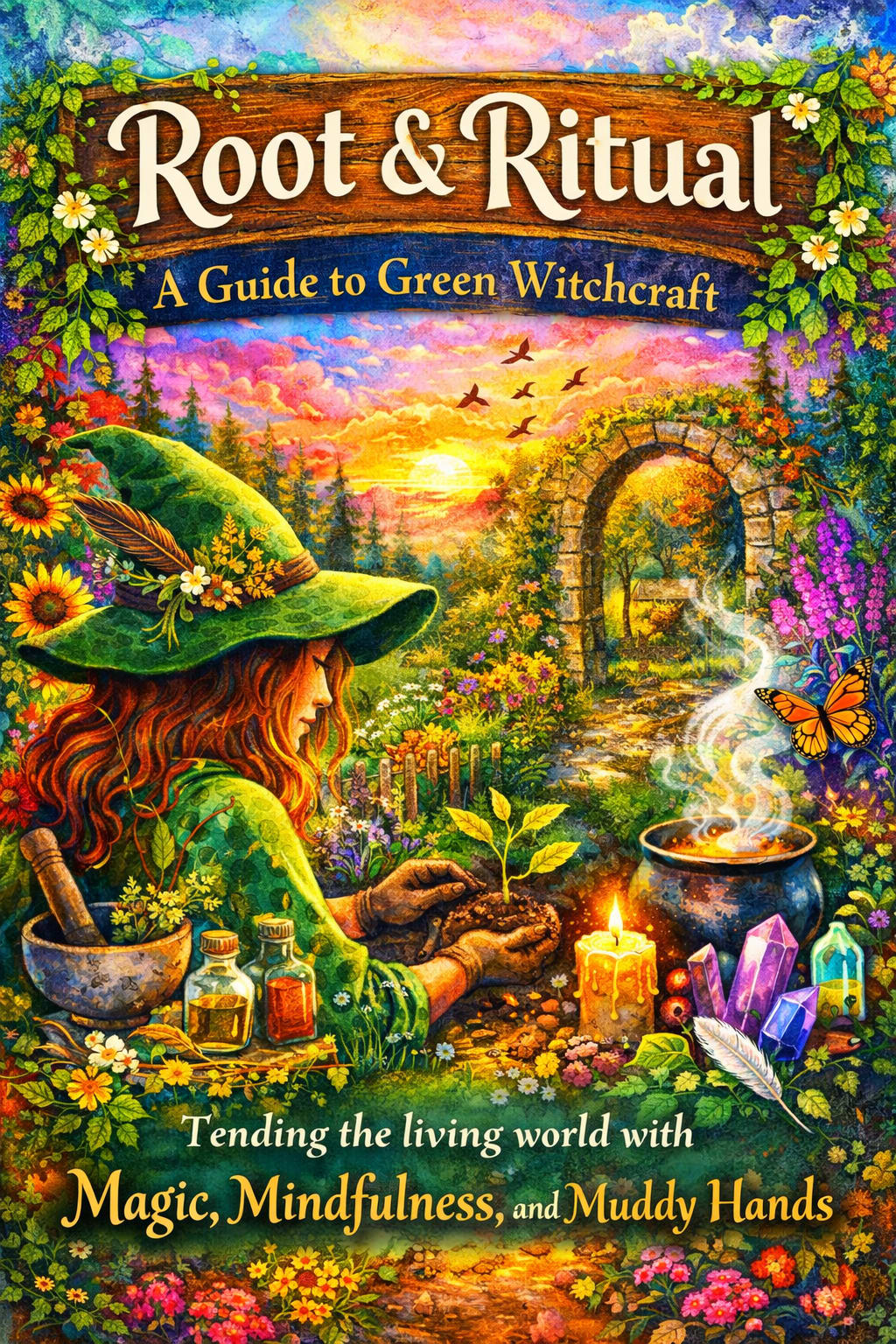
Root & Ritual: A Guide to Green Witchcraft
Tending the living world with Magic, Mindfulness, and Muddy Hands

The Whispering Path of Green Witchcraft
Green witchcraft, often referred to as garden witchery, herbal magic, or nature-based craft, functions less as a codified system and more as a lived relationship with the natural world. Practice begins with attentiveness rather than instruction. Bare feet meeting soil, wind stirring branches, and water moving across stone offer lessons that cannot be learned through books alone. Knowledge develops through patience, observation, and repeated engagement with land and season. Magic emerges through familiarity and trust rather than spectacle.
This form of witchcraft follows rhythms older than written tradition. Seasonal cycles guide both practice and perception. Spring signals renewal and planting, summer brings growth and vitality, autumn teaches release and harvest, and winter offers rest and reflection. Lunar phases further refine timing, with waxing phases supporting growth and intention-setting, and waning phases encouraging cleansing and release. Solstices and equinoxes mark balance and transition, serving as natural thresholds for reflection and recalibration. Living in awareness of these cycles fosters harmony between inner experience and external environment.
Green witchcraft rests at the intersection of the mystical and the practical. Herbs, trees, flowers, roots, and stones function as collaborators rather than tools. Each plant carries a long history of folkloric, medicinal, and magical associations supported by ethnobotanical records and traditional herbalism. Chamomile has been valued for calming properties and digestive support across European folk traditions. Rosemary has long symbolized memory and mental clarity, appearing in ancient Greek funeral rites and medieval healing practices. Yarrow holds a reputation for resilience and protection, supported by historical battlefield use for wound care. Engagement with these plants creates an ongoing dialogue shaped by experience and respect.
Ritual within green witchcraft rarely requires elaborate preparation. Meaning arises through mindful action. Sowing seeds becomes an act of intention. Harvesting herbs at dawn aligns human effort with natural potency recognized in traditional herbal lore. Preparing teas, tinctures, oils, or salves transforms daily care into sacred practice. Each gesture carries purpose, reinforcing the idea that magic thrives within ordinary moments when awareness is present.
Ethical responsibility forms the foundation of this path. Traditional green witchcraft emphasizes reciprocity and stewardship rather than extraction. Sustainable harvesting practices, seasonal restraint, and habitat preservation reflect an understanding that balance sustains power. Many folk traditions emphasize offerings of labor, care, or gratitude when gathering from wild spaces. Composting, seed saving, replanting, and tending neglected land function as acts of both magic and responsibility. Respect for ecosystems strengthens spiritual connection and ensures continuity of practice.
Green witchcraft appeals to individuals drawn toward intentional living, sensory awareness, and ecological mindfulness. The path values curiosity, creativity, and humility. Hands working soil, eyes tracking lunar light through leaves, and intuition shaped through observation become central guides. Rather than seeking control, green witchcraft teaches cooperation with natural forces. Wisdom emerges quietly, carried on wind, rooted in earth, and revealed through patient listening to the living world.
Key Terms
Green Witch
A green witch practices a nature-centered form of witchcraft rooted in sustained relationship with land, plants, and seasonal change. This role blends practical knowledge with spiritual awareness, drawing from folk magic, traditional herbalism, and ecological observation. Historical parallels appear in village herbalists, wise folk, and cunning practitioners who relied on direct interaction with the environment rather than formal initiation. Attention to lunar cycles, weather patterns, and plant behavior informs both magical and personal development, making the craft an extension of daily life rather than a separate ritual identity.
Herbalism
Herbalism is the study and use of plants for physical care, emotional balance, and spiritual support, with documented traditions spanning ancient Egypt, Greece, China, and Indigenous cultures worldwide. Within green witchcraft, herbalism incorporates both empirical knowledge and symbolic meaning. Leaves, roots, flowers, and resins are prepared as teas, tinctures, poultices, oils, incense, and charms. Each preparation reflects generations of accumulated knowledge regarding plant properties, seasonal potency, and appropriate application, blending practical wellness with intentional magic.
Seasonal Magic
Seasonal magic aligns spiritual practice with the cyclical structure of the natural year. Solstices and equinoxes mark observable astronomical events that have been honored since prehistoric times, as evidenced by sites such as Stonehenge and Newgrange. Cross-quarter days further reflect agricultural rhythms tied to planting, growth, harvest, and rest. Working within these cycles fosters awareness of natural momentum, allowing intention to harmonize with periods of expansion, culmination, release, or dormancy.
Sympathetic Magic
Sympathetic magic operates on the principle that resemblance and symbolic association create influence, a concept documented by anthropologist James George Frazer in The Golden Bough. This approach appears across global folk traditions and remains central to green witchcraft. Plants are selected for qualities reflecting desired outcomes, such as protective herbs with strong scents or resilient growth patterns. The underlying concept rests on observable traits translated into symbolic meaning, reinforcing the idea that natural characteristics mirror energetic function.
Eco-Magic
Eco-magic emphasizes environmental responsibility as an integral part of spiritual practice. This approach aligns with modern ecological ethics while reflecting older animistic worldviews that regarded land as alive and responsive. Choices such as organic cultivation, biodegradable materials, responsible disposal, and minimal extraction support sustainability. Magic practiced in this way acknowledges interdependence between human action and environmental health, reinforcing balance rather than exploitation.
Hedgewitch and Hedgecraft
Hedgecraft refers to spiritual work conducted at symbolic and energetic boundaries, often described as the hedge separating cultivated land from wilderness. The term traces back to Old English haegtesse, associated with liminal figures and folk practitioners. Hedgewitches explore altered states through meditation, trance, or ritual journeying to access insight, ancestral wisdom, or spirit realms. Plants traditionally associated with threshold spaces, such as elder or hawthorn, frequently support this work, alongside divination and protective practices.
Nature Spirits
Belief in nature spirits appears across cultures, including European folklore, Shinto practices, and Indigenous animism. These spirits are understood as conscious presences connected to specific landscapes, plants, or elements. Engagement within green witchcraft emphasizes respect, boundaries, and reciprocity. Offerings, mindful interaction, and environmental care form the basis of any relationship, reflecting the belief that cooperation rather than command sustains harmony.
Elemental Magic
Elemental magic draws upon the classical framework of earth, air, fire, and water, first articulated in ancient Greek philosophy and later incorporated into Western esoteric systems. Each element represents observable qualities such as stability, movement, transformation, and flow. Green witches often work with physical expressions of these elements, including soil, breath, flame, and water sources. Aligning intention with elemental character brings structure and clarity to ritual work.
Wildcrafting
Wildcrafting involves the ethical harvesting of plants from natural environments, a practice deeply rooted in traditional foraging cultures. Accurate plant identification, seasonal awareness, and conservation ethics are essential. Sustainable wildcrafting guidelines emphasize taking only what is needed, avoiding endangered species, and ensuring regeneration. This practice reinforces gratitude and accountability while preserving ecological balance.
Altar
An altar functions as a focal point for spiritual attention and ritual activity. In green witchcraft, altars often reflect seasonal change and natural materials rather than fixed symbolism. Stones, herbs, water, candles, and found objects serve as anchors for intention and reflection. This space supports meditation, spellwork, and observation, acting as a physical reminder of ongoing connection with natural cycles.
Grimoire or Book of Shadows
A grimoire or Book of Shadows serves as a personal record of magical knowledge and lived experience. Historically, grimoires contained collections of spells, herbal correspondences, and ritual instructions. Within green witchcraft, this record expands to include plant observations, seasonal notes, experimental results, and personal insights. The text evolves over time, reflecting growth and deepening understanding.
Correspondences
Correspondences describe established relationships between natural elements, intentions, and symbolic meaning. These associations emerge from folklore, astrology, herbal tradition, and experiential practice. Plants, stones, colors, and lunar phases are selected based on observed and recorded effects. Understanding correspondences allows magical work to align intention with natural affinity rather than arbitrary choice.
Moon Magic and Lunar Work
Lunar practice is based on the observable influence of the Moon on tides, agriculture, and biological rhythms. Ancient farming calendars and modern biodynamic practices both recognize lunar phases as significant timing markers. Waxing phases support growth and attraction, full phases emphasize culmination and clarity, waning phases assist release, and new phases encourage rest and renewal. Green witches time rituals accordingly to work with natural momentum.
Eco-Conscious Ritual Tools
Eco-conscious tools prioritize sustainability and ethical sourcing. Reusable materials, natural fibers, locally gathered items, and responsibly sourced stones reduce environmental impact. This approach reflects the belief that tools carry the energy of their origins and that mindful selection strengthens ritual integrity.
Divination
Divination seeks insight through pattern recognition and symbolic interpretation, practices documented across ancient cultures. Green witches often use natural materials such as stones, leaves, water, or plant-based symbols. These methods emphasize attunement rather than prediction, supporting reflection and alignment with natural rhythms.
Seasonal Observances and Sabbats
Seasonal observances honor key moments within the agricultural and solar year. The eight Sabbats, structured around solstices, equinoxes, and cross-quarter days, reflect cycles of growth, harvest, death, and renewal. Celebrations acknowledge ecological interdependence and reinforce awareness of time as a living process rather than a linear measure.
Key Figures and Contributions
Green witchcraft does not trace its roots to a single founder or unified tradition. Instead, it emerges from centuries of folk magic, herbal practice, agricultural knowledge, and land-based spirituality found across cultures. Wise women, village healers, cunning folk, and herbalists preserved practical and spiritual relationships with plants long before the term green witch existed. In the modern era, several writers and teachers helped articulate these practices into accessible frameworks while emphasizing ethics, sustainability, and direct engagement with nature. Their contributions continue to shape contemporary green witchcraft as a living, evolving path.
Doreen Valiente (1922 to 1999)
Doreen Valiente played a foundational role in the development of modern witchcraft, particularly through contributions to early Wiccan liturgy and philosophy. While not the sole architect of modern witchcraft, Valiente was instrumental in refining ritual language and restoring poetic reverence for the natural world. Seasonal observance, Earth-centered devotion, and ethical responsibility feature prominently in her work. Valiente’s poetry and prose emphasized balance, reciprocity, and the sacredness of land and life, helping shift witchcraft away from rigid ceremonialism toward a more organic and spiritually grounded practice.
Scott Cunningham (1956 to 1993)
Scott Cunningham significantly influenced the popular understanding of green and solitary witchcraft during the late twentieth century. His writings emphasized personal experience, accessibility, and respect for nature over hierarchy or formal initiation. Works such as Encyclopedia of Magical Herbs and Earth Power introduced generations of practitioners to herbal correspondences grounded in folklore and traditional symbolism. Cunningham’s approach encouraged ethical plant use, intuitive practice, and integration of magic into everyday life, shaping modern green witchcraft as practical, gentle, and deeply personal.
Arin Murphy-Hiscock
Arin Murphy-Hiscock is a contemporary author whose work emphasizes sustainable magic, mindfulness, and ecological responsibility. Drawing from modern witchcraft, folk traditions, and environmental ethics, Murphy-Hiscock encourages thoughtful engagement with natural resources and intentional living. Publications such as The Green Witch and The House Witch focus on seasonal awareness, plant-based practice, and low-impact ritual. This body of work reinforces the idea that magic and environmental stewardship are inseparable aspects of responsible practice.
Raymond Buckland (1934 to 2017)
Raymond Buckland is widely recognized as the primary figure responsible for introducing Wicca to the United States. Beyond this role, Buckland’s influence extended into folklore studies, nature magic, and hedgecraft-inspired exploration. His interest in Saxon traditions, spirit communication, and experiential learning encouraged practitioners to engage directly with both natural and spiritual landscapes. Buckland’s emphasis on personal exploration and structured learning helped establish pathways for solitary and nature-based practitioners seeking depth beyond formal covens.
Diane Wilkes and Other Green Witch Pioneers
Diane Wilkes contributed to the popularization of nature-based and kitchen-centered witchcraft through accessible writing focused on herbs, household magic, and seasonal awareness. While often associated with kitchen witchery, this work overlaps significantly with green witchcraft through emphasis on plants, sustainability, and daily practice. Alongside other contemporary educators, Wilkes helped demonstrate that meaningful connection with nature can flourish in urban environments, small gardens, or domestic spaces, reinforcing adaptability as a core principle of the green path.
Influence of Buckland’s Students and Modern Hedgecraft Educators
Students influenced by Buckland’s teachings, along with later hedgecraft educators, expanded nature-based witchcraft into diverse forms. These practitioners integrated ethical wildcrafting, sustainable gardening, trance work, and folklore-based spirituality into cohesive practices. Emphasis on liminality, environmental respect, and experiential learning helped establish green witchcraft as both spiritually rich and ecologically grounded. Through teaching, writing, and mentorship, this lineage continues to evolve while remaining rooted in land awareness.
Juliet Diaz
Juliet Diaz brings a contemporary and socially conscious perspective to green witchcraft through teachings rooted in plant medicine, ancestral connection, and ecological responsibility. Often drawing from Indigenous-informed frameworks while emphasizing respect and accountability, Diaz highlights communal healing, land stewardship, and relationship-based plant work. Gardens, shared spaces, and collective rituals play central roles, reframing green witchcraft as both personal practice and community engagement.
Diana L. Paxson
Diana L. Paxson is primarily known for contributions to modern paganism and Heathen spirituality, yet her influence extends strongly into nature-centered practice. Paxson’s work explores sacred landscapes, land spirits, and the spiritual intelligence of place. Through both fiction and non-fiction, this writing encourages attentiveness to forests, fields, and ancestral land connections. Such perspectives have informed green witchcraft by reinforcing reverence for natural environments as living spiritual participants.
Together, these figures helped articulate green witchcraft as an ethical, approachable, and ecologically informed path. Their contributions bridge traditional plant lore, folk spirituality, and modern environmental awareness. Rather than presenting magic as control or domination, this lineage frames green witchcraft as partnership, responsibility, and mindful participation in the living world.
Ethics of the Green Witch
The ethical foundation of green witchcraft rests on an understanding that every action carries consequence. This path emphasizes awareness over authority and responsibility over control. Rather than following a rigid moral code, green witchcraft encourages attentiveness to how choices affect land, living beings, and long-term balance. The Earth is regarded not as a resource to dominate, but as an active participant in magical and spiritual life.
A central ethical principle within this tradition is the commitment to minimize harm. This value appears consistently across historical folk practices and modern ecological ethics. Whether preparing a remedy, gathering materials, or performing spellwork, care and restraint guide each step. Plants are not harvested casually or excessively. Attention is given to timing, plant health, and environmental context. These practices align with traditional foraging ethics taught in herbalism, where responsible harvesting ensures both plant survival and future availability.
Sustainable harvesting plays a critical role in ethical green witchcraft. Plants, fungi, and trees exist within interdependent systems that support soil health, pollinators, and wildlife. Disrupting these systems through overharvesting weakens the land itself. Green witches learn to identify species accurately, understand growth cycles, and harvest selectively. Established guidelines such as taking no more than a small percentage of a plant population reflect long-standing conservation principles found in both Indigenous knowledge systems and modern ecological science.
Respect for land and place forms another cornerstone of this ethical approach. Natural spaces are entered with mindfulness rather than entitlement. Forests, rivers, gardens, and wild edges are treated as living environments with their own rhythms and needs. Quiet acknowledgments, offerings, or moments of gratitude before gathering or ritual work reflect animistic traditions found worldwide. This reverence fosters a deeper relationship with place and reinforces the belief that magic grows strongest where respect is present.
Intentionality shapes ethical magical practice. Green witchcraft emphasizes working with natural forces instead of attempting to override them. Lunar phases, seasonal shifts, plant life cycles, and elemental conditions influence timing and method. This cooperative approach mirrors agricultural and herbal traditions that rely on environmental awareness rather than force. Magic becomes an act of alignment, allowing outcomes to unfold with greater stability and clarity.
Reciprocity binds these ethical values together. Traditional land-based cultures consistently emphasize the importance of giving back when something is taken. In green witchcraft, reciprocity may take many forms, including composting plant remains, replanting seeds, tending neglected spaces, or offering water and care to the land. These actions reinforce balance and acknowledge participation within a broader ecological cycle. Reciprocity is not symbolic alone; it is practical stewardship expressed through ongoing care.
The ethics of green witchcraft extend beyond ritual and spellwork into daily living. Choices related to consumption, waste, gardening, and environmental impact reflect the same principles applied in magical practice. Mindfulness, patience, and respect guide interaction with the natural world. Through these values, green witchcraft becomes not only a spiritual path but a way of moving through life with awareness, humility, and responsibility toward the Earth.
Rituals and Practices
Green witchcraft is shaped by direct engagement with the natural world rather than prescribed ceremony. Practice develops through repeated, attentive interaction with land, plants, weather, and seasonal change. Physical sensations and environmental cues serve as teachers. The feel of soil, the scent released by crushed leaves, the sound of water moving over stone, and the weight of gathered herbs all contribute to a form of embodied knowledge. Ritual arises naturally from these experiences, grounded in familiarity rather than performance.
Herbal spellcraft occupies a central place within this tradition and draws from centuries of folk herbalism and symbolic plant use. Herbs are selected based on traditional associations, observed effects, and personal experience. Lavender has long been linked with calm and rest in European folk practice, while rosemary carries historical associations with memory, focus, and protection. Chamomile appears in both medicinal and folkloric records as a plant connected with soothing, luck, and gentle protection. Preparation methods such as teas, infused oils, sachets, and charms reflect traditional domestic and healing practices. Effective herbal work requires observation of growth patterns, seasonal potency, and environmental conditions rather than reliance on fixed formulas.
Gardening functions as both practical labor and spiritual discipline. Historical agrarian societies treated planting and tending as sacred responsibilities tied to survival and seasonal rhythm. Within green witchcraft, cultivating herbs or food plants reinforces patience, accountability, and relationship with place. Repetitive tasks such as watering, pruning, and composting create steady cycles that support focus and mindfulness. The acts of sowing, tending, harvesting, and returning organic matter to the soil mirror broader patterns of renewal and decay found throughout nature.
Seasonal rituals mark the turning points of the solar and agricultural year. Solstices and equinoxes correspond to measurable changes in daylight that have been observed and honored since prehistoric times. Cross-quarter days align with traditional agricultural markers such as planting, lambing, and harvest preparation. Ritual observance may include lighting candles, preparing seasonal foods or teas, leaving garden offerings, or spending time outdoors observing shifts in temperature and light. Lunar cycles further refine timing, with waxing phases traditionally associated with growth and attraction, and waning phases associated with cleansing and release. These practices align with historical farming calendars and biodynamic timing methods.
Nature walks form an essential practice within green witchcraft by cultivating sensory awareness and environmental literacy. Slow movement through natural spaces encourages observation of plant communities, animal behavior, and subtle shifts in weather. Attention to bird calls, wind patterns, soil texture, and water flow sharpens intuition and deepens connection to place. Such walks have long been used in folk traditions as methods of reflection, healing, and spiritual grounding. Time spent in natural settings also supports mental clarity and restoration, reinforcing the reciprocal relationship between practitioner and environment.
Hedgecraft introduces a contemplative and visionary dimension to green witchcraft. The hedge symbolizes the boundary between cultivated land and wild space, as well as the threshold between ordinary awareness and altered perception. Historical references to hedge-riders and cunning folk describe practices involving trance, spirit contact, and liminal travel. Modern hedgecraft employs meditation, rhythmic breathing, drumming, and visualization to access insight or ancestral memory. Natural thresholds such as garden gates, forest edges, and stone formations often serve as symbolic entry points. Emphasis remains on personal experience, discernment, and grounded return rather than escapism.
Elemental practice provides structural balance within ritual work. Earth corresponds with stability, nourishment, and physical presence, often engaged through soil, stones, or plant roots. Water reflects emotional flow and purification, accessed through rivers, rain, or vessels of collected water. Fire represents transformation and focused intention, commonly expressed through candles or hearth flames. Air embodies movement, thought, and communication, observed through wind, breath, and scent. Working with these elements reflects classical natural philosophy and reinforces awareness of interconnected forces shaping both environment and self.
Together, these rituals and practices establish green witchcraft as an integrated way of living rather than a collection of isolated techniques. Daily actions and seasonal observances blend seamlessly with magical intention. Through consistent interaction with land, plants, and natural cycles, green witchcraft becomes a path defined by presence, responsibility, and enduring relationship with the living world.
Tools of the Green Witch
The tools used in green witchcraft are practical extensions of daily interaction with the natural world. Rather than serving as symbols alone, these items support observation, preparation, and intentional action. Simplicity and sustainability guide their use, reflecting traditions rooted in domestic craft, folk magic, and land-based practice. Each tool strengthens awareness of natural cycles and reinforces respectful engagement with the environment.
Herbs and living plants form the foundation of green witchcraft. Cultivated gardens, window boxes, and responsibly gathered wild plants provide material for both practical and spiritual work. Historical herbal traditions document the use of lavender for calm and rest, rosemary for memory and clarity, sage for purification, chamomile for soothing and gentle protection, and thyme for courage and vitality. Green witches learn plant qualities through seasonal observation, soil conditions, and growth patterns as much as through written sources. Harvesting follows ethical guidelines, and preparation methods such as teas, tinctures, infused oils, sachets, and incense reflect long-standing domestic and healing practices.
The mortar and pestle serve as essential preparation tools with deep historical roots. Used since ancient times across multiple cultures, this instrument allows herbs and resins to be crushed, blended, and activated through physical effort. The act of grinding releases aroma and texture while encouraging focus and deliberate pacing. Materials such as stone, wood, or ceramic are traditionally favored for durability and natural composition, aligning with sustainability and minimizing contamination of herbal preparations.
Cauldrons and cooking vessels occupy a dual role as symbolic containers and functional tools. Historically, communal and household pots served as centers of nourishment, medicine-making, and ritual activity. In green witchcraft, these vessels are used to brew teas, simmer decoctions, prepare salves, or hold offerings. Cast iron, enamel, and stainless steel are commonly chosen for their heat retention and practicality. The process of brewing reinforces patience, attentiveness, and transformation through controlled heat and time.
Journals and grimoires function as records of accumulated knowledge and personal experience. Folk practitioners have long relied on handwritten notes to preserve herbal recipes, seasonal markers, and observational data. Within green witchcraft, journals document plant behavior, lunar timing, ritual outcomes, dreams, and intuitive insights. Writing supports reflection and refinement, allowing practice to evolve through experience rather than imitation. Over time, these records become individualized reference works shaped by lived interaction with the natural world.
Natural altar items bring elements of the outdoors into focused ritual space. Stones, shells, feathers, seed pods, dried flowers, pinecones, and driftwood carry symbolic and elemental associations grounded in their origins. Responsible collection and ethical sourcing are essential, emphasizing meaning over aesthetic display. These items help anchor intention, support elemental balance, and maintain a tangible connection to place and season within ritual settings.
Hedgecraft tools support work at symbolic and spiritual thresholds. Drums and rhythmic instruments have been used across cultures to induce altered states and support trance work. Bells historically marked transitions, warded spaces, or signaled ritual boundaries. Amulets and simple wands crafted from wood or natural materials assist with focus, protection, and directional energy. These tools are often handmade or personally adapted, emphasizing relationship and familiarity over formality.
Within green witchcraft, tools remain secondary to awareness and intention. Each item reflects an ongoing relationship with nature rather than dependence on objects alone. Herbs, vessels, journals, and instruments serve as companions that support practice without replacing personal responsibility. Through mindful selection and ethical use, these tools reinforce sustainability, respect, and enduring connection with the living world.
Eco-Friendly Practices
Eco-friendly practice forms the structural backbone of green witchcraft. This path understands magic as an extension of daily interaction with land, resources, and living systems. Every choice carries consequence, whether made in a garden, a kitchen, or a ritual space. Sustainability is not treated as an optional consideration but as an ethical responsibility rooted in respect for ecological balance. Magical work is believed to gain strength when actions support life rather than deplete it.
Careful sourcing of materials is a fundamental practice. Herbs, stones, feathers, and natural objects are gathered with discernment and restraint. Ethical foraging traditions emphasize selective harvesting, accurate plant identification, and seasonal awareness. Only healthy, abundant populations are gathered from, ensuring continued growth and ecological stability. Stones and shells are collected without disturbing habitats or wildlife. These practices reflect long-standing foraging ethics found in traditional herbalism and conservation education.
Gardening serves as a direct expression of environmental responsibility. Organic cultivation methods prioritize soil health, pollinators, and long-term resilience. Chemical pesticides and synthetic fertilizers are avoided in favor of compost, mulch, and natural soil amendments. Companion planting and crop rotation, techniques documented in agricultural history, encourage balanced growth and reduce disease. Gardens function as living ecosystems rather than controlled outputs, allowing observation of interdependence between plants, insects, weather, and soil.
Upcycling and repurposing reinforce the principle of mindful consumption. Glass jars, fabric remnants, metal tins, and wooden containers are reused for herb storage, ritual tools, or household magic. This practice reflects historical household craft traditions, where resources were conserved out of necessity. Repurposing reduces waste while encouraging creativity, reminding practitioners that intention matters more than novelty or expense.
Composting returns organic matter to the soil and embodies reciprocity in tangible form. Plant trimmings, spent herbs, ritual remnants, and kitchen waste are transformed into nourishment for future growth. Composting improves soil structure, supports microbial life, and reduces landfill contribution. This cycle mirrors ecological processes of decay and renewal, reinforcing awareness that nothing is wasted within natural systems.
Plastic-free and low-waste rituals further reduce environmental impact. Beeswax and soy candles offer biodegradable alternatives to paraffin, which is petroleum-based. Natural twine, wooden tools, reusable containers, and biodegradable offerings replace synthetic materials. Selecting non-toxic and sustainable items aligns practice with environmental well-being and reduces long-term ecological harm.
Water and energy conservation extend eco-friendly ethics into daily ritual habits. Water used for brewing, cleansing, or plant care is managed thoughtfully, often reused when safe and appropriate. Natural light, outdoor spaces, and seasonal timing reduce reliance on artificial energy sources. Fire and heat are used deliberately rather than excessively, reflecting traditional awareness of resource value.
Eco-friendly practices are not additions to green witchcraft; they are integral to its structure. Sustainability, restraint, and reciprocity shape every aspect of the path. Through consistent attention to environmental impact, green witchcraft becomes a living partnership with the Earth, ensuring that both magic and ecosystems remain healthy, resilient, and enduring.
Additional Key Considerations
Green witchcraft remains a dynamic and adaptive path shaped by ongoing observation, study, and ethical awareness. Beyond ritual structure and material tools, deeper considerations support skill development, environmental harmony, and long-term sustainability. These elements strengthen both practical competence and spiritual connection, ensuring that practice matures alongside understanding.
Wildcrafting requires particular care and education. Ethical gathering depends on accurate plant identification, familiarity with growth cycles, and awareness of ecological impact. Many plants occupy essential roles within their environments, supporting pollinators, soil health, and wildlife. Responsible wildcrafting avoids endangered species, limits harvest to abundant populations, and follows established guidelines such as taking only a small portion of available growth. Knowledge of toxic and look-alike species is essential for safety, reinforcing the importance of study and caution. When approached correctly, wildcrafting becomes an act of stewardship rather than extraction.
Connection to local ecosystems deepens the effectiveness and relevance of magical practice. Learning native plant species, seasonal weather patterns, and animal behavior fosters attunement to place. Ecological literacy allows rituals and offerings to reflect the needs and rhythms of the surrounding environment rather than abstract symbolism. This relationship cultivates a sense of belonging rooted in landscape, reinforcing the idea that magic emerges from direct participation within living systems.
Integration of practical skills with spiritual practice defines green witchcraft. Herbalism, soil care, food cultivation, and sustainable living are not separate from magical work but form its foundation. Folk medicine traditions demonstrate how plant knowledge serves both healing and spiritual purposes. Gardening and composting reinforce cycles of nourishment and renewal, illustrating that spiritual intention gains strength through physical action. Daily habits become expressions of craft, dissolving boundaries between ritual and routine.
Balance between solitary and communal practice contributes to resilience and growth. Solitary work supports introspection, experimentation, and personal rhythm. Community engagement provides shared knowledge, collective effort, and expanded perspective. Historical agricultural societies relied on communal labor and seasonal observance, reflecting the strength found in cooperation. Modern expressions such as community gardens, seed libraries, educational workshops, and seasonal gatherings continue this tradition, fostering both ecological responsibility and shared stewardship.
These considerations affirm that green witchcraft extends beyond technique into a comprehensive way of living. Ethical wildcrafting, ecological awareness, practical integration, and community connection shape a path grounded in responsibility and relationship. Through these principles, green witchcraft remains responsive, sustainable, and deeply aligned with the living world.
Recommended Readings: #commissionearned
This book serves as one of the most widely recognized modern introductions to green witchcraft and nature-based magic. Arin Murphy-Hiscock presents green witchcraft as a lifestyle rooted in attentiveness, sustainability, and everyday ritual rather than dramatic ceremony. Strong emphasis is placed on building relationships with plants through observation, care, and seasonal awareness, making the material accessible to readers with limited space or resources. Practical sections explore herbal teas, infused oils, incense blends, and basic ritual practices, all framed within ethical engagement with nature. The book also introduces plant correspondences, elemental symbolism, and lunar timing without overwhelming the reader with rigid structure. Journaling, sketching, and mindful record keeping are encouraged as ways to deepen plant relationships and personal insight. This work aligns closely with the blog’s focus on ecological responsibility, intentional living, and the idea that green witchcraft grows through consistency and respect rather than complexity.
Paige Vanderbeck offers a grounded and experiential approach to green witchcraft that emphasizes learning through practice rather than memorization. The book blends folk magic principles with hands-on plant work, focusing on how herbs, flowers, and crystals interact with daily life. Clear guidance is provided for kitchen magic, meditation, protection work, and simple spellcraft, all supported by ethical harvesting and sustainable sourcing practices. Vanderbeck places strong importance on experimentation, encouraging readers to observe outcomes and refine techniques over time. Urban and suburban practitioners are directly addressed, with realistic methods for working within limited space. Crystal work is presented as a supportive tool rather than a central focus, reinforcing the plant-centered nature of the craft. This book complements the blog’s emphasis on observation, adaptability, and responsible engagement with the natural world.
This encyclopedia functions as a practical reference for practitioners seeking deeper botanical knowledge within a magical framework. Rowan Morgana presents 150 plant entries that combine folklore, historical use, and modern green witchcraft applications. Each entry includes correspondences, energetic qualities, and suggestions for spellwork, ritual use, or everyday incorporation. Preparation methods such as teas, oils, salves, and charms are explained alongside important safety considerations. Attention is given to cultivation methods suitable for gardens, containers, or ethical wildcrafting. The text encourages readers to observe how plants behave in specific environments, reinforcing personal experience over blind repetition. This reference supports the blog’s focus on ethical harvesting, plant relationship building, and informed practice rooted in both tradition and ecology.
Green Witchcraft: Folk Magic, Fairy Lore, and Herb Craft by Ann Moura
Ann Moura’s work stands as one of the earlier modern texts that helped shape green witchcraft as a distinct path. Drawing from European folk magic, herbal traditions, and fairy lore, the book presents green witchcraft as a solitary and nature-focused practice. Moura emphasizes flexibility, encouraging adaptation to local landscapes and personal intuition rather than adherence to strict rules. Herbal recipes, spells, and seasonal rituals are presented alongside discussions of natural spirits and land awareness. Historical context connects modern practice with older traditions of cunning folk and rural magic. Ethical engagement with nature and respect for unseen forces are recurring themes throughout the text. This book directly supports the blog’s exploration of green witchcraft as a lineage of folk practice rooted in land, observation, and reverence.
This book focuses on the creation and maintenance of a personal grimoire grounded in nature-based practice. Arin Murphy-Hiscock presents the grimoire as a living document shaped by experience, seasonal change, and personal growth. Practical guidance is offered for recording plant correspondences, ritual notes, lunar observations, and experimental outcomes. Artistic expression, journaling, and reflective writing are presented as valid and valuable components of magical record keeping. The book emphasizes that documentation strengthens awareness and accountability within green witchcraft. Templates and examples provide structure while allowing freedom for individual adaptation. This work directly supports the blog’s emphasis on observation, intentional practice, and the long-term cultivation of knowledge through lived experience.
Brittany Nightshade offers an accessible introduction for readers new to green witchcraft and nature-centered Wiccan practice. Foundational concepts such as plant magic, lunar cycles, elemental work, and ethical interaction with nature are presented in clear and approachable language. The book includes simple rituals, spellwork, and journaling exercises suitable for solitary practitioners and small living spaces. Garden magic, even at the level of potted plants or windowsill herbs, is treated as meaningful and effective. Attention is given to reciprocity, mindfulness, and sustainable practice throughout the text. Divination methods and seasonal observances are introduced without excessive complexity. This guide aligns with the blog’s message that green witchcraft is accessible, responsible, and rooted in everyday interaction with the living world.
The Way of the Green Witch
Green witchcraft offers a path of careful attentiveness and meaningful engagement with the natural world. It asks practitioners to slow down, observe, and respond to the land with care, respect, and responsibility. Every herb gathered, seed planted, and seasonal ritual performed becomes part of an ongoing conversation with the Earth. Through herbalism, gardening, folk practices, and seasonal observances, green witches learn to work with natural rhythms instead of against them. In this way, magic is not a series of actions but a lived ethic, where spiritual practice and everyday choices support and reflect one another.
Immersion in nature lies at the heart of this path. Time spent in forests, fields, gardens, or even small urban green spaces allows patterns, cycles, and subtle energies to become visible. Plants teach patience, weather teaches adaptability, and seasonal changes remind the practitioner that growth and rest are equally necessary. Observing these elements with intention fosters a practice that is grounded, respectful, and attuned to the living world. Magic emerges naturally from cooperation, not control, and from connection, not obligation.
Continual learning strengthens and deepens this practice. Studying herbalism, local ecology, folklore, and historical traditions enriches understanding and supports safe, ethical work. Local libraries provide access to texts on plant identification, medicinal uses, and traditional folkcraft. Online archives, botanical societies, and university databases offer additional information when approached thoughtfully. It is important to verify sources carefully, compare information across multiple references, and distinguish historical practices from modern interpretations. A mindful and critical approach ensures that the practice remains responsible, informed, and connected to living systems.
Ultimately, green witchcraft is not defined by spells or tools, but by the quality of relationship with the Earth. Observing natural cycles, practicing ethical magic, and integrating care for the environment into daily life create a path rich in creativity, spiritual depth, and ecological awareness. The Earth teaches generously to those who pay attention, offering guidance, lessons, and inspiration. Walking this path means embracing awareness, respect, and mindfulness in every act, season after season, step by step.
About the Creator
Marcus Hedare
Hello, I am Marcus Hedare, host of The Metaphysical Emporium, a YouTube channel that talks about metaphysical, occult and esoteric topics.
https://linktr.ee/metaphysicalemporium
Keep reading
More stories from Marcus Hedare and writers in BookClub and other communities.
The Blood Moon
When the Moon Turns Red For millennia, the sudden darkening of the full Moon has stirred awe, fear, reverence, and speculation. A total lunar eclipse transforms a familiar celestial body into something uncanny, as Earth’s shadow slowly overtakes the lunar surface and replaces silver light with deep copper and crimson tones. This phenomenon, commonly called the Blood Moon, occurs through a precise interaction of orbital mechanics and atmospheric physics. Sunlight passing through Earth’s atmosphere bends and scatters, filtering out shorter wavelengths and allowing red and orange light to reach the Moon. The result is neither illusion nor omen, but a predictable yet visually arresting event grounded in natural law.
By Marcus Hedare7 days ago in BookClub
My New Book is Finally Here
My poetry collection Beautiful and Brutal Things is done. It's actually done and finally published over 270 pages. Over a year of my life went into this book. More than a year, really. Long days at my computer, sometimes seven days a week because I couldn't stop even when I probably should have. Then two months of editing that felt harder than the writing itself. But it's finished, and I'm still standing, and the book is real.
By Tim Carmichaela day ago in BookClub
7 Amazing Books To Help Improve Your Critical Thinking
In a world overflowing with information, opinions, and half-truths, critical thinking is no longer a “nice-to-have” skill—it’s essential. Every day, we’re asked to evaluate news headlines, make financial decisions, assess workplace strategies, and navigate complex social issues. Without strong critical thinking skills, we risk accepting flawed arguments, falling for misinformation, or making decisions that don’t serve our long-term goals.
By Diana Meresc4 days ago in BookClub




Comments
There are no comments for this story
Be the first to respond and start the conversation.