
Revisiting Sapiens
How Harari’s Masterpiece affected Me

When I first picked up Yuval Noah Harari’s “Sapiens: A Brief History of Humankind,” I was expecting a straightforward historical account of our species. Yet, what I encountered was a profound exploration of human nature, culture, and society; a book that not only challenged my preconceptions but also inspired deep philosophical reflection. Here is the story of how I approached, grappled with, and ultimately absorbed the transformative ideas in Sapiens.
The First Encounter
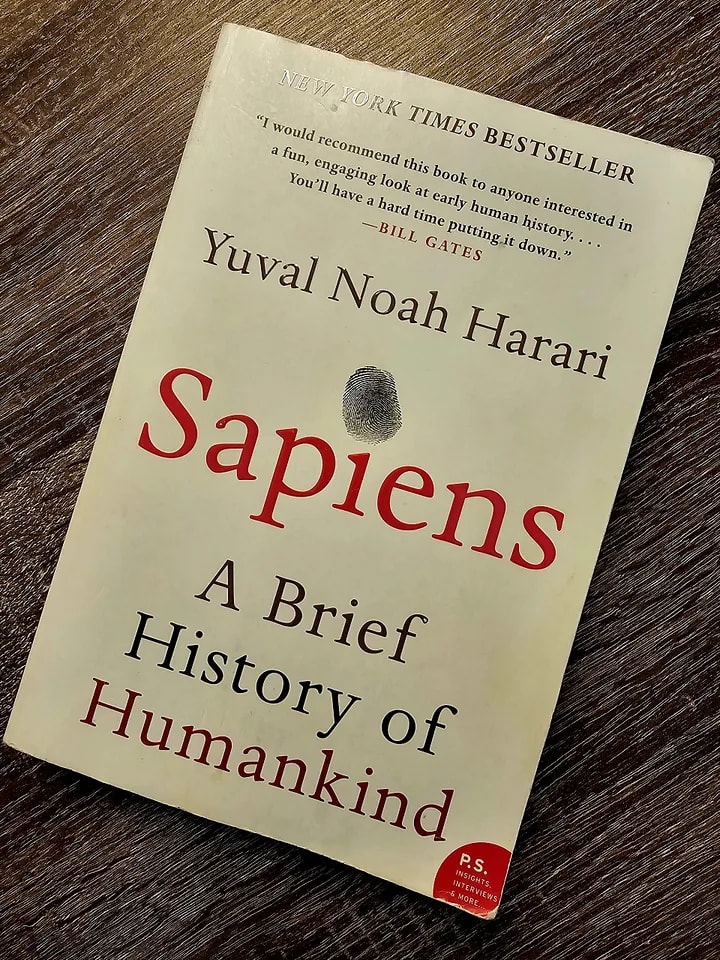
I remember the day I stumbled upon Sapiens. It was a rainy afternoon, the kind that coerces you into introspection. As I browsed through my books (I’m sure we can all relate to sometimes overzealously buying a book “for later reading”!), Harari’s book, with its simple and elegant ‘thumbprint’ cover, caught my eye. Little did I know, this serendipitous encounter would set me on a journey through time, from the dawn of our species to the modern age, where I would be inspired to pick up my own pen.
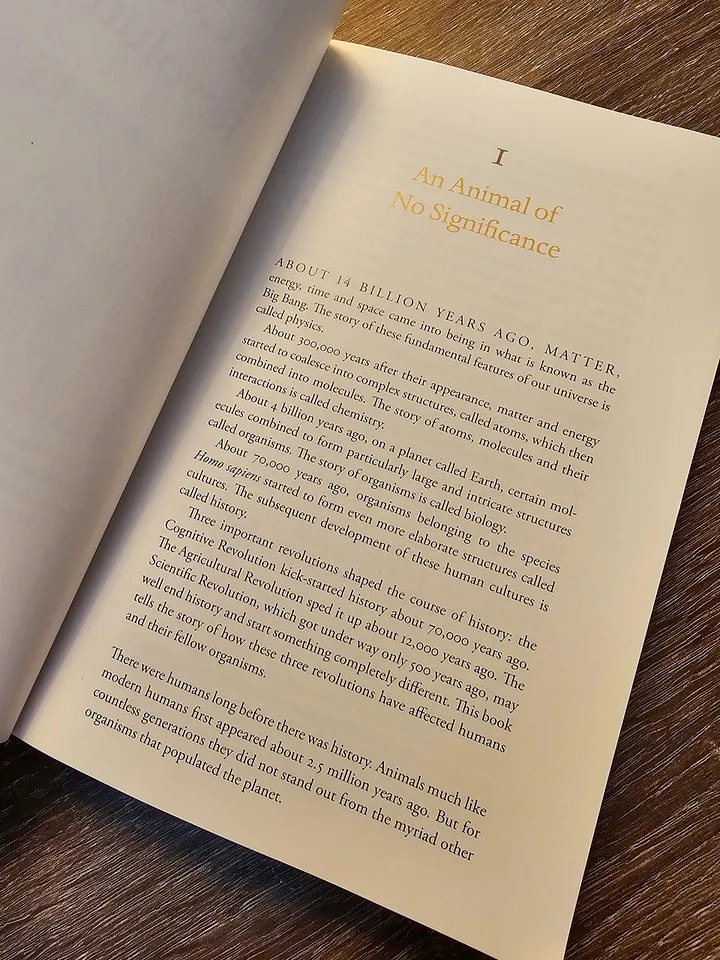
Harari begins the journey with the Cognitive Revolution, a period about 70,000 years ago when Homo sapiens started to outpace other human species. This era marked the birth of fictional thinking, enabling us to create myths, religions, and ideologies. As I reflect back now, I can’t help but see the influence in my own writings, particularly my exploration of belief systems and their impact on society. In Decrypting Globalization, I talked about how myths shape our economic and political landscapes, much like Harari describes the role of shared myths in uniting early human societies.
Harari’s assertion that “we control the world because we are the only animal that can cooperate flexibly in large numbers” is a theme that I’ve often pondered in my own philosophical inquiries. How did we, a seemingly insignificant species, rise to dominate the planet? Harari attributes this to our ability to believe in shared myths, from religions to corporations. These myths enable large-scale cooperation and societal complexity. It asserts how we are more than just a herd in the Serengeti.
I often used to ponder upon the nature of belief and fact, thinking about the importance of distinguishing between empirical evidence and unfalsifiable beliefs. Harari’s analysis of the Cognitive Revolution provided a historical context for this distinction, showing how our capacity for belief has been both a strength and a vulnerability. This duality resonated deeply with my view that while beliefs can unite and inspire, they can also mislead and divide.

The Agricultural Revolution
Moving through the book, I found myself particularly intrigued by Harari’s treatment of the Agricultural Revolution. He provocatively claims that it was “history’s biggest fraud,” suggesting that farming led to a decrease in quality of life for many people. This perspective was a revelation, prompting me to reconsider my assumptions about progress and human development. I had often thought about capitalism and the start of commerce, where our species was led astray, pursuing material possessions that will never satisfy their internal cravings; but to think about it, THAT far back, was mind opening.
Harari’s argument that agriculture trapped humans in a cycle of hard labor and social inequality echoed my own concerns about the loss of individual autonomy. The transition from foraging to farming, Harari argues, led to larger populations but also to disease, malnutrition, and social stratification. This historical lens added depth to my understanding of how societal structures evolve and the price of so-called progress.
Myths of Modernity
Harari’s narrative doesn’t stop at ancient history; it extends to the present, dissecting the Scientific Revolution and the rise of capitalism. His discussion on capitalism, in particular, resonated with my critiques in The Temples of Consumerism. Harari describes capitalism as the most successful religion ever created, with its own myths and rituals that drive our modern economy.
Harari’s beautifully phrased insights sprinkled throughout the book are extremely attention grabbing. He says that “the most important economic resource is trust in the future.” Without context, this idea is open to many interpretations. For instance, I might say that it aligns with my exploration of consumer culture, where the promise of future happiness drives perpetual consumption or that it invokes hope about a positive, brighter future; but to geta true ‘Big Picture,’ I definitely recommend reading this masterpiece.
Harari’s historical perspective reinforced my belief that understanding the roots of our economic systems is crucial to addressing their flaws. By tracing the evolution of capitalism, he unveils how our trust in the future has been manipulated to sustain continuous economic growth, often at the expense of social equity and environmental sustainability.
Wrestling with the Anthropocene
One of the most compelling parts of Sapiens is Harari’s examination of the ‘Anthropocene’, the (arguably) current epoch where humans are the dominant influence on the planet. This chapter forced me to confront uncomfortable truths about our impact on the environment, an issue I have now repeatedly written about in my own work.
Harari’s depiction of humans as a “flood of life” altering the earth’s ecosystems was both sobering and motivating. It aligned with my discussions in Decrypting Globalization about the environmental costs of modern economic practices. Harari’s call to rethink our relationship with the planet echoed my own advocacy for sustainable living and mindful consumption. His historical narrative provided a broader context for my arguments, reinforcing the urgency of addressing our ecological footprint.
Confronting the Future
As I neared the end of Sapiens, Harari’s speculative exploration of the future left me with a mix of awe and apprehension. He posits that Homo sapiens might evolve into a different kind of being through advances in biotechnology and artificial intelligence. This future, where humans play god with life itself, raises profound ethical questions that resonate with my concerns about the future. To some, his assertions might seem to merge into science fiction, but to me, they exhibited the elements of a ‘danger’ sign; not to be taken literally, but to be taken seriously in context of our reality.
Harari’s vision of a future where our technological creations surpass our ethical frameworks underscores the need for a philosophical approach to progress. It reminded me of my discussions on the moral responsibilities that come with power, whether in technology, politics, or economics. Harari’s insights compelled me to further explore how we can navigate these emerging challenges with wisdom and foresight.
Reflecting on the Journey
Reading Sapiens was not just an intellectual exercise but a transformative journey. Harari’s ability to weave complex ideas into a compelling narrative mirrored my own aspiration to blend storytelling with philosophical inquiry. His book challenged me to think more deeply about the nature of humanity, the myths we live by, and the future we are shaping.
Harari’s work is a testament to the power of interdisciplinary thinking, drawing from history, anthropology, biology, and philosophy. It reinforced my belief in the importance of a holistic approach to understanding human society; a theme that runs through all my writings. Whether exploring the intricacies of free will, the ethics of power, or the impact of globalization, I strive to connect disparate threads into a coherent narrative that illuminates the human condition.
A Thoughtful Engagement
Sapiens is more than a history book; it is a profound meditation on what it means to be human. Harari’s exploration of our past offers invaluable insights into our present and future. As I reflected on his ideas, I found parallels with my own work and new avenues for inquiry.
Harari’s book is a call to engage thoughtfully with the world around us, to question the myths we hold, and to strive for a deeper understanding of our shared humanity. It is a reminder that the story of Homo sapiens is still being written, and each of us has a role in shaping its next chapters. My journey through Sapiens has been one of intellectual growth and philosophical reflection, and I encourage everyone to embark on this enlightening voyage.
In the end, reading Sapiens was not just about absorbing knowledge but about evolving my perspective. It was a reminder of the power of ideas to transform how we see the world and our place in it. Harari’s masterpiece, with its rich insights, left an indelible mark on my intellectual canvas, and for that, I am profoundly grateful.
I look forward to, one day, leaving the same mark on a different mind!
About the Creator
Keep reading
More stories from Waleed Mahmud Tariq and writers in BookClub and other communities.
My New Book is Finally Here
My poetry collection Beautiful and Brutal Things is done. It's actually done and finally published over 270 pages. Over a year of my life went into this book. More than a year, really. Long days at my computer, sometimes seven days a week because I couldn't stop even when I probably should have. Then two months of editing that felt harder than the writing itself. But it's finished, and I'm still standing, and the book is real.
By Tim Carmichael4 days ago in BookClub
The Horned God: Lord of the Wild
Encountering the Horned God Across Paleolithic cave walls, Neolithic standing stones, Iron Age reliefs, ritual masks, and contemporary devotional spaces, a recurring figure emerges with remarkable consistency. Antlers rise from a human brow. Animal limbs merge with upright posture. Surrounding imagery evokes forests, herds, sexuality, decay, seasonal return, and the tension between cultivation and wilderness. Known in modern discourse as the Horned God, this figure represents one of the most persistent and multilayered symbols within the religious imagination of Europe and the wider Indo-European world.
By Marcus Hedare7 days ago in BookClub
The Devil's Cut
“Comrade, finally you’re awake.” The voice was smooth, sensual. A flickering incandescent bar was all that lit the white, sterile room. All Vladimir remembered was everything going black. He tried to move his arms and found them strapped to the gurney.
By Matthew J. Fromm7 days ago in Fiction




Comments
There are no comments for this story
Be the first to respond and start the conversation.