
The Horned God: Lord of the Wild
Ancient Symbolism, Pagan Revival, and the Sacred Wild

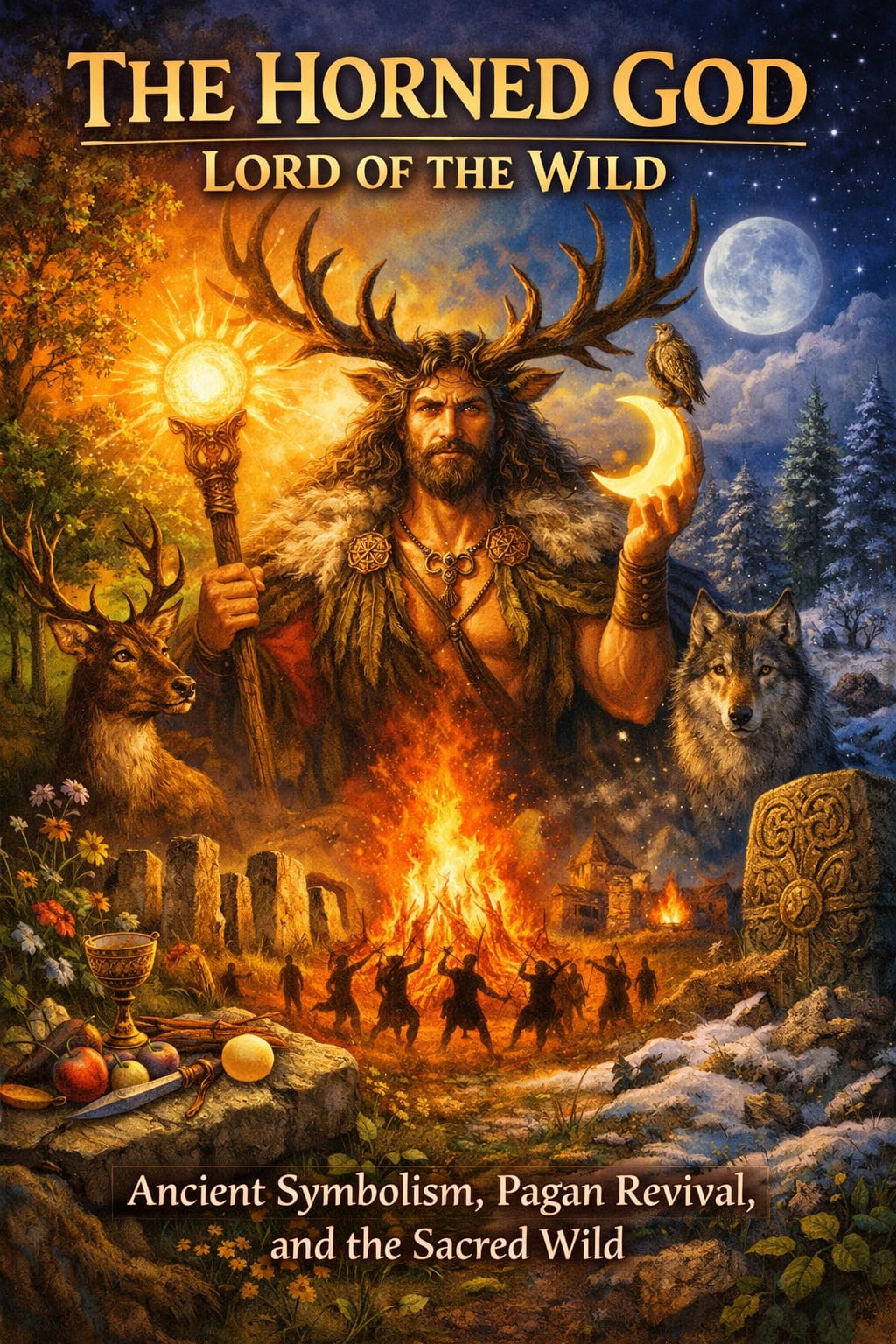
Encountering the Horned God
Across Paleolithic cave walls, Neolithic standing stones, Iron Age reliefs, ritual masks, and contemporary devotional spaces, a recurring figure emerges with remarkable consistency. Antlers rise from a human brow. Animal limbs merge with upright posture. Surrounding imagery evokes forests, herds, sexuality, decay, seasonal return, and the tension between cultivation and wilderness. Known in modern discourse as the Horned God, this figure represents one of the most persistent and multilayered symbols within the religious imagination of Europe and the wider Indo-European world.
No single culture created the Horned God, and no unified myth defines the figure. Instead, the image formed through the accumulation of symbolic language drawn from hunting societies, pastoral economies, agricultural cycles, and cosmological thought. Horns and antlers carried deep meaning long before organized religion. In many ancient societies, horned animals signified vitality, dominance, virility, and survival. Antlers, shed and regrown each year, embodied visible renewal and cyclical time. The fusion of human and animal features expressed a sacred threshold where instinct, consciousness, and environment converged.
Archaeological evidence reveals horned or antlered figures as early as the Upper Paleolithic period. The figure commonly referred to as the Sorcerer of Les Trois Frères, dated to approximately 13,000 BCE, depicts a humanlike form adorned with antlers and animal characteristics, often interpreted by scholars as a ritual specialist or liminal being associated with hunting magic. Similar motifs appear throughout prehistoric Europe, suggesting continuity rather than coincidence. These images reflect an intimate spiritual relationship with animal life, landscape, and survival rather than abstract theology.
During the Iron Age, horned deities entered clearer historical record. The Gaulish god Cernunnos, identified through iconography on artifacts such as the Gundestrup Cauldron, appears seated in a yogic posture, bearing antlers and associated with animals, wealth, and fertility. Roman accounts and inscriptions attest to regional cults devoted to horned or nature-oriented deities, often syncretized under Roman rule yet retaining distinct local characteristics. These figures functioned as guardians of liminal spaces such as forests, crossroads, and seasonal transitions.
With the spread of Christianity across Europe, horned imagery underwent dramatic reinterpretation. Pre-Christian symbols associated with wilderness and instinct became reframed through a moral lens that opposed the cultivated and the wild. Horns, once symbols of strength and generative power, were increasingly associated with chaos, temptation, and sin. Medieval depictions of the Christian Devil absorbed visual elements drawn from older horned gods, particularly those linked to forests, animals, and sexuality. This transformation obscured earlier meanings without erasing the underlying archetype.
Despite theological suppression, the horned figure persisted through folklore, seasonal festivals, and rural custom. Figures such as Herne the Hunter in English folklore, the Green Man carved into medieval churches, and masked horned performers in European winter rites preserved fragments of older symbolic structures. These survivals maintained associations with hunting, fertility, death, and renewal, often operating beneath formal religious doctrine.
In the twentieth century, modern Pagan traditions reclaimed the Horned God as a central sacred figure. Within these spiritual systems, the Horned God represents generative force, cyclical time, embodied nature, and reciprocal relationship with the land. Modern interpretations draw selectively from archaeology, folklore, classical sources, and esoteric philosophy. While these reconstructions differ from ancient practice, they reflect an ongoing human engagement with the same symbolic core that first shaped horned imagery millennia ago.
The Horned God endures not as a fixed deity bound to one culture, but as a living archetype shaped by environment, ritual, art, and belief. The figure occupies the threshold between civilization and wilderness, life and death, restraint and instinct. Across time, horned imagery continues to articulate humanity’s relationship with the natural world and the forces that exist beyond domestication and control.
Horned Imagery in Prehistoric Religion
The earliest expressions of religious thought emerged long before written language or formal theology. Prehistoric communities communicated spiritual understanding through pigment, stone, bone, and ritualized movement. Among the most striking survivals of this period are images that merge human and animal characteristics, with horned and antlered forms appearing repeatedly across regions and millennia. Such imagery reflects a worldview rooted in direct dependence upon animals, landscape, and seasonal continuity.
Horned animals occupied a position of particular importance within Paleolithic societies. Species such as deer, aurochs, bison, and ibex provided food, clothing, tools, and symbolic meaning. Antlers and horns embodied physical power, reproductive vitality, and survival within harsh environments. The annual shedding and regrowth of antlers offered a visible model of death followed by renewal, reinforcing cyclical understandings of time and life.
Paleolithic Cave Art
One of the most studied examples of horned imagery appears within the Cave of Trois Frères in the Ariège region of southern France. Created during the late Magdalenian period and dated to approximately 13,000 BCE, the figure commonly known as the Sorcerer occupies a secluded chamber high above the cave floor. The image depicts a humanoid form with prominent antlers, animal ears, a tail, and bent limbs suggestive of movement or dance. The placement and posture indicate ritual significance rather than casual decoration.
Scholarly interpretation of the Sorcerer remains divided. Some researchers identify the figure as a ritual specialist engaged in hunting magic or trance practice. Other interpretations favor representation of a supernatural being embodying animal power and environmental mastery. Both perspectives acknowledge deliberate synthesis of human and animal traits as central to meaning. The image reflects a symbolic boundary state where human identity and animal vitality converge.
Comparable figures appear at other Upper Paleolithic sites, including Chauvet, Lascaux, and Les Combarelles. Engravings and paintings frequently emphasize horned animals rendered with anatomical precision, often accompanied by abstract signs or humanlike elements. The consistency of these motifs across wide geographic distances suggests shared symbolic frameworks rather than isolated artistic expression.
Archaeological context supports interpretation of horned imagery as sacred rather than decorative. Many figures appear in deep cave chambers inaccessible without effort, locations associated with acoustics, darkness, and sensory disorientation. Such environments align with ritual activity rather than habitation. Associated artifacts, including pierced antlers, carved figurines, and ochre deposits, further indicate ceremonial use.
No written records survive from the Paleolithic era, and direct identification of deities remains impossible. Interpretation relies upon material evidence, spatial analysis, and anthropological comparison with later hunting cultures documented through ethnography. These comparative studies demonstrate widespread use of animal regalia, antlers, and masks in ritual contexts designed to mediate relationships between human communities and animal populations.
Within this prehistoric framework, horned imagery conveys sacred power, transformation, and access to forces beyond ordinary human experience. The fusion of human and animal form articulates a religious understanding grounded in reciprocity with the natural world, long before the emergence of named gods or formal mythological systems.
Horned Deities in the Ancient World
With the development of writing systems and monumental art, religious symbolism entered a new phase of preservation and interpretation. Horned imagery became increasingly formalized, appearing within codified pantheons, royal iconography, and temple reliefs. Across the ancient world, horns functioned as markers of divine authority, generative power, and cosmic legitimacy. While many horned figures of this period differ in form and function from later conceptions of the Horned God, these traditions contributed essential symbolic foundations.
Mesopotamia and the Near East
In ancient Mesopotamia, horns served as one of the most consistent visual indicators of divinity. From the Early Dynastic period onward, gods and goddesses were depicted wearing horned crowns composed of stacked pairs of bull or ram horns. The number of horn tiers often corresponded to divine rank. This iconography appears across Sumerian, Akkadian, Babylonian, and Assyrian art, establishing horns as emblems of supernatural authority rather than animal identity.
Major deities such as Enlil, god of wind and cosmic order, Anu, god of the heavens, and Ishtar, goddess of fertility, warfare, and sovereignty, were routinely portrayed with horned headdresses. These crowns signified separation from humanity and alignment with cosmic forces. Unlike later horned nature figures, Mesopotamian gods retained fully anthropomorphic bodies, emphasizing governance of law, kingship, and celestial order over wild or liminal spaces.
Bull symbolism held particular prominence within Mesopotamian religion. Bulls represented strength, virility, and agricultural prosperity, qualities essential to river-based civilizations dependent upon irrigation and labor. The Bull of Heaven in the Epic of Gilgamesh illustrates the association between horns, divine power, and catastrophic force when cosmic order is disrupted. Horns, in this context, expressed controlled potency rather than untamed wilderness.
In the broader Near East and Mediterranean basin, horned iconography appeared in fertility cults and agrarian religion. Deities such as Baal, a storm and fertility god worshipped in Canaanite regions, were associated with bulls and horned symbolism, reflecting rainfall, crop abundance, and reproductive vitality. Baal Hammon, venerated in Phoenician and later Carthaginian contexts, bore associations with vegetation cycles, solar power, and renewal. Horns in these traditions conveyed generative capacity and seasonal continuity rather than hybrid animal-human form.
Ancient Egypt
Egyptian religious expression favored animal-headed deities over horned human figures. This symbolic system allowed divine qualities to be expressed through specific animal attributes while maintaining clear theological structure. Several major Egyptian gods incorporated horns as part of their iconography, though these elements functioned within a distinct cosmological framework.
Khnum, a creator deity associated with the Nile’s inundation, appeared with the head of a ram. Rams symbolized fertility, procreative force, and the generative power of flowing water. Khnum was believed to fashion human bodies upon a potter’s wheel, linking horned imagery to creation and biological formation. Hathor, a goddess of love, motherhood, and joy, often wore a solar disk framed by cow horns, signifying nourishment, femininity, and celestial order. Isis later adopted similar iconography as her cult expanded across the Mediterranean.
These horned elements expressed fertility, protection, and cosmic balance rather than wilderness or liminality. Egyptian theology emphasized harmony between divine order and terrestrial life, leaving little space for a god embodying untamed nature in opposition to civilization. As a result, Egyptian horned imagery contributed symbolic vocabulary without generating a direct parallel to the later Horned God archetype.
Greece and the Figure of Pan
Within the ancient Greek world, the god Pan presents the most direct antecedent to later horned wilderness figures. Originating in Arcadia, a rugged and pastoral region, Pan presided over shepherds, flocks, mountain terrain, and uncultivated land. Artistic representations depict Pan with the horns, ears, and legs of a goat, combined with a human torso and face marked by beard and wild expression.
Pan occupied a marginal position within the Greek pantheon. Unlike the Olympian gods associated with civic order and urban life, Pan dwelled in caves, forests, and highlands. Mythological narratives emphasize music, sexuality, sudden terror, and ecstatic movement. The term panic derives from Pan’s reputed ability to instill irrational fear in those who encountered his presence in desolate places.
Greek sources present Pan as a figure of instinctual force and embodied vitality. Sexual appetite, fertility, and unregulated emotion formed core aspects of Pan’s identity. Encounters with Pan often disrupted social norms, reinforcing the divide between cultivated space and untamed terrain. Despite occasional integration into broader myth cycles, Pan remained fundamentally resistant to Olympian domestication.
Later philosophical and religious traditions frequently reinterpreted Pan as a symbol of nature itself. Roman adaptations, Renaissance literature, and modern esoteric thought drew heavily upon Pan’s imagery when reconstructing horned divinity. While Pan remained a distinct Greek god with specific cultural origins, the combination of horns, wilderness, music, and generative force profoundly influenced subsequent representations of horned sacred figures.
Across these ancient civilizations, horns signified divinity, vitality, and power in varied forms. Whether crowning cosmic rulers, symbolizing agricultural abundance, or marking the presence of untamed nature, horned imagery established a symbolic lineage that later converged into broader archetypal expression.
Celtic Europe and the Enigmatic Cernunnos
Within the religious landscape of ancient Europe, few horned figures possess the symbolic gravity or modern resonance of Cernunnos. Unlike Mediterranean deities preserved through extensive literary tradition, Cernunnos emerges from fragmentary archaeological evidence, offering a powerful yet elusive presence. The scarcity of textual material has transformed Cernunnos into a figure defined by image, posture, and association rather than narrative myth, allowing both scholarly inquiry and later spiritual interpretation to develop around visual symbolism.
Archaeological Evidence
The clearest historical reference to Cernunnos appears on the Pillar of the Boatmen, a monumental stone relief erected by the guild of Parisian boatmen during the reign of Emperor Tiberius in the early first century CE. Discovered beneath Notre Dame Cathedral in 1710, the pillar features multiple deities blending Roman and local religious traditions. One panel bears the inscription “Cernunnos” above a male figure adorned with prominent antlers. This inscription provides the sole securely attested written name associated with the antlered deity.
Additional imagery attributed to Cernunnos appears on the Gundestrup Cauldron, a richly decorated silver vessel dated to approximately the late second or early first century BCE. Although discovered in Denmark, stylistic and iconographic analysis suggests Celtic workmanship, likely originating from regions influenced by Thracian and La Tène artistic traditions. One interior panel depicts a seated antlered figure holding a torc in one hand and a ram-headed serpent in the other, surrounded by animals including deer, cattle, and possibly wolves.
The torc functioned as a symbol of status, wealth, and sacred authority within Celtic societies. Its presence in the hand of the antlered figure suggests sovereignty over material abundance and social order. The ram-headed serpent, a recurring motif in Celtic art, likely represented chthonic power, cyclical renewal, or the boundary between life and death. Together, these elements frame Cernunnos as a mediator between human society, animal life, and unseen forces.
Additional representations of antlered figures appear across Gaul and Britain in the form of relief carvings, coins, and votive objects. While none include inscriptions identifying the figure by name, shared iconographic features such as antlers, seated posture, and animal companions support the interpretation of a widespread religious type rather than an isolated local symbol. These images consistently emphasize forest animals, wealth symbols, and liminal positioning rather than martial or celestial authority.
Symbolic Associations
Stag symbolism held particular significance within Celtic cultures. Deer occupied liminal ecological spaces between forest and field, embodying both grace and elusiveness. The seasonal shedding of antlers reinforced associations with regeneration and cyclical time. In many Indo-European traditions, the stag functioned as a symbol of sovereignty and passage between worlds, often linked to kingship, hunting, and the sacred landscape.
Cernunnos appears neither enthroned nor armed. Instead, iconography emphasizes stillness, balance, and integration with animal life. This presentation contrasts with Roman or Greek gods of power and conquest, suggesting a religious orientation centered on reciprocity with the natural world rather than domination over it.
Limitations of Historical Knowledge
No surviving myths, hymns, or ritual instructions describe Cernunnos in narrative form. Classical authors who recorded aspects of Celtic religion, including Julius Caesar and later Roman commentators, provide little insight into indigenous theology beyond generalized observation. As a result, modern understanding relies upon archaeological context, artistic comparison, and cautious inference.
Claims identifying Cernunnos as a god of death, rebirth, or the underworld lack direct historical support. While chthonic elements appear within the iconography, particularly through serpentine imagery, such associations remain interpretive rather than documented. Scholarly consensus treats Cernunnos as a regional deity associated with fertility, prosperity, animal life, and liminal spaces, while acknowledging significant gaps in evidence.
Modern Pagan traditions frequently elevate Cernunnos as a central embodiment of horned divinity, drawing upon visual symbolism to construct theological meaning. Academic scholarship maintains a more restrained position, recognizing Cernunnos as an important yet partially obscured figure within Celtic religious practice. The enduring power of Cernunnos lies not in complete historical reconstruction, but in the strength of the symbolic language preserved through stone, metal, and ritual image.
Medieval Transformation and Demonization
The expansion of Christianity across Europe initiated a profound transformation of horned imagery, converting symbols of vitality, fertility, and liminal authority into markers of sin, spiritual disorder, and malevolence. This process reflected both theological objectives and broader sociocultural dynamics, including the consolidation of ecclesiastical power, suppression of local religious practices, and redefinition of human relationships with the natural world.
From Sacred Symbol to Diabolical Form
Horns, long associated with strength, virility, and animal potency in pre-Christian contexts, assumed new moral meaning within medieval Christian thought. Theological writings increasingly equated horns with lust, rebellion, and demonic influence. Early Church Fathers, including Augustine of Hippo and Gregory the Great, emphasized the contrast between natural, instinctual forces and the disciplined soul, framing previously sacred symbols as instruments of temptation. Pagan deities connected to wilderness, fertility, and sexuality conflicted directly with Christian ideals of asceticism, spiritual obedience, and cultivation of the soul.
Artistic expression reinforced this symbolic inversion. From the ninth century onward, visual depictions of Satan consistently incorporated horned and animalized features, drawing upon classical and folkloric antecedents. Goat-like horns, cloven hooves, goat or wolf ears, and human-animal hybrid forms were adapted from Greco-Roman and Celtic representations of Pan, satyrs, and antlered deities. These features conveyed moral threat, reinforcing theological concepts of sin as both visible and corporeal. Illuminated manuscripts, church frescoes, and cathedral sculptures portrayed horned demons alongside scenes of temptation, heresy, and eternal punishment, embedding the association of horns with evil deeply into cultural memory.
Literary sources reinforced the visual rhetoric. Works such as Dante Alighieri’s Inferno, medieval miracle plays, and the Legenda Aurea described infernal beings with horns and animal traits, echoing iconographic traditions while providing narrative frameworks in which horns symbolized lust, violence, and moral corruption. These representations influenced both elite and popular understanding of pre-Christian imagery, producing enduring misconceptions regarding horned deities as inherently malevolent.
Folklore Survivals
Despite systematic demonization, pre-Christian horned imagery persisted in folklore, seasonal rituals, and rural superstition. Figures such as Herne the Hunter, documented in 14th and 15th century English sources, embody antlered authority over forests, wildlife, and liminal spaces. Herne is described as a ghostly huntsman, sometimes connected to fertility of the land and protection of game, preserving symbolic associations with natural cycles and forest sovereignty.
Central European folklore recorded the Wild Hunt, a spectral cavalcade of hunters led by horned figures, often portrayed as both feared and revered. Leaders of the Wild Hunt incorporated antlers, animal features, or horned headdresses, linking the tradition to older European archetypes of liminality, fertility, and forest authority. In Scandinavia, Norse sagas recorded horned or antlered spirits in connection with hunting, seasonal transition, and threshold spaces between human settlements and wilderness.
Seasonal festivals and ritualized performances preserved these motifs in hybrid form. Masks, costumes, and wooden carvings featuring horns or antlers appeared in winter and harvest rites across Europe. These performances maintained symbolic continuity with older religious practices, blending fear, humor, and reverence. Horned figures in these contexts acted as mediators between human communities and the natural world, reflecting enduring cultural memory of pre-Christian spirituality.
By the late medieval period, horns had acquired a dual identity. Within ecclesiastical and literary frameworks, horns signified moral threat, diabolical power, and social transgression. Within rural and folkloric contexts, horns continued to embody fertility, wildness, and liminality. This complex symbolism ensured that horned imagery remained culturally potent, bridging ancient pagan practices, medieval moral theology, and the later reinterpretations that shaped Renaissance, Romantic, and modern Pagan conceptions of the Horned God.
The Modern Revival and the Birth of the Horned God Concept
The figure of the Horned God as understood today emerged during the twentieth century, shaped by scholarship, folklore collection, and the revival of pre-Christian spiritual practices. This modern conception represents a synthesis of historical research, creative reconstruction, and religious imagination, uniting fragmented traces of ancient horned figures into a cohesive archetype within contemporary Paganism.
Margaret Murray and the Witch Cult Hypothesis
Margaret Murray, an early twentieth-century anthropologist and Egyptologist, advanced a controversial theory that medieval witchcraft represented a surviving pagan fertility cult centered on a horned deity. In works such as The Witch-Cult in Western Europe (1921) and The God of the Witches (1931), Murray argued that trial records, folklore, and ritual practices indicated an organized, underground religious continuity from pre-Christian Europe. Horned imagery, she proposed, represented the central god of this clandestine cult, overseeing fertility, wilderness, and seasonal cycles.
Murray’s theory achieved significant cultural influence, inspiring early folklorists, artists, and writers interested in European witchcraft and neo-pagan traditions. The notion of a persistent Horned God provided a tangible link between folklore, archaeology, and spiritual practice, even in the absence of surviving ritual texts or uninterrupted religious lineages.
Modern historians and anthropologists reject the witch cult hypothesis due to the absence of credible evidence for continuous organized pagan worship after the Christianization of Europe. Trial records, previously interpreted as evidence of structured cultic activity, now appear more accurately as projections of inquisitorial imagination onto accused individuals. Despite these scholarly critiques, Murray’s work profoundly shaped the symbolic framework of contemporary Paganism. Her identification of a horned deity as a focal point of fertility, wilderness, and liminality laid the foundation for subsequent reconstruction and ritual practice.
Gerald Gardner and the Formation of Wicca
Gerald Gardner, a British civil servant and occultist active in the mid-twentieth century, incorporated the Horned God into the framework of Gardnerian Wicca, establishing the figure as a central theological principle. Within this system, the Horned God functions as the male complement to the Goddess, forming a duotheistic cosmology emphasizing polarity, balance, and reciprocal power. The Horned God embodies natural cycles, sexuality, hunting, and death, reflecting enduring symbolic themes found in pre-Christian horned figures while adapting them to modern ritual practice.
Gardnerian Wicca integrated the Horned God into the Wheel of the Year, a sequence of seasonal festivals aligning with solstices, equinoxes, and cross-quarter days. Rituals honor the Horned God alongside the Goddess, often dramatizing the tension between life and death, growth and decay, and human interaction with the natural world. Iconography associated with the Horned God frequently draws upon Pan, Cernunnos, and other historical antecedents, synthesizing classical, Celtic, and folkloric elements into a contemporary religious symbol.
The Horned God in modern Paganism is not a direct revival of any single historical deity but rather a living archetype shaped by scholarship, creativity, and spiritual practice. The figure embodies continuity with ancient symbolism while remaining adaptable to individual and communal religious experience. Through Wicca and related movements, the Horned God has become one of the most recognizable and enduring images of modern Pagan spirituality, bridging centuries of European religious thought and human engagement with wilderness, fertility, and liminal power.
Symbolism of the Horned God
The Horned God functions primarily as a symbolic archetype rather than a historical deity with codified myths or a fixed narrative. Across historical, folkloric, and modern contexts, the figure embodies the intersection of human experience with nature, vitality, and the cycles of life. Symbolic interpretation encompasses ecological, social, and psychological dimensions, reflecting the enduring relevance of horned imagery.
Nature and Wilderness
The Horned God represents untamed landscapes and the forces of the natural world. Forests, mountains, rivers, storms, and wild animals all fall within the domain of the horned archetype. In contrast to figures emphasizing human control over the environment, the Horned God embodies reciprocity with nature, respect for ecological balance, and recognition of wilderness as a space of power, danger, and mystery. Mythic and folkloric precedents—including Pan, Cernunnos, and Herne the Hunter—associate horned figures with hunting, forest sovereignty, and liminality, situating them at thresholds between human civilization and the wild.
Fertility and Vitality
Horns function as enduring symbols of reproductive power, generative force, and vitality. Across ancient cultures, horned animals—stags, bulls, goats, rams—embodied strength, virility, and survival, providing both material sustenance and symbolic models for human social and spiritual life. Agricultural and pastoral communities associated horned figures with fertility of the land, abundance of game, and cyclical renewal of life. The Horned God synthesizes these associations, representing both human and ecological fecundity while emphasizing the interdependence of life forms.
Life, Death, and Renewal
Life, death, and regeneration constitute central themes in the symbolic role of the Horned God. Seasonal cycles, agricultural patterns, and the life cycles of horned animals inform ritual enactments in which the Horned God undergoes symbolic death and rebirth. Such practices dramatize the passage from growth to decay and back again, reflecting natural rhythms and human engagement with mortality, renewal, and transformation. In modern Pagan ritual, this cycle parallels the Wheel of the Year, reinforcing the Horned God as a living emblem of continuity, liminality, and the persistent flow of life.
Masculine Archetype
From a psychological perspective, the Horned God represents the integration of instinct, strength, and sexuality within human consciousness. Carl Jungian and post-Jungian interpretations frame the figure as an archetype embodying the untamed, instinctual masculine principle, mediating between civilization and the animal aspects of human nature. The Horned God symbolizes the harmonization of drive, courage, and creativity with awareness, allowing engagement with both instinctual and cultural dimensions of existence.
Through these overlapping layers—wilderness, fertility, cyclical renewal, and archetypal masculinity—the Horned God maintains a dynamic symbolic presence. The figure articulates human connection to natural forces, ecological cycles, and inner instinct, providing a bridge between historical iconography, folkloric memory, and contemporary spiritual practice.
Ritual Practice in Contemporary Paganism
Ritual engagement with the Horned God in contemporary Paganism represents a complex intersection of historical precedent, folklore, and modern spiritual innovation. Practices emphasize experiential connection, symbolic understanding, and personal or communal interaction with the natural and liminal realms. Rituals situate the Horned God as both an archetypal figure and a living presence, embodying wilderness, vitality, fertility, and the cyclical forces of life.
Seasonal Observances
The Horned God plays a central role in the Wheel of the Year, a framework of eight seasonal festivals observed in Wicca and other modern Pagan traditions. These festivals include solstices and equinoxes, such as Yule and Ostara, as well as cross-quarter days including Beltane, Lammas, Imbolc, and Samhain. Each festival aligns with solar movement, agricultural cycles, and natural phenomena, allowing ritual participants to honor the Horned God as a guardian of life cycles, harvest, and the untamed aspects of the environment.
The Oak King and Holly King motif illustrates alternating seasonal authority, representing the waxing and waning of daylight, fertility, and strength within the natural world. Ritual dramatization of these figures often includes symbolic combat, song, dance, and offerings, emphasizing the Horned God’s role in mediating the balance between growth and decline, life and death, and human engagement with seasonal rhythms. Historical and ethnographic parallels exist in European folk festivals, such as May Day celebrations and winter solstice rites, which preserved ritualized attention to natural cycles, hunting, and fertility.
The Horned God is also associated with animals and vegetation through seasonal symbolism. Deer, stags, bulls, and goats appear in ritual iconography, representing virility, abundance, and wilderness authority. Rituals frequently include offerings of grains, fruits, wine, or symbolic representations of animal life, reflecting ancient European practices in which horned figures oversaw hunting, fertility, and ecological balance.
Devotional Practice
Devotional approaches to the Horned God in modern Paganism are diverse and intentionally fluid. In some traditions, the Horned God is approached as a literal deity with consciousness and agency. Devotional practices include prayer, meditation, ritual offering, and ceremonial invocation. The figure is often petitioned to provide guidance, protection, or insight into natural forces and cycles. Ritual altars may include symbols such as horns, antlers, representations of wildlife, torcs, or other artifacts that evoke pre-Christian European religious practice.
In other contexts, the Horned God functions symbolically, allowing practitioners to explore instinctual energy, sexuality, courage, and connection with wilderness without asserting literal deityhood. Ritual exercises include guided visualization, embodiment practices such as dance and movement, and storytelling that dramatizes archetypal narratives. Symbolic engagement provides a mechanism to integrate the qualities of the Horned God into human consciousness, promoting personal growth, ecological awareness, and psychological insight.
Ritual practice is not governed by central authority or codified liturgy. Local covens, solitary practitioners, and eclectic groups develop ceremonies that reflect specific spiritual goals, environmental conditions, and cultural contexts. This diversity reinforces the Horned God as a flexible archetype capable of embodying both individual experience and collective cultural memory.
Integration with Community and Ecology
Beyond seasonal festivals and personal devotion, the Horned God is frequently invoked in ecological and community-centered practices. Ritual attention often focuses on forest stewardship, wildlife preservation, land management, and seasonal agricultural work. Festivals, workshops, and community rituals reinforce human responsibility toward the environment while honoring the Horned God’s traditional association with wild spaces, fertility, and natural authority.
Horned God-centered ritual also connects participants to historical European practices. Masked performances, horned costumes, and processional enactments in contemporary Pagan communities echo pre-Christian festivals, such as Celtic Beltane rites, Germanic winter solstice customs, and the English May Day and Harvest traditions. These reenactments sustain continuity with ancestral symbolic frameworks, while adapting ritual expression to modern ecological, social, and spiritual priorities.
Through seasonal observances, personal and communal devotion, and ecological engagement, the Horned God maintains a dynamic presence in contemporary Pagan practice. Rituals articulate the cycles of growth, decline, death, and renewal. They connect practitioners to instinctual energy, wild landscapes, and the enduring archetypal force of horned divinity, linking centuries of human engagement with natural and spiritual worlds into ongoing, living practice.
Academic Perspective and Historical Clarity
Scholarly research emphasizes the widespread and enduring nature of horned imagery while maintaining critical distinction between historical evidence and modern interpretation. Archaeological, anthropological, and comparative mythological studies confirm that horned figures appear in Europe, the Near East, and other regions across millennia. Paleolithic cave art, Neolithic carvings, Iron Age reliefs, and classical depictions in Greece, Rome, and Celtic Europe demonstrate repeated symbolic use of antlers, horns, and animal-human fusion. These images reflect concerns with fertility, vitality, seasonal cycles, liminality, and the human relationship with wilderness.
Academic inquiry rejects the notion of a continuous, prehistoric Horned God cult surviving into the medieval period. Anthropological analysis, scrutiny of historical records, and ethnographic comparison indicate that claims of an unbroken pagan fertility religion, such as those proposed by Margaret Murray in the early twentieth century, lack substantive evidence. Trial records, folklore, and ritual artifacts suggest localized and diverse religious expression rather than centralized or codified worship of a single horned deity. No surviving texts or inscriptions indicate continuous organized religious practice centered on a Horned God across prehistory or through the Christianization of Europe.
Despite this historical clarity, modern Pagan traditions reinterpret and synthesize horned imagery to create living religious frameworks. These frameworks draw selectively from historical, folkloric, and literary sources, integrating classical depictions, Celtic iconography, Greco-Roman myth, and contemporary symbolic practice. Gerald Gardner’s Wicca exemplifies such synthesis, positioning the Horned God as a central theological figure within a duotheistic cosmology, while aligning ritual practice with seasonal cycles, ecological awareness, and archetypal symbolism.
Recognizing the distinction between historical evidence and modern religious construction does not diminish spiritual or symbolic validity. Instead, such clarity enhances understanding by situating contemporary practice within its cultural, historical, and symbolic contexts. It allows scholars and practitioners to honor the archaeological and literary record while acknowledging the creative, adaptive qualities of modern Pagan spirituality. This perspective affirms both the enduring significance of horned imagery across human history and the ongoing role of the Horned God as a living archetype in contemporary religious expression.
Recommended Reading: #commissionearned
The Horned God of the Witches by Jason Mankey
This book explores the Horned God as a central figure within modern Witchcraft and Pagan ritual. Mankey examines the historical roots of horned imagery while emphasizing its symbolic and archetypal dimensions in contemporary practice. Seasonal cycles, fertility, hunting, and liminality receive attention as core aspects of the Horned God’s identity. The text explains the Oak King and Holly King motif and its role in dramatizing the balance of growth and decline throughout the year. Ritual, meditation, and devotional practice are presented as ways to integrate the Horned God into personal spirituality. Mankey also traces connections to classical and Celtic horned deities, situating modern practice within a broader cultural lineage. The book directly informs understanding of how contemporary Paganism interprets and enacts the Horned God, linking symbolism to lived spiritual experience.
The Triumph of the Moon by Ronald Hutton
Modern Witchcraft and Wicca receive thorough historical analysis in this comprehensive study. Hutton traces the evolution of Pagan revival movements, folklore, ceremonial magic, and early twentieth-century religious experimentation. The Horned God is examined within Wiccan theology, highlighting selective adoption of ancient and folkloric motifs. This work distinguishes carefully between historical evidence, myth, and reconstructed practice, clarifying the origins of contemporary Pagan ritual. Hutton places horned imagery in context with European cultural history, medieval demonization, and classical antecedents such as Pan. Scholarly attention to Margaret Murray’s theories and subsequent critiques provides a critical framework for understanding the creation of modern Horned God archetypes. The book offers essential historical grounding for the blog while explaining how modern symbolism transforms fragmented historical motifs into living religious practice.
Medieval witchcraft is framed here as the possible survival of pre-Christian fertility cults centered on a horned deity. Murray examines trial records, folkloric accounts, and ritual practices to reconstruct what she hypothesized as an underground Pagan religion. Horned imagery is interpreted as central to these cults, linking fertility, wilderness, and seasonal cycles. The book documents spells, familiar spirits, and ceremonial objects, situating the Horned God as a symbolic figure of authority and natural power. Later scholarship has challenged the continuity of such cults, but Murray’s ideas profoundly influenced the formation of Wicca and modern Pagan ritual. Her identification of horned divinity informs seasonal observances, iconography, and theological structure in contemporary practice. This text offers insight into the creative reinterpretation of historical traces that shaped the modern Horned God archetype.
Pan and the Nightmare by James Hillman
Psychological and archetypal perspectives on Pan form the core of this study, linking instinct, sexuality, and wildness to the human psyche. Hillman interprets Pan as a symbolic force representing untamed energy, fear, and creative potential. The book emphasizes the tension between human civilization and instinctual nature, framing horned figures as mediators of unconscious drives. Archetypal analysis explores the transformative power of engagement with mythic figures, highlighting ritual, imagination, and dream as tools for integration. Hillman’s work illuminates the Horned God’s role as an expression of instinct, vitality, and liminal authority. Classical Pan and the Horned God of modern Paganism are linked through shared symbolic qualities, including sexuality, wilderness, and unpredictability. The text enriches discussion of psychological dimensions in the blog, offering depth to the archetypal understanding of horned divinity.
The Pagan Religions of the Ancient British Isles: Their Nature and Legacy by Ronald Hutton
Ancient British religious traditions are analyzed through archaeological, literary, and folkloric evidence in this detailed survey. Horned figures, seasonal rituals, and fertility symbolism are traced across Celtic, Roman, and early medieval contexts. Hutton clarifies the distinction between historical practice and later folklore, demonstrating the selective survival of certain motifs into modern consciousness. Deer, stags, and antlered deities appear as symbols of fertility, forest authority, and liminality. The text situates horned imagery within ecological, social, and symbolic frameworks, revealing its cultural persistence over centuries. Connections to contemporary Pagan practice are highlighted, showing how historical forms influenced the conceptual development of the Horned God. This book provides authoritative historical context for the blog, grounding modern spiritual interpretation in evidence-based research.
Pagan Portals - Pan: Dark Lord of the Forest and Horned God of the Witches by Melusine Draco
Pan’s classical origins, mythology, and enduring influence in modern Paganism are the focus of this volume. The text explores Pan as a model for the modern Horned God, emphasizing themes of wildness, sexuality, and liminal power. Ritual practice, seasonal festivals, and devotional frameworks are connected to historical precedents, illustrating continuity and adaptation. Draco highlights Pan’s duality as playful, ecstatic, and terrifying, mirroring the Horned God’s multifaceted symbolism. The book traces the appropriation of Pan into modern Pagan theology, demonstrating how ancient imagery informs contemporary ritual and archetypal understanding. Horned imagery is examined as both psychological and spiritual tool, bridging historical knowledge with living practice. This work enhances the blog’s discussion of symbolic and ritual dimensions of horned divinity, linking past myth to modern religious imagination.
Horns of Honor: Regaining the Spirit of the Pagan Horned God by Fredrick Thomas Elworthy
European folklore and early Pagan traditions provide the foundation for Elworthy’s exploration of horned deities. The text documents historical artifacts, festivals, and masked performances that preserve traces of horned worship. Horned figures are linked to fertility, hunting, forest sovereignty, and seasonal cycles, reflecting ecological and cultural significance. Elworthy examines the transformation of horned imagery through Christianization, highlighting demonization and reinterpretation. The work advocates reclaiming the spiritual and symbolic aspects of the Horned God in modern Pagan practice. Ritual, folklore, and symbolic continuity are analyzed to demonstrate the archetype’s enduring presence. For the blog, this book reinforces the Horned God as both historical motif and contemporary living archetype, connecting past European religious traditions to modern Pagan devotion.
Continuing the Journey of Knowledge
The Horned God occupies a unique space at the intersection of history, mythology, and spiritual practice. Prehistoric cave art, Neolithic carvings, and Bronze Age artifacts show recurring depictions of horned figures, emphasizing the importance of animals, forests, fertility, and the liminal spaces where humans interact with the natural world. Classical examples, such as Pan in Greece, illustrate horned imagery as a symbol of instinct, sexuality, and untamed wilderness, while Celtic depictions, including Cernunnos, link horns to sovereignty, fertility, and the cycles of life. During the medieval period, Christian reinterpretation transformed many of these symbols into figures of fear, associating horns with sin, vice, and demonic power. Despite this, folklore, seasonal festivals, and masked performances preserved elements of horned symbolism, which later influenced the modern Pagan revival. Contemporary Pagan practice has reclaimed these symbols, integrating them into ritual, seasonal observance, and meditative reflection on vitality, nature, and liminal authority. The Horned God thus exists as both a historical motif and a living archetype, bridging past cultural memory with ongoing spiritual exploration.
Further understanding comes from actively engaging with research and primary sources. Public libraries provide free access to books, historical texts, and scholarly works that contextualize horned imagery across time and culture. Many universities and museums offer online archives, digitized collections, and open-access databases where artifacts, inscriptions, and iconography can be studied without cost. Online academic journals, historical repositories, and museum websites allow careful examination of archaeology, folklore, and comparative religion. When exploring digital resources, attention to the credibility of the source and verification against multiple references is essential. Independent reading encourages critical thinking, connecting historical evidence with symbolic interpretation and contemporary practice. By consulting multiple perspectives and sources, readers can trace the evolution of horned imagery while distinguishing between historical fact, folklore, and modern spiritual adaptation. The Horned God, as symbol and archetype, invites continuous study and reflection, rewarding those who explore freely available resources with a deeper understanding of humanity’s enduring engagement with nature, instinct, and the sacred.
About the Creator
Marcus Hedare
Hello, I am Marcus Hedare, host of The Metaphysical Emporium, a YouTube channel that talks about metaphysical, occult and esoteric topics.
https://linktr.ee/metaphysicalemporium
Keep reading
More stories from Marcus Hedare and writers in BookClub and other communities.
Roots of the Cosmos: The World Tree Explained
The Tree at the Center of Everything Across civilizations separated by oceans, centuries, and languages, a single image emerges with striking consistency. A vast tree stands at the center of existence, neither planted nor cultivated, but inherent to the structure of the universe itself. Its roots descend into unseen depths where memory, death, and origin reside. Its trunk rises through the visible world, providing stability, continuity, and presence. Its branches extend into the heavens, touching realms associated with divinity, fate, and cosmic order. This image is now commonly described as the World Tree, a symbol through which ancient cultures articulated the architecture of reality.
By Marcus Hedare5 days ago in BookClub
My New Book is Finally Here
My poetry collection Beautiful and Brutal Things is done. It's actually done and finally published over 270 pages. Over a year of my life went into this book. More than a year, really. Long days at my computer, sometimes seven days a week because I couldn't stop even when I probably should have. Then two months of editing that felt harder than the writing itself. But it's finished, and I'm still standing, and the book is real.
By Tim Carmichaela day ago in BookClub
7 Books About Psychology That Are Impossible To Put Down
Psychology is not just an academic discipline—it’s a mirror held up to our inner world. It explains why we think the way we do, why we fall in love, why we sabotage ourselves, and why some habits cling to us like gravity. The best psychology books don’t feel like textbooks; they feel like conversations that change how we see ourselves and others.
By Diana Meresca day ago in BookClub
Wild Card Weekend Recap: What Happens Now?
I think I figured out why I love Wild Card Weekend so much. It's because it's the first playoff anything of the calendar year. The NFL season starts in the fall, and once upon a time, the champion was crowned either on or slightly before New Year's. The evolution of the NFL schedule has resulted in the playoffs starting just into the New Year, and currently, the final week of the season falls on the first weekend of the New Year, with Wild Card Weekend coming a week after that. So yes, chronologically, the NFL's Wild Card Weekend serves as the first playoff anything of the calendar year.
By Clyde E. Dawkins6 days ago in Unbalanced




Comments
There are no comments for this story
Be the first to respond and start the conversation.