
Review of Genesis (Chapter 3)
This chapter really annoys me.


This chapter really annoys me. Once again, we are on the subject of the “forbidden tree” that exists for seemingly no good reason at all. Now enters a talking serpent!
The serpent comes up to the woman and asks her if God really said she must not eat from the any of the trees in the garden. There’s all of two people on this planet right now, plus God, and then a bunch of other animals that I’m assuming can’t talk. Weird that only one animal would be given the ability to speak, but whatever. The real issue is- where did the serpent hear this information? Who is sharing gossip with seemingly the only humanoid animal on the planet?
So the woman tells the serpent that they can eat from any tree except for the forbidden tree, and that if they eat it or even touch it, they’ll die. The serpent assures her that she won’t die, that her eyes will be opened as soon as she eats it and she’ll be like God, knowing both good and evil. Why does the serpent know this information? Animals were just created a few days ago. How does this serpent know so much? Again, who is sharing gossip with this serpent?
Now I have several questions. First, I’ll ask again- WHY DID GOD CREATE THE TREE JUST TO FORBID THEM FROM EATING OR TOUCHING IT? What purpose does that serve? Why did he create this serpent that talks and tells the woman the truth? Why did he lie to the woman and tell her she would die if she ate from or touched the tree? Wouldn’t it have been easier to just not create these things?
The woman eats from the tree and shares it with her husband. All of a sudden, they realize they’re naked. How does this work? How do they just go from not knowing they’re naked to all of a sudden realizing it and sewing themselves some clothes? Where did their sewing skills come from? Was that just a side effect of learning good and evil?
They hide from God, who is now really upset that they are no longer naked. Dude sounds like a perv.
The woman blames the serpent for deceiving her, and God gets angry and curses him, then the woman, and then the man. Why did he have to curse everyone? If he’s all powerful, why not just do a little reverse spell or whatever and undo the situation? Or why not just turn the three of them back to dust and create new main characters in their place, using what he learned from this experience to make some plot changes?
Why did he create a tree just to sit there and tempt them?
Why did he create a talking serpent?
Why did he create the concept of deceit?
And more importantly, why was it the serpent who was being accused of deceit? He was honest about the tree. God was not. If anyone was being deceitful, it was him.
Anyway, God curses the three of them. He takes away the serpent’s legs, tells the woman she’ll have painful childbirth and that her husband (the guy who went along with what she said) will rule over her, and tells the man that he’ll have to fight with the ground for his food. You know, totally normal punishments, right?
I’m sorry, I just can’t get over the concept of taking someone’s legs away as punishment. That’s just so random that it’s hilarious.
Finally, the man and woman get names. I guess the man (now called Adam) got tired of starting off his conversations by saying “hey woman!”.
After the randomly timed names, we get to hear God seemingly talking to himself again while using the term “us”. Does he have his own imaginary friend, or is there an unnamed character that he’s speaking to? While talking to himself, he shares with himself his fear that the humans will eat from a different tree that apparently makes you immortal, so he kicks them out of the garden after murdering some animals to replace their clothes with more clothes. I guess the leaf clothes they made weren’t good enough?
Why was this tree not mentioned before? Or were they allowed to eat it until they learned good and evil? Either God only wanted to be immortal with mindless followers, or this tree was just now added to the story- in which case, I guess we’re supposed to overlook it?
With the addition of this tree comes more questions though- once again, why does this tree exist? Does God need this tree to be immortal? What was he doing before he made this garden a few days ago? If God needs this tree to become/remain immortal, does he also need the other tree to retain his knowledge of good and evil? If so, this sounds more like he stumbled upon some kind of magical fantasy garden and decided he’s now the ruler of all things. If he needs this garden to keep his powers, then that makes me question how he could have possibly made everything, including that garden, without these powers.
After kicking Adam and Eve out of the garden for eating from a tree that he put there, he then stations an angel and a flaming sword outside of the garden to guard only the tree of life. Guess the tree of knowledge of good and evil isn’t a big deal anymore. Also, where did the angel come from? These characters weren’t mentioned before. Did he spawn an angel just for the sole purpose of guarding this garden, or were they background characters that the author forgot to mention until just now?
About the Creator
Clara Jayne
Ex-Christian reviewing the Bible
Keep reading
More stories from Clara Jayne and writers in BookClub and other communities.
Review of Genesis (Chapter 2)
In the second chapter, we get more details of God’s manic episode. He’s furnishing and adding final details now. He’s made everything so far out of nothing. So why does he need dust to make the first human? Why not just poof him out of nothing like everything else?
By Clara Jayne6 months ago in BookClub
Rachel Reviews: Lakefront Wolves by Joseph Deegan
Meet Finn. He's an 18 year old kid who has potential. He's bright with great school scores and he's also an athlete, a footballer of some prowess. He has it all going for him, it would seem, and yet, he's determined to send what could be a well-planned, stable existence firmly off the rails. He drinks, he smokes, he takes drugs, he has violent tendencies and he's in danger of losing not only his mind but all that he holds dear.
By Rachel Deeming12 days ago in BookClub
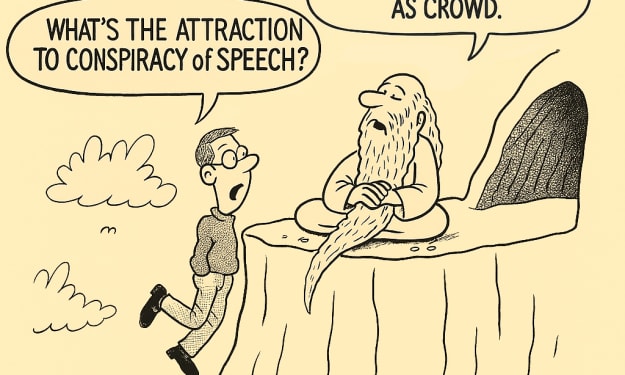
The Conspiracy of Speech
Breathing Together in an Age of Noise: A Review of The Conspiracy of Speech The Conspiracy of Speech, the second part of Volume I with the same name in THE MISCOMMUNICATION TRILOGY, is an ambitious and penetrating study of how speech itself becomes the engine of distortion in contemporary society. If the earlier theoretical groundwork of the volume diagnosed the structural decay of language, this book moves from structure to performance. It asks not merely how language deteriorates, but how speech actively produces the conditions for misunderstanding, ideological capture, and social fragmentation.
By Peter Ayolov7 days ago in BookClub



Comments
There are no comments for this story
Be the first to respond and start the conversation.