
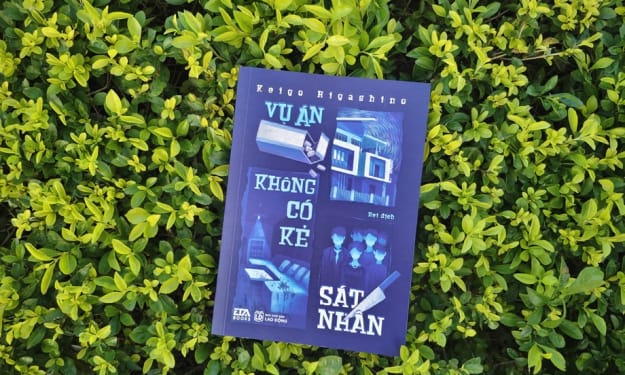
REVIEW & INTRODUCTION OF THE BOOK DEATH PENALTY – WHEN THE DEVIL IS NOT ANYONE ELSE, BUT US.
The perfect combination of horror, psychological and criminal genres


INFORMATION ABOUT THE WORK:
1. The plot is a psychological battle of wits and a journey of mystery discovery in the style of an anti-detective story.
2. The work is built in the form of an extra-legal interview/investigation.
3. The work is not just a normal mystery novel, but also a profound study of: Crime and compassion; Psychological manipulation; Death penalty and justice…
4. A complex work, blending crime, psychology and horror genres, making it one of Kushiki Riu's most famous and memorable works.
GOOD QUOTES IN DEATH COURT
“In a world where the truth is hidden, only those brave enough can face their own darkness.”
“The death penalty is not just a punishment. It is also an open question, a confrontation between justice and injustice.”
“When you turn the truth around, you may discover that you are the culprit in your own story.”
“This world, sometimes, does not distinguish between right and wrong. We are just people lost in the darkness of people’s hearts.”
“What you see may not be the truth. Behind every smile, there may be a dark secret waiting to be discovered.”
“Crime is not only in the action, but also in the psychological power it gives to the perpetrator.”
“When death approaches, people realize that their lives are not what they chose, but what they missed.”
“Only when we face the painful truth can we feel the value of compassion.”
“Fear is not the greatest enemy. It is passivity that makes us helpless before fate.”
“In every crime, there is an untold story. If we are willing to listen, the secrets will reveal themselves.”
“Sometimes, the answers to the hardest questions lie in the things we are afraid to admit.”
“Judgment is never simple. Everyone has reasons, and sometimes, those reasons make us feel sympathetic.”
“The death penalty is not just an end. It is also a reminder of the brutality of life and the price of decisions.”
“Where the light cannot reach, the darkness speaks. And only those who dare to step into the shadows can understand.”
“On the path to justice, you cannot always believe what you see.”
“When one life has to pay for the mistakes of another, is there still justice?”
I. GENERAL INTRODUCTION: HAUNTED BY THE SWEET CAKE
In the flow of Japanese detective and psychological horror genres, “Death Penalty” (original title: 死刑にいたる病 - Death Penalty Illness) by Riu Kushiki emerges as a work of radical psychological anatomy about the nature of evil. The book is not just a crime story but a soul laboratory, where the line between predator and prey, between truth and manipulation, is blurred in a creepy way.
The story revolves around Kakei Masaya, a 20-year-old student living in melancholy, suddenly receives a letter tinged with the smell of death from Haimura Yamato—a death row inmate, a serial killer, who used to be the owner of a warm bakery in Masaya's childhood memories. The letter is not a confession, but a strange request: to investigate the ninth case in which he claims innocence.
This work immediately positions itself as an anti-detective story. Masaya's journey is not a search for justice or objective truth, but an extrajudicial psychological battle of wits. The truth about the 24 teenagers who lost their lives at the hands of Haimura, and the cold sophistication of the cases, push the book to a new level: It not only explores crime, but also explores the invisible spread of evil into seemingly innocent souls.
Readers approach “Death Sentence Disease” with curiosity, but will leave with a lasting haunting feeling—a nagging question: Can we ourselves be easily “infected” like Masaya, with just a letter and a play of power?
II. ABOUT THE AUTHOR: RIU KUSHIKI - THE EXPLORER OF THE INNER DARKNESS
Riu Kushiki is a prominent female writer in the Japanese horror, mystery and psychological suspense genre. Her writing career was shaped by the great success of works such as Haunted Campus (19th Japan Horror Novel Award) and Aka to Shiro.
Kushiki's style does not focus on thrilling chases but on deep exploration of human psychology and social pathology. She is famous for her ability to build tension and shocking "plot twists", not only to subvert the plot but also to subvert the reader's moral perception.
Kushiki's philosophy in this work is deeply philosophical, inspired by Kierkegaard's Sickness Unto Death. The original title of the book (Kakei ni Itaru Yamai - The Disease That Leads to the Death Penalty) conveys the message: Evil is not just the obvious act of murder, but a mental "pathology", a state of degeneration that anyone can suffer from. Her erudition is to turn a death row inmate into a master manipulator, turning the investigation into a kind of reverse psychotherapy, forcing participants to face the darkness within.
Riu Kushiki was born in 1972 in Niigata Prefecture, Japan. After graduating from university, she worked at fashion and construction companies before starting her writing career.
In 2012, she debuted with her first work Haunted Campus and excellently won the 19th Japanese Horror Novel Award (2012) voted by readers; the 25th Subaru Novel Award (Shosetsu Subaru) for new authors for Aka to Shiro.
Riu Kushiki's writing style mainly focuses on the genres of Horror, Mystery, and Psychological Suspense, deeply exploring human psychology and is especially notable for building tension and shocking plot twists.
III. MAIN CONTENT: CYCLE OF MANIPULATION, INHERITANCE OF DARKNESS AND SPREAD OF EVIL OVERVIEW OF THE ENTIRE BOOK
The book “Death Penalty Case” is a two-line story: the gloomy reality of college student Kakei Masaya and the dark past of death row inmate Haimura Yamato.
The story begins when Masaya, a depressed college student, receives a letter from Haimura, who was sentenced to death for 24 brutal murders of teenagers (torture, peeling off fingernails). Haimura admits to 23 of the cases but denies the last one—the murder of Kaoru Nezu, a 26-year-old man. He asks Masaya to investigate this wrongful death.
Masaya, because of his past relationship with Haimura’s warm bakery, is drawn into it. As Masaya digs deeper, he realizes the difference between the Nezu case and the previous ones, but at the same time, he is also manipulated by Haimura through letters, instilling in him a sense of strength and purpose—something he has always lacked in his lonely life after his grandmother's death.
The truth is eventually revealed: There was no wrongful death. The Nezu case was just part of a "game" that Haimura concocted, sending letters to over 50 random people, choosing Masaya only because he was susceptible to his father-son love. Haimura's sole purpose was to entertain himself during his days of waiting to die, while at the same time "spreading the disease"—turning normal people into monsters. Haimura's evil did not stop at the prison bars; it spread and silently grew in seemingly harmless souls, including Masaya's new lover, Akari Kano.
The Message That the Author Conveys
The core message of the work is the obsession with the ability of evil to spread and multiply; it is not a congenital defect but a psychological pathology that can be inherited through experience and manipulation.
Kushiki wants the reader to face the truth that we all carry within us a potential darkness, and evil only needs a sophisticated enough manipulation mechanism to awaken it.
"Evil is not only an obvious action but can also be a state of mind, a social pathology, something that makes people convicted - not only by the law but by themselves."
The work is a chilling warning: the degeneration of a serial killer is not an isolated problem, but a social wound that can be transmitted from one person to another, especially through relationships based on power and emotional dependence.
Key Issues: Analyzing the Manipulation Mechanism and the Destruction of Identity
The book achieves excellence by delving into and exposing each layer of complex psychological mechanisms, making it impossible for readers to tear themselves away from this sick mind game.
1. Psychological Warfare and the Anti-Detective Structure: Paradoxical Dependence
The first key issue is the breakdown of the traditional detective structure to create a completely new psychological battlefield. Masaya is not Sherlock Holmes; he is a host, a tool in the hands of a death row inmate.
a. Manipulation in the Demand for "Justice":
Haimura, who has admitted to 23 brutal murders, focuses all of Masaya's energy on the 9th case (Kaoru Nezu), which he claims is innocent. This paradox is the perfect bait. . Masaya, desperate for meaning and recognition, immediately believes he can do what the entire legal system has failed to do: find the truth.
"The book delves into the issue: 'evil' is not just in the perpetrator, but also spreads, affecting those around him, even those who seem innocent – and Masaya himself must face the truth that he can be 'infected' by it."
The investigation becomes a journey of Masaya's distorted self-awareness. He changes dramatically: from a depressed, weak student, he becomes more confident, begins to fall in love and even dares to act violently (beating the guy who bumped his shoulder to near death). Masaya is not investigating the case; he is being 'investigated' by Haimura and recreated into a strong, but sick version.
b. Death Row Prisoner Is A Master Interrogator:
Haimura never needed the truth. He needed Masaya's attention, participation, and dependence to prove that even "normal" people were just puppets in his game of power. The whole process was just a "joke to kill time waiting to die" of a man who had reached the peak of corruption and loneliness.
2. The Inheritance of Darkness: The Manipulation Mechanism of the "5 Hooks"
Haimura's sophistication lies in his recognition and exploitation of Masaya's deep psychological wounds, using them as "hooks" to keep him in the game.
a. Analysis of the "5 Hooks": The book's content reveals that Haimura used five psychological "hooks" to control Masaya. :
Addiction to the Father Figure: Masaya suspects Haimura is his biological father (due to the resemblance and connection through his adoptive mother), creating a distorted father-son complex. Masaya yearns to be recognized and loved by a powerful figure.
Injustice Hope: Haimura instills hope in Masaya about the wrongful conviction so that he feels like a savior, someone who has the ability to change the fate of others.
Fear of Loneliness: Masaya is an isolated, depressed student. His involvement in the case and Haimura's letters are his only connection, dispelling his fear of being forgotten.
Failure Self-Reproach: Masaya feels guilty for failing the entrance exam to a top university. Haimura makes him believe that his failure can be redeemed through courageous investigation.
Desire to Change Himself (From Weak to Strong): Haimura awakens Masaya's latent violent impulses, transforming him from a weak person into someone capable of dominating others.
b. The Sickness of the Predator: Haimura's evil roots are revealed from his childhood of being abused by his biological parents, then being adopted by a human rights activist (Kirie). He opened a warm bakery as "bait". Haimura viewed children as "toys" to dominate before killing, not out of lust or anger, but out of a thirst for absolute power over the lives of others.
3. The Authorized Evil and the Destruction of Ikki Kanayama
The 9th case, which was thought to be a false case, became evidence of Haimura's authorized evil, clarifying his pathological nature.
a. The Nezu Case: The Hidden Evil: Yamato used Ikki Kanayama—a former victim of brainwashing since the age of 10, who used to play with knives and kill his younger brother under Haimura's manipulation—to incriminate Kaoru Nezu (9th case). . The fact that Yamato created his own alibi, and Ikki confessed "I killed." This shows that Haimura has developed a new level of evil: not doing it himself, but using others.
b. Essential Fear: The detail that Yamato used Ikki to snitch on Nezu because he was "afraid of dirt" when torturing Nezu with mud (a different case) is a chilling psychological exploration. It implies that Haimura's evil has become so sophisticated that it has gone beyond physical needs (like collecting fingernails), moving to a purely spiritual level—using violence through a medium to keep his hands "clean".
4. Fragmented Identity and the Endless Spread of Evil
The book’s ending delivers a devastating twist on identity and a warning message about the spread of evil.
a. Breaking the Family Illusion: Masaya, in a near-homicidal moment, calls out to his mother. She reveals the truth: Haimura is not his father; she was pregnant with him but the fetus died. Whether it’s a biological truth or a lie to protect him, this information destroys the entire illusion of origin and identity that Masaya has tried to build around Haimura. Masaya’s entire quest for truth and purpose collapses, forcing him to confront his original emptiness and the violent impulses that have been unleashed.
b. Pathological Contagion: Masaya eventually breaks free from the manipulation and cuts off contact. However, Haimura’s evil doesn’t stop there. . The final haunting twist comes when Akari Kano—Masaya’s new lover, who also receives letters from Haimura—reveals that she is being manipulated by him in a similar way, whispering, “I want to try stripping…”
“Death Sentence” ends with a chilling warning: Haimura’s mental illness does not die with the death sentence. He has succeeded in infecting vulnerable souls with the seeds of darkness, turning evil into a never-ending chain reaction that spreads throughout society. No one is truly safe, and the eternity of evil lies in its ability to thrive in anyone.
IV. CONCLUSION: THE TRUTH BEHIND THE SWEET CAKE
“Death Sentence” possesses a shocking plot and the ability to break moral boundaries. The book does not offer an easy escape, but forces one to confront the fact that evil can be born from loneliness, the desire for recognition, and psychological damage. Haimura's manipulation is not magic, but a ruthless exploitation of the most basic human needs (like the need for a father, for a purpose). The work leaves a chilling warning: sobriety and self-awareness are the only line of defense against the invisible "disease" that always seeks out weak souls to plant its "hook" and start the cycle of destruction.
OVERALL REVIEW: DEATH CASE - AN EXCELLENT BOOK ON CRIMINAL PSYCHOLOGY
It can be said that Death Case has described the complex and haunting criminal psychology of a serial killer who shocked a peaceful village - 24 teenagers lost their lives at his hands.
With his slim appearance, white skin, big double eyelids with long eyelashes, his somewhat "fragile" scholarly appearance, along with his genius ability to manipulate, he deceived, or more precisely, "enchanted" to the point of controlling the victims, they just fell into his orders without knowing it.
And Masaya, a 20-year-old university student, received a letter from this murderer, with a strange request: Masaya wanted to reinvestigate the 9th case - the last case in the series of crimes that the police accused him of - in which he claimed he was not the culprit.
The story attracted me since Masaya - a Law student who was going through dark and boring days, unable to find himself, was suddenly caught up in the investigation. But in this special investigation, he slowly transformed completely, then regained his old confidence, and looked like a real future lawyer.
With his efforts to investigate and piece together information, Masaya discovered many important details, not only related to the murderer but also related to himself and his family.
What impressed me about the story is that the psychology of the serial killer has been carefully researched and built by the author, and there are also surprising twists that make readers fall over - it is truly a fascinating book about criminal psychology.
Perhaps among the dozens of works by Riu Kushiki, Death Penalty Case is the one that made me sit still for a long time after closing the last page. Not because of the breathtaking twist, nor because of the complicated case like Riu Kushiki often sees, but because of the obsession with people and the price of justice. This is no longer simply a detective novel - it is the most naked indictment of society, of morality, and of the so-called "sin" in each person's soul.
The story opens with a seemingly simple murder case: a man is killed, the murderer is caught, and everything is clear. But Riu Kushiki does not let the reader stop at "who killed whom". He puts us in the position of witnesses and judges, making us wonder: does the death of a criminal really end all pain? And does justice really exist when people's hearts still have so many dark corners?
Riu Kushiki skillfully turns the court and the investigation into a psychological operating room, where each character - whether prisoner, lawyer, police officer or relative - is dissected to the core of their thoughts. Testimonies and seemingly small details reveal the complex nature of human beings: everyone has reasons to be right, to be wrong, to hate, and to be forgiven. The "medical record" in the title is not only about the death penalty - but also the medical record of the soul, where everyone carries within them wounds that are not easy to heal.
What is special about Death Penalty Case is the way Riu Kushiki does not judge anyone. He makes every choice reasonable, so that every mistake stems from fear, love or the desire to live. And it is that cold objectivity that hurts the reader more. Because we realize that between right and wrong, good and evil, is just a fragile boundary that people can easily cross in a moment of weakness.
About the Creator
HieuDinh
- Loves nature, likes to grow ornamental plants such as succulents, lotus (participates in volunteer activities to plant forests, protect forests in the locality)
- Loves dogs and cats (participates in local wildlife rescue activities)
Rachel Reviews: Lakefront Wolves by Joseph Deegan
Meet Finn. He's an 18 year old kid who has potential. He's bright with great school scores and he's also an athlete, a footballer of some prowess. He has it all going for him, it would seem, and yet, he's determined to send what could be a well-planned, stable existence firmly off the rails. He drinks, he smokes, he takes drugs, he has violent tendencies and he's in danger of losing not only his mind but all that he holds dear.
By Rachel Deeming15 days ago in BookClub
7 Low Fantasy Books You Must Read In 2026
Low fantasy occupies a unique and fascinating space in literature. Unlike high fantasy—with its sprawling worlds, elaborate magic systems, and epic quests—low fantasy brings the supernatural into a world that feels remarkably like our own. The magic is subtle, often unsettling. The settings resemble real history or everyday life. And the stories focus deeply on human struggle, morality, and consequence.
By Diana Meresc6 days ago in BookClub


Comments
There are no comments for this story
Be the first to respond and start the conversation.