
REVIEW BOOK"THE CASE WITHOUT A MURDERER – INTENTIONALLY OR ACCIDENTALLY, KILLER OR VICTIM".
That a case without a murderer is not simply a case without murder.

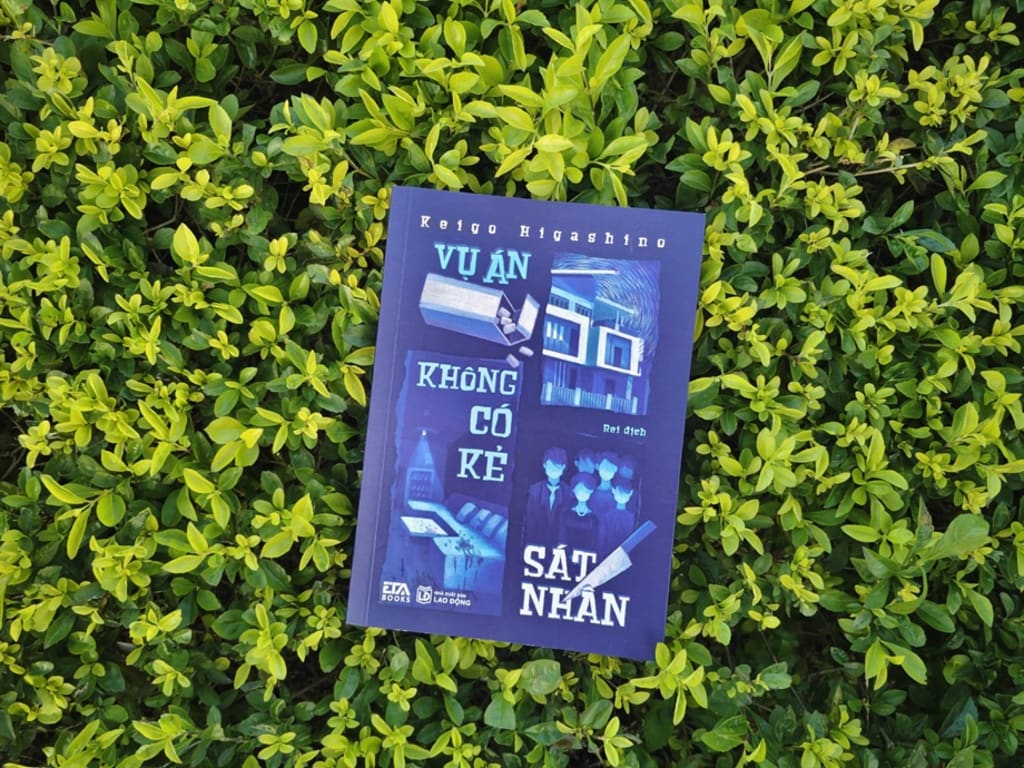
OVERVIEW
Consisting of 7 short stories, in which The Case Without A Murderer is the title for the entire collection, as if it captures the content that author Higashino Keigo puts into each story, and also captures his spirit in many works throughout his massive writing career. That a case without a murderer is not simply a case that is not a murder. But from many angles, going deep into the motive of the crime, the murderer can also be the victim in their own story. Or because, there is someone who intentionally builds a case without a murderer.
A Case Without a Murderer is a collection of seven outstanding detective short stories by Higashino Keigo, a master of Japanese detective literature. Each story in the collection has his signature style: dramatic, haunting, and revealing the hidden corners of human psychology.
The cases in this collection are not simply investigations of death or murder, but also delve into the hidden motives within each person. With his excellent storytelling talent, Higashino Keigo leads readers from one surprise to another, while evoking deep reflections on morality, truth, and justice.
SUMMARY OF SOME FEATURED STORIES
- A small intentional act
A close friend fell from the rooftop and died. "I" did not believe it was a suicide, so I was determined to find out the truth. But the more I investigated, the more I discovered that a seemingly small action could lead to terrible consequences.
- Goodbye Coach
Naomi left a dying video. Why did she choose to end her life like that? What secret was hidden behind her final decision?
- A case without a murderer
A strange murder occurred in the Kishida house, but there was no corpse or murderer. So, in the end, what really happened? Was this a perfect murder?
- Two in the Dark
The story begins with an early morning phone call: a ninth-grade boy asks for a day off from school because his three-month-old brother has died. He suspects the child was murdered. Everything is told from the teacher's perspective, with each small clue gradually appearing. As the truth is revealed, the story becomes more haunting than ever, making the reader shiver and wonder: "Are there tragedies like this in real life?"
ABOUT THE AUTHOR: KEIGO HIGASHINO
Born in Osaka in 1958. Graduated from Osaka University, Faculty of Electrical Engineering. While still an engineer, he won the 31st Edogawa Ranpo Prize for After School in 1985. Then, in 1999, he won the 52nd Mystery Writers Association of Japan Award for Naoko's Secret. In 2006, his work The Concealment of Suspect X won the 134th Naoki Prize and the 6th Honkaku Mystery Prize. In 2012, he won the 7th Chuokoron Art Prize for Miracles of the Namiya General Store. The work "Flower of Illusion" won the 26th Shibata Renzaburo Prize in 2013. In 2014, "When the Dusk of Prayer Falls" won the 48th Yoshikawa Eji Literary Prize. In 2019, he received the Noma Publishing Culture Award. He always aims to diversify his literary style, so he quickly became known and loved by the general audience. His recent works are "Silent Parade" and "Thread of Hope".
INTENTIONAL OR ACCIDENTAL
Taking the form of a short story collection, each story contains a different content, so it can be said that the cause, form, and motive of the case in the collection The Case Without a Murderer are extremely rich and diverse. There is unintentional, true to the meaning of "a case without a murderer", but there is also intentionality to arrange so that the murder becomes a "case without a murderer." However, whether intentional or unintentional, there are murderous intentions that appear and each case contains its own complexity in the short story genre that author Higashino Keigo has worked very hard to create, each with a unique technique with a system of characters of all ages, classes, professions... All of which make each story like a slice containing a glass face in the kaleidoscope of contemporary Japanese society.
Indeed, these are cases where victims have ended their own lives, in one way or another, stemming from despair in a life with no way out or from helplessness, disorientation about an uncertain future. They once had a reason to live and then when that reason became a fatal wound, they chose to self-destruct, ending the unfinished business and the uncertain future ahead. They came to death with a purpose, indicating that the cause of their death, whether accidental or intentional, requires the investigator to dig deeper to reach the mysteries that are still sealed, in the victim's identity and past. That is, when death occurs, all of it is a combination of countless factors, the victim's desire to die, the unintentional impact of external factors, and the murderous intent of the person. Who is to blame? When from a small, intentional action, a life has left this world forever, and the truth is only known later.
And that is when, with only the length of a short story, author Higashino Keigo has built up stories with complex forms, layered content in the structure of stories within stories with the appearance of elaborate crime staging, not too complicated crime methods but with great effort in terms of motives. Therefore, there are things that seem unintentional, but unintentionally create White Weapons that are deeply engraved in people's subconscious, from which they become murderous intentions that create irreversible tragedies. There are also intentional desires, engraved in the shadow of Two People in the Dark Night, appearing in the moral decay of personal and family tragedies.
And The Case Without a Murderer, as a conclusion to the correlation between intentionality and unintentionality. That in the end, every tragedy has evil intentions and murderous intent. Whether victim or perpetrator, this painful dilemma has always returned in Mr. Keigo's novels, as well as the short stories in the collection The Case Without a Murderer that he wrote.
THE KILLER OR THE VICTIM
As mentioned, whether it is a novel or a short story, each of Mr. Keigo's works is built with a layered content, a rather typical story-within-a-story structure to bring readers multi-dimensional perspectives on multifaceted people and colorful life. Therefore, each of those works, no matter how diverse the topics, seem to meet at a common point, when author Higashino Keigo always creates fragile boundaries between right - wrong, good - evil that the victim or the murderer, standing from different perspectives, are difficult to distinguish in the story. And the short story collection The Case Without a Murderer is not outside of that characteristic of Higashino Keigo's writing.
The Case Without a Murderer is a case without a perpetrator because the nature of that case, the victim actually ended his life; or the case was elaborately staged so that the incident disappeared without a trace; or that the murderer in the case is also the victim of another, older story that, in terms of “emotion”, perhaps does not have the heart to judge the tragic case they have experienced. Therefore, each story in the collection The Case Without a Murderer is like a multi-dimensional slice of a complex contemporary Japan with moral decay that seems to have metastasized to the cellular level of each person.
“The decay takes place silently and slowly, like watching a slow-motion film.”
A small, intentional act that ends a life, so that those who remain, the endless torment of pain, the burden that has weighed on their shoulders for years past until the present, can look back once again. The girl dances, and only desires to dance, but when her passion is confronted with human pettiness and selfishness, that desire is like a fatal cut, pulling out the last anchor that anchors the girl to the world. Goodbye coach, after the goodbye is the reunion, the reunion between the girl who burned her youth with the dream cake that was built before her eyes, and then when she reached the slope of her career, she realized that she had nothing left and it was all a lie.
It is the endless darkness, prolonging the hidden prejudice from the past to the present, from prejudice that creates malice between people who love each other. And it is also the darkness tinged with lust that corrupts morality, erodes the human soul, more than Two people in the dark night.
It is the white, invisible, formless weapon that an extremely unfortunate woman can only blame for all the crimes on that weapon, before all the losses she has to endure. And it is a case without a murderer, containing there completely, the decay of human emotions and personality to the utmost in the whirl of desire and bottomless greed.
Seven short stories, seven writing styles create separate plots, especially The Case Without a Murderer is also built with two timelines, the separation of the narrator "I" into two points of view in two different individuals; each small world in the short story collection The Case Without a Murderer has depicted the image of modern people who are always wavering between the boundary of good and evil like that. Victim or murderer, just need to change the angle of approach to the problem, the correlation will probably also change.
It's just that, whether standing from the perspective of the victim or the murderer, each story leaves a bitter aftertaste of the torment, thinking before the image of contemporary people carrying deep hidden inhibitions, dark corners in the soul. And that, have there ever been times when people also had murderous thoughts in a Case Without a Murderer?
REVIEW & FEELINGS
-Strengths
Compelling, detective-style plot: The cases in this collection are not just murders but also have many layers of psychological and social meaning. Higashino Keigo skillfully builds stories that are both thrilling and realistic to the point of being scary.
Concise, easy-to-read content: Because it is a collection of short stories, each story can be read in one sitting, very suitable for those who want to enjoy a detective work but do not have much time.
Humanity and psychological depth: The characters in the story all have very "human" motives, no one is completely good or bad. This makes the story realistic and leaves a deep impression on the reader.
-Weaknesses
Some stories have a slow pace: Some stories build up situations a bit too long before reaching the climax, which can reduce the interest of readers who like a fast pace.
Not Every Story Is Great: While the entire collection is of high quality, some stories don't stand out as much as others, making the overall book somewhat uneven.
About the Creator
HieuDinh
- Loves nature, likes to grow ornamental plants such as succulents, lotus (participates in volunteer activities to plant forests, protect forests in the locality)
- Loves dogs and cats (participates in local wildlife rescue activities)
7 Books For A Relentless Mindset
In a world that constantly tests our patience, confidence, and resilience, cultivating a relentless mindset is no longer optional—it’s essential. Whether we’re building a career, pursuing financial freedom, training our bodies, or navigating personal challenges, success belongs to those who refuse to quit when progress feels slow or obstacles feel overwhelming.
By Diana Meresc3 days ago in BookClub
Miss Persephone's Manual to a Seemingly Ordinary Life
Miss Persephone was found at the dining table, her blue eyes swollen, her tears arriving and retreating like the tides of the ocean. Earlier that day, her family had visited her in the retirement home where she had lived for eight years. It was her eightieth birthday.
By Imola Tóth3 days ago in Fiction




Comments
There are no comments for this story
Be the first to respond and start the conversation.