
Peter Ayolov’s The Shapes of the Self: Identity and Recognition in Visual Space
(Book review)

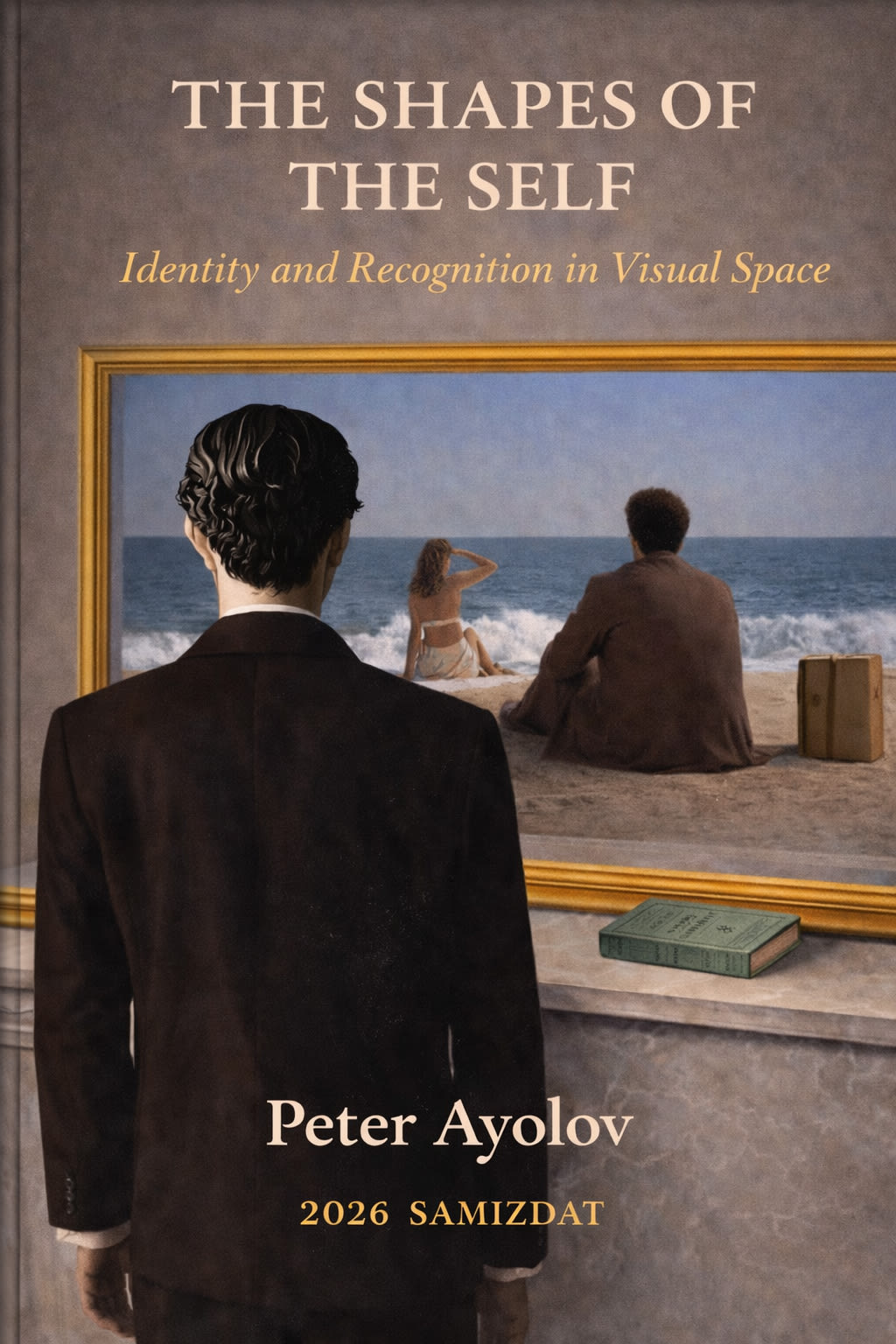
Peter Ayolov’s The Shapes of the Self: Identity and Recognition in Visual Space (Book review)
Peter Ayolov’s The Shapes of the Self: Identity and Recognition in Visual Space arrives not as an isolated philosophical meditation but as the culminating movement of the Mirror Selves Trilogy, following Identity Industrial Complex and Copyrighting the Self. If the first volume mapped the political economy of the human image and the second traced the juridical and proprietary capture of likeness, this final work undertakes the most ontological task of all: to ask what kind of self remains when the world itself has become image.
The trilogy unfolds as a progressive deepening. In Identity Industrial Complex, Ayolov demonstrated how contemporary capitalism no longer produces merely goods and services but produces identities as visual commodities. The human image becomes infrastructure, brand, asset, measurable capital. In Copyrighting the Self, the argument sharpens: the self is not only commodified but legally formatted, turned into proprietary likeness, licensed presence, regulated representation. The subject is reorganized under regimes of intellectual property and biometric governance. Now, in The Shapes of the Self, Ayolov steps back from the economic and legal frameworks and addresses the underlying ontological condition that makes such capture possible: the transformation of the world into a world-picture and the self into a staged figure within it.
The book is formally situated within contemporary aesthetics and image theory, yet it exceeds disciplinary boundaries. It moves from art history to philosophy of technology, from media theory to ontology, drawing on figures such as Heidegger, Malevich, Duchamp, Baudrillard and Žarko Paić, yet never dissolving into commentary. Instead, Ayolov reconfigures their insights around a central thesis: the self does not merely inhabit visual space; it is shaped by the structural conditions of that space. The image is no longer a representation of the self. Rather, the self appears only insofar as it is formatted within the world-picture.
This reversal is the decisive move of the trilogy’s final part. The book refuses nostalgic accounts of lost authenticity or romantic appeals to a pre-visual human interiority. It begins from the assumption that the contemporary world is video-centric in the deepest sense: not simply saturated with images, but ontologically structured as image. The “world-picture,” borrowed from Heidegger but reinterpreted through contemporary technosphere conditions, becomes the central category. The world is not something we depict; it is something already arranged as depictable. To exist within it is to be staged, framed, rendered operable.
In this sense, Ayolov extends the logic of the earlier volumes. If identity has become a commodity and likeness has become proprietary, this is not merely because of market logic or legal overreach. It is because the world itself has been reconfigured as a scene. The subject is no longer simply a perceiver or a speaker; it is a representable function within an information-communication circuit. The self becomes a scene-object, positioned within feeds, interfaces, biometric systems, algorithmic architectures.
One of the book’s strongest contributions lies in its insistence that this transformation is not primarily psychological but ontological. The question is not why individuals curate themselves online, nor why social media induces narcissism. Those analyses, common in cultural critique, remain superficial. Ayolov instead asks: what becomes of subjectivity when worldhood itself is structured as staging? When visibility is not optional but constitutive? When recognition is mediated through technical infrastructures that pre-format appearance?
Throughout the text, the reader is led through a genealogy of the image: from cultic identity to Platonic mimesis, from medieval icon to Renaissance perspective, from modern representation to avant-garde iconoclasm. Yet the narrative does not culminate in abstraction as triumph. Instead, abstraction signals a deeper rupture. The disappearance of the figurative body in modern art anticipates the disappearance of objectivity in a world where bodies become data sets, movements become metrics, and presence becomes operational availability.
In dialogue with Paić’s reflections on video-centrism and iconoclasm, Ayolov situates contemporary visual culture beyond traditional aesthetic categories. The transition from “fine arts” to “visual arts,” from representation to communication, marks not simply institutional expansion but a paradigm shift. The image becomes medium, then environment, then world. The classical debate about whether images imitate or signify dissolves when the image becomes the field in which meaning itself is generated.
The book’s treatment of the body is particularly incisive. In the technosphere, the body no longer appears as a stable figure to be represented. It is scanned, mapped, reconstructed, rendered in 3D, replicated in digital avatars. The “body-as-movement” replaces the still portrait. What once required contemplation now unfolds in refresh rates and motion capture. The body becomes autopoietic construct, a modifiable assembly of data points. The self, in turn, becomes indistinguishable from its renderings.
Ayolov does not describe this as mere loss. He frames it as a “fatal event” in the strict sense: a turning point where the image ceases to mirror and begins to generate. The image no longer refers back to a transcendent or metaphysical ground. It produces the real as operational surface. In this condition, the self’s demand to appear is inseparable from its formatting. Profiles, feeds, thumbnails, biometric signatures and algorithmic portraits are not secondary layers; they are primary modes of existence.
What distinguishes The Shapes of the Self from other critiques of digital culture is its refusal of moral panic. There is no simple denunciation of screens or nostalgia for pre-digital intimacy. Instead, the book remains within the ontological register. It asks whether any remainder of the self can resist total staging. Whether there remains an “excess imaginary” beyond operational transparency. Whether the self can retain a dimension that is not reducible to representational availability.
Stylistically, the work maintains a continuous, dense philosophical flow. There are no abrupt didactic digressions. Concepts accumulate and interlock. The rhythm mirrors the very condition it analyzes: the unbroken circulation of images. Yet within this density, key distinctions are carefully drawn. Representation is not staging; communication is not worldhood; visibility is not revelation. These distinctions allow the book to avoid conceptual collapse into generalized critique.
The trilogy’s arc becomes especially clear in retrospect. *Identity Industrial Complex* diagnosed the economic capture of the image. *Copyrighting the Self* exposed the legal codification of likeness. *The Shapes of the Self* reveals the ontological precondition: the world as image that makes both capture and codification intelligible. Together, the three volumes map a comprehensive theory of contemporary subjectivity under visual capitalism and technospheric governance.
Importantly, Ayolov’s argument does not end in total negation. The closing sections suggest that the possibility of resistance may lie not in producing better images, but in interrupting the scene itself. Liberation would not mean escaping images but unsettling the structural demand that everything must appear as image to be real. The self’s remainder, if it exists, would not be a hidden interior essence but a refusal of complete formatting.
In this respect, the book resonates with broader philosophical questions about post-human conditions, artificial intelligence, and algorithmic governance. If the world-picture has become autopoietic system, if visibility equals operability, then the self increasingly competes with technical images that exceed human capacities of perception and memory. The trilogy subtly anticipates this confrontation without reducing it to science fiction. The “mirror selves” of the trilogy’s title are not metaphors; they are infrastructures.
As the final part of the Mirror Selves Trilogy, The Shapes of the Self achieves conceptual closure without repetition. It does not restate earlier theses but deepens them. The economic and juridical analyses of the preceding volumes are recontextualized within a larger ontological transformation. The trilogy thus moves from surface structures of power to the underlying reconfiguration of worldhood itself.
For scholars of visual culture, media theory, contemporary aesthetics, and philosophy of technology, this book offers a rigorous framework for thinking beyond familiar binaries of real and virtual, subject and object, representation and simulation. For readers concerned with the fate of subjectivity in the age of digital platforms, it provides a vocabulary capable of articulating what often feels inarticulate: the sense that we do not simply use images, but inhabit them.
Ultimately, The Shapes of the Self stands as a demanding but necessary meditation on the conditions under which the human appears today. It insists that the crisis of identity is not merely sociological but ontological. The self is shaped not only by narratives or markets, but by the structural transformation of the world into image. To understand ourselves, we must understand the scene.
With this final volume, Ayolov completes a trilogy that traces the journey of the self from commodity to property to staged presence. The Mirror Selves Trilogy does not offer consolation. It offers diagnosis. It suggests that the modern subject is no longer a sovereign interiority expressing itself outwardly, but a formatted entity whose appearance is preconditioned by visual infrastructures. And yet, in articulating this condition with philosophical precision, the trilogy performs an act of clarity that itself resists the nullification of meaning.
If the self now appears only insofar as it is formatted within the world-picture, then to write such a book is already to carve a fissure within that formatting. The trilogy ends not with an answer, but with a sharpened awareness: that the shapes of the self are neither natural nor accidental, but historically constructed forms within a world that has become image.
About the Creator
Peter Ayolov
Peter Ayolov’s key contribution to media theory is the development of the "Propaganda 2.0" or the "manufacture of dissent" model, which he details in his 2024 book, The Economic Policy of Online Media: Manufacture of Dissent.
Keep reading
More stories from Peter Ayolov and writers in BookClub and other communities.
Copyrighting the Self: Manufacturing Mirror Selves
Review: Peter Ayolov — Copyrighting the Self: Manufacturing Mirror Selves Peter Ayolov’s book proposes something more ambitious than a cultural critique of social media or a philosophical reflection on identity in the digital age. It attempts a reclassification of the human being under conditions of technological mediation. Rather than asking how media influence people, the text asks what kind of being becomes possible once recognition, representation and interpretation precede encounter. The work therefore belongs less to media studies than to philosophical anthropology. Its central claim is simple but radical: contemporary society has moved from interacting with persons to interacting with authorised representations of persons, and this shift changes the structure of existence itself.
By Peter Ayolov6 days ago in BookClub
Self Help: Grifters' Gospel
On Self-Help, Snake Oil, and the Illusion of Change Psychology professionals and students can be imagined on two opposite sides of a line called self-help books: likely a larger group opposes pop-science and step-by-step manuals filled with talk of success, journaling, and not giving a f**k; others love them, but they aren’t many.
By Avocado Nunzella BSc (Psych) -- M.A.P 26 days ago in BookClub
7 Spiritual Awakening Books You Should Read In 2026
At some point in life, many of us feel an unmistakable inner pull — a quiet but persistent sense that there must be more to existence than routines, achievements, and external validation. This moment often marks the beginning of a spiritual awakening: a shift in awareness that changes how we perceive ourselves, others, and reality itself.
By Diana Meresc5 days ago in BookClub


Comments
There are no comments for this story
Be the first to respond and start the conversation.