
Ostara: The Sacred Balance of Light, Renewal, and the Returning Earth
Balance, Renewal, and Belief: Pagan Roots of the Spring Equinox

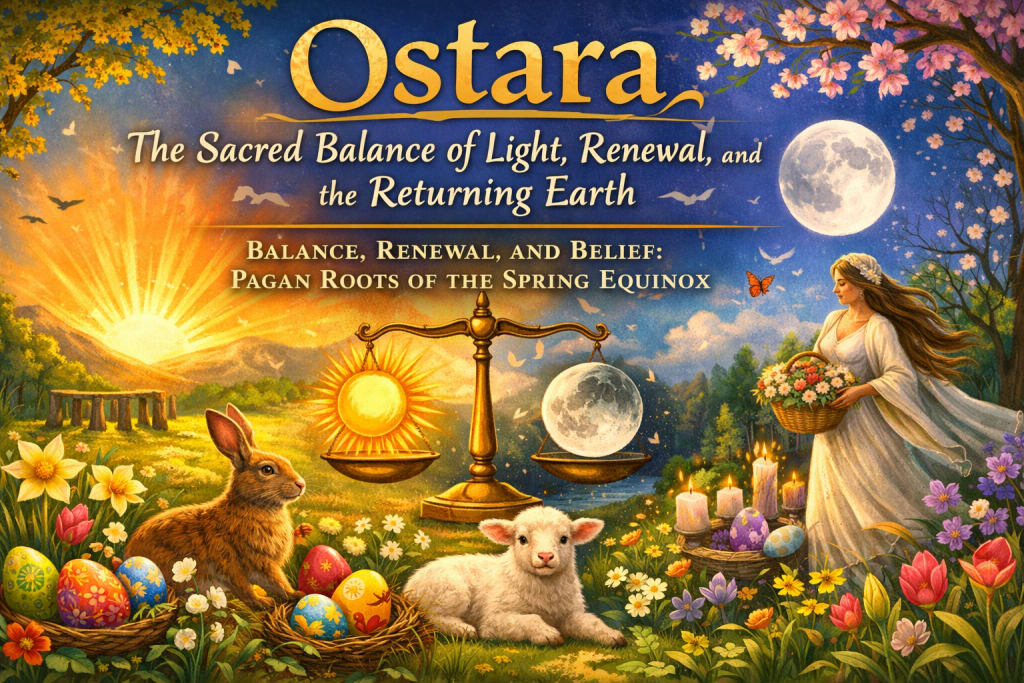
When Light and Earth Reawaken
Ostara coincides with the Spring Equinox, an astronomical event occurring when the Sun crosses the celestial equator, resulting in nearly equal hours of daylight and darkness. In the Northern Hemisphere, this alignment takes place between March 19 and March 22, a range determined by Earth’s axial tilt and orbital movement. Since antiquity, equinoxes served as fixed points within seasonal timekeeping systems, allowing early societies to regulate agricultural labor, ritual calendars, and communal responsibilities.
For preindustrial cultures dependent on land and climate, the Spring Equinox marked a decisive environmental transition. Soil temperatures began to rise, dormant seeds responded to increasing sunlight, and grazing patterns shifted as pastureland slowly revived. Archaeological and archaeoastronomical studies confirm that ancient peoples tracked this solar moment with precision. Monumental sites such as Stonehenge in England, Cairn T at Loughcrew in Ireland, and the Temple of Karnak in Egypt exhibit equinox-aligned features, demonstrating sustained observation of solar movement across centuries. These structures reflect deliberate engineering choices rooted in cosmological understanding rather than coincidence.
Seasonal balance held spiritual and philosophical significance alongside practical value. Many ancient worldviews framed existence as a cycle governed by reciprocity between opposing forces. Light and darkness, growth and rest, death and renewal were understood as interdependent states rather than moral absolutes. The equinox symbolized harmony within this system, a fleeting equilibrium preceding the return of solar dominance. Agricultural rites, fertility blessings, and communal observances often accompanied this period, reinforcing social cohesion and collective responsibility to the land.
Within Pagan cosmology, Ostara represents the awakening phase of the natural cycle. Fertility during this season is expressed through potential rather than harvest, emphasizing preparation, patience, and alignment with natural timing. Budding trees, returning migratory birds, and lengthening days serve as visible markers of this shift. The land does not erupt into abundance but signals readiness for growth. This restrained emergence underscores a worldview rooted in observation and respect for natural processes.
Ostara preserves an ancient recognition that balance is neither static nor permanent. The equinox offers a brief moment of equilibrium before daylight steadily increases toward midsummer. That impermanence grants the season spiritual depth, reminding observers that harmony exists within motion and change. Through reverence for seasonal thresholds, Ostara reflects humanity’s enduring relationship with Earth’s rhythms and the celestial forces shaping life on a planetary scale.
Origins Rooted in Season and Memory
The name Ostara is most frequently linked to the Germanic goddess Eostre, recorded by the Anglo-Saxon monk Bede in the 8th century work *De Temporum Ratione* or *The Reckoning of Time*. Bede notes that the month corresponding to April was once called *Eosturmonath*, named for a goddess honored with feasts during that season, and that Christian celebrations later adopted the term. This account remains the only explicit historical reference to Eostre by name, yet its significance lies in linguistic continuity rather than isolated testimony. The Old English *Eostre* and Old High German *Ostara* derive from Proto-Germanic roots associated with dawn, east, and the rising Sun, reinforcing symbolic ties to light’s return and seasonal renewal.
Although direct archaeological evidence of Eostre worship is limited, comparative mythology supports the presence of spring and dawn goddesses across Indo-European cultures. Figures such as the Greek Eos, the Roman Aurora, and the Vedic Ushas share common attributes linked to light, fertility, and cyclical rebirth. These parallels suggest a shared mythological framework rather than a singular localized cult. The continuity of symbolism across regions strengthens the argument for widespread seasonal reverence centered on the equinox and the return of solar power.
Germanic and Anglo-Saxon societies placed considerable importance on seasonal thresholds. The Spring Equinox functioned as a practical agricultural marker rather than a symbolic abstraction. Increasing daylight enabled longer work periods, soil conditions improved for planting, and livestock entered reproductive cycles essential for long-term survival. Seasonal law codes, farming calendars, and oral traditions often revolved around these natural shifts, embedding astronomical observation into daily life.
Evidence of equinox awareness extends far beyond Northern Europe. In the Roman world, the festival of Hilaria honored Cybele and Attis, celebrating resurrection and renewed life during the spring season. In Persia, Nowruz marked the New Year at the vernal equinox, a tradition still observed today and rooted in Zoroastrian cosmology emphasizing order, balance, and renewal. In ancient Egypt, temple alignments and solar symbolism reflected equinox awareness tied to agricultural cycles along the Nile. Mesoamerican civilizations such as the Maya and later the Aztecs constructed ceremonial sites where equinox sunlight created dramatic visual effects, underscoring the sacred role of solar balance.
Modern Pagan observance of Ostara does not claim uninterrupted practice from antiquity but instead represents a reconstructed tradition informed by historical records, folklore, archaeology, and comparative religion. This synthesis reflects how ancient peoples themselves adapted seasonal rites across generations. Ostara emerges not as a singular inherited festival but as a convergence of human responses to the same environmental reality. Seasonal balance, agricultural renewal, and the return of light formed a shared foundation that transcended cultural boundaries and continues to resonate within contemporary spiritual practice.
Ostara Within the Living Cycle of the Wheel
Within modern Wiccan and Pagan traditions, Ostara holds a transitional position between Imbolc and Beltane on the Wheel of the Year. This placement reflects a movement from the quiet stirring of late winter toward the visible vitality of early summer. Ostara functions as a threshold rather than a culmination. Seasonal energy shifts from inward preparation to outward expression, yet remains restrained and deliberate. Light continues to increase, but cold has not fully released its hold, creating a natural tension that defines the sabbat’s character.
The spiritual significance of Ostara rests in equilibrium and momentum rather than culmination. Unlike later festivals centered on fertility at its peak or harvest in abundance, Ostara acknowledges growth in its earliest stages. Seeds swell beneath the soil before breaking the surface. Buds form without opening. This stage of the cycle reinforces patience, attentiveness, and trust in gradual transformation. Pagan cosmology frequently interprets this phase as a reminder that sustainable growth depends on balance rather than excess.
Ritual observance during Ostara often reflects these themes through grounded and accessible practices. Altars may be adorned with symbols of the season such as eggs, fresh flowers, green branches, and representations of the Sun. Seed blessings serve both symbolic and practical purposes, connecting spiritual intention with agricultural reality. The act of planting carries ritual weight, as seeds placed in the earth embody commitment to future responsibility rather than immediate reward.
Outdoor observance plays a central role in many traditions. Walking the land, observing returning wildlife, and noting subtle environmental changes reinforce a direct relationship with seasonal rhythms. Balance rituals may involve paired symbols such as light and dark candles, water and soil, or written intentions weighed against ethical reflection. These acts emphasize accountability alongside aspiration, grounding spiritual renewal in conscious action.
Ethical renewal forms an essential component of Ostara within contemporary practice. Many traditions encourage examination of personal conduct, community responsibility, and relationship to the natural world. Renewal is understood not as reinvention but as realignment. Actions, values, and long-term intentions are brought into harmony with the rhythms observed in nature. Through this lens, Ostara affirms that meaningful change begins quietly, shaped by awareness, restraint, and respect for the cycles that sustain life.
Symbols of Awakening and Sacred Equilibrium
Eggs
Eggs stand among the most enduring symbols associated with Ostara and the Spring Equinox. Across ancient cultures, eggs represented creation, fertility, and the mystery of life contained within a single form. Archaeological evidence confirms the use of decorated eggs in spring rites long before the rise of Christianity. Dyed ostrich eggs have been discovered in ancient Persian and Egyptian burial sites, while painted eggs appear in Eastern European folk traditions dating back centuries. The symbolism transcends regional boundaries, reflecting a universal understanding of the egg as a vessel of potential.
Within Pagan symbolism, the egg represents the cosmos in miniature. A hardened shell conceals fragile life, mirroring the hidden processes of growth occurring beneath the soil during early spring. At Ostara, eggs embody beginnings that require patience and protection. The act of decorating eggs carries ritual significance, transforming a natural object into a symbolic offering aligned with intention, fertility, and renewal.
Hares and Rabbits
Hares and rabbits hold a prominent place in Ostara symbolism due to strong associations with fertility, regeneration, and seasonal cycles. Unlike domesticated rabbits, hares were viewed as liminal creatures in ancient Europe, active primarily at dawn and dusk and often observed during the breeding season in early spring. Classical authors such as Julius Caesar recorded taboos against eating hare flesh in Britain, suggesting ritual or sacred significance.
Folklore across Germanic and Celtic regions links hares to lunar symbolism and female deities connected to fertility and the land. The hare’s rapid reproductive cycle and visible presence during spring reinforced symbolic ties to abundance and renewal. In later folk traditions, hares became messengers of seasonal change, bridging wild nature and agricultural life. These associations contributed to the enduring presence of hare imagery in spring celebrations connected to Ostara.
Flowers and Green Shoots
The emergence of flowers and green shoots serves as one of the most visible signs of seasonal transition. Early-blooming plants such as crocuses, daffodils, snowdrops, tulips, and violets respond directly to increasing daylight and rising soil temperatures. In agricultural societies, these plants functioned as natural indicators that planting season approached.
Symbolically, green shoots breaking through cold or compacted earth represent resilience and continuity. Growth appears fragile yet persistent, reflecting a cycle that returns regardless of human intervention. Floral symbolism at Ostara emphasizes hope grounded in observation rather than abstraction. Each blossom marks a measurable response to environmental change, reinforcing the connection between seasonal timing and survival.
Balance and Duality
The Spring Equinox forms the symbolic foundation of Ostara, representing a rare moment of equilibrium within the solar year. Light and darkness occupy equal measure before daylight begins its gradual dominance. Ancient cosmologies often viewed balance as a necessary condition for stability rather than a permanent state. The equinox embodied this philosophy through celestial movement rather than metaphor alone.
Spiritual interpretations of this balance emphasize integration over opposition. Life and rest, action and reflection, growth and restraint coexist within a unified cycle. Ostara honors this harmony not as an endpoint but as a passage. The brief equilibrium of the equinox reinforces an understanding of transformation guided by rhythm, timing, and natural order rather than force or excess.
Divine Figures of Renewal and Returning Light
Deities honored during Ostara reflect shared mythological responses to seasonal transition rather than allegiance to a single pantheon. Across cultures, spring deities embody fertility, regeneration, and the restoration of life following winter dormancy. These figures often govern vegetation cycles, agricultural prosperity, and the rhythmic relationship between life, death, and return. Ostara observance frequently draws from this broader mythological landscape, emphasizing thematic resonance over historical exclusivity.
Eostre remains the most frequently associated deity within Ostara traditions. The name derives from Germanic linguistic roots connected to dawn and the east, reinforcing symbolic links to light’s return. Although historical references to Eostre are limited, the goddess represents a convergence of seasonal symbolism tied to rebirth, fertility, and the renewal of land. In modern practice, Eostre often serves as a focal point for honoring the reemergence of growth and the balance achieved at the equinox.
Persephone occupies a central role within Greek seasonal mythology. According to the Homeric Hymn to Demeter, Persephone’s annual return from the Underworld marks the restoration of fertility to the earth. This myth provided an agricultural explanation for seasonal change in ancient Greece and informed ritual practices such as the Eleusinian Mysteries. Persephone embodies the dual nature of life and death, ruling both the subterranean realm and the living landscape. The return of Persephone aligns symbolically with spring’s arrival and the visible resurgence of vegetation.
Freyr represents fertility, abundance, and favorable seasons within Norse cosmology. As a member of the Vanir, Freyr governs agricultural prosperity, peace, and natural cycles. Medieval Icelandic sources such as the Poetic Edda and Prose Edda describe Freyr as a bringer of good harvests and fruitful land. Springtime offerings to Freyr historically sought successful planting and communal well-being, reinforcing the god’s association with seasonal growth and renewal.
Flora, the Roman goddess of flowers and blooming plants, presided over the Floralia, a festival celebrated in late April and early May. Ancient Roman writers such as Ovid describe the Floralia as a joyful observance marked by floral adornment and public celebration. Flora symbolizes the flowering stage of vegetation rather than its origin or harvest, placing her influence within the early to mid-spring cycle. Her presence within Ostara-related observance reflects reverence for the visible beauty and vitality emerging across the landscape.
Cybele, often referred to as the Great Mother, held prominence in Anatolian and later Roman religious practice. Cybele governed wild nature, fertility, and regeneration, with mythological narratives centered on death and rebirth through the figure of Attis. Ritual observances associated with Cybele occurred during the spring season and emphasized renewal through sacrifice, mourning, and restoration. Her inclusion within Ostara symbolism reflects ancient recognition of cyclical transformation rooted in the natural world.
Together, these deities illustrate a shared mythological language centered on seasonal balance, regeneration, and agricultural survival. Differences in cultural expression do not obscure underlying similarities. Ostara honors this continuity, recognizing spring deities as expressions of a universal human response to the returning light and the renewal of life across the earth.
Rituals of Renewal, Intention, and Seasonal Alignment
Ostara ritual practices arise from agricultural timing, environmental observation, and symbolic acknowledgment of emerging life. Unlike festivals centered on culmination or abundance, Ostara observances emphasize preparation, balance, and conscious engagement with the natural world. Ritual activity during this sabbat reflects early spring conditions, when growth begins beneath the surface and careful stewardship determines future success.
Seed planting remains one of the most widespread Ostara practices. Historically, seed blessing rituals acknowledged dependence on favorable weather, fertile soil, and seasonal cooperation. Seeds were often held, spoken over, or marked with symbols before being placed into the earth. This act joined spiritual intention with physical labor, reinforcing responsibility for both effort and outcome. In many traditions, planting at Ostara represented commitment to long-term cultivation rather than immediate reward.
Egg coloring holds ritual significance beyond decoration. Natural dyes derived from onion skins, beetroot, berries, and herbs were historically used to mark eggs for spring rites. Patterns and colors often carried symbolic meaning related to fertility, protection, and prosperity. The egg served as both offering and talisman, embodying life in a suspended state. In some folk traditions, eggs were buried in fields or placed near entrances to encourage fertility and safeguard the household.
Spring cleaning occupies an important place within Ostara observance. Across cultures, the removal of winter debris, soot, and clutter marked a necessary transition into the growing season. This practice carried symbolic weight, aligning physical order with mental clarity and ethical renewal. Cleansing rituals often extended beyond the home to include tools, altars, and communal spaces, reflecting readiness for productive work and spiritual recalibration.
Offerings to land spirits and nature deities form another aspect of Ostara practice. Agricultural societies frequently acknowledged local spirits associated with fields, forests, and waterways at seasonal thresholds. Offerings of bread, milk, honey, or eggs expressed gratitude and sought continued harmony with the land. These acts reinforced reciprocal relationships between human communities and the ecosystems sustaining them.
Divination practices at Ostara tend to focus on direction rather than outcome. Traditional methods such as rune casting, ogham reading, scrying, or seed-based divination emphasize future pathways and potential obstacles. The equinox, defined by balance, provides an appropriate context for assessing alignment between intention and action. Divination during this period often addresses timing, responsibility, and sustainable growth.
Food traditions associated with Ostara reflect early spring availability and symbolic nourishment. Fresh greens such as spinach, nettles, and early herbs represent cleansing and vitality. Eggs and dairy products highlight fertility and renewal, while breads symbolize sustenance shaped through human effort. Honey appears frequently as a reminder of sweetness returning after scarcity. Shared meals during Ostara reinforce communal bonds and acknowledge the interdependence of land, labor, and survival.
Together, these practices ground Ostara in lived experience rather than abstraction. Ritual observance during the Spring Equinox affirms attentiveness, preparation, and respect for seasonal limits. Growth is honored as a process requiring patience, care, and ethical responsibility, mirroring the natural rhythms that sustain life year after year.
Ostara Foods and Seasonal Recipes
Ostara celebrates renewal, growth, and the awakening of the land after winter. Food has long played a central role in equinox observance, linking symbolic meaning with sustenance and community. Early spring ingredients—fresh greens, eggs, dairy, honey, and grains—were historically accessible after winter scarcity and carried rich associations with fertility, vitality, and abundance. Eggs represent creation and potential, while fresh herbs and early vegetables embody perseverance, life emerging from dormancy, and cyclical continuity. Sweeteners such as honey signify prosperity, gratitude, and the reward of patience through long winters. Breads and baked goods shaped into symbols like suns, rabbits, or eggs were common in European spring festivals, serving both ritual and communal purposes. Offering food to land spirits or sharing meals within the community reflected respect for natural cycles and reinforced social cohesion.
Recipes for Ostara can be both practical and symbolic. Simple preparations highlight seasonal ingredients and can be incorporated into ritual or reflective practice. Three easy, traditional recipes include:
1. Honey and Herb Spring Bread
A soft, enriched bread flavored with early herbs and honey, symbolizing renewal and nourishment. Ingredients include 3 cups all-purpose flour, 2 teaspoons baking powder, 1 teaspoon salt, 1/4 cup honey, 1/2 cup milk, 1/4 cup butter (melted), 2 eggs, and 2 tablespoons finely chopped fresh herbs such as chives, parsley, or dill. Mix dry ingredients in a bowl, then combine honey, milk, butter, and eggs in a separate bowl. Fold wet ingredients into dry, knead lightly, and shape into a round loaf. Optionally, press a few small eggs or seeds into the top before baking. Bake at 350°F (175°C) for 30–35 minutes until golden. This bread symbolizes fertility, growth, and the nurturing quality of springtime, perfect for ritual offerings or seasonal meals.
2. Early Spring Green Salad with Lemon-Honey Dressing
This fresh salad celebrates emerging greens and represents vitality and renewal. Combine 2 cups baby spinach, 1 cup arugula, 1/2 cup chopped fresh parsley, and 1/4 cup thinly sliced radishes in a bowl. Prepare dressing by whisking 2 tablespoons honey, 1 tablespoon lemon juice, 2 tablespoons olive oil, and a pinch of salt. Toss greens with dressing just before serving. Optional additions include toasted seeds or nuts for extra symbolism of growth and potential. This dish emphasizes connection to the land, highlighting the first bounty of spring while reinforcing Ostara’s themes of awakening and renewal.
3. Baked Eggs in Spring Vegetables
A simple, symbolic dish celebrating eggs as life and fertility combined with early spring produce. Preheat oven to 375°F (190°C). Sauté 1 cup chopped asparagus, 1/2 cup chopped leeks, and 1/2 cup diced bell pepper in a lightly oiled baking dish for 3–5 minutes. Make small wells in the vegetables and crack 2–4 eggs directly over them. Sprinkle with salt, pepper, and fresh herbs such as thyme or chives. Bake for 12–15 minutes until eggs are set but yolks remain soft. This dish honors growth, balance, and the nurturing power of seasonal abundance, making it suitable for ritual meals or equinox breakfast.
Incorporating these recipes into Ostara observance offers a tangible connection to seasonal cycles, grounding spiritual reflection in everyday experience. Preparing and sharing food allows direct engagement with natural rhythms, reinforcing themes of renewal, gratitude, and balance. Culinary practice can also be ritualized, such as blessing ingredients, arranging food symbolically, or sharing a meal in reflection of light returning and fertility renewed. Historical continuity and symbolism embedded in these foods highlight how nourishment, ritual, and seasonal awareness converge, providing a holistic experience of the Spring Equinox.
The Evolution and Enduring Relevance of Ostara
Modern Ostara observance represents a reconstructed tradition, emerging from a convergence of historical records, folklore, archaeological study, and experiential spiritual practice. Evidence for direct continuity from pre-Christian Germanic or Anglo-Saxon festivals is limited, yet fragments of seasonal rites, linguistic traces, and mythological narratives provide a foundation for contemporary practice. The adaptive nature of Ostara mirrors broader patterns observed in ancient religions, where rituals, deities, and symbols evolved to meet the needs of changing communities and environmental conditions.
Historical reconstruction of Ostara relies on careful scholarship. Textual sources, such as Bede’s De Temporum Ratione, offer limited but crucial insights into early spring observances. Comparative mythology situates Eostre within a wider Indo-European framework of fertility and dawn deities, revealing common symbolic motifs across Greece, Rome, Scandinavia, and the British Isles. Archaeological evidence, including equinox-aligned monuments, seasonal deposits, and ritual objects, further illuminates the significance of balance and renewal in ancient European practice. Folklore from rural communities preserves additional layers of meaning, connecting mythic symbolism with practical agricultural observation.
The process of reconstruction does not diminish authenticity; rather, it reflects a continuity of human engagement with natural cycles. Like ancient peoples, modern practitioners respond to seasonal rhythms, agricultural cues, and solar movement to structure ritual, ethical reflection, and communal celebration. Adaptation ensures that Ostara remains relevant to contemporary observers while retaining connections to its historical, symbolic, and mythological roots. Symbols such as eggs, hares, and early blossoms continue to provide tangible links to the land and the solar year, even as ritual expression evolves.
Ostara as a living sabbat demonstrates the resilience of human spiritual imagination. Each generation interprets seasonal observance through cultural, ecological, and personal lenses, creating a dynamic interplay between inherited knowledge and present experience. This flexibility reflects the same practical and symbolic concerns that shaped ancient rites: awareness of the land, acknowledgment of seasonal thresholds, and ethical alignment with cycles of growth and renewal. Through this lens, Ostara embodies both continuity and transformation, offering a space for reflection, celebration, and engagement with the natural world in a manner that is simultaneously historical and immediate.
Recommended Reading: #commissionearned
The Stations of the Sun: A History of the Ritual Year in Britain by Ronald Hutton
An in-depth exploration of Britain’s seasonal festivals, this book examines how rituals connected to solstices, equinoxes, and agricultural cycles developed over centuries. The work draws on archaeology, folklore, and historical texts to uncover how communities observed the passage of time through the year. It reveals the social, spiritual, and environmental reasoning behind festivals of renewal, fertility, and light. May Day, harvest celebrations, and winter rites are placed in context with spring equinox observances, showing a continuity of symbolic attention to balance and seasonal thresholds. Hutton highlights the transformation of pre-Christian customs as they intersected with Christian tradition and folk culture. Themes of preparation, cyclical awareness, and respect for natural rhythms emerge as central to understanding Ostara. This book provides both historical foundation and insight into the human impulse to mark seasonal change.
Pagan Britain by Ronald Hutton
Through archaeological findings and historical research, this book reconstructs religious life in pre-Christian Britain, including the rituals tied to the seasons. Sacred spaces like stone circles, burial mounds, and ceremonial sites are analyzed for their alignment with solar and equinox events. The narrative examines how seasonal awareness shaped agricultural planning, ethical reflection, and communal ceremonies. Spring festivals and fertility rites are contextualized within everyday life, demonstrating the centrality of renewal and balance. Hutton details the adaptation of pagan practices under later religious pressures, showing patterns of continuity, reinterpretation, and cultural survival. The book emphasizes the interplay between natural cycles and human observance, providing rich context for understanding Ostara’s themes of growth and emergence. It is a vital resource for anyone seeking a historically grounded perspective on seasonal celebration.
Ostara: Rituals, Recipes & Lore for the Spring Equinox by Kerri Connor
This practical guide brings the Spring Equinox to life with rituals, seasonal recipes, and craft projects that embody renewal and fertility. Readers learn how to incorporate symbolic practices such as seed planting, egg decoration, and offerings to the land into contemporary observance. Historical and folkloric context explains why each practice carries meaning tied to balance and emerging life. Divination techniques and meditative exercises connect personal intention to natural rhythms, providing a reflective layer to the physical activities. Seasonal foods reinforce the connection between nourishment and the Earth’s cycles, highlighting the symbolic and practical elements of spring. The book encourages active participation, making Ostara tangible through sensory engagement. Its combination of history, ritual, and creative practice makes it a rich guide for both novice and experienced observers of seasonal spirituality.
Exploring the eight seasonal festivals, this book presents a holistic approach to aligning life with nature’s rhythms. Ostara is highlighted as a pivotal point of balance, where the interplay of light and dark shapes ritual, reflection, and preparation for growth. The text weaves historical insight, environmental observation, and practical exercises into each festival discussion. Attention to plant behavior, animal patterns, and solar movement demonstrates how careful observation informs meaningful seasonal practice. Reflection prompts, journaling ideas, and meditative guidance connect inner growth with the external environment. The work emphasizes themes of renewal, harmony, and ethical alignment with natural cycles. Its accessible approach makes the seasonal wheel tangible, contextualizing Ostara within a living cycle rather than a symbolic abstraction.
The White Goddess: A Historical Grammar of Poetic Myth by Robert Graves
Graves investigates the symbolic power of European goddess traditions, linking fertility, seasonal change, and mythic imagination. The book presents recurring motifs of birth, death, and regeneration, illustrating how poetic and mythological traditions encode seasonal awareness. Themes central to Ostara, including renewal, fertility, and cyclical transformation, are examined through the lens of mythic archetypes. Lunar symbolism, goddess figures, and natural cycles provide insight into the symbolic frameworks that informed seasonal ritual. Graves connects literary expression with ritual practice, showing how myth continues to shape cultural understanding of the seasons. The text offers a layered, interpretive exploration of how fertility, balance, and renewal resonate in human consciousness. It enriches comprehension of Ostara’s symbolic and mythological dimensions.
Traditional Festivals: A Multicultural Encyclopedia by Christian Roy
This expansive reference work examines seasonal and sacred festivals as expressions of cultural identity, environmental awareness, and cosmological belief. Rather than treating festivals as isolated curiosities, the encyclopedia situates each observance within its historical, geographic, and social context. Spring celebrations receive particular attention as moments tied to agricultural renewal, astronomical balance, and communal regeneration. Entries explore how equinox festivals across Asia, the Middle East, Europe, and Indigenous cultures articulate shared human concerns such as fertility, balance, and the return of light. Detailed descriptions of ritual practices, ceremonial foods, symbolic objects, and calendrical timing provide insight into how seasonal thresholds were experienced in daily life. The comparative structure allows recurring motifs, including rebirth, harmony, and gratitude toward the land, to emerge organically across cultures. This work deepens understanding of Ostara by placing the Spring Equinox within a broader human tradition of honoring cyclical time and seasonal transformation through ritual and celebration.
The Triumph of the Moon: A History of Modern Pagan Witchcraft by Ronald Hutton
This historical account traces the development of modern Pagan witchcraft, including the codification of seasonal festivals such as Ostara into the Wheel of the Year. Examination of early twentieth century sources, folk revivals, and practitioner testimony reveals how seasonal observance became standardized while retaining adaptability. The book highlights the interplay between historical inspiration and creative innovation in contemporary practice. Seasonal rituals are treated as evolving cultural phenomena, emphasizing the dynamic nature of spiritual observance. Themes of renewal, ethical alignment with natural cycles, and symbolic engagement with the environment are explored in historical and social context. The text situates Ostara as both historically informed and continually reinterpreted in living practice. This work provides essential understanding of how seasonal spirituality functions in modern Paganism.
Ostara Through Study and Exploration
Ostara embodies more than seasonal festivity; it is a profound meditation on balance, renewal, and the resilience inherent in both nature and human experience. Observance of the Spring Equinox highlights the interdependence of light and darkness, growth and dormancy, preparation and fruition, inviting contemplation of cycles that extend from soil to psyche. Historical study of Ostara and related festivals uncovers connections between ancient ritual, mythology, and the practical rhythms of agricultural life, showing how symbolic acts once guided communities in harmony with the environment. Examining comparative traditions—from Roman, Norse, and Celtic spring rites to global equinox celebrations—reveals patterns of human engagement with seasonal change and illuminates universal themes of fertility, transformation, and renewal.
Independent research forms the foundation for meaningful understanding. Public and university libraries offer extensive access to primary texts, scholarly publications, and historical records that provide context beyond surface interpretations. Critical reading of academic sources allows the exploration of ritual, myth, and folklore in a rigorous manner, distinguishing historically grounded information from anecdotal or speculative accounts. Free online resources can be useful starting points, but caution is necessary, as accuracy and depth vary widely. Evaluating sources carefully, comparing accounts, and tracing citations strengthens comprehension of both historical and modern Ostara practices.
Engagement with ritual and symbolic practice benefits from this layered study, allowing seasonal observance to become both informed and personally resonant. Deeper understanding emerges when learning is paired with curiosity, reflection, and hands-on experience in observing natural rhythms. Ostara offers the opportunity to connect study, history, and lived experience, demonstrating how seasonal awareness can inform ethical, spiritual, and environmental consciousness. Continued inquiry into its mythology, symbolism, and contemporary practice ensures that the Spring Equinox is appreciated not merely as a date on the calendar but as a dynamic, enduring framework for reflection, growth, and balance.
About the Creator
Marcus Hedare
Hello, I am Marcus Hedare, host of The Metaphysical Emporium, a YouTube channel that talks about metaphysical, occult and esoteric topics.
https://linktr.ee/metaphysicalemporium
Keep reading
More stories from Marcus Hedare and writers in BookClub and other communities.
The Hidden Knowledge: Gnosticism
A World Awakened by Hidden Knowledge Gnosticism emerged during the first centuries of the Common Era within a world shaped by religious experimentation, philosophical exchange, and profound social change. The eastern Mediterranean functioned as a crossroads of Jewish theology, Greek philosophy, Egyptian religion, and emerging Christian thought. Within this environment, Gnostic traditions developed as spiritual systems concerned with the origin of existence, the nature of divinity, and the condition of the human soul. Rather than forming a single religion or centralized movement, Gnosticism encompassed multiple schools and communities bound by a shared conviction that salvation arose through direct, transformative knowledge.
By Marcus Hedarea day ago in BookClub
My New Book is Finally Here
My poetry collection Beautiful and Brutal Things is done. It's actually done and finally published over 270 pages. Over a year of my life went into this book. More than a year, really. Long days at my computer, sometimes seven days a week because I couldn't stop even when I probably should have. Then two months of editing that felt harder than the writing itself. But it's finished, and I'm still standing, and the book is real.
By Tim Carmichael3 days ago in BookClub
The 2025 Bibliophile Advent Calendar Special
There’s a moment every December when the world finally exhales. For me, it usually happens right after I pull out my favorite winter mug and I take that first deep breath of the season. The lights glow a little softer. The books on my shelves seem to lean toward me, waiting. And I remember why winter reading feels like a ritual.
By Kristen Barenthaler5 days ago in BookClub




Comments
There are no comments for this story
Be the first to respond and start the conversation.