
The Hidden Knowledge: Gnosticism
The Secret History, Sacred Texts, and Lasting Influence

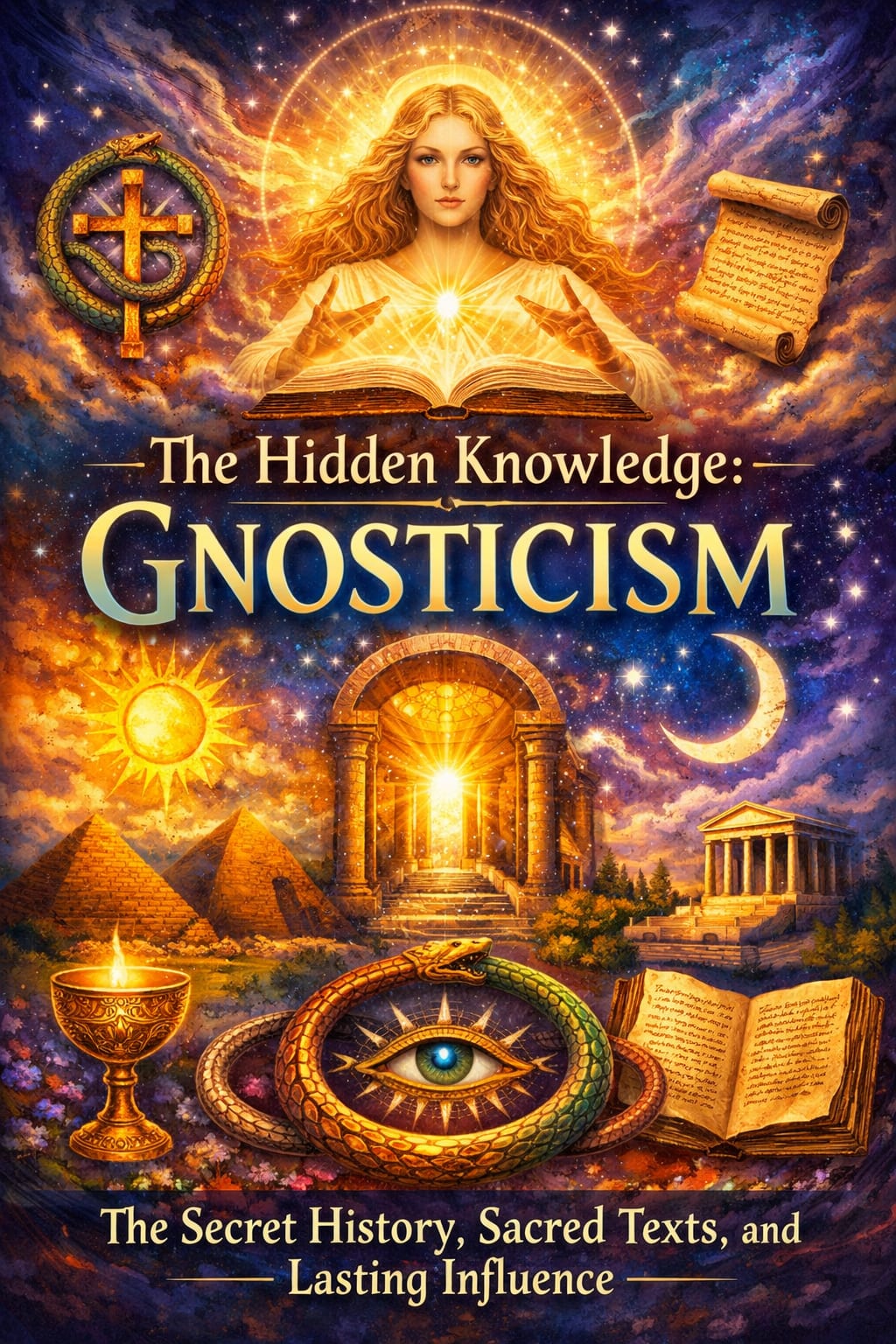
A World Awakened by Hidden Knowledge
Gnosticism emerged during the first centuries of the Common Era within a world shaped by religious experimentation, philosophical exchange, and profound social change. The eastern Mediterranean functioned as a crossroads of Jewish theology, Greek philosophy, Egyptian religion, and emerging Christian thought. Within this environment, Gnostic traditions developed as spiritual systems concerned with the origin of existence, the nature of divinity, and the condition of the human soul. Rather than forming a single religion or centralized movement, Gnosticism encompassed multiple schools and communities bound by a shared conviction that salvation arose through direct, transformative knowledge.
This knowledge, known as gnosis, referred not to intellectual learning alone but to an experiential awareness of divine reality. Gnostic teachings commonly described the material world as a flawed or illusory domain fashioned by a lesser creative power, often identified as the Demiurge. Above this realm existed a transcendent and ineffable divine source, inaccessible through conventional worship yet reachable through awakening and insight. Humanity occupied a pivotal position within this cosmology, carrying a fragment of divine essence concealed within physical existence.
Early Christian writings, Platonic metaphysics, and Jewish apocalyptic traditions all contributed to the development of Gnostic cosmologies. Some Gnostic groups reinterpreted biblical narratives, portraying figures such as Adam, Eve, or Sophia as bearers of liberating wisdom rather than symbols of transgression. Others presented Christ not as a suffering redeemer bound to physical death, but as a revealer of hidden truth sent to awaken spiritual memory. These interpretations diverged sharply from doctrines that later became orthodox, prompting fierce opposition from emerging ecclesiastical authorities.
By the second and third centuries CE, Gnostic communities flourished across regions including Egypt, Syria, and Asia Minor. Teachers such as Valentinus articulated complex theological systems that rivaled mainstream Christian theology in sophistication and influence. Opposition from church leaders resulted in polemical writings that condemned Gnostic teachings as heretical, leading to the suppression and eventual disappearance of many communities. For centuries, knowledge of Gnosticism survived primarily through hostile accounts written by critics.
The modern rediscovery of Gnostic texts, particularly the Nag Hammadi codices uncovered in Egypt in 1945, transformed scholarly understanding of these traditions. Original writings revealed philosophical depth, poetic symbolism, and spiritual concerns far more nuanced than earlier portrayals suggested. Gnosticism now stands as a vital lens through which the diversity of early religious thought can be understood, offering insight into enduring human questions surrounding freedom, identity, and the pursuit of transcendent truth.
Historical Context and Development
Gnosticism developed during the first and second centuries of the Common Era within a Mediterranean world marked by cultural exchange, political upheaval, and religious plurality. The Roman Empire governed vast territories that connected Jewish communities, Greek philosophical schools, Egyptian religious traditions, and newly forming Christian assemblies. This environment encouraged theological experimentation and the blending of ideas, allowing alternative interpretations of divinity and salvation to take root.
Jewish apocalyptic literature contributed significantly to early Gnostic thought, particularly concepts concerning divine wisdom, cosmic struggle, and hidden revelation. Texts such as the Book of Daniel, Enochic literature, and wisdom traditions introduced themes of secret knowledge disclosed to chosen individuals. These elements later appeared in Gnostic mythologies that emphasized revelation granted to a spiritual elite rather than to the masses. Platonic philosophy, especially Middle Platonism, supplied metaphysical frameworks that distinguished between eternal, perfect realities and the impermanent material world. The Platonic hierarchy of being provided intellectual support for Gnostic dualism and theories of emanation.
Christian narratives also played a central role in the formation of Gnostic systems. Early Christian communities were far from doctrinally uniform, and debates surrounding the nature of Christ, creation, resurrection, and salvation remained unresolved for centuries. Some Gnostic teachers interpreted Jesus as a divine emissary whose primary function involved imparting hidden wisdom capable of awakening spiritual memory. This interpretation contrasted sharply with emerging ecclesiastical doctrines that emphasized bodily incarnation, sacrificial atonement, and institutional authority.
The term Gnosticism derives from the Greek gnosis, meaning knowledge, yet historical evidence indicates that ancient groups rarely employed this term as a collective identity. Modern scholarship applies the label as a classificatory tool rather than a reflection of ancient self designation. Scholar Michael Allen Williams has argued that the diversity among these groups challenges the usefulness of the term as a singular category, noting substantial differences in cosmology, theology, and ritual practice across traditions.
By the second century CE, identifiable schools such as the Valentinians, Sethians, and Basilideans had developed sophisticated theological systems. Valentinian communities in particular achieved considerable influence, operating openly within Christian congregations while promoting alternative interpretations of scripture and salvation. Sethian groups emphasized primordial figures associated with divine knowledge and constructed elaborate cosmologies populated by spiritual entities known as aeons. Basilidean traditions introduced unique metaphysical structures that combined philosophical abstraction with mythic narrative.
Opposition to these movements intensified as Christian leadership sought doctrinal unity. Figures such as Irenaeus of Lyons, Tertullian of Carthage, and Hippolytus of Rome composed detailed refutations that preserved valuable information about Gnostic teachings while simultaneously condemning them as heretical. These polemical works shaped historical understanding for centuries, often portraying Gnosticism as incoherent or morally suspect. The eventual consolidation of orthodoxy under imperial patronage in the fourth century led to the suppression of heterodox communities and the disappearance of many Gnostic texts.
The question of Gnosticism’s origins prior to the second century remains contested. Some scholars argue for pre–Christian Gnostic tendencies rooted in Jewish mysticism or Near Eastern religious traditions, while others view Gnosticism primarily as a response to early Christianity. The absence of definitive textual evidence from the first century prevents firm conclusions, ensuring that the study of Gnostic origins remains an active field of academic inquiry.
Core Beliefs and Conceptual Framework
At the heart of Gnostic thought lies a radical inquiry into the nature of existence and the predicament of the human soul. Gnostic systems describe reality as divided between an ultimate, transcendent source of being and the visible cosmos experienced through the senses. This supreme principle, often referred to in texts as the Invisible Spirit or the True God, exists beyond language, form, and material limitation. Unlike the creator figure presented in many biblical traditions, this highest divinity remains untouched by the corruption and imperfection associated with the physical universe.
The material world occupies a diminished position within Gnostic cosmology. Creation is frequently attributed to a subordinate entity known as the Demiurge, sometimes assisted by lesser powers called archons. These beings govern the material realm and maintain the structures that bind spiritual essence to physical form. Gnostic texts portray this act of creation not as an expression of benevolence, but as the result of ignorance, arrogance, or cosmic error. The material cosmos functions as a veil that obscures divine reality and entraps the spiritual element within humanity.
Human beings hold a unique status within this framework. Gnostic writings describe the presence of a divine spark embedded within certain individuals, originating from the higher realms of light. This spark remains dormant within the body and psyche, unaware of its true origin due to the constraints imposed by material existence. The human condition is therefore defined by forgetfulness rather than sin, and the fundamental problem confronting the soul involves ignorance of its divine source.
Liberation within Gnostic traditions is achieved through gnosis, a form of direct, experiential knowledge that awakens spiritual memory. This knowledge is not equivalent to intellectual assent or adherence to doctrine. Gnosis involves an inner recognition of divine origin and an understanding of the cosmic structures that govern existence. Through this awakening, the soul gains the capacity to transcend the material realm and return to its place within the higher spiritual order.
A pronounced dualism characterizes many Gnostic systems. Spirit and matter are treated as opposing principles, with spirit associated with fullness, truth, and permanence, while matter is linked to deficiency, illusion, and decay. This dualism does not always imply moral evil within matter itself, but rather an ontological inferiority that renders material existence incapable of providing ultimate fulfillment. The spiritual realm alone possesses enduring reality.
Revelation plays a central role in transmitting Gnostic knowledge. Teachings are often conveyed through symbolic language, visionary discourse, and mythic narrative rather than systematic theology. Gnostic texts describe secret teachings revealed by divine intermediaries, frequently identified with figures such as Christ, Seth, or Sophia. These revelations are intended for those capable of receiving them, reinforcing the idea that salvation depends upon insight rather than collective ritual participation.
Gnostic cosmologies employ elaborate mythological structures to articulate metaphysical truths. Emanation serves as a recurring concept, describing the gradual unfolding of reality from the highest divine source into successive levels of existence. These emanations populate the spiritual realms with aeons, each representing aspects of divine fullness. The descent of the soul into matter and the possibility of ascent through knowledge form the narrative arc underlying many Gnostic texts.
While Gnosticism shares narrative elements with early Christianity, significant theological divergences distinguish the two traditions. Gnostic interpretations of Jesus often emphasize the role of teacher and revealer rather than sacrificial redeemer. Texts such as the Gospel of Thomas present collections of sayings that stress self knowledge and spiritual awakening. Resurrection is frequently understood in symbolic or spiritual terms rather than as a future bodily event. These interpretations challenged emerging orthodox positions and contributed to the eventual marginalization of Gnostic communities.
Taken together, these beliefs form a coherent yet diverse conceptual framework centered on awakening, remembrance, and liberation from spiritual ignorance. Gnosticism offers a vision of salvation grounded in knowledge of divine origin and cosmic structure, presenting an alternative spiritual worldview that continues to resonate through philosophical, mystical, and esoteric traditions.
Gnostic Rituals, Practices, and Symbols
Gnostic communities cultivated a rich repertoire of rituals and practices aimed at awakening spiritual knowledge and liberating the divine spark trapped within the human soul. One of the central rites was the baptism of light, a symbolic immersion representing purification, rebirth, and preparation for ascent toward the ineffable God. This ritual differed from mainstream Christian baptism in emphasizing inner illumination and mystical knowledge over public confession or formal adherence to dogma. Some groups, such as the Valentinians, incorporated multiple baptisms or layered initiation ceremonies, each marking a deeper stage of spiritual understanding.
Sacred meals and communal gatherings often functioned as ritual enactments of cosmological narratives. These meals symbolized the unity of the community with divine realities, the soul’s nourishment from spiritual knowledge, and participation in the cosmic drama described in Gnostic myth. Texts such as the Gospel of Philip reference these sacramental meals in connection with bridal imagery and mystical union, reflecting a symbolic bridging between human experience and divine archetypes.
Meditative and contemplative practices also played a significant role. Some Gnostic communities encouraged visualization, silent reflection, and guided dream interpretation to access hidden truths. These practices were intended to reveal inner divine wisdom and facilitate the soul’s ascent past the archons—cosmic rulers obstructing spiritual liberation. The use of mantras, secret prayers, and liturgical formulas in certain Sethian and Valentinian texts suggests that repetitive verbal or mental exercises were employed as techniques for focusing consciousness on transcendent realities.
Symbolism pervaded both texts and ritual practice. Light was a recurring motif, representing gnosis, divine illumination, and liberation from ignorance. Water symbolized purification and the flow of life, while serpentine imagery often represented hidden wisdom, regeneration, and the transformative power of knowledge. The figure of Sophia, central to many Gnostic myths, appeared not only as a mythic entity but also as a symbol invoked in rituals emphasizing wisdom, feminine creative power, and the restoration of balance between spiritual and material realms.
Gnostic practices were intentionally esoteric, designed for initiates who had been instructed in the community’s secret teachings. Secrecy was not merely protective; it served a pedagogical function, allowing gradual comprehension of complex cosmologies and metaphysical truths. Unlike orthodox liturgies that emphasized uniform observance, Gnostic rituals were adaptable, reflective of the individual’s progress toward gnosis, and often personalized according to one’s spiritual aptitude and insight.
Historical evidence for these practices comes from the Nag Hammadi library, Patristic critiques, and later accounts of Valentinian and Sethian communities. Writings such as the Apocryphon of John, Gospel of Philip, and Trimorphic Protennoia provide detailed descriptions of ritual symbolism, metaphysical hierarchies, and the transformative goals of these ceremonies. Scholarly analysis suggests that Gnostic rituals were less about compliance and more about cultivating a direct, experiential encounter with the divine, a hallmark that distinguishes Gnostic religious life from contemporaneous traditions.
By examining these rituals and symbols, readers gain insight into how Gnostic cosmology and theology were lived and enacted. Rituals provided a bridge between abstract metaphysical concepts and personal spiritual experience, allowing communities to embody ideas about liberation, divine emanation, and the soul’s journey. This focus on practice demonstrates that Gnosticism was not only an intellectual or textual movement but a fully integrated religious tradition in which knowledge, symbol, and ritual interwove to shape the believer’s path toward inner freedom.
Gnosticism and Comparative Mysticism
Gnosticism shares striking conceptual parallels with other mystical and esoteric traditions across time and geography, highlighting universal concerns about human consciousness, spiritual ascent, and the pursuit of hidden knowledge. Many Gnostic cosmologies emphasize the emanation of divine reality, a theme that finds resonance in Neoplatonism, where the One gives rise to successive layers of being, and in Jewish Kabbalah, which describes the emanation of the sefirot from the Ein Sof, the infinite source. Both systems, like Gnostic thought, depict reality as structured in hierarchical layers through which the soul ascends toward union with the ultimate divine. Similarly, certain strands of Sufism employ symbolic language and contemplative practices to convey the journey of the soul through inner purification toward divine proximity, echoing the Gnostic emphasis on inner illumination and experiential knowledge.
Eastern traditions also offer points of convergence. In Vedantic and Buddhist philosophies, the material world is often viewed as transient or illusory, and liberation is achieved through insight into the ultimate reality underlying ordinary perception. Gnostic dualism—the sharp distinction between the flawed material realm and the transcendent spiritual domain—parallels these teachings, although Gnosticism typically embeds this dualism within a mythic narrative populated by archons, aeons, and emanations. Across these diverse systems, a common thread emerges: liberation is not imposed externally but realized internally, through self‑knowledge, meditation, or mystical insight.
Despite these similarities, Gnosticism remains distinct in its complex mythopoetic structures and emphasis on salvific knowledge revealed through hidden or esoteric teachings. The figure of Sophia, the divine wisdom, and the motif of the Demiurge as an imperfect creator are unique contributions that shape Gnostic approaches to both cosmology and human experience. Comparative study underscores how Gnosticism interacts with a wider mystical matrix while retaining originality, offering scholars and spiritual seekers insight into the cross-cultural dynamics of religious thought. Recognizing these parallels enriches understanding of Gnostic ideas, demonstrating that the pursuit of transcendence, direct knowledge, and inner freedom has been a shared human concern across cultures, yet expressed with distinctive narrative, ritual, and symbolic language in Gnostic contexts.
This perspective situates Gnosticism not as an isolated phenomenon but as part of a broader continuum of mystical inquiry, encouraging readers to explore comparative sources and appreciate the shared motifs and unique innovations that define Gnostic thought.
Primary Texts and Sources
Knowledge of Gnosticism depends largely on the survival and recovery of ancient texts, many of which disappeared from circulation for more than a millennium. For centuries, information about Gnostic traditions derived almost exclusively from hostile accounts written by early Christian theologians. Authors such as Irenaeus of Lyons, Tertullian of Carthage, and Hippolytus of Rome composed detailed refutations intended to expose and discredit teachings deemed heretical. While invaluable as historical records, these writings framed Gnosticism through a polemical lens that emphasized deviation rather than philosophical substance.
A decisive transformation in the study of Gnosticism occurred in 1945 with the discovery of a cache of ancient manuscripts near Nag Hammadi in Upper Egypt. Known collectively as the Nag Hammadi library, this collection consists of thirteen leather bound codices containing over fifty texts written primarily in Coptic. Paleographic and linguistic analysis indicates that these manuscripts date to the fourth century CE, although many of the works they preserve originated several centuries earlier in Greek. The circumstances of their burial remain uncertain, though scholarly consensus suggests intentional concealment during periods of increasing religious suppression.
The Nag Hammadi texts revealed a diverse and sophisticated body of literature that dramatically altered scholarly understanding of early Christianity and late antique religion. Rather than presenting a single doctrine, these writings display a range of theological systems, mythological structures, and spiritual practices. Many texts adopt a revelatory format in which divine knowledge is disclosed through visionary experiences or secret teachings imparted by transcendent figures.
Among the most influential works is the Apocryphon of John, also known as the Secret Book of John. This text exists in multiple versions and serves as a cornerstone of Sethian Gnostic mythology. It presents a detailed cosmological narrative describing the emanation of divine aeons from the highest source and the emergence of the Demiurge as creator of the material realm. The text offers a reinterpretation of the Genesis creation account, portraying the creator figure as ignorant of the higher divine reality.
The Gospel of Thomas occupies a distinctive position within Gnostic and early Christian literature. Unlike narrative gospels, this work consists of 114 sayings attributed to Jesus, many of which emphasize self knowledge, inner illumination, and the recognition of divine presence within. Although scholarly debate continues regarding its classification, the text reflects themes consistent with Gnostic spirituality and preserves early traditions independent of canonical frameworks.
Sethian literature appears prominently within the Nag Hammadi corpus. Texts such as The Holy Book of the Great Invisible Spirit, sometimes called the Gospel of the Egyptians, articulate a cosmology centered on primordial divine entities and a spiritual lineage associated with Seth, the third son of Adam. These writings emphasize ritual language, baptismal imagery, and the ultimate restoration of the spiritual race to the realm of light.
Other works address specific theological concerns within a Gnostic framework. The Treatise on the Resurrection presents resurrection not as a future physical event but as a present spiritual reality attained through knowledge and transformation. The Gospel of Mary offers a perspective that elevates inner understanding and portrays Mary Magdalene as a recipient of privileged revelation. The Gospel of Philip explores sacramental symbolism, divine union, and the restoration of spiritual wholeness through mystical insight.
Beyond the Nag Hammadi collection, additional Gnostic related materials survive in fragmentary form through quotations, summaries, and translations preserved in patristic literature. Manichaean texts and Mandaean scriptures also preserve themes resonant with Gnostic cosmology, although scholarly caution distinguishes these traditions from classical Gnosticism while acknowledging shared motifs.
The systematic study and cataloguing of these texts reshaped modern scholarship by revealing the intellectual depth and diversity of early religious movements. Access to original writings allows Gnosticism to be understood as a complex spiritual tradition rather than a marginal deviation. These sources illuminate a vibrant landscape of theological experimentation that existed alongside emerging orthodox Christianity, challenging simplified narratives of religious development in late antiquity.
Major Figures and Influential Schools
The development of Gnostic thought owes much to a diverse array of teachers, interpreters, and intellectual communities active during the first three centuries of the Common Era. These figures operated within overlapping philosophical, religious, and cultural networks, producing systems of thought that rivaled emerging orthodox Christianity in complexity and appeal.
Valentinus stands among the most prominent and intellectually sophisticated Gnostic teachers. Active in Rome during the mid second century CE, Valentinus received a classical education and engaged deeply with Platonic philosophy and Christian theology. Valentinian teaching presented an elaborate cosmology centered on the emanation of divine fullness, known as the Pleroma, populated by paired spiritual entities called aeons. Salvation within this system involved the restoration of harmony disrupted by cosmic imbalance, achieved through knowledge imparted by Christ. Valentinian communities functioned openly within Christian congregations for several generations, demonstrating the porous boundaries between orthodoxy and heterodoxy during this period.
Basilides of Alexandria developed a distinct metaphysical system that combined abstraction with mythic narrative. Active during the early second century CE, Basilides proposed a complex hierarchy of heavens governed by archons and emphasized the transcendence of the ultimate divine source beyond comprehension. Basilidean thought introduced ethical reflections on suffering and responsibility, framing existence as part of a cosmic process shaped by ignorance rather than malice. Although much of Basilides’ work survives only through hostile summaries, the system exerted lasting influence on later speculative theology.
Sethian traditions represent one of the earliest and most mythologically rich forms of Gnostic thought. These communities traced spiritual lineage to Seth, regarded as a bearer of divine wisdom. Sethian texts emphasize primordial revelation, the fall of divine wisdom personified as Sophia, and the entrapment of spiritual humanity within the material realm. Works such as the Apocryphon of John and The Three Steles of Seth articulate a vision of salvation through remembrance of divine origin. Sethian communities appear to have flourished primarily in Egypt and Syria.
Marcion of Sinope occupies a contested position in the study of Gnosticism. Active in the mid second century CE, Marcion advanced a radical theological distinction between the creator god associated with the Hebrew scriptures and the higher god revealed through Christ. Although Marcion rejected mythological cosmologies characteristic of many Gnostic systems, the sharp dualism and rejection of the material order aligned closely with Gnostic sensibilities. Marcion’s formation of a distinct canon and ecclesiastical structure marked one of the earliest organized alternatives to emerging orthodox Christianity.
Simon Magus, a figure known primarily through early Christian polemics, is traditionally regarded as an antecedent to later Gnostic movements. According to sources such as Justin Martyr and Irenaeus, Simon promoted teachings centered on divine power manifested through knowledge and liberation from material constraints. While historical details remain uncertain, Simonian traditions appear to have influenced subsequent developments in Gnostic mythology and self understanding.
Carpocrates of Alexandria introduced ethical interpretations that challenged conventional moral frameworks. Carpocratian teaching emphasized liberation from material law and social constraint through knowledge, arguing that the soul must experience all aspects of existence to achieve freedom. Although later writers portrayed these teachings as morally extreme, surviving accounts suggest a philosophical system concerned with transcendence of material limitation.
Engagement with Gnostic thought extended beyond self identified communities. Neoplatonic philosophers such as Plotinus encountered Gnostic systems and responded critically. Plotinus rejected Gnostic denigration of the material cosmos, defending the goodness and rationality of creation while acknowledging the ineffability of the highest principle. The resulting intellectual exchanges reflect the shared philosophical terrain occupied by Gnostic and Platonic thinkers, particularly concerning metaphysics, emanation, and the ascent of the soul.
Additional figures contributed to the broader Gnostic landscape through teaching, commentary, and community leadership. Figures such as Theodotus, Heracleon, and Ptolemy elaborated Valentinian theology and engaged directly with Christian scripture through allegorical interpretation. Their writings reveal a sustained effort to reconcile revelatory knowledge with philosophical rigor.
Taken together, these individuals and schools demonstrate that Gnosticism was not a marginal or isolated phenomenon. The movement attracted highly educated thinkers capable of articulating sophisticated theological systems. Through debate, adaptation, and conflict, these figures shaped the intellectual and spiritual contours of late antiquity, leaving a legacy that continues to inform scholarly inquiry and esoteric tradition alike.
Women and Gender in Gnostic Thought
Gnostic texts and communities often present a strikingly egalitarian approach to spiritual authority and insight, particularly in comparison to mainstream late antique Christianity. Female figures frequently occupy central roles in both myth and practice, with Sophia—the personification of divine wisdom—serving as a primary example of feminine spiritual authority. Sophia’s narrative, found in texts such as the Apocryphon of John and The Hypostasis of the Archons, depicts her as both a cosmic agent of creation and a figure whose missteps and redemption mirror the human soul’s journey toward gnosis.
Historical evidence suggests that women were active participants and leaders in Gnostic communities. Texts like the Gospel of Mary highlight Mary Magdalene as a prominent disciple, whose understanding and teaching of secret knowledge surpass that of some male followers. In several traditions, she functions not merely as a witness but as an interpreter of the divine mysteries, embodying the principle that spiritual authority derives from insight rather than gender or institutional position. These examples reflect a broader pattern within certain Gnostic sects, such as the Valentinians and Sethians, where women could occupy leadership roles, serve as teachers, and engage in ritual practices on equal footing with men.
Theologically, Gnostic frameworks often reinterpret the creation and fall narratives to emphasize balance, complementarity, and the divine feminine. By presenting wisdom, nurturing, and creation as integral aspects of the divine, these texts challenge patriarchal assumptions inherent in other contemporary religious systems. This approach also underscores the spiritual potential inherent in all individuals, affirming that liberation and gnosis are accessible without reference to social or gender hierarchy.
Studying women and gender in Gnosticism enriches understanding of how these movements questioned social and theological norms while providing alternative models of leadership, authority, and spiritual participation. It also illuminates the enduring influence of these perspectives on later mystical and esoteric traditions, where feminine archetypes, wisdom figures, and gender-inclusive practices continue to resonate. Awareness of these dimensions encourages a more nuanced view of Gnosticism, revealing it as a dynamic tradition that integrated theological innovation with social and spiritual inclusivity.
Influence and Legacy
Gnosticism persisted as an intellectual and spiritual current long after the consolidation of Christian orthodoxy in the fourth century CE. Imperial endorsement of Nicene Christianity under Constantine and subsequent rulers resulted in the systematic suppression of heterodox communities. Councils and synods codified doctrinal orthodoxy, labeling divergent teachings as heretical, while texts and manuscripts associated with Gnostic traditions were often destroyed or hidden. Despite these measures, the philosophical and mystical motifs of Gnosticism endured, often concealed beneath other religious, mystical, or philosophical frameworks.
During the medieval period, traces of Gnostic thought resurfaced in movements characterized by dualist cosmologies and emphasis on inner spiritual authority. The Cathars, active in southern France during the twelfth and thirteenth centuries, exhibited a stark dualism between spirit and matter reminiscent of classical Gnosticism. Cathar doctrine emphasized the corruption of the material world and the liberation of the soul through spiritual insight and ascetic practice. These communities attracted both popular and intellectual attention, provoking campaigns by the Catholic Church, including the Albigensian Crusade, to eradicate what was seen as heretical influence.
The Renaissance witnessed a revival of interest in Hermeticism and other esoteric philosophies, where Gnostic motifs were reinterpreted in a syncretic context. Thinkers such as Marsilio Ficino, Giovanni Pico della Mirandola, and the broader Florentine intellectual milieu explored the hierarchy of spiritual realms, the ascent of the soul, and the potential for human knowledge to unite with divine reality. Hermetic texts, which circulated widely after the invention of printing, contained cosmological and ethical ideas that closely paralleled the themes of emanation, divine sparks, and spiritual awakening central to Gnostic systems.
In modern times, the impact of Gnostic ideas is evident in a range of esoteric, occult, and spiritual movements. The rediscovery of the Nag Hammadi library in 1945 catalyzed renewed interest in authentic Gnostic texts, influencing 20th-century thinkers in psychology, literature, and mysticism. Carl Jung, for example, drew on Gnostic symbolism to articulate the processes of individuation and the confrontation with unconscious forces, framing ancient myth as a template for inner psychological transformation. Contemporary Western esoteric movements, including Theosophy, Rosicrucianism, and elements of modern occultism, often incorporate Gnostic motifs such as the divine spark, hidden wisdom, and personal initiation as central principles of practice.
Gnostic influence also extends into literary and philosophical expression. Writers such as Jorge Luis Borges, Hermann Hesse, and Philip K. Dick engaged with Gnostic themes, including the illusory nature of reality, the presence of higher knowledge beyond ordinary perception, and the tension between spiritual freedom and material limitation. These cultural manifestations illustrate that Gnostic ideas transcend strictly religious contexts, continuing to shape imaginative and intellectual landscapes.
The enduring legacy of Gnosticism lies not only in historical texts or doctrinal systems but in the persistent human attraction to direct knowledge of the divine, the questioning of external authority, and the pursuit of inner transformation. Across centuries, these principles have inspired reformulation and adaptation, demonstrating the capacity of Gnostic thought to resonate with shifting social, philosophical, and spiritual conditions while maintaining its distinctive emphasis on knowledge, liberation, and the transcendence of the material world.
Gnosticism and Modern Occultism
The influence of Gnosticism on modern occultism is profound, shaping both philosophical frameworks and practical approaches to spiritual development. While historical Gnostic sects largely disappeared by late antiquity, their concepts survived through reinterpretation, textual preservation, and incorporation into mystical and esoteric currents. These enduring motifs include the emphasis on direct, experiential knowledge of the divine, the recognition of a transcendent reality beyond the material world, and the aspiration for liberation from constraints imposed by physical existence.
Modern occultism frequently reflects the dualistic cosmology of classical Gnosticism. The material world is often portrayed as a veil that obscures higher spiritual realities, while the inner self is regarded as containing a spark of the divine capable of awakening through disciplined practice. Initiatory knowledge, meditation, ritual, and symbolic study serve as vehicles for realizing this potential. Western ceremonial magic, Hermetic philosophy, and contemporary magical orders emphasize experiential insight, moral discernment, and self-transformation rather than reliance on dogmatic authority, echoing the Gnostic insistence on personal gnosis.
The nineteenth and early twentieth centuries saw a resurgence of interest in Gnostic thought that coincided with the emergence of modern occult societies. Theosophical teachings incorporated Gnostic ideas of emanation, spiritual hierarchies, and the progressive ascent of consciousness. The Hermetic Order of the Golden Dawn explored correspondences between material and spiritual realms, ritualized ascent, and inner illumination, often using symbolic structures reminiscent of Gnostic cosmologies. Rosicrucian groups similarly integrated metaphysical speculation with moral and ethical frameworks derived in part from classical Gnostic principles.
Carl Jung’s engagement with Gnosticism represents a key moment in its modern intellectual reception. Jung interpreted Gnostic myths and symbols as expressions of inner psychic processes, portraying struggles between unconscious and conscious forces as reflective of universal spiritual dynamics. Gnostic texts provided Jung with a vocabulary for describing individuation, the emergence of self-awareness, and the integration of opposites. This psychological reading of Gnosticism emphasized gnosis as an experiential and transformative practice rather than merely a theological or historical phenomenon.
Contemporary occult and esoteric traditions continue to display Gnostic influence. Chaos magic, modern witchcraft, and certain New Age movements adopt principles of personal spiritual authority, the interrogation of conventional belief systems, and the pursuit of hidden truths through meditation, visualization, and altered states of consciousness. The Demiurge frequently appears in modern interpretations as a metaphor for limiting structures, cultural illusions, or authoritarian systems, maintaining the classical Gnostic critique of material and institutional oppression while situating it in symbolic, rather than literal, terms.
The availability of authentic Gnostic texts, particularly following the publication of the Nag Hammadi codices, catalyzed direct engagement with original sources. Occult practitioners and scholars gained access to foundational writings such as the Apocryphon of John, Gospel of Thomas, and Sethian scriptures. These texts offered guidance for reconstructing spiritual practice, ritual symbolism, and mythopoetic systems grounded in classical Gnostic cosmology. The presence of these sources allowed modern occultism to move beyond earlier misrepresentations and reinterpretations, fostering renewed appreciation of Gnosticism’s intellectual and mystical depth.
Within modern occult frameworks, Gnosticism functions less as a reconstructed religion and more as a philosophical, symbolic, and practical orientation. The central tenets—inner illumination, liberation through knowledge, and the recognition of divine essence within the self—provide a durable foundation for spiritual inquiry. Across centuries, these ideas have bridged the ancient and the contemporary, influencing esoteric philosophy, mystical practice, and spiritual culture while preserving the core Gnostic emphasis on awakening, personal insight, and transcendence.
Recommended Readings: #commissionearned
The Nag Hammadi Scriptures edited by Marvin W. Meyer
This comprehensive collection gathers the complete corpus of ancient Gnostic writings discovered near Nag Hammadi, Egypt in 1945, preserving voices long lost to history. The texts include foundational works such as the Gospel of Thomas, Gospel of Mary, and Apocryphon of John, each offering insight into how spiritual knowledge and revelation shaped early religious imagination. Introductory essays and annotations provide essential historical context and situate each text within its cultural and philosophical environment. Rather than presenting a single unified theology, the volume showcases the diversity of Gnostic cosmologies, soteriological visions, and mystical metaphors that emerged in the early centuries of the Common Era. The collection demonstrates how Gnostic communities understood divine emanation, spiritual ascent, and the nature of salvation. Access to these texts deepens appreciation for Gnostic emphasis on inner transformative knowledge and self-awareness. For readers seeking direct engagement with primary materials, this edition provides the most complete and authoritative presentation available.
The Gnostic Scriptures by Bentley Layton
This book offers a curated selection of essential Gnostic texts with scholarly translation and commentary that illuminates both their theological and literary character. Works from the Nag Hammadi library and other sources are included, allowing comparison of diverse voices within the tradition. Introductions and annotations provide historical context and interpretive guidance, clarifying linguistic nuances and symbolic motifs. The texts explore creation myths, cosmological structures, and concepts of spiritual ascent, providing insight into the Gnostic vision of liberation through knowledge. Careful attention to textual history and patristic references situates each writing in dialogue with early critiques of Gnosticism. This volume supports study of how Gnostic communities articulated questions about divine origin, human destiny, and spiritual awakening. Engagement with this book reinforces understanding of the primary sources that shaped both historical Gnosticism and its ongoing influence on esoteric thought.
Rethinking Gnosticism by Michael Allen Williams
This work interrogates the scholarly category of Gnosticism, challenging the notion that it represents a single, coherent religious movement. Close analysis of primary texts shows that groups traditionally labeled as Gnostic often did not share beliefs or self-identify under the term. The book examines early Christian, Jewish, and Hellenistic influences, highlighting the complex social and intellectual contexts in which these teachings arose. Historical polemics and surviving manuscripts are assessed critically to reconstruct a nuanced picture of early religious diversity. The author demonstrates that Gnostic cosmologies, soteriologies, and ritual practices were highly variable and context-dependent. This analysis enhances understanding of the blog’s discussion on the multiplicity of Gnostic schools and their distinctive teachings. The work encourages careful attention to historical evidence rather than reliance on inherited labels or simplistic classifications.
Ancient Gnosticism: Traditions and Literature by Birger Pearson
This text provides an academically grounded overview of Gnostic groups, writings, and practices, emphasizing historical and literary contexts. The work examines both canonical and non-canonical texts to explore mythic structures, cosmologies, and ritual patterns central to Gnostic communities. It situates Gnostic thought within the broader late antique environment, including interactions with Christianity, Judaism, and Hellenistic philosophy. Close attention is given to the symbolic language and theological reasoning used in the primary sources. The book addresses debates about origins, definition, and diversity of Gnostic groups, clarifying complex scholarly discussions. Readers gain tools for evaluating textual evidence and interpreting Gnostic beliefs in context. This resource complements the blog’s exploration of history, texts, and philosophical frameworks within Gnosticism.
Lost Christianities by Bart D. Ehrman
This historical survey explores the diversity of early Christian movements, including those commonly described as Gnostic, and traces how certain groups were marginalized or suppressed. The book examines the formation of canonical texts, the negotiation of theological authority, and the disputes that shaped orthodox doctrine. Attention is given to apocryphal and non-canonical writings, showing alternative understandings of Christ, salvation, and divine hierarchy. Social and political dynamics of early communities are highlighted, clarifying why some traditions were lost or hidden. The text emphasizes the fluidity and plurality of early Christianity, situating Gnostic movements as one important strand among many. This perspective aligns with the blog’s discussion of historical context and the persistence of Gnostic ideas. Ehrman’s narrative bridges accessible historical writing with rigorous scholarship, making it a useful introduction for readers seeking broader context.
The Gnostic New Age by April D. DeConick
This work examines how Gnostic spirituality persisted and resurfaced in later cultural and religious movements, linking ancient ideas to modern esoteric and mystical contexts. It highlights key themes such as personal revelation, inner transformation, and critique of hierarchical authority, tracing their influence across time. The book demonstrates how Gnostic motifs reappeared in Renaissance thought, Hermetic philosophy, and contemporary spiritual practice. Detailed historical and comparative analysis explores continuity and adaptation, showing that core concepts such as divine sparks and spiritual ascent remained influential. The text also addresses modern interpretations of Gnosticism in occultism, highlighting symbolic and philosophical applications. Emphasis on inner knowledge and liberation mirrors the blog’s discussion of modern esoteric engagement with Gnostic themes. The study reinforces the relevance of Gnostic principles for understanding alternative spiritual currents across history.
The Gnostic Religion by Hans Jonas
This classic work examines the historical development, cosmology, and philosophical dimensions of early Gnostic movements. It provides a systematic analysis of Gnostic myths, including the roles of the Demiurge, aeons, and divine emanation. The book situates Gnosticism within the broader cultural and religious milieu of late antiquity, exploring interactions with Christianity, Hellenistic philosophy, and Jewish mysticism. Themes of alienation, human longing, and spiritual liberation are explored in depth, revealing the existential concerns underlying Gnostic thought. The text demonstrates how Gnostic communities developed rich theological systems capable of addressing fundamental questions of reality, knowledge, and salvation. By connecting mythic narrative to philosophical reflection, the book deepens understanding of the intellectual sophistication of these movements. Its comprehensive approach supports the blog’s discussion of beliefs, cosmology, and enduring influence in both historical and modern contexts.
Embracing the Path of Knowledge
Gnosticism offers a profound and multifaceted perspective on spiritual life, providing insights that extend far beyond conventional narratives of early Christianity. Its cosmologies, mythologies, and philosophical reflections illuminate the enduring human quest to understand the divine, the self, and the nature of reality. The recovery of texts such as those found in the Nag Hammadi library has revealed the remarkable diversity of thought that flourished alongside orthodox Christianity, demonstrating that questions of authority, revelation, and spiritual knowledge were central to many ancient communities. Engaging directly with these primary sources allows for a deeper appreciation of the symbolic, mystical, and intellectual dimensions that define Gnostic traditions, while also highlighting the creativity and adaptability of these teachings over time. Readers are encouraged to explore further through reputable scholarly works, public libraries, and academic editions that provide reliable translations and commentary. Caution is advised when consulting free online resources, as many texts are incomplete, mistranslated, or presented without necessary historical context. Pursuing careful, well-supported study not only fosters a more accurate understanding of Gnosticism but also encourages personal reflection on the questions of consciousness, liberation, and hidden knowledge that remain relevant across centuries. By following these paths, the study of Gnosticism can become both an intellectual and a transformative journey, opening new ways of thinking about spiritual experience, human potential, and the enduring pursuit of wisdom.
About the Creator
Marcus Hedare
Hello, I am Marcus Hedare, host of The Metaphysical Emporium, a YouTube channel that talks about metaphysical, occult and esoteric topics.
https://linktr.ee/metaphysicalemporium
Keep reading
More stories from Marcus Hedare and writers in BookClub and other communities.
Druids: Keepers of the Sacred Grove
The True Identity of the Druids The word Druid carries deep historical weight, rooted in the landscapes and societies of Iron Age Europe rather than in later fantasy. Ancient accounts and archaeological evidence point to an educated and influential class embedded within Celtic cultures across Gaul, Britain, and Ireland between roughly the 5th century BCE and the early centuries of the Common Era. Associations with oak groves, sacred springs, and open-air sanctuaries reflect authentic religious practices that emphasized the sanctity of the natural world as a living and ordered system.
By Marcus Hedarea day ago in BookClub
My New Book is Finally Here
My poetry collection Beautiful and Brutal Things is done. It's actually done and finally published over 270 pages. Over a year of my life went into this book. More than a year, really. Long days at my computer, sometimes seven days a week because I couldn't stop even when I probably should have. Then two months of editing that felt harder than the writing itself. But it's finished, and I'm still standing, and the book is real.
By Tim Carmichael2 days ago in BookClub
The Painter of the Void
Dedication To the unknown creators, the artists who spill their blood upon canvas, the writers who pour their souls onto pages, the musicians who translate their inner torments into melodies—this book is dedicated to you. To those who understand the exquisite pain of creation, the terrifying beauty of exposure, and the persistent pull of the shadow-self that lurks at the edge of every masterpiece.
By LUCCIAN LAYTH4 days ago in BookClub
Wild Card Weekend Recap: What Happens Now?
I think I figured out why I love Wild Card Weekend so much. It's because it's the first playoff anything of the calendar year. The NFL season starts in the fall, and once upon a time, the champion was crowned either on or slightly before New Year's. The evolution of the NFL schedule has resulted in the playoffs starting just into the New Year, and currently, the final week of the season falls on the first weekend of the New Year, with Wild Card Weekend coming a week after that. So yes, chronologically, the NFL's Wild Card Weekend serves as the first playoff anything of the calendar year.
By Clyde E. Dawkins6 days ago in Unbalanced




Comments
There are no comments for this story
Be the first to respond and start the conversation.