
Mystery story: how to create one
The Vanishing Violin: explained in a nutshell...

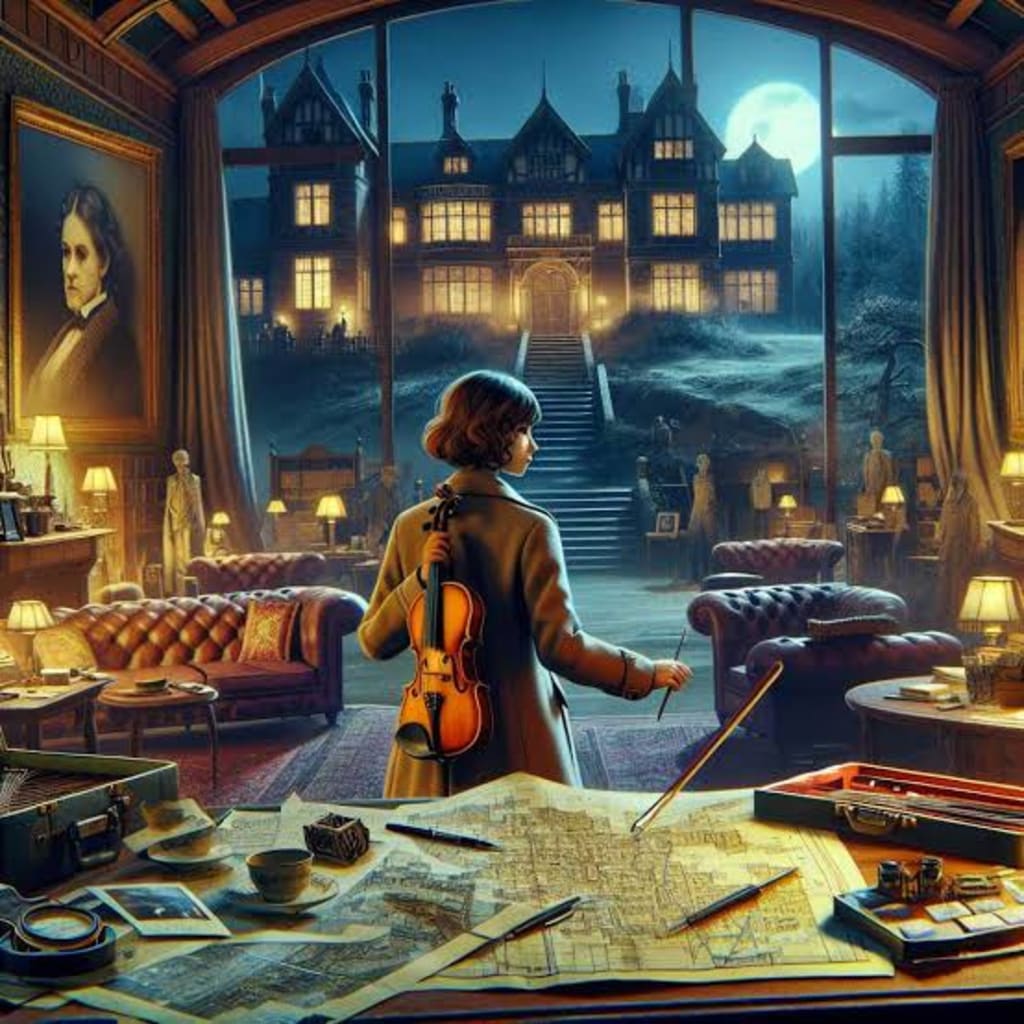
Mystery story - explained in a nutshell.
Example: The Vanishing Violin
Part 1: The Mystery
Detective Amir Patel adjusted his glasses as he stared at the empty glass case in the Melrose Museum. Just an hour ago, the *Red Violin*—a priceless 200-year-old instrument—had been on display. Now, it was gone.
No broken glass. No alarms triggered. The security guard swore no one had entered or exited.
Amir’s assistant, Maya, frowned. "How do you steal a violin without a trace?"
"That," Amir said, "is what makes this a *mystery*."
---
What Is a Mystery story?
A mystery is a story where something unknown happens (a crime, disappearance, or strange event), and the protagonist must uncover the truth by finding *clues*, questioning suspects, and solving puzzles. The best mysteries:
1. Hook the reader early (e.g., a theft, a murder, a secret letter).
2. Drop clues (subtle hints the detective—and reader—can piece together).
3. Include red herrings (fake clues to mislead).
4. End with a satisfying solution (the "aha!" moment).
---
Part 2: The Investigation
Amir examined the case. "The thief didn’t break in. They had a key."
Clue #1: The security guard’s keycard had been borrowed yesterday by a museum intern, *Luca*.
Clue #2: A faint smell of lavender lingered near the case—the same perfume worn by the museum’s curator, *Dr. Ellis*.
Red Herring: A janitor reported seeing a "shadowy figure," but the cameras showed nothing.
---
Famous Mystery Examples
1. Sherlock Holmes (*Arthur Conan Doyle*) – Uses logic to solve crimes (e.g., *The Hound of the Baskervilles*).
2. Nancy Drew (*Carolyn Keene*) – A teen detective solves small-town puzzles.
3. Agatha Christie’s Poirot – Focuses on psychology (e.g., *Murder on the Orient Express*).
---
Part 3: The Solution
Amir gathered the suspects:
- Luca: "I lost my keycard yesterday! I didn’t take it!"
- Dr. Ellis: "I was in my office all night!" (But her lavender perfume matched the scent.)
Then Amir noticed— Dr. Ellis’s sleeve had a tiny violin-string cut*.
The Truth: Dr. Ellis stole the violin by using Luca’s keycard, then hid it inside her *foldable umbrella* (leaving no trace). The "shadow" was her reflection!
---
How to Write Your Own Mystery
1. Start with the crime (e.g., stolen artifact, missing person).
2. Create a detective (professional, amateur, or accidental).
3. Add 3 suspects(each with motive + alibi).
4.Plant clues & red herrings (e.g., a fingerprint, a lie).
5. Reveal the culprit (surprising but logical).
---
Final Words
Maya grinned. "So mysteries are like puzzles—you hide the pieces but play fair."
"Exactly," Amir said. "Now, let’s return that violin."
---
Here are the most famous mystery stories, celebrated for their enduring influence, clever plotting, and cultural impact:
1. Agatha Christie’s Masterpieces
Christie, the "Queen of Crime," dominates the genre with classics like *And Then There Were None* (1939), the best-selling mystery novel of all time . Ten strangers trapped on an island are murdered one by one, with a twist ending that redefined the genre. Her *Murder on the Orient Express* (1934) features Hercule Poirot solving a locked-room murder aboard a train, challenging notions of justice.
2. Sherlock Holmes by Arthur Conan Doyle
Doyle’s *The Hound of the Baskervilles* (1902) blends Gothic horror with deductive logic, as Holmes investigates a family curse. *A Study in Scarlet* (1887) introduced Holmes and Watson, establishing the "consulting detective" archetype .
3. Hard-Boiled Detectives
Dashiell Hammett’s *The Maltese Falcon* (1930) stars Sam Spade in a gritty tale of greed and deception. Raymond Chandler’s *The Big Sleep* (1939) features Philip Marlowe navigating corruption in 1930s Los Angeles, defining the noir style.
4. Modern Thrillers and Psychological Suspense
Gillian Flynn’s *Gone Girl* (2012) revolutionized domestic noir with its unreliable narrators and shocking twists. Stieg Larsson’s *The Girl with the Dragon Tattoo* (2005) combines financial intrigue, cold cases, and a hacker protagonist, Lisbeth Salander.
5. True Crime and Literary Crossovers
Truman Capote’s *In Cold Blood* (1966) pioneered the "nonfiction novel," detailing the 1959 Clutter family murders. Wilkie Collins’ *The Woman in White* (1859) , an early sensation, blends mystery with Gothic suspense and unreliable narration.
6. Innovative Subgenres
*The Da Vinci Code* (2003) by Dan Brown popularized religious conspiracy thrillers, while *The Silence of the Lambs* (1988) by Thomas Harris fused crime with horror through the iconic Hannibal Lecter.
Legacy and Influence
These works set benchmarks for plot twists (*And Then There Were None*), character depth (*The Big Sleep*), and genre-blending (*In Cold Blood*). Christie and Doyle remain pillars of "whodunits," while modern authors like Flynn and Larsson explore societal critiques through suspense . For readers, these stories exemplify the thrill of solving puzzles while reflecting human nature’s darker facets.
---
Want a different theme (haunted house? spy mystery?) or more detail? Let me know right here on Vocal Media. Please subscribe if you want more stories from me. Have a nice day! 😊
About the Creator
Keep reading
More stories from franklin coetzee and writers in BookClub and other communities.
7 Emotional Intelligence Books You Must Read In 2026
What separates truly successful leaders, fulfilled professionals, and resilient individuals from the rest? It’s not raw intelligence, talent, or even experience—it’s emotional intelligence (EQ). Emotional intelligence is our ability to recognize, understand, manage, and influence emotions—both our own and those of others.
By Diana Meresc6 days ago in BookClub




Comments (1)
This was such a brilliant breakdown clear ,clever,and so fun to read.