
Moral Outrage Networks, The Sociology of Digital Anger (2026)
Book review

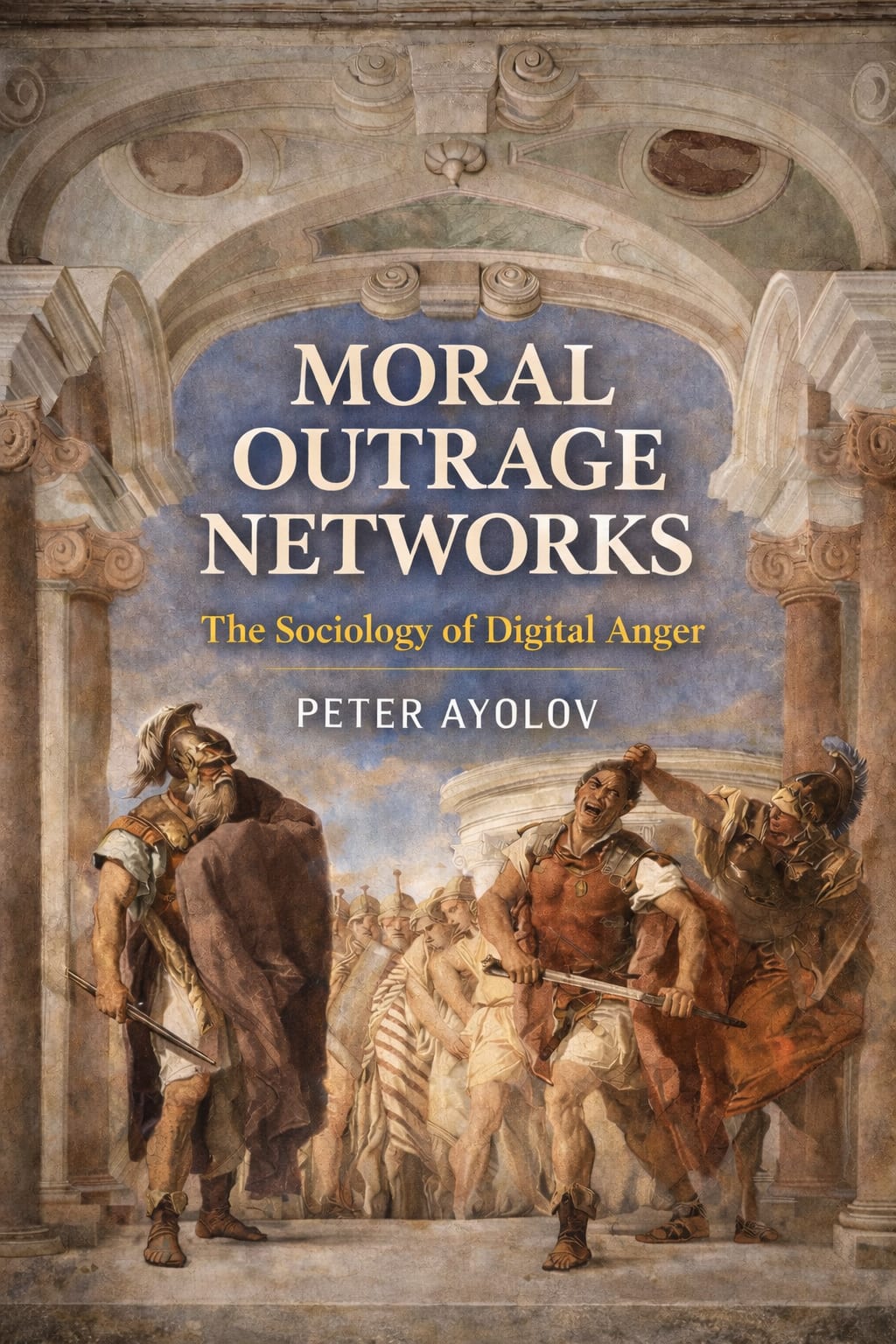
Peter Ayolov, Moral Outrage Networks: The Sociology of Digital Anger (2026)
Moral Outrage Networks: The Sociology of Digital Anger continues and deepens Peter Ayolov’s earlier work The Economic Policy of Online Media (2023), in which he developed the theory of the Manufacture of Dissent and outlined the Propaganda 2.1 Model as an update to classical propaganda theory under conditions of platform capitalism. While the earlier book focused on the political economy of digital media and the monetisation of dissent, this new volume turns decisively toward the emotional infrastructure that makes such systems viable. Ayolov now advances a more fundamental claim: moral anger is not merely exploited by digital media systems but constitutes one of the basic structural conditions of morality itself, and therefore of social life in networked societies.
Departing from dominant approaches that frame outrage as a pathological distortion of public reason, a media malfunction, or a democratic failure, the book argues that moral anger is an indispensable mechanism through which moral boundaries are detected, communicated, and enforced. Wherever morality exists, anger follows. What distinguishes the contemporary moment is not the presence of outrage, but its infrastructuralisation. Digital platforms, algorithms, and attention economies have transformed moral anger into a scalable, continuous, and economically productive force.
The book opens with a foreword, ‘Networks of Conspicuous Morality’, which situates the analysis within a long tradition of thinking about public virtue, visibility, and collective emotion. Ayolov shows that moral emotions have always required public expression to function socially, but that digital environments radically intensify this requirement by making moral signalling permanent, measurable, and monetisable. Anger, once embedded in ritual, doctrine, and institutional authority, now circulates through metrics, feeds, and algorithmic amplification.
The introductory chapter, ‘Manufacturing Moral Anger’, establishes the central conceptual framework. Ayolov argues that moral anger has become the primary emotional infrastructure of contemporary public life, displacing deliberation, persuasion, and factual consensus. In digital environments, communication is increasingly oriented toward activation rather than understanding. Speech functions less as a medium of truth than as a trigger of indignation. This transformation, the author suggests, marks a civilisational shift in the sociology of language, emotion, and power.
Chapter 2, ‘The Sociology of Anger’, provides the book’s theoretical foundations. Through a systematic distinction between anger, moral anger, and righteous anger, Ayolov integrates insights from moral psychology with classical sociological theory. He challenges the assumption that anger is inherently destructive or irrational, instead demonstrating its role as a moral watchdog that signals violations and sustains collective norms. Moral disagreement, the chapter shows, is not an anomaly of modern societies but an unavoidable feature of moral life itself.
The third chapter, ‘Manufacturing Anger’, offers a genealogy of moral emotion across historical media regimes. Building directly on the author’s earlier theory of the Manufacture of Dissent, this chapter examines how anger has been linguistically structured, politically mobilised, and rationalised across different communicative environments. Sections on the grammar of outrage, the rationality of anger, and anger management reveal how institutions and platforms alternately amplify and pacify outrage as a technique of governance and stability.
Chapter 4, ‘Moral Outrage Networks’, constitutes the analytical core of the book. Here Ayolov develops concepts such as rage-baiting, anger-clicking, and outrage exploitation networks to explain how platform architectures reward provocation, incivility, and emotional escalation. The Propaganda 2.1 Model is refined and extended to show how contemporary power no longer relies primarily on ideological coherence but on the management of affective circulation. Moral outrage becomes a resource, not an error.
The concluding chapter, ‘The Morality of Anger’, brings the argument to its most uncompromising formulation. Ayolov advances three fundamental propositions: there is no society without collective morality; there is no moral system without moral anger and shame; and therefore there can be no society without anger and outrage. From this perspective, the proliferation of offence, aggression, symbolic violence, and moral conflict in digital publics is not a deviation from social order but one of its conditions. As societies become global, dispersed, and digitally mediated, anger adapts accordingly, generating new moral forms, new conflicts, and new principles of social coordination.
What distinguishes Moral Outrage Networks is its refusal to moralise against moral anger itself. Rather than calling for its suppression, Ayolov insists on understanding its structural necessity, its transformations, and its dangers. The book provides a powerful framework for analysing polarisation, media distrust, and the reconfiguration of moral authority without retreating into nostalgia for a rational public sphere that may never have existed.
Conceptually ambitious and theoretically rigorous, Moral Outrage Networks will be of interest to scholars of sociology, media studies, political theory, and moral psychology. It stands as a significant continuation of Ayolov’s work on digital power and dissent, and as a timely contribution to understanding why anger has become the dominant moral language of the digital age.
About the Creator
Peter Ayolov
Peter Ayolov’s key contribution to media theory is the development of the "Propaganda 2.0" or the "manufacture of dissent" model, which he details in his 2024 book, The Economic Policy of Online Media: Manufacture of Dissent.
Keep reading
More stories from Peter Ayolov and writers in BookClub and other communities.
The Economic Policy of Online Media: Manufacture of Dissent
Peter Ayolov’s The Economic Policy of Online Media: Manufacture of Dissent is best read as a political economy of attention written from inside the contemporary media machine: a study of how dissent is not simply reported, represented, or ‘allowed’, but produced as a monetisable output of platform capitalism. The book’s organising intuition is both simple and unsettling. In the online environment, conflict is not a malfunction of communication; it is a business model. What appears to users as spontaneous outrage, grassroots polarisation, or organic ‘culture war’ is, at scale, a routinised industrial process—engineered through incentives, metrics, and infrastructures that reward emotional volatility and punish slow, careful public reasoning.
By Peter Ayolovabout 5 hours ago in BookClub
Rachel Reviews: The Spiral Archive by Pieter Hendrik
It's difficult for me to know where to start with a review of this book as it was, for me, an entirely unique experience and one that I'll probably never have again. I don't want that to be interpreted as unenjoyable but it has left me scratching my head a little and ruminating on its content, its themes and its characters.
By Rachel Deeming9 days ago in BookClub
7 Books That Start Slow and End Up Blowing Your Mind
Have you ever picked up a book that seemed slow, even tedious at first, only to find yourself completely captivated as the story unfolds? Books that start slow and end up blowing your mind are a unique breed. They demand patience, but the payoff is enormous—leaving you thinking, questioning, and marveling long after the last page. Below is a list of 7 books that start slow and end up blowing your mind.
By Diana Meresc2 days ago in BookClub


Comments
There are no comments for this story
Be the first to respond and start the conversation.