
Malvolio, in William Shakespeare's Twelfth Night
By Doc Sherwood

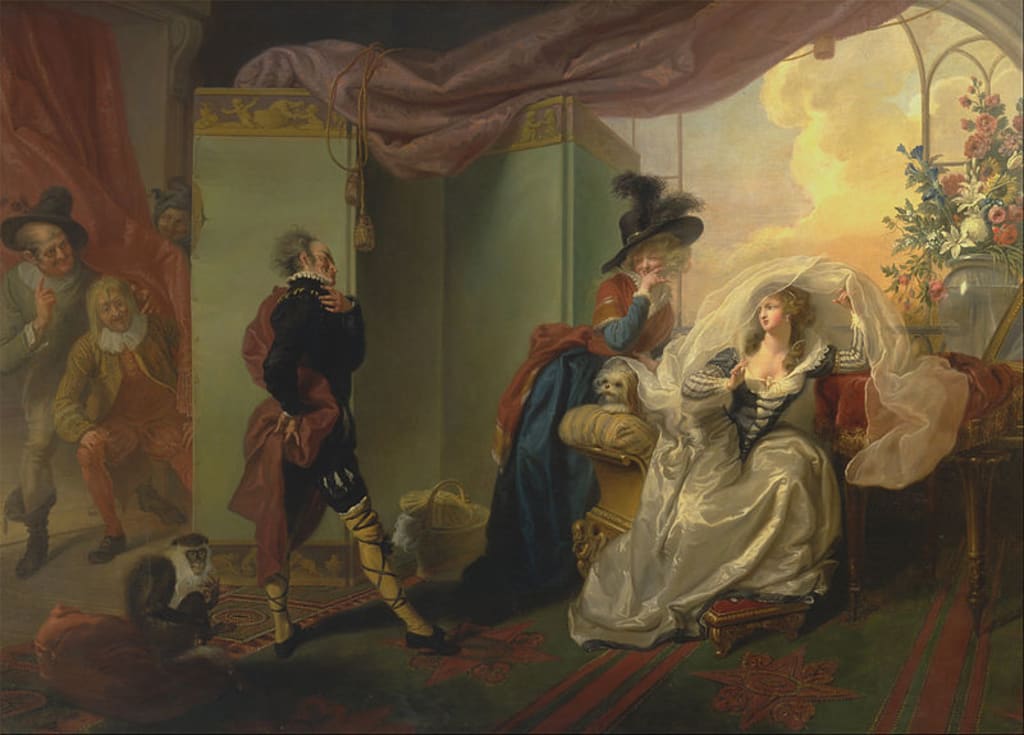
Twelfth Night; or, What You Will does not appear to have seen print until the first collected edition of Shakespeare’s works in 1623. We know however it was written around 1601, and performed in February 1602. This would make Twelfth Night the last in the group of plays we consider Shakespeare’s great comedies. By 1602 Shakespeare had already begun work on what are sometimes called the four great tragedies, and his more ambiguous and troubling comedies which are now known as the problem plays.
Twelfth Night more than lives up to its interim position between these two different chapters of Shakespeare’s writing career. For all that it resembles earlier sunny romances such as Much Ado About Nothing and As You Like It, sadder and darker elements lurk beneath these surface similarities. One among many is the play’s treatment of Lady Olivia’s steward, Malvolio.
From this character’s first appearances we see well enough that he’s a rude and self-important little man, the kind likely to make enemies. Sure enough, in an early scenes he reprimands Olivia’s drunken uncle Sir Toby Belch for his unruly behaviour, and insults Feste, the household clown. Together, these friends begin to contemplate taking revenge on Malvolio.
One of Shakespeare’s most famous comic scenes thereby ensues, when Olivia’s maid Maria (who is also in on the plot) fakes a letter from her mistress containing a confession of love for Malvolio. When the vain steward finds and reads it, he is immediately fooled. Maria has written that Olivia wants to marry him and share her fortune, so he need never think himself a common servant again.
She also convinces Malvolio that Olivia regards his yellow stockings with cross-garters as his single most attractive items of clothing...
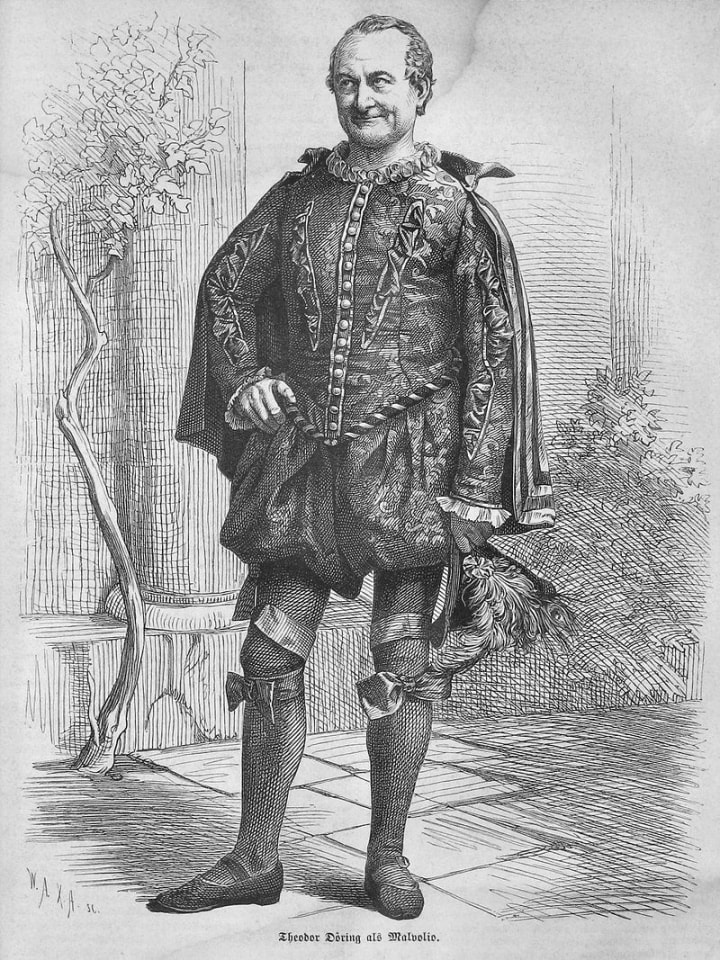
Thus Malvolio presents himself before Olivia, resplendent in the said garments, little suspecting his mistress actually despises such fashion. Making preposterous romantic overtures to Olivia, and quoting the letter of which she knows nothing, Malvolio thoroughly humiliates himself. Sir Toby’s prank has worked.
The spectacle of this foolish old man learning that pride comes before a fall seems to fit perfectly into a lighthearted romantic comedy, and from the earliest performances of Twelfth Night all the way to the present this has proved to be one of the play’s most memorable moments. The problem is what happens after that. Olivia, believing Malvolio to have gone mad, orders her servants to keep him under close guard. Of course, the servants know full well they’re the ones who made him look crazy in the first place, and they’re not finished having fun with him yet.
Unfortunately, the fun takes a considerably crueller turn at this point. Sir Toby and Maria lock Malvolio in a dark room for hours, and send Feste to play mocking tricks on him until Malvolio starts to wonder whether he really is losing his mind. The yellow stockings may have been funny, but it’s hard for modern audiences to laugh at the persecution of an old man who’s done no serious wrong.
In Olivia’s final words on the subject (and indeed, her last line in the play) she declares the joke has been carried much too far. Audiences of today are almost certain to agree with her. If Shakespeare’s viewing public laughed at the later Malvolio scenes without finding them in the least distressing, then it’s one of many instances we find in Shakespeare which suggests the values of Renaissance folk were more unlike than like our own.
If you were a director, about to undertake a production of Twelfth Night, you’d probably find yourself facing one of two choices. The first would be to tone-down or remove entirely Malvolio’s later scenes, thereby preserving the general feel of innocent period comedy. Or, you could include everything from the original, and prepare yourself for reviews holding forth on your bold or challenging “inclusion of the play’s often-overlooked darker elements.” This copy is taken directly from my DVD cover of John Gorrie’s 1980 BBC television adaptation, but it might be worth asking, when did faithfulness to Shakespeare come to mean the same thing as making a “darker” version? What is the frame of reference here?
I'll leave you with that question, and the clip below. Yes, I was Malvolio. What a triumph of legitimate theatre!
About the Creator
Keep reading
More stories from Doc Sherwood and writers in BookClub and other communities.
William Shakespeare's The Comedy of Errors
The Comedy of Errors was written around 1594, and is one of the eight or so plays that may have been Shakespeare’s first. Like several others from the early group, it does not appear to have seen print until the collected edition of 1623.
By Doc Sherwood2 years ago in BookClub
Whiskers, Wanderlust & the World’s Street Cats
Welcome back to The Chapter Café, where stories are always on the menu and comfort is served by the chapter. I’m your host, Kristen, and today we’re curling up with a book that’s part travelogue, part love letter, and entirely purr-worthy. On today’s menu? Street Cats & Where to Find Them by Jeff Bogle—a photographic journey through the world’s most feline-friendly cities, told with warmth, wit, and a deep appreciation for the cats who roam them.
By Kristen Barenthaler3 days ago in BookClub



Comments (3)
It is uncomfortable, I agree, the treatment of Malvolio and I do wonder if it's a cultural difference. I mean, bear baiting is cruel so the ridiculing of an old man seems tame in comparison. It does make you wonder by Shakespeare included it. Maybe because of his pomposity? I don't know. Red or yellow tights, Doc - the effect is the same although you have moderately more poise as Richard, if you don't mind me saying so.
I felt so sad for Malvolio. Humiliating someone is never funny. I'm the kinda person that loves dark humour but disrespect isn't funny. Also, the video at the end cannot be played.
That was a cute short clip, I wish it was longer 🙂