
Inside the Real Matrix
Michael Evans’ Audiobook Exposes the Hidden Psychology of Sex Trafficking—and the AI Tools That May Finally Stop It

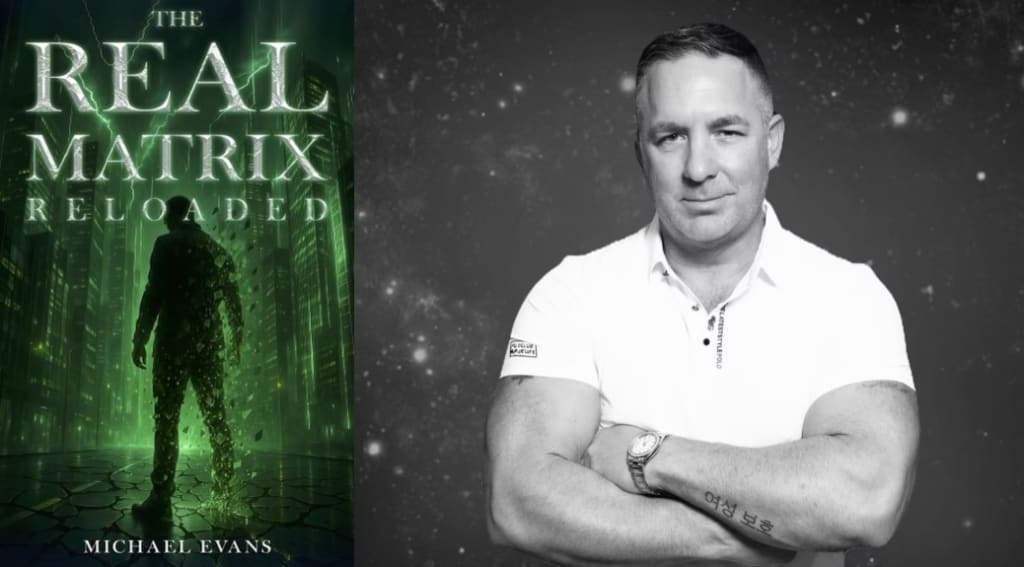
For more than twenty years, author, philanthropist, and global rescue leader Michael Evans has stepped into the darkest corners of trafficking networks to pull young women, often teenagers back into the world they thought they had lost. His new audiobook, The Real Matrix Reloaded, is not just a retelling of rescues. It is a guide to understanding the invisible emotional manipulation that fuels modern trafficking and the emerging role of AI in dismantling it.
Evans begins by challenging the most persistent American misconception: the idea that trafficking looks like a violent movie abduction. “Most people imagine a dramatic kidnapping,” he explains. “But the truth is far quieter and far more personal. Trafficking almost always begins with trust.” A trafficker fills an emotional gap, mirrors affection, and becomes the one person the girl believes understands her. By the time the manipulation turns into control, the chains are emotional and financial, not physical. “Danger looks friendly at first,” he says.

This psychological grooming is especially effective among immigrant women, who often arrive in the U.S. with immense family pressure and financial responsibility. “They come here with the weight of their families on their backs,” Evans explains. Traffickers study that urgency. They promise fast income, stability, and belonging, knowing that shame and fear will keep these women silent once the trap closes.
One story that haunts Evans involves a young woman from China who felt she had “failed at life.” That sense of unworthiness became her restraint. “Almost every time, the real chain is emotional,” he says. “The moment a girl believes she has nowhere else to go, she stops trying to escape.”
The psychological patterns traffickers exploit are so consistent they might as well be templates: insecurity, loneliness, guilt, invisibility. “A girl who feels unseen becomes someone who will cling to the first person who gives her attention,” Evans notes. Traffickers manipulate affection in cycles, giving it, withdrawing it, then returning it, to create an unstable dependency that a teenager can’t interpret as abuse.

Contrary to popular assumptions, trafficking hotspots aren’t seedy alleys or urban shadows. They are ordinary spaces: suburbs, small towns, budget motels, Airbnb rentals, tourist corridors, and digital platforms where grooming takes place long before a girl ever steps into someone’s car. “Trafficking thrives where people assume they’re safe,” Evans says. “It hides inside normal life.”
That digital shift is precisely where artificial intelligence is beginning to transform prevention and rescue work.
“AI can spot what the human eye misses,” Evans explains. Traffickers move fast—faster than any one organization can track. AI can sift through thousands of messages, ads, and transactions to identify patterns humans overlook. While many experts point to AI’s ability to flag suspicious ads or track financial anomalies, Evans believes one capability stands above the rest: language analysis.
“Control relies heavily on words,” he says. “Threats, promises, emotional hooks, they follow patterns. If AI can recognize those patterns in texts or social messages, we can intervene before emotional grooming becomes physical exploitation.”

But Evans insists that AI alone is not enough. Survivor insights, real-world knowledge of tone, timing, and manipulation must shape the algorithms. “AI widens the search. Survivors teach it what to look for,” he explains. “Together, they create a map of danger that is far harder for traffickers to hide inside.”
The Real Matrix Reloaded ties these insights together, offering teens, parents, and adults a framework to recognize emotional traps long before traffickers weaponize them. “Trafficking begins when someone doubts their own worth,” Evans says. His audiobook teaches listeners to identify that moment, strengthen their instincts, and understand the stories they tell themselves.
What does he hope listeners take away? “That their mind is not their enemy. Most manipulation succeeds because people don’t understand their inner dialogue. The audiobook helps them separate truth from fear. It helps them see when a connection feels safe and when it feels scripted.”
In the end, Evans’ message is both sobering and hopeful: clarity is protection, awareness is armor, and with the help of survivor intelligence and AI, the emotional machinery of trafficking may finally begin to crumble.
About the Creator
Keep reading
More stories from Ben Nelson and writers in BookClub and other communities.
A Fearless Triumph of Punk-Horror Imagination
With Rufus, writer-director Mars Roberge doesn’t just enter the horror genre—he detonates it from the inside out. Premiering at six film festivals and already boasting wins for Best Horror Film (L.A. IFS Film Festival, L.A. Punk Film Festival) and Best Supernatural Feature (New York Science Fiction and Horror Film Festival), Rufus arrives this week as one of the most daring, gleefully anarchic horror films of the year. It’s wildly imaginative, proudly weird, and unmistakably Roberge: a filmmaker who has always “embraced the bizarre” and refuses to play by anyone’s rules but his own.
By Ben Nelson3 months ago in Horror
Rachel Reviews: Lunch Tales: Teagan by Lucille Guarino
Well, I did enjoy this! Sometimes, all you need is just great storytelling and this is what Lucille Guarino delivers here. There's no big message to this book; it's just about folks and families, living their lives and coping with everything that's being thrown at them and finding their way. But when it's done well, like it is here, then you have characters to whom you can relate, tension which leaves you rooting for a better outcome, attraction which has your heart racing and an urge, as a reader, to see the characters happy with the people with whom they belong.
By Rachel Deeming22 days ago in BookClub
I Reread Harry Potter and the Chamber of Secrets—And Found a Secret Lifehack Hiding in Plain Sight
When I first picked up Harry Potter and the Chamber of Secrets by J. K. Rowling, I was excited to return to the magical world of Hogwarts. As a kid, I was drawn to the spells, the Quidditch matches, and the epic battles against dark forces. But revisiting it as an adult, I realized there was something far deeper hiding in the pages—a lifehack that’s relevant for anyone trying to overcome fear, face challenges, and achieve personal growth.
By Lukáš Hrdlička2 days ago in BookClub
Staying sane in the insane world.
”It is no measure of health to be well adjusted to a profoundly sick society.” Jiddu Krishnamurti This quote has been one of my favourites since the moment I first laid my eyes on it. To me, it cuts right through the fog of the illusion of normality that permeates our lives. And since I am someone who has never felt (well) adjusted to this society, Krishnamurti’s words gifted me with the realisation that there isn’t anything inherently wrong with me.
By Eva Smitte2 days ago in Humans



Comments
There are no comments for this story
Be the first to respond and start the conversation.