
Fletch and the Man Who
A Review...and a Look at Who We Are

2024 is turning out to be a pretty ugly year. There is the continued war in the Middle East (when isn’t there one, you might say; so cynical), price inflation for basic food items (priceflation is an expression I will not use after completing this piece), there is the election noise of the various parties up here in my beloved Canada…and down below. Our parties seem to grow quickly, like mold in a basement. And I tend to wonder why there isn’t more growth in that noisy basement I refer to as the United States. I tend to ignore politics until it is trying to take more money out of my wallet, or asking me to care…or entertaining me on the page or screen.
*
So, that leads me to Fletch. After finishing my third book of Gregory Mcdonald’s smart-ass reporter, I found myself wondering what I am taking from all this reading, hunting and scribbling. In an earlier piece, I promised myself that I would devote one summer to just reading “pulp literature”. I went back to the list I made and looked at the list of tomes on it. And I realized I had not read a single one of them. No science fiction; no police novels; not a single thing that could be considered romantic. And I wondered why…for a moment.
I could say that it was all because of my refined literary tastes.
Ha, ha.
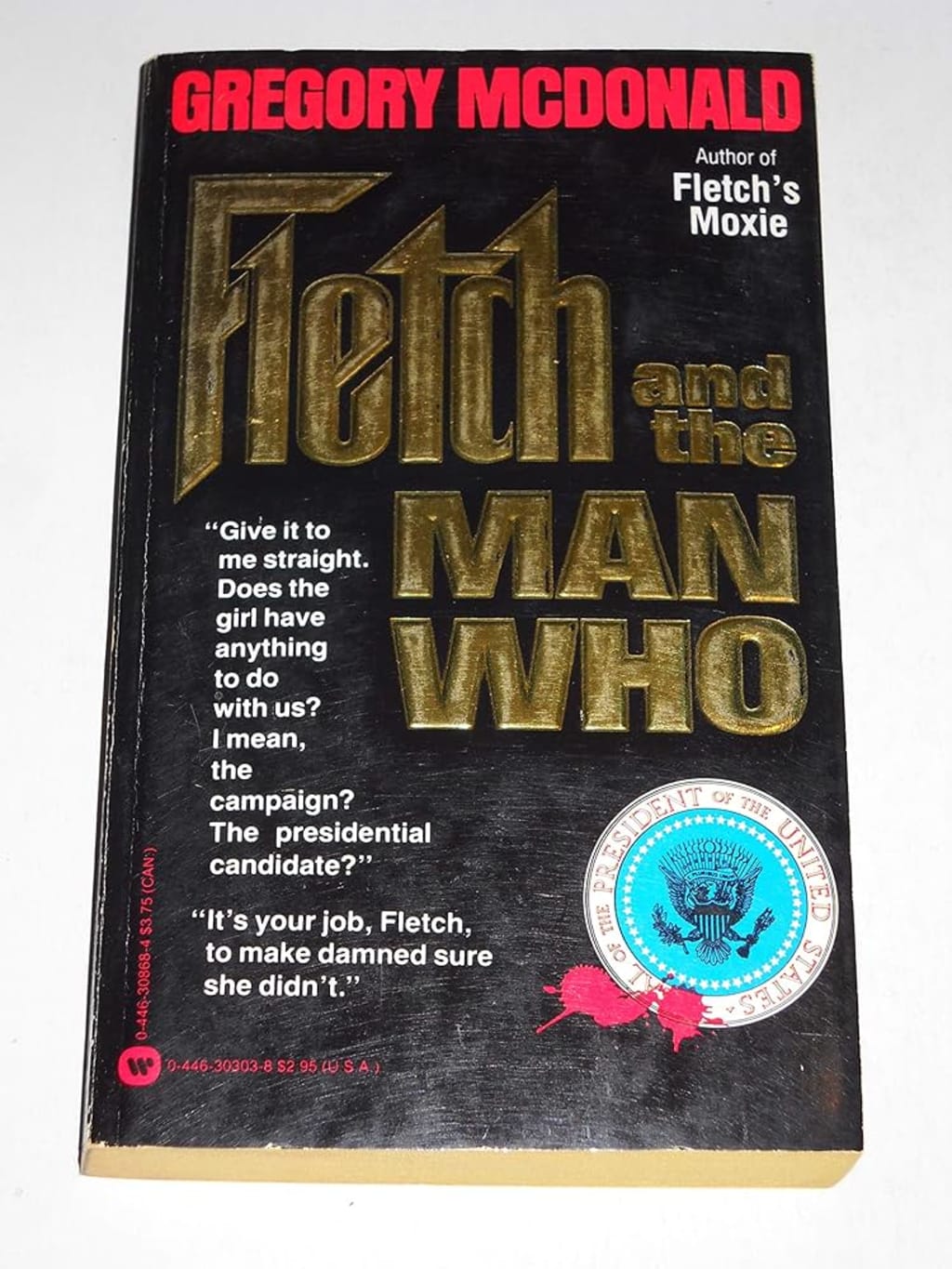
It was simply because there was too much else that I wanted to read and enjoy. It was a summer where I volunteered at a festival, worked a few contracts, and wondered what the rest of the year would bring. It was also the summer when I finally read one of those Fletch books I knew little about: “Fletch’s Fortune”. I have already written about my feelings about this one, but I never wrote about the second one I read: “Fletch and the Widow Bradley”. Not my favourite of the pair, but I kept going. And I found this: “Fletch and the Man Who,” a slightly confusing title from a distance, but one that becomes agonizingly clear when you read the blurb on the cover and dive in.
*
Irwin M. Fletcher is no longer a reporter (at least for one book). He has been hired to work on a political campaign as a press secretary for Governor Caxton Wheeler who is running for President of the United States. This is an interesting way for him to view the Fourth Estate from an interesting perspective. There is, being a Fletch book, a murder mystery to be solved (two dead women trailing the campaign’s stops at different hotels), and the usual nonsense of politics you might expect.
So, why am I taking the time to write this on a Monday night when I should be preparing for another week of teaching?
Mainly for scenes like this:
“A campaign is punch and duck, punch and duck. Fast footwork, you know? Always smiling. The voters want to see fast action. Their attention won’t hold for anything more. From day to day, give ‘em happy film, and short reassuring statements. If you really try to say anything, really ask them to stop and think, they’ll hate you for it. They can’t think, you know? Being asked makes us feel inferior. We don’t like to feel inferior to our candidates. Against the democratic ideal, you know? The candidate’s just got to keep giving the impression he’s a man of the people – no better than they are, just doin’ a different job. No is ever elected in this country on the basis of what he really thinks. The candidate is elected on the basis of thousands of different, comfortable small impressions, not one which really asks the voters to think.”
That paragraph, in the mouth of the former Caxton press secretary in a long phone call with Fletch, caught me off guard. Usually, we do not expect to be stopped in our abstract tracks with this type of fiction. These books are meant to be worked through so that you are entertained enough to move on with your day. And I am not someone who has ever embraced politics as some divine calling (working for Elections Canada wrecked that for me), but this section seems…out of place.
It was published in 1983, in the Reagan era when Michael Jackson wasn't scary, MTV played music, and most of the films in theatres were not also being watched on small screens. Reagan spoke about Russia as the Evil Empire, hostages were being taken almost every other day, and there was a real concern that there would be another war, this one much more permanent. In the middle of all this, we had a book written as a type of release for all the different obsessions of the zeitgeist. This seems to me to be a very subversive thing to do, and something that should be done more often. mainly because...nothing has really changed (except for the music on MTV - do they still play music?).
Mcdonald writes like Hunter S. Thompson with less interest in the winning phrase, but he does speak to his time. He gets through to that part of the narrative that you want to read. And I will admit to being able to figure out who the killer was before the revelation at a campaign rally. But this is a remarkable and breezy ride for anyone willing to go with one of the more amusing figures in pulp literature.
And the Man Who...?
You'll just have to find out…

*
Thank you for reading!
If you liked this, you can add your Insights, Comment, leave a Heart, Tip, Pledge, or Subscribe. I will appreciate any support you have shown for my work.
You can find more poems, stories, and articles by Kendall Defoe on my Vocal profile. I complain, argue, provoke and create...just like everybody else.
Give it a look...
About the Creator
Kendall Defoe
Teacher, reader, writer, dreamer... I am a college instructor who cannot stop letting his thoughts end up on the page. No AI. No Fake Work. It's all me...
And I did this:
Keep reading
More stories from Kendall Defoe and writers in BookClub and other communities.
Review: "The Twilight World"
From the very first page of this narrative: Most details are factually correct; some are not. What was important to the author was something other than accuracy, some essence he thought he glimpsed when he encountered the protagonist of this story.
By Kendall Defoe 2 years ago in BookClub
Rachel Reviews: Lakefront Wolves by Joseph Deegan
Meet Finn. He's an 18 year old kid who has potential. He's bright with great school scores and he's also an athlete, a footballer of some prowess. He has it all going for him, it would seem, and yet, he's determined to send what could be a well-planned, stable existence firmly off the rails. He drinks, he smokes, he takes drugs, he has violent tendencies and he's in danger of losing not only his mind but all that he holds dear.
By Rachel Deeming11 days ago in BookClub
7 Historical Romance Books You Must Read in 2026
Historical romance captivates readers by transporting them to eras filled with passion, intrigue, and societal constraints. These stories blend the allure of history with the timeless appeal of love, offering more than just escapism—they provide a window into past cultures, values, and human emotions.
By Diana Meresc5 days ago in BookClub
Early March 2026: 4 Goals Accomplished
It's early March and I've now accomplished my 4th writing goal for the year of 2026. Before diving into the behind-the-scenes of it... why not tell you up front what that accomplishment was? I was published in a 2nd publication for this year. Published in Helix Literary Magazine out of Central Connecticut State University. You can read it for free right now!
By Stephen Kramer Avitabile7 days ago in Writers


Comments (1)
I feel like a lot of people also vote along “party lines” because they don’t like thinking, at all, ever. They think “my parents and friends vote for this party, so that’s what I’ll vote for, too!” And then they memorize the rhetoric on television without even knowing what it means just so they can pretend like they’re actually defending themselves if someone asks “why do you vote that way.” So the rhetoric isn’t necessarily to change people’s minds (because people are to dumb to listen or understand the rhetoric anyway) but just to give brain dead voters a vague way to repeat the “party lines” and pretend they know what “the party line is” (they don’t) then that way they can mindlessly vote the way their friends and family vote without ever once thinking “why do i vote this way? Do I actually believe in the values of the party or am I voting this way because everyone I know tells me I should.” Also very well written and great article! 😃