
Brideshead Regurgitated
My Honest Thoughts about Evelyn Waugh's Most Popular Novel


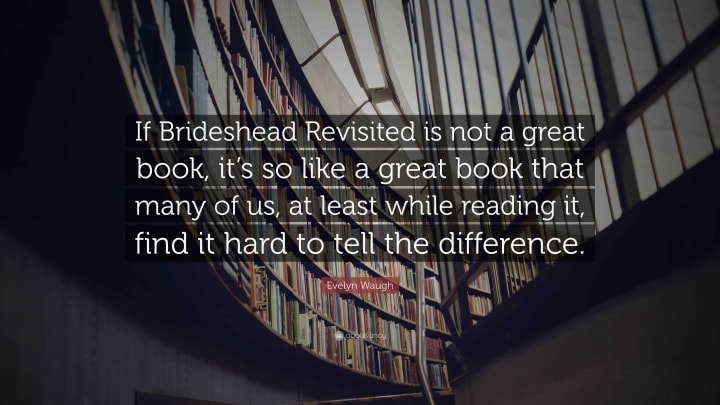
To get the obvious out of the way, based on the title chosen above, I was not a fan of the book.
To get some other ideas out of the way before I continue, I am still a fan of the writer.
So, what went wrong?
*
Oh, Annie Kapur... Please forgive me. You wrote about the book several times and I read your assessments with an open mind. First, this one:
And then I discovered this one:
The first one I read claimed it was a “masterpiece,” the second “a reading experience”. I lean toward the latter with how I feel about this one. As I stated before, I am a fan of the writer. The man is not someone that I regret missing. As I have pointed out before, he was a snob, a bully, a reactionary and a very narrowminded Catholic just in time for the first wave of Vatican II (look that up). But then I return to the work, especially that incredible period of the 1930s when we get the real satirical genius that is “Vile Bodies,” “Black Mischief,” “Scoop” and the first Waugh book I read in school, and the one that I think is the better masterpiece, “A Handful of Dust.” Those books have not aged because human nature has not improved. You can go back to them again and again.
I may never do that with “Brideshead Revisited”.
What the hell happened?
*
The subtitle is a good start for my complaint:
The Sacred and Profane Memories of Captain Charles Ryder
Set during World War Two, Captain Ryder is with his battalion when they discover that there is land available for the soldiery at the once fine home of the Brideshead family. Immediately, we are brought back to the youth of a man who discovered an “august, masculine atmosphere of a better age” within the home of an old Catholic family of great wealth and little ambition. He finds his way into this tribe through the unlikely person of Sebastian Flyte, the dissolute son of Brideshead who introduces himself by vomiting through Charles' first floor window at Oxford. They, of course, become good friends. But that is not the whole story. There is the backdrop of history, the pain of facing the modern world, and the unceasing ties of Catholicism and history.
And something else...
Charles Ryder and Sebastian Flyte are clearly meant to be seen as a homosexual couple, in an era when that information would not have been acceptable to the reading public. Perhaps the overweening language and tone of the book prevented reviewers from noting as much at the time of publication. I am rereading two reviews, one the notes that were intended to be a piece on the novel by George Orwell. It was actually the last book review he intended to write, and it reveals a great deal about how an audience of that era would approach the book:
“Note that everyone is snobbish, but that Waugh’s loyalty is to a form of society no longer visible, of which he must be aware.”
Of course, he must be, right? It was only the fact that they were in the middle of a world war that made the author long for that particular society. And it continues:
“Real theme – Sebastian’s drunkenness, & family’s unwillingness to cure this at the expense of committing a sin.”
And that sin? I want to say it is denying the character of Sebastian his own free will or allowing him to be a full human being (as a recovering Catholic, I could not really figure it out). Then we get to his own conclusions:
“Note that all the veneer is bound to crack sooner or later.”
And this hits hard:
“One cannot really be Catholic & grown-up.”
That may seem harsh, but Charles consistently echoes this feeling. He sees the glory and glitter of the family’s legacy, but he cannot stomach the fact that they believe in what they believe. As I write this, I am thinking of one character in particular. Sebastian’s sister, Julia, seems to have some sort of breakdown. She had earlier made love to Charles on a ship caught in a terrible storm, with Waugh’s most embarrassing description of a sexual encounter I have ever read:
“Now on the rough water there was a formality to be observed, no more. It was as though a deed of conveyance of her narrow loins had been drawn and sealed. I was making my first entry as a freeholder of a property I would enjoy and develop at leisure.” (underlined portions by me)
Unbelievable, and it does explain why this great love of his life begins to crack, going on for several pages about “ ‘Mummy carrying my sin with her to church…mummy dying with my sin eating at her…Mummy dying with it; Christ dying with it, nailed hand and foot…’ ” and on and on it goes, until finally she realizes, with the death of a loved one, that she cannot love anyone. Maybe Orwell really did have a point? Maybe it is not possible to be a full adult and still accept this particular religion?
I am not here to promote a particular faith or belief, but I think that it is absolutely impossible to read the novel without understanding what the faith is all about. But that may be why this is his most successful novel. Readers seem to enjoy that elegant and gilded world of upper-class life without understanding the deeper histories and attitudes behind it. I know that I am not one of those readers. I want the themes and the prose to suit each other instead of working for opposite ends (no one would expect Stephen King to sound like Jane Austen if he used his style to stage a tale in a pre-Victorian setting). It belongs to the world of melodrama and that is a true shame.
Waugh is still one of my favourite writers, despite all his deep and often unbearable faults, and I refuse to accept that this book is the one that draws the most devoted readers to his particular camp. Please look for the earlier travel and satirical tomes I mentioned and avoid this one. Even the television series feels like a cheat, and you are doing yourself no favours with it.
It is a “good bad book” – thank you, Mr. Amis – and the world already has plenty of those.
Some places do not merit a re-visit.
*
Thank you for reading!
If you liked this, you can add your Insights, Comment, leave a Heart, Tip, Pledge, or Subscribe. I will appreciate any support you have shown for my work.
You can find more poems, stories, and articles by Kendall Defoe on my Vocal profile. I complain, argue, provoke and create...just like everybody else.
Give it a look...
About the Creator
Kendall Defoe
Teacher, reader, writer, dreamer... I am a college instructor who cannot stop letting his thoughts end up on the page. No AI. No Fake Work. It's all me...
And I did this:
Keep reading
More stories from Kendall Defoe and writers in BookClub and other communities.
And what do you think, Mr. Robbins?
No, I had no idea what the title meant when I picked up this book from the local library. And no, I was not a long time fan of the author when I heard of his death and found that I had two of his paperbacks ready to go: “Another Roadside Attraction” (his first novel), and “Jitterbug Perfume” (catchy titles, I think). But I knew his name. I had seen the books and I knew that someone was actually insane enough to make a film out of his “Even Cowgirls Get the Blues,” a film starring Uma Thurman as a hitchhiker with a very generous length of thumb (no, it was not a hit). And I stayed away from them all. My feeling was that Mr. Tom Robbins belonged to that interesting clique of writers from the late sixties that once had the ear of the zeitgeist, but soon lost it when people realized that they had nothing else to say (reviewing the remainder pile of the local bookstores has become an unmerciful duty). There was no place in my life for books on hippies, the counterculture that failed, and the false promise of psychedelics.
By Kendall Defoe 6 months ago in BookClub
Rachel Reviews: Lunch Tales: Teagan by Lucille Guarino
Well, I did enjoy this! Sometimes, all you need is just great storytelling and this is what Lucille Guarino delivers here. There's no big message to this book; it's just about folks and families, living their lives and coping with everything that's being thrown at them and finding their way. But when it's done well, like it is here, then you have characters to whom you can relate, tension which leaves you rooting for a better outcome, attraction which has your heart racing and an urge, as a reader, to see the characters happy with the people with whom they belong.
By Rachel Deeming22 days ago in BookClub
I Reread Harry Potter and the Order of the Phoenix—And Discovered a Lifehack for Overcoming Doubt and Authority
When I first read Harry Potter and the Order of the Phoenix by J. K. Rowling, I was struck by the darker tone, the political intrigue at Hogwarts, and the growing threats from Voldemort. At the time, I focused mostly on the drama and magical battles. But revisiting it as an adult revealed a hidden lifehack that applies far beyond Hogwarts: it’s a guide for handling doubt, navigating bureaucracy, and maintaining focus when authority, criticism, or external pressures try to derail you.
By Lukáš Hrdlička2 days ago in BookClub
Tatt~Master
— Assembly Line Tatt Machine ~ Impressions to Impress — As I begin to understand more about the Tattoo Phenomenon. I've written silly, yet verbatim, dating site anecdotes in 'Frazzled.' So let me ask you: Would you be More attracted to someone slathered with tattoos, or Less?
By Jay Kantorabout 7 hours ago in Humor


Comments (6)
I’ve been meaning to get into Waugh… did some jacket reading and this one seems like a pass for me. I’ve got sword of honor queued up
Thank you for this very detailed review. I have not read Brideshead and most likely will not. I am not quite the avid reader as I once was. These days my reading does not go much beyond the confines of Vocal Media. However, my interest is piqued by some of the other Waugh titles you mentioned.
I like your honesty. I would not attempt to even read this book even if it was the last book on earth. 😊
Great and honest review, Kendall. I've never heard of this author before but you certainly got me interested with the books you recommended.
Thanks for sharing your honest opinions mate (and for that heartfelt mention to me). I would rather you be honest about the book than pretend you liked it just because a lot of other people do. Again, great piece of writing mate - even if I do still fall in love with Brideshead whenever I revisit it x Appreciate the honesty too 🩷🩷🩷
Thank you for the honest review. I feel that we don’t see enough of those without them being completely mean to the author, but yours feel balanced while still not being unnecessarily insulting of either the work or its author. I don’t think that I’ll pick up this book any time soon, but maybe someday I’ll get around to one of his other books that you recommended. What do you like about his writing outside of this work, anyway?