
[BOOK SUMMARY & REVIEW] “THE LAST BRIDGE”: THE HAUNTING OF FAMILY TRAUMA
When everything has fallen apart, when the wounds have cut deep, what is left of people besides pain?

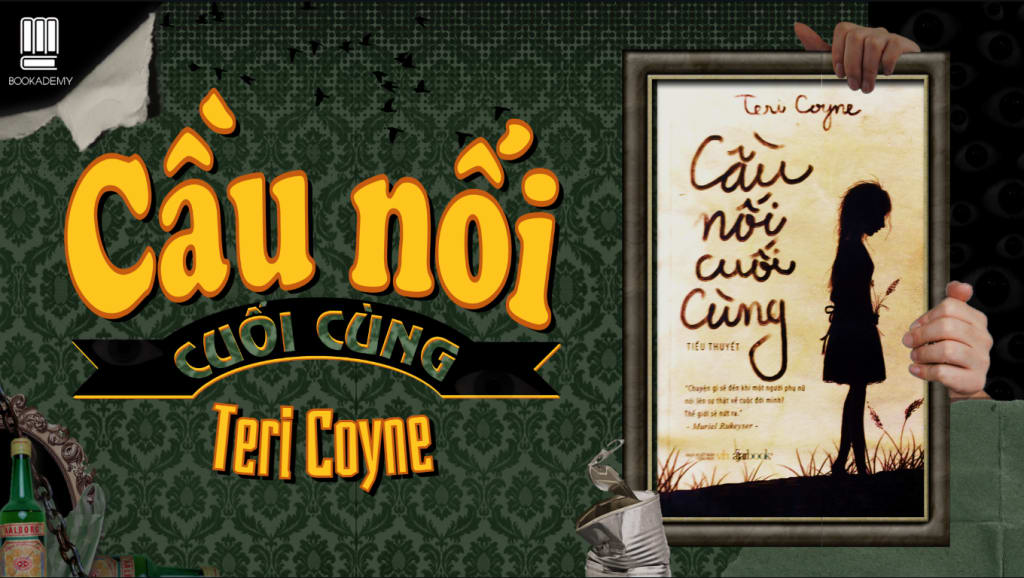
I. AUTHOR INTRODUCTION:
Teri Coyne is an American novelist, born and raised in Pittsburgh, Pennsylvania. She attended Mt. Lebanon High School, where she befriended another writer, Gwyn Cready. As an adult, she attended New York University, participating in various creative activities, including directing, screenwriting, and film production. “The Last Bridge” is her debut book, marking Teri Coyne's first public appearance as a writer. This is a novel about the complexities of human psychology, imbued with a melancholic atmosphere and touching upon a dark subject with raw realism, a journey into the abyss of a wounded soul. The book has received praise from renowned authors such as Publisher Weekly, Kirkus Review, and Booklist.
II. OVERVIEW OF THE WORK:
The story begins with an introduction to the main character, Alexandra “Cat” Rucker – a 27-year-old woman living a dissolute life of alcohol and nightclub work in a foreign city. After hearing of her mother's death, Cat reluctantly returns to her hometown in Ohio after a 10-year absence. Her mother, who committed suicide, left a personal message for Cat: “Cat, He’s not the person you think he is. I xxxooo.” This is when she begins her journey to unravel the mystery of her mother’s death, revisiting her teenage memories and delving into the darkness within her own soul. Parallel to the current investigation are flashbacks to Cat’s traumatic childhood, through which the reader is guided through these painful memories to understand the origins of her current brokenness.
Cat is a character built with many flaws, such as her addiction to alcohol, her lowly jobs, and her miserable existence for 10 long years. But it is precisely these flaws that make Cat so real. She doesn't play the role of a selfless person who can forgive those who hurt her, nor does she portray an inspiring story of overcoming adversity. Cat's transformation begins as a girl who withdraws into her own world behind her self-drawn pictures, to a person who constantly confides in alcohol and suffers from chronic drunkenness, leading to multiple hospitalizations. Through this, Cat emerges as a realistic portrayal of a person destroyed by mental trauma and the lingering effects of abuse, ironically choosing to numb her emotions rather than confront them directly. What Cat did wasn't a moral depravity, but a necessary paralyzing drug she gave herself to survive the immense pain she couldn't cope with on her own.
The breakdown of the family structure:
The family environment is one of the prerequisites for human development. Therefore, any disruptions caused in this environment leave aftershocks in a person's character, affecting how they interact with society or face reality. Looking at Cat's story, we see a completely asymmetrical family, unbalanced in power and utterly unhappy. In it, the father plays the role of a dictator, constantly consolidating his position in the family, even to the point of repeatedly committing brutal acts against other members. As for the mother, when she tried to take the children away from the abuse, the father caught them. To punish and deter, he severed part of his wife's finger in front of the children. This act was not merely a barbaric physical act, but also a psychological tactic to subdue her. Every time the children looked at their mother's missing hand, it was a reminder of their father's absolute power and the price of resistance in this family. From then on, we only see a mother who is utterly submissive and obedient, completely submissive. She became an accomplice to violence instead of a protector, accepting submission to maintain a false sense of peace. As for the children, the years that followed were filled with helplessness, realizing they would forever live under the control of a monster they had to constantly be wary of.
In the story, the father's hateful attitude and the destruction he brings to the family stem from his realization that he is merely a replacement, a person who doesn't receive love but must bear the responsibility of raising someone with whom he has no loving connection.
"You can be lonelier with someone else than you are alone. That kind of love, the life your mother created, has destroyed everything. Living alone has never hurt anyone."
Cat herself realized the absurdity of her mother's decision, a foolish act that led to the devastation of wounded souls. Family love, which should not be forced or coerced but entirely voluntary, had become a burden for its members. A love and bond that was merely a facade of completeness transformed their lives into a terrifying nightmare, each day filled with the oppressive weight of their brokenness. Her father, in the end, never realized the cruelty and destructive power he had inflicted upon the family. Even though he lay in the hospital, far away from Cat, he remained a haunting shadow that even ten years of addiction couldn't help her escape.
“I looked around me and wondered who they were. What defined us as a family? Certainly not shared experiences, because each person carries a unique story. And even though we share the same characters, the villain in my life story might be the hero in Wendy’s eyes.”
It’s strange that Wendy, the youngest daughter, wasn’t a direct victim of her father’s abuse. The one who suffered the most was Cat, the black sheep of the family, used as a scapegoat for her father’s power. The imbalance and discrimination within the family, where one child is completely innocent and the other constantly bears the brunt of suffering, further exacerbates the already unstable family structure, adding to the injustice and cognitive chaos despite living together as a family. If Wendy’s father is a hero, then could the man in her mother’s message be him? Could it be that her father, despite his mistreatment of Cat, wasn't the person Cat perceived him to be to others?
Of course, Cat still has many unresolved questions and doubts from the past. Why did her mother, after her father's stroke and subsequent coma—a moment that should have been her liberation—die so prematurely? Was there a hidden motive behind her father's brutal actions, her mother's subservience, her brother's cowardice, and her younger sister Wendy's indifference? After years of carrying the pain and haunting memories that gnawed at her mind, her mother couldn't imagine a life of independence, a life free from the fear she was accustomed to, and so she chose to end her own life. This further emphasizes the terrifying impact and devastating influence that violence can have on a person's life. The psychological shadow that the father cast over the entire family is inescapable for all members, and it will cling persistently until they are willing to accept and confront it.
The "Last Bridge" Symbol:
In this family, Cat is the frequent victim of abuse. She is constantly controlled, scrutinized, and judged by her father, fostering a cautious and fearful mindset. Therefore, she is the only child in the family who has to flee, to leave because she can no longer face the brutal acts her father has inflicted upon her.
The Last Bridge is a witness to an end, but at the same time, it symbolizes a new beginning. It is both a bridge of separation and a bridge of connection.
At seventeen, on the last day she thought she could escape the clutches of her vile father, Cat was brutally abused by him. Even more painful, Cat knows that someone witnessed the scene that night but did nothing to save her from the humiliation. That night marked the end of Cat's suffering, leaving her with no choice but to flee from a harsh reality and pain too great to continue gnawing at her. She abandoned the child she had given birth to, her cowardice that year pushing her away from what she shouldn't have been running from. The disgust at the evil and wickedness that had crept into that family could no longer hold Cat back. That bridge marked the end of a humiliating period in her life.
The symbolic bridge of that beginning was none other than her mother, who pulled her back to confront her past. That suicide shot, that piece of paper with a mysterious message, dragged her into a miserable life of doing nothing but trying to forget the pain, as if for ten years Cat remained trapped in that night by the bridge. That piece of paper was the riddle Cat needed to decipher to free herself from the deep psychological wound etched in her heart. Was it her despicable father, her cowardly brother, or her first love? Was her mother the one who witnessed it all, or did she already know the man's identity?
It was her mother's dying words that gave Cat a reason to return; it was her mother's death that brought Cat back to the beginning, and that note prompted her to search through her memories.
The contents of the ziplock-wrapped note caused Cat extreme confusion. Just a short sentence, yet it carried such weight, as if it were a cold denial of Cat's painful past. It forced her to return to the past, connecting the dots to find out what she had ultimately overlooked. It was both a shockwave that shattered the barriers she had built deep within to protect herself from harm, and a catalyst for Cat to embark on a journey of self-reflection and healing from unhealed wounds. Cat didn't need to understand or accept that the things she once cared about, feared, and avoided were different; she needed to know that even if things and people weren't what she perceived them to be, she still had the right to choose and could change by confronting her past and the people who had entered her life.
That symbolic bridge connected the past with the present, leading Cat to the future. A future where Cat had to learn to live with the monster of the past, gathering the fragments of reality to bring her back to life and build a new life, where she could find happiness again without continuing the trauma of the previous generation.\
IV. PERSONAL REFLECTION:
The entire story is told to lead us to Cat's ultimate fate: escaping from a tormenting and tumultuous family. However, in reality, this journey is Cat's way of picking herself up, not only to rationalize the pain she experienced, but also to re-examine her life and discover what she missed during those years. This leaves us wondering: after the scars of time, after an irreparable breakdown, and with a heart that can never be healed, what can Cat still find in the ashes of her memories?
Transcending the pain and loss of the past, Cat is on a journey of redefining herself and restructuring her understanding of her personal identity. Instead of identifying herself as a victim of abuse and a broken family structure, Cat re-evaluates what she missed, what she lost forever, to define who she is after those events. This helps her create space for potential, raw moments that Cat can fill with a new perspective. Now that the threat has been left behind, though it still lingers in Cat's mind, by looking back and reflecting, directly confronting a reality she left behind, Cat can take control of her perception and return to life. When Cat chooses to return and search for her memories, she also empowers herself to rebuild her self. She is no longer a passive victim in her memories, but has become a conscious person, with choices, capable of recreating herself in the present.
Instead of avoiding or running away, Cat looks back through the eyes of a third party, allowing herself to create a new life, a way to transform her pain through the motivation for change. This is not simply a healing journey or a miraculous recovery, but a story about a person re-decoding their place in the world through healing at the highest level – integration.
The story allows the reader to witness the entire narrative and delve into Cat's inner world; we accompany Cat, feel her pain, and empathize with her. The book shows us the healing value of trauma literature lies in transforming the incomprehensible into the empathetic. It doesn't just pull out gruesome, disturbing details to frighten the reader, but it gives us a story that has always been hidden beneath the veil of everyday life, one we haven't yet touched. It allows us to see pain not just as a boulder plunging us into despair, but offers us another option, another perspective to transform pain into motivation for change. Therefore, the value of life lies not in comforting aching souls, but in inviting contemplation of humanity and life.
This is certainly a dark novel, imbued with violence and profound suffering that permeates every page. The work may make you feel uneasy and restless, but it is a necessary unease, because it allows the reader to feel empathy for the protagonist. This unease awakens compassion and reminds us that: Even in the most desolate ashes, the seeds of rebirth always exist, as long as we dare to face the truth.
About the Creator
HieuDinh
- Loves nature, likes to grow ornamental plants such as succulents, lotus (participates in volunteer activities to plant forests, protect forests in the locality)
- Loves dogs and cats (participates in local wildlife rescue activities)
Rachel Reviews: Lakefront Wolves by Joseph Deegan
Meet Finn. He's an 18 year old kid who has potential. He's bright with great school scores and he's also an athlete, a footballer of some prowess. He has it all going for him, it would seem, and yet, he's determined to send what could be a well-planned, stable existence firmly off the rails. He drinks, he smokes, he takes drugs, he has violent tendencies and he's in danger of losing not only his mind but all that he holds dear.
By Rachel Deeming15 days ago in BookClub
7 Best Books to Calm Your Overthinking Mind
In an era of constant notifications, deadlines, and endless digital noise, our minds rarely get a moment of rest. Overthinking has become an almost universal challenge, leaving us trapped in cycles of worry, “what ifs,” and mental exhaustion. It doesn’t just affect our focus—it can fuel anxiety, disrupt sleep, and even impact our physical health. Yet, there is a gentle, effective way to reclaim mental clarity: books. The right book does more than entertain—it teaches us to observe our thoughts, release mental tension, and cultivate calm.
By Diana Meresca day ago in BookClub


Comments
There are no comments for this story
Be the first to respond and start the conversation.