
Book review: The Moonstone by Wilkie Collins
The Moonstone: A Romance by Wilkie Collins is an 1868 British epistolary novel. It is an early example of the modern detective novel, and established many of the ground rules of the modern genre.

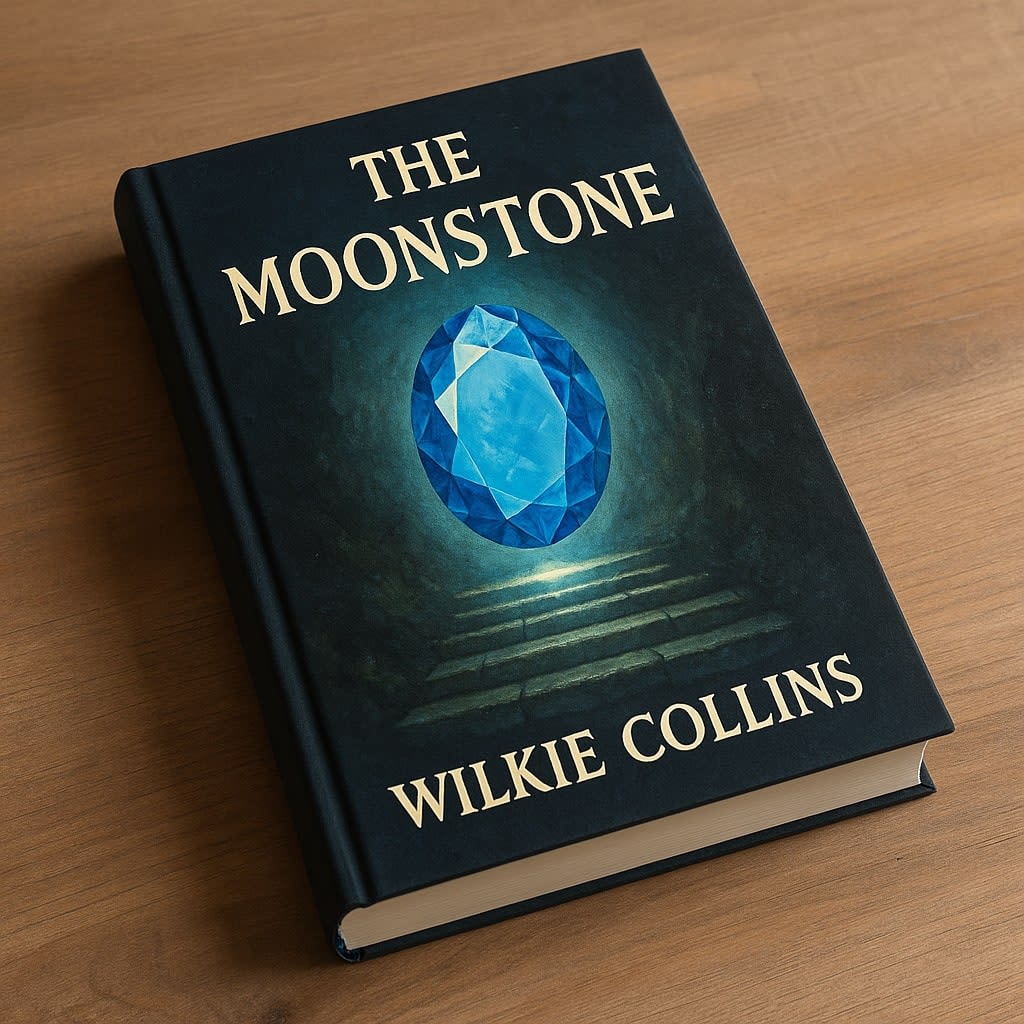
When I first picked up The Moonstone by Wilkie Collins, I expected a solid Victorian mystery, but what I discovered was something far more complex and rewarding. This novel, often hailed as the first full-length detective novel in the English language, proved to be a rich, layered narrative that blends suspense, psychological insight, and social commentary into a remarkably sophisticated whole.
The Moonstone, written by Wilkie Collins and published in 1868, is a pioneering work in the detective fiction genre. Although written in the nineteenth century, its structure, characters, and plot techniques have had a profound influence on modern mystery writing. The novel is best suited for adult readers and lovers of classic literature, particularly those interested in the evolution of crime fiction and narrative innovation. Collins, a contemporary and close friend of Charles Dickens, pushed boundaries with this book, both stylistically and thematically, producing a work that still feels fresh and engaging more than 150 years after its debut.
The story centers around the mysterious disappearance of a large and valuable diamond—the titular Moonstone—on the night of Rachel Verinder’s birthday. The gem, which has a dark colonial past rooted in violence and sacred tradition in India, vanishes under strange circumstances from Rachel’s room. What follows is an intricate investigation involving multiple suspects, red herrings, psychological tension, and revelations that test the boundaries of trust and justice. The narrative unfolds primarily in England, within the Verinder estate and the surrounding countryside, set against the backdrop of mid-Victorian society. The characters are vividly drawn, from the brilliant but troubled Sergeant Cuff to the pious Miss Clack, and from the steady Gabriel Betteredge to the enigmatic Rachel Verinder. Each of them brings a unique perspective to the events as they unfold.
What makes The Moonstone truly remarkable is its narrative structure. Collins uses a multi-narrator approach, allowing the story to be told from various viewpoints. This technique not only adds richness and depth to the plot but also gives the reader insight into the biases and limitations of each character. Gabriel Betteredge, the elderly steward of the Verinder estate, opens the novel with a wonderfully dry and often humorous voice, setting the tone for a tale that is both entertaining and reflective. As other characters take over the narrative, the style, pacing, and reliability shift accordingly, giving the reader a more complete picture of the mystery while also raising questions about truth, perspective, and memory.
Collins’ language is precise and expressive. He writes with the confidence of someone fully in control of his craft, able to convey emotion, irony, and suspense with subtlety and power. His descriptive passages are detailed but never overwrought, and his dialogue is lively and often laced with understated humor. The pacing of the novel is deliberate, especially in the early sections, but it rewards patience with a deepening sense of intrigue and a gradual intensification of tension. Unlike many modern thrillers that rely on shock and speed, The Moonstone builds its drama through character development and the slow, methodical accumulation of clues and misdirection.
The themes of the novel are surprisingly contemporary. Colonialism and its lingering moral implications are central to the story, as the diamond itself is a spoil of British imperialism, stolen from India and shrouded in a mythic curse. The novel raises questions about cultural arrogance, justice, and restitution long before these became common subjects in literature. There are also powerful explorations of class, gender, and the nature of personal responsibility. Rachel Verinder, for instance, is not a passive heroine but a strong-willed young woman who resists the expectations placed upon her. The various narrators also reflect a broad cross-section of Victorian society, and their differing voices and values create a complex social tapestry that gives the novel both breadth and resonance.
Emotionally, the book covers a wide range of tones—from the comedic absurdities of Betteredge’s obsession with Robinson Crusoe to the tragic intensity of characters wrestling with guilt, love, and betrayal. There is a strong undercurrent of melancholy that runs through the story, particularly in the way it deals with missed opportunities, human frailty, and the corrosive effects of secrets. Yet, despite its darker moments, the novel is also full of warmth, wit, and moments of grace, offering a vision of humanity that is ultimately hopeful, if not idealistic.
If I had to point out any flaws, it would be the occasionally slow pacing, particularly in the middle sections where the plot seems to stall slightly. Some readers may find the multiple narrators initially disorienting, especially given the abrupt tonal shifts between them. However, these structural choices are also part of what gives the novel its lasting power and uniqueness. The variety of perspectives ultimately enhances the mystery and invites the reader to participate more actively in its unraveling.
Personally, I found The Moonstone to be an immensely satisfying read. What impressed me most was Collins' confidence in his reader—his willingness to trust that we would follow the complexity of the plot and appreciate the subtlety of his characterizations. The novel differs from many in its genre by refusing to simplify moral questions or resort to easy answers. It left me thinking about justice, loyalty, and the fine line between appearance and truth long after I turned the final page. I also appreciated its historical importance; it’s clear how foundational this work is to detective fiction, and yet it still holds its own as a compelling and emotionally rich narrative.
The Moonstone by Wilkie Collins is not only a milestone in literary history but also a thoroughly engaging and thought-provoking novel. I would recommend it without hesitation to anyone who enjoys mysteries with depth, character-driven storytelling, and historical insight. Readers with patience and a love for classic literature will find themselves richly rewarded. As a final verdict: The Moonstone is both a landmark and a masterpiece—complex, atmospheric, and still utterly captivating.
This book review was written using the following references 👇
About the Creator
Caleb Foster
Hi! My name is Caleb Foster, I’m 29, and I live in Ashland, Oregon. I studied English at Southern Oregon University and now work as a freelance editor, reviewing books and editing texts for publishers.
Keep reading
More stories from Caleb Foster and writers in BookClub and other communities.
Book review: The Million Pound Bank Note by Mark Twain
I always find it fascinating when a short literary work manages to deliver as much wit, social critique, and narrative charm as a full-length novel, and The Million Pound Bank Note by Mark Twain is a prime example of such brilliance in brevity. With his trademark humor and astute observation of human nature, Twain crafts a satirical story that remains surprisingly relevant despite having been written more than a century ago.
By Caleb Foster7 months ago in BookClub
My New Book is Finally Here
My poetry collection Beautiful and Brutal Things is done. It's actually done and finally published over 270 pages. Over a year of my life went into this book. More than a year, really. Long days at my computer, sometimes seven days a week because I couldn't stop even when I probably should have. Then two months of editing that felt harder than the writing itself. But it's finished, and I'm still standing, and the book is real.
By Tim Carmichael5 days ago in BookClub
Rachel Reviews: Paradise Cove - They Escaped the Cuckoo's Nest by Pini Dunner
On starting Pini Dunner's book, I was grateful for the thorough history that is provided at the start. This gives a much-needed context in order to enjoy the subsequent letters contained therein. The letters belong to George Nagel, an octagenarian pursuing a psychology degree which in itself would be remarkable; however, it is soon clear that this is just one remarkable thing in a life full of them.
By Rachel Deeming5 days ago in BookClub




Comments
There are no comments for this story
Be the first to respond and start the conversation.