
Book Review: The Media Scenario, Scriptwriting for Journalists by Peter Ayolov, 2026
Journalism Between Smirnenski’s Ladder and Vonnegut’s Story Curves

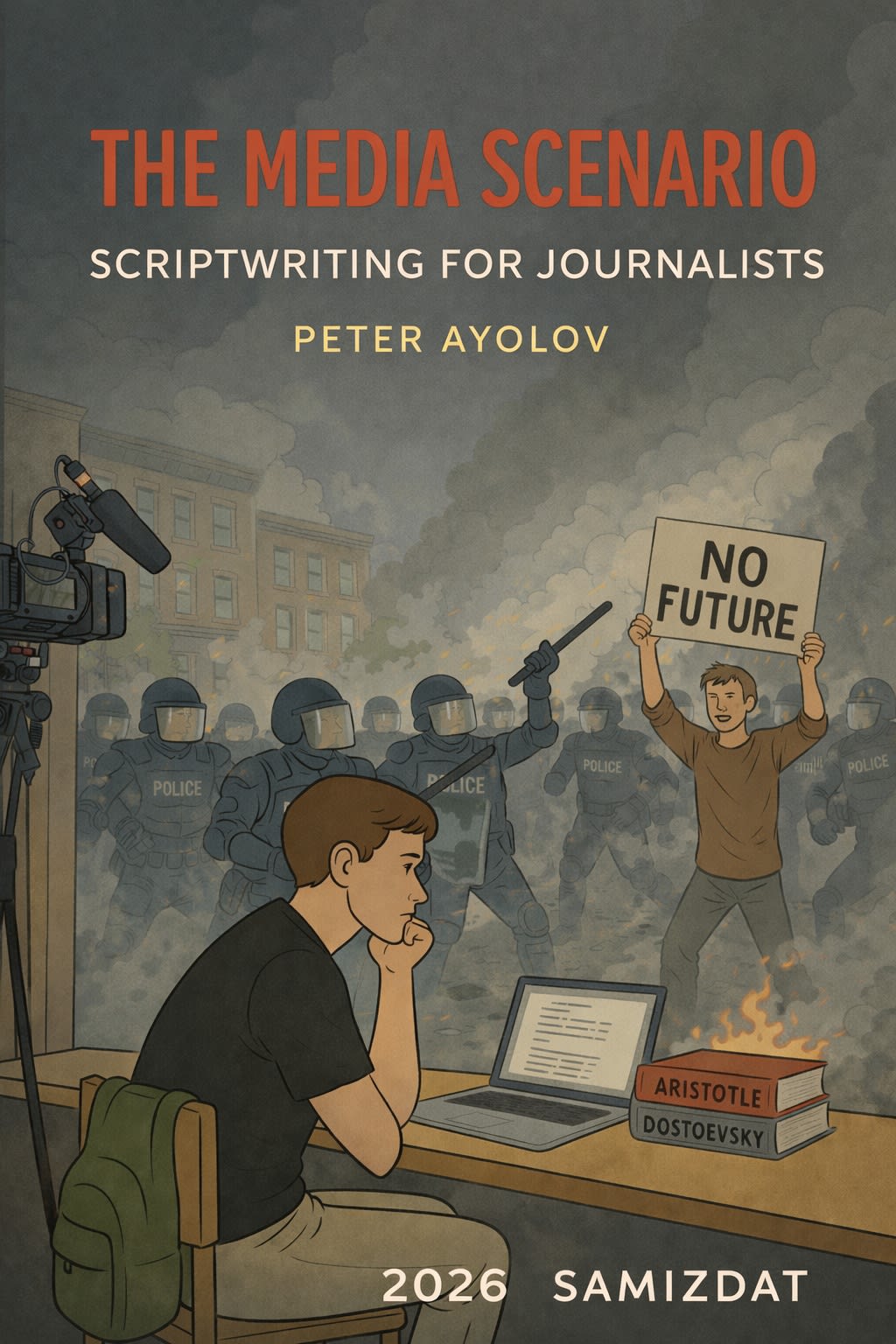
Book Review: The Media Scenario, Scriptwriting for Journalists by Peter Ayolov, 2026
Journalism Between Smirnenski’s Ladder and Vonnegut’s Story Curves
Peter Ayolov’s The Media Scenario is a formidable intervention in contemporary media theory — not merely a book about media, but a book about how the very experience of reality is now mediated, structured, and governed by narratives that function as playable environments rather than as neutral information. In a cultural moment saturated with data, platforms, and spectacle, Ayolov reframes our fundamental assumptions about communication: media is no longer a mirror of the world, but the skeleton of the world itself.
In contrast to much writing on digital culture that fixates on platforms, metrics, or technological determinism, The Media Scenario operates at the conceptual heart of mediation. Drawing on a rich lineage of thinkers — from Marshall McLuhan and Slavoj Žižek to Frank Rose and Jane McGonigal — Ayolov argues that storytelling has shifted from a form of representation to a form of participation. The book traces how propaganda, strategic communication, immersive narratives, foresight scenarios, and multiplayer worlds converge into a civilisational architecture in which people inhabit stories rather than merely consume them.
What makes Ayolov’s analysis compelling is his synthetic precision: he links the mechanics of strategic communication not only to press offices and spin doctors, but to affective economies, gaming grammars, algorithmic feedback loops, and the politics of attention. His argument is that narratives today function structurally — as scenarios that distribute roles, map identities, choreograph interactions, and prefigure behaviour — and not merely as texts to be decoded.
Compared to Manufacture of Dissent (2023), where Ayolov traced the deliberate construction and exploitation of political disagreement in the digital public sphere, The Media Scenario expands the frame to explore why and how narratives become environments that shape cognition, identity, and social reality itself. In that earlier work, Ayolov focused on the production of conflict; here he situates conflict within a larger grammar of participation and immersion. Where Manufacture of Dissent diagnosed epistemic fragmentation and contestation, The Media Scenario maps the architectures that produce these phenomena in the first place.
Similarly, readers of Moral Outrage Networks (2026) will recognise thematic continuities — particularly in Ayolov’s analysis of how affective mechanisms (anger, shock, indignation) are engineered and deployed in digital environments. Moral Outrage Networks dissected the systemic infrastructures that amplify outrage as a socio-technical force; The Media Scenario places these infrastructures within a broader narrative ecosystem, showing how outrage, immersion, gameplay, and scenario-building interact to produce contemporary subjectivities.
The book’s strongest sections — on immersive media, scenario planning, and the Metaverse as civilisation model — turn abstract theory into practical anthropology. Ayolov explains not just what is happening, but how it feels to live inside scenarios that continually shape expectation, identity, agency, and belief. His reading of the Metaverse — not as a technology, but as a cultural ontology — is among the most insightful contributions to current debates about digital mediation.
Ayolov does not descend into dystopian alarmism; he does not claim that media determines thought in a mechanistic sense. Rather, he shows how narrative structures, when internalised as environments of participation, redefine the conditions of agency and responsibility. Power today is less about issuing commands and more about designing playable worlds in which actors discover their roles as they act.
For scholars of media, culture, politics, and technology, The Media Scenario offers a conceptual vocabulary that extends beyond critique into practical comprehension. It explains why reality feels increasingly staged, interactive, and unstable — not because of a failure of media literacy, but because media is the scaffolding of experience itself. In doing so, it complements and extends Ayolov’s earlier work, providing a broader cartography of the narrative forces that shape the twenty-first century.
The Media Scenario is essential reading for anyone who wants not just to understand contemporary media environments, but to navigate them with philosophical clarity, critical awareness, and theoretical depth. It is a book that, like the scenarios it describes, invites us to participate in understanding the world — not as observers, but as co-authors of the stories we inhabit.
Conclusion: Vonnegut’s Shape of Stories
To understand the narrative logic of modern journalism, it is useful to return briefly to Hristo Smirnenski and his metaphor of the ladder. Smirnenski was a Bulgarian poet and satirist of the early twentieth century, whose work focused on social inequality, urban poverty, and the moral contradictions of modern life. His ladder is not a symbol of progress in the optimistic sense. It is a fragile, ironic structure that connects different social levels while exposing the illusions of ascent. Those who climb it gain visibility and voice, but often at the cost of solidarity, clarity, or truth. The ladder reveals that social mobility is also a narrative construction: who is allowed to speak, who is seen, and whose story is elevated.
Journalism operates through a similar vertical mechanism. It raises certain events, voices, and conflicts onto the public stage, while leaving others below the threshold of visibility. This act of elevation is never neutral. It already implies a story about importance, urgency, and relevance. Smirnenski’s ladder reminds us that every act of “giving voice” is also an act of framing, and that climbing the media ladder can distort as much as it reveals.
If Smirnenski shows how social reality is vertically arranged, Shakespeare’s Hamlet shows how truth itself becomes theatrical. Hamlet understands that power does not reveal itself directly; it performs. His decision to stage a play in order to expose the crime is a recognition that reality often becomes visible only through dramatization. Journalism inherits this paradox. It does not simply uncover facts; it arranges scenes in which contradictions can be perceived. Timing, sequencing, and emphasis become as important as evidence.
Kurt Vonnegut completes this picture by offering a simple but powerful insight: stories move in shapes. His diagrams of rise and fall, loss and recovery, explain why audiences recognise meaning not in isolated facts, but in emotional trajectories. Journalism increasingly relies on these shapes to organise attention. Crises, scandals, and reforms are framed as arcs rather than processes. Events are expected to curve, to escalate, to resolve. What does not bend into a recognisable shape struggles to survive in the media flow.
Taken together, Smirnenski, Hamlet, and Vonnegut describe three dimensions of contemporary journalism. Smirnenski reveals its vertical logic, Hamlet its performative awareness, and Vonnegut its emotional geometry. In the age of media scenarios, journalism no longer simply reports reality; it stages it, elevates it, and shapes it into trajectories that can be followed. The ethical challenge is not to abandon narrative, but to resist false ascents, forced dramas, and premature resolutions. Journalism retains its public function only when it recognises the ladders it builds, the stages it constructs, and the curves it imposes on reality.
About the Creator
Peter Ayolov
Peter Ayolov’s key contribution to media theory is the development of the "Propaganda 2.0" or the "manufacture of dissent" model, which he details in his 2024 book, The Economic Policy of Online Media: Manufacture of Dissent.
Keep reading
More stories from Peter Ayolov and writers in BookClub and other communities.
Moral Outrage Networks, The Sociology of Digital Anger (2026)
Peter Ayolov, Moral Outrage Networks: The Sociology of Digital Anger (2026) Moral Outrage Networks: The Sociology of Digital Anger continues and deepens Peter Ayolov’s earlier work The Economic Policy of Online Media (2023), in which he developed the theory of the Manufacture of Dissent and outlined the Propaganda 2.1 Model as an update to classical propaganda theory under conditions of platform capitalism. While the earlier book focused on the political economy of digital media and the monetisation of dissent, this new volume turns decisively toward the emotional infrastructure that makes such systems viable. Ayolov now advances a more fundamental claim: moral anger is not merely exploited by digital media systems but constitutes one of the basic structural conditions of morality itself, and therefore of social life in networked societies.
By Peter Ayolovabout 21 hours ago in BookClub
My New Book is Finally Here
My poetry collection Beautiful and Brutal Things is done. It's actually done and finally published over 270 pages. Over a year of my life went into this book. More than a year, really. Long days at my computer, sometimes seven days a week because I couldn't stop even when I probably should have. Then two months of editing that felt harder than the writing itself. But it's finished, and I'm still standing, and the book is real.
By Tim Carmichael11 days ago in BookClub
7 Books You’ll Be Thinking About All Day
Books have a quiet power. Some entertain us for a few hours and then fade, while others take up residence in our minds, resurfacing in conversations, decisions, and moments of reflection long after we’ve finished reading. These are the books that make us pause mid-day, rethink long-held beliefs, or see ordinary experiences through a sharper lens. Below is a list of 7 books you’ll be thinking about all day.
By Diana Merescabout 19 hours ago in BookClub


Comments
There are no comments for this story
Be the first to respond and start the conversation.