
Book review: The Great Gatsby by F. Scott Fitzgerald
The Great Gatsby is a 1925 novel by American writer F. Scott Fitzgerald. Set in the Jazz Age on Long Island, near New York City, the novel depicts first-person narrator Nick Carraway's interactions with Jay Gatsby, a mysterious millionaire obsessed with reuniting with his former lover, Daisy Buchanan.


There are books that you read and forget, and then there are those that linger, haunting the edges of your memory with their beauty, melancholy, and truth. The Great Gatsby by F. Scott Fitzgerald is firmly in the second category for me. Every time I return to it, I find something new—not because the story has changed, but because I have. It is a novel that matures with the reader, a mirror reflecting different aspects of our dreams and disappointments, our illusions and our realities.
Published in 1925, The Great Gatsby is a cornerstone of American literature. Written during the Jazz Age by one of its most eloquent chroniclers, F. Scott Fitzgerald, the novel is often classified as modernist fiction, but it reads with the elegance of a tragic romance and the bite of sharp social satire. Though not immediately successful upon publication, it has since become one of the most widely studied and quoted American novels, appealing to readers of all ages but especially those who are attuned to themes of aspiration, identity, and disillusionment. It is both accessible and layered, a story that can be read in a weekend and contemplated for a lifetime.
The plot is deceptively simple. Set in the summer of 1922 on Long Island, New York, the novel is narrated by Nick Carraway, a Yale graduate and World War I veteran who rents a modest house in West Egg, a fictionalized version of Great Neck. His neighbor is the enigmatic Jay Gatsby, a wealthy and mysterious man known for his lavish parties, whispered scandals, and unwavering pursuit of a dream. Across the bay lies East Egg, home to Tom and Daisy Buchanan—people of old money, brittle charm, and dangerous carelessness. As Nick becomes entangled in Gatsby’s world, he uncovers the truth behind Gatsby’s relentless hope, the tangled relationships between the characters, and the rotting moral foundation beneath their glittering surface. The story unfolds over a single summer, culminating in revelations and consequences that echo far beyond its pages.
At the heart of The Great Gatsby lies the American Dream—not the hopeful pursuit of a better life, but its distortion into something hollow and cruel. Gatsby, who begins as a self-made man driven by idealistic love, gradually becomes a symbol of the unattainable, the illusory, and the ultimately tragic. His dream is pure, but the world he moves through is not. Fitzgerald exposes the moral decay behind the opulence of the 1920s, portraying a society where wealth has become a substitute for meaning and where people float from one pleasure to the next without ever truly connecting. The novel explores themes of identity, memory, time, and class, all woven into a narrative that is as subtle as it is profound.
Fitzgerald’s prose is nothing short of exquisite. His language is poetic but never flowery, economical but emotionally potent. He uses imagery with painterly precision, evoking shimmering heat, decaying grandeur, and empty extravagance with a few carefully chosen words. The green light at the end of Daisy’s dock, the eyes of Doctor T. J. Eckleburg looming over the valley of ashes, the drifting rhythm of Gatsby’s parties—all of these have become part of the American literary consciousness because Fitzgerald renders them with such symbolic clarity. His sentences are musical, his metaphors striking, and his tone expertly calibrated between romantic yearning and cynical detachment.
The structure of the novel is also noteworthy. Told entirely from Nick’s point of view, the narrative is shaped not just by events, but by memory, perception, and judgment. Nick is not an omniscient narrator; he is reflective, sometimes uncertain, and deeply affected by what he witnesses. His voice creates a layer of complexity that allows readers to consider both what is being told and how it is being told. The use of retrospective narration—Nick writing after the fact, from a place of emotional and moral exhaustion—gives the novel its haunting quality. We sense from the beginning that something beautiful has already been lost, and the story is its elegy.
Emotionally, The Great Gatsby is both exhilarating and devastating. It captures the heady excitement of youth, ambition, and new love, only to show how fragile those things are when confronted by reality. Gatsby himself is a character who inspires admiration and pity in equal measure. He is both larger than life and heartbreakingly human—a man who has crafted himself from nothing, only to discover that reinvention has limits. The other characters, too, are drawn with startling accuracy: Daisy, charming and elusive, shaped by privilege and fear; Tom, brutish and arrogant, clinging to entitlement; and Nick, the quiet observer torn between cynicism and compassion. Their interactions are filled with emotional nuance, and Fitzgerald’s insight into their psychology is both sharp and empathetic.
If the novel has a flaw, it may be in its brevity. Some characters—particularly the women—are sketched rather than fully developed, and readers who long for deeper exploration of Daisy’s inner world may be left wanting. Yet this lack of access may be intentional; Daisy’s ambiguity is part of her role in Gatsby’s myth. Similarly, the novel’s tight focus on a small group of characters limits its scope, but that same focus gives it its emotional intensity. In this sense, the narrowness of the narrative is both a constraint and a strength—it allows for concentration, for poetic compression, for meaning to accumulate in small gestures and repeated images.
What impressed me most about The Great Gatsby is how it continues to reveal itself with each reading. On the surface, it is a beautifully written story of love and loss. But beneath that, it is a meditation on illusion, a critique of social inequality, and a lament for a nation that confuses wealth with virtue. It asks timeless questions: Can we truly escape our past? Can we ever know the people we love? Is the dream ever worth the price we pay to pursue it? These questions are as relevant now as they were a century ago, perhaps even more so in a world still obsessed with image, success, and reinvention.
So, The Great Gatsby is a rare achievement—a novel that is at once a period piece and a timeless reflection of the human heart. F. Scott Fitzgerald’s artistry lies in his ability to combine the precision of language with the ambiguity of emotion, crafting a story that is both tightly controlled and emotionally expansive. I would recommend this novel to anyone who values lyrical writing, moral complexity, and stories that linger long after they end. A tragic, beautiful, and enduring meditation on dreams, desire, and the cost of illusion.
This book review was written using the following references 👇
About the Creator
Caleb Foster
Hi! My name is Caleb Foster, I’m 29, and I live in Ashland, Oregon. I studied English at Southern Oregon University and now work as a freelance editor, reviewing books and editing texts for publishers.
Keep reading
More stories from Caleb Foster and writers in BookClub and other communities.
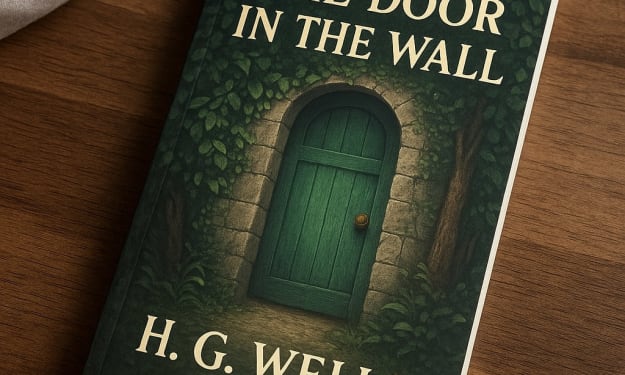
Book review: The Door in the Wall by H. G. Wells
There are stories that remain with you not because of what they resolve, but because of what they leave unresolved. The Door in the Wall by H. G. Wells is precisely such a story. From the first page, it beckoned to me in the same mysterious way the titular door beckons to its protagonist—quietly, insistently, with a suggestion that something perfect lies just out of reach. This short yet profound tale transcends the boundaries of genre fiction and philosophical reflection, crafting a narrative that resonates deeply with anyone who has ever felt the pang of lost possibility or the weight of choices made in life’s unfolding years.
By Caleb Foster7 months ago in BookClub
My New Book is Finally Here
My poetry collection Beautiful and Brutal Things is done. It's actually done and finally published over 270 pages. Over a year of my life went into this book. More than a year, really. Long days at my computer, sometimes seven days a week because I couldn't stop even when I probably should have. Then two months of editing that felt harder than the writing itself. But it's finished, and I'm still standing, and the book is real.
By Tim Carmichael5 days ago in BookClub
8 Short Books You Need To Read In 2026
In a world where our attention is constantly pulled in a million directions, finding time to read can feel impossible. Yet, short books offer a unique solution: they deliver profound insights, unforgettable stories, and transformative lessons—all without demanding weeks of commitment. Short books are perfect for busy professionals, students, or anyone who wants to enrich their mind efficiently.
By Diana Meresc2 days ago in BookClub



Comments
There are no comments for this story
Be the first to respond and start the conversation.