
Book review: The Door in the Wall by H. G. Wells
"The Door in the Wall" is a short story by H. G. Wells first published in the Daily Chronicle in 1906 and first collected in his The Country of the Blind and Other Stories in 1911.


There are stories that remain with you not because of what they resolve, but because of what they leave unresolved. The Door in the Wall by H. G. Wells is precisely such a story. From the first page, it beckoned to me in the same mysterious way the titular door beckons to its protagonist—quietly, insistently, with a suggestion that something perfect lies just out of reach. This short yet profound tale transcends the boundaries of genre fiction and philosophical reflection, crafting a narrative that resonates deeply with anyone who has ever felt the pang of lost possibility or the weight of choices made in life’s unfolding years.
Written in 1906 and first published in 1911 in the collection also titled The Door in the Wall and Other Stories, this tale reveals a very different side of H. G. Wells, who is often remembered as the father of modern science fiction. While Wells is best known for works like The War of the Worlds, The Time Machine, and The Invisible Man, The Door in the Wall moves away from external speculation and into the internal world of longing, memory, and psychological introspection. Though it contains fantastical elements, it is best classified as literary fiction with symbolic and philosophical overtones. It is a story for readers who appreciate subtlety and ambiguity, who understand that the most powerful questions are often those left unanswered.
The story is presented as a recollection by a man named Redmond, who recounts the strange and moving confessions of his friend Lionel Wallace. Wallace, a highly respected and successful politician, harbors a lifelong secret. As a child, he once discovered a green door in a white wall in a grim London street. When he stepped through, he entered an enchanted garden of peace and beauty, where everything seemed to exist in perfect harmony and fulfillment. But he was eventually pulled back into the real world—and from that moment on, he was haunted by a longing to return. The door appears to him again at various points in his life, always unexpectedly, always just when he is in the midst of some duty or worldly commitment. And each time, he chooses not to open it.
At the heart of the story lies a tension between imagination and reality, between the demands of practical life and the allure of transcendent beauty. The door in the wall symbolizes more than a literal passage; it becomes a metaphor for the spiritual or emotional states we often suppress in favor of ambition, conformity, or routine. Wallace is not mad, nor is he weak. Rather, he is achingly human—aware of what he has lost, and aware that he has chosen, time and again, not to reclaim it. The story is as much about regret as it is about longing. It does not offer a moral lesson, but rather a meditation on the nature of choice and the cost of forsaking our deepest truths for the sake of worldly success.
Wells’s language in this piece is notably different from his more technical or action-oriented works. Here, the prose is lyrical, reflective, and imbued with a tone of wistful melancholy. His use of language to evoke mood is remarkable. There is a softness to his descriptions of the garden behind the door—its beauty is never pinned down with specifics, but instead glows with emotional resonance. At the same time, the realism of London’s gray streets, of Wallace’s professional world, is rendered with a precision that makes the contrast even starker. The narrative voice, filtered through Redmond’s perspective, adds another layer of ambiguity. Redmond does not fully believe Wallace, but neither does he disbelieve him. This uncertainty mirrors the reader’s own ambivalence, inviting us to wonder whether Wallace’s experience was real, imagined, or something in between.
Structurally, the story is beautifully balanced. It begins with the air of a casual recollection, deepens into an intense psychological confession, and ends with a subtle yet profound question mark. The absence of resolution is not a flaw; it is essential to the story’s emotional power. Wallace’s final fate—and the circumstances surrounding it—can be read in multiple ways. Is it tragedy or triumph? Is it despair or release? Wells leaves it to the reader to decide, and in doing so, he honors the complexity of the human spirit.
The imagery in The Door in the Wall is hauntingly suggestive. The green door is not a portal in the typical fantasy sense; it is a symbol of everything Wallace truly wants and cannot have. Its color, its placement in an ordinary white wall, the way it appears and disappears—each element carries layers of metaphorical weight. The garden itself, with its serene animals and luminous beauty, evokes childhood innocence, spiritual grace, or perhaps even the afterlife. Yet it remains elusive, always slipping away just when it is within reach. That motif—of the thing most longed for being most easily missed—is one of the story’s most poignant elements.
What impressed me most about this story is how deeply it resonates without ever raising its voice. There are no dramatic confrontations, no supernatural revelations. Everything happens in the quiet spaces between memory and possibility, between longing and resignation. It reminded me of the small, haunting moments in life when we glimpse a path not taken and wonder what might have been. Wells captures that ache with exquisite precision. Unlike his better-known novels, The Door in the Wall is not concerned with machines or Martians, but with the inner machinery of the soul. It is as much a spiritual allegory as a psychological sketch.
If I were to identify any shortcoming, it might be that readers expecting the kind of high-concept speculative fiction Wells is famous for may feel disappointed. This is not a story of plot-driven events or scientific wonder. It is quiet, introspective, and built entirely around emotional and philosophical resonance. Its very ambiguity may frustrate those looking for clear answers or dramatic turns. But for those open to its mood and message, the story offers something rare—a moment of quiet reflection that lingers long after the final page.
So, The Door in the Wall is a short but masterful exploration of the human soul—its dreams, its fears, and its silences. H. G. Wells, best known for imagining the future, here looks inward, into the secret chambers of longing and regret that define us all. I would recommend it to readers who are drawn to meditative fiction, to stories that ask questions without forcing answers, and to anyone who has ever felt that there is something just beyond reach—something beautiful, meaningful, and maybe irretrievably lost. A profound, haunting story that speaks softly, but leaves a lasting echo.
This book review was written using the following references 👇
About the Creator
Caleb Foster
Hi! My name is Caleb Foster, I’m 29, and I live in Ashland, Oregon. I studied English at Southern Oregon University and now work as a freelance editor, reviewing books and editing texts for publishers.
Keep reading
More stories from Caleb Foster and writers in BookClub and other communities.
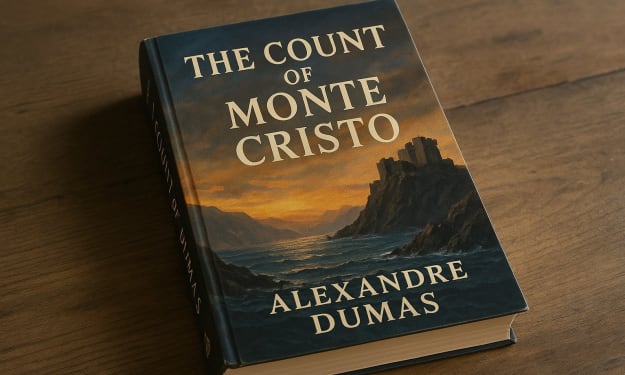
Book review: The Count of Monte Cristo by Alexandre Dumas
There are books that entertain, books that inspire, and then there are books that utterly consume you. The Count of Monte Cristo by Alexandre Dumas belongs to the last category for me. From the moment I began reading, I was swept into a whirlwind of betrayal, vengeance, love, and transformation—an epic that felt as inexhaustible as it was immersive. Though it spans hundreds of pages, I never once felt weary; instead, I was continually surprised by the novel’s depth, scope, and emotional complexity.
By Caleb Foster7 months ago in BookClub
My New Book is Finally Here
My poetry collection Beautiful and Brutal Things is done. It's actually done and finally published over 270 pages. Over a year of my life went into this book. More than a year, really. Long days at my computer, sometimes seven days a week because I couldn't stop even when I probably should have. Then two months of editing that felt harder than the writing itself. But it's finished, and I'm still standing, and the book is real.
By Tim Carmichael5 days ago in BookClub
Feast & Folklore: Autumn Recipes with a Story
Welcome to The Chapter Café, where stories simmer, flavors mingle, and every book is served with a side of imagination. Today’s menu? Cookbooks—the kind that leave grease stains on the margins and breadcrumbs in the binding. You know the ones: well-loved, well-used, and maybe even a little chewed on by time (or a curious pet).
By Kristen Barenthaler7 days ago in BookClub
Smart phones, Humans and Aliens.
WARNING. I will be tapping into one of your favorite creative tensions: The absurdity of humans worshipping their glowing rectangles as if they were tiny oracles. There’s something deliciously poetic about that contradiction, and it lends itself beautifully to an instructive proviso.
By Novel Allen6 days ago in Poets



Comments
There are no comments for this story
Be the first to respond and start the conversation.