
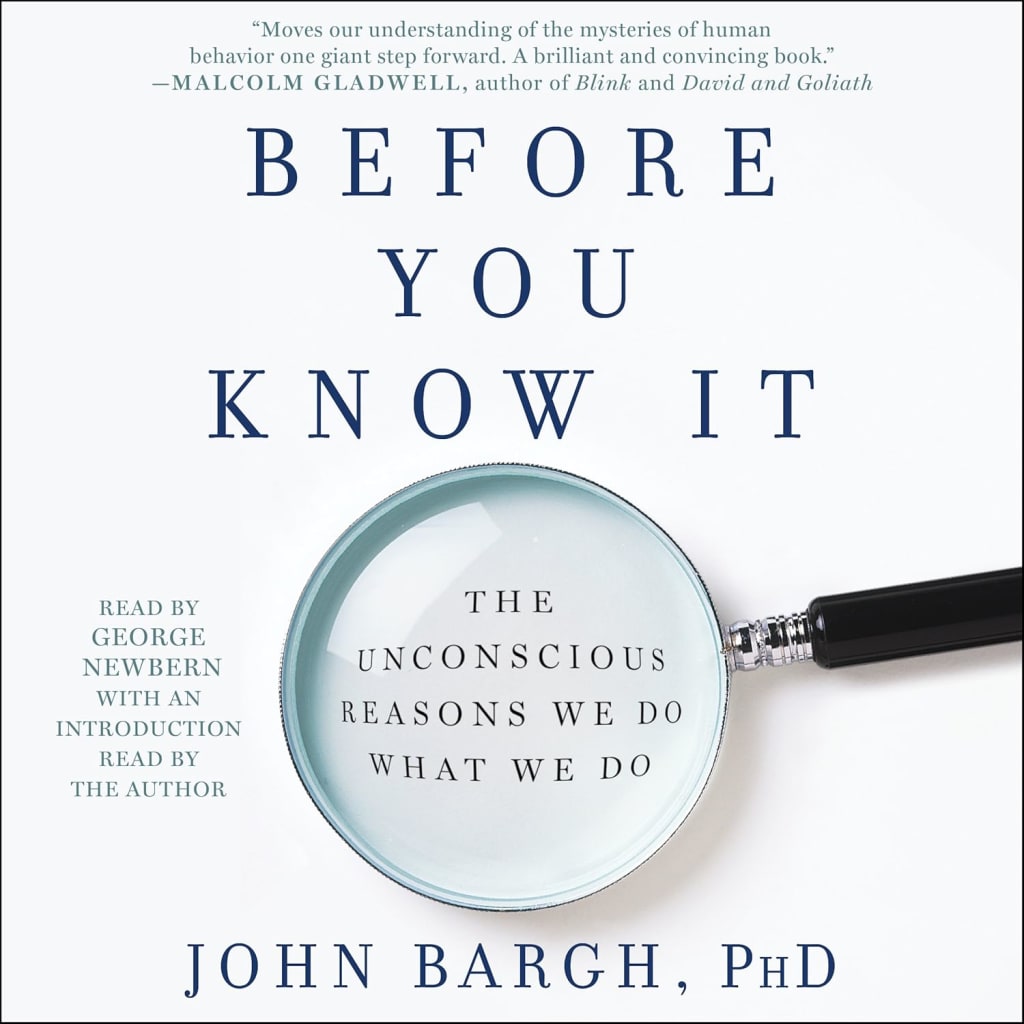
Book Review: Before You Know It: The Unconscious Reasons We Do What We Do
Dr. John Bargh, the world's leading expert on the unconscious mind, presents a groundbreaking book, 20 years in the making, that gives us an entirely new understanding of the hidden mental processes that secretly govern every aspect of our behavior.

Introduction
John Bargh's Before You Know It: The Unconscious Reasons We Do What We Do is a compelling exploration of the hidden forces shaping human behavior. As one of the most influential social psychologists of our time, Bargh delves into the unconscious mind and reveals how it impacts our decisions, emotions, and interactions in ways we often fail to recognize. The book presents groundbreaking research in psychology and neuroscience, shedding light on how much of our behavior is driven by automatic processes rather than conscious decision-making.
This review examines the book's key themes, strengths, and potential drawbacks while assessing its relevance for readers interested in psychology, self-improvement, and human behavior.
Bargh organizes Before You Know It into three major sections, each focusing on a different aspect of unconscious influences: our past, present, and future. These sections systematically explain how our hidden mental processes shape our daily lives and long-term goals.
1. The Past: How Our History Shapes Us
One of the most fascinating aspects of the book is Bargh's discussion of how past experiences and early childhood influences shape our unconscious behaviors. He argues that much of what we do is rooted in learned associations formed early. Once set in motion, these automatic responses continue to affect our perceptions and interactions long after we have forgotten their origins.
Key insights include:
The Power of Priming – Bargh's famous experiments on priming illustrate how exposure to certain words, images, or environmental cues can unconsciously influence our actions. For example, studies have shown that people exposed to words related to old age (like "slow," "frail," and "retirement") tend to walk more slowly afterward.
Parental Influence – Even in adulthood, our childhood experiences shape how we respond to authority, handle relationships, and manage stress. The unconscious scripts we develop as children continue to play out in our decision-making.
Cultural and Societal Influences – Bargh also explores how cultural conditioning and social norms dictate unconscious responses, influencing everything from political beliefs to consumer choices.
2. The Present: How Unconscious Processes Drive Everyday Behavior
This section reveals how unconscious mental processes affect us in real time, often without awareness. Bargh demonstrates how our actions are shaped by factors we rarely consider, such as environmental stimuli, social expectations, and even our bodily states.
Key topics include:
The Role of Habit and Automaticity – Many of our daily actions, from choosing what to eat to how we respond to emails, are guided by unconscious habits rather than conscious deliberation. Bargh explains how forming positive habits can lead to better decision-making without requiring constant willpower.
Unconscious Biases and Stereotypes – The book delves into implicit biases, explaining how they operate beneath the surface and influence our judgments. Bargh presents compelling evidence that even well-meaning individuals can harbor biases they are unaware of.
The Influence of Physical States – Studies suggest that hunger, fatigue, and body temperature subtly affect our decision-making and emotional responses. For example, judges tend to hand down harsher sentences before lunch when they are hungry, highlighting how unconscious states influence rational thought.
3. The Future: Using the Unconscious Mind to Our Advantage
In the final section, Bargh shifts from uncovering unconscious influences to providing strategies for harnessing them to achieve personal growth and success.
Key takeaways include:
Harnessing the Power of Goals – Bargh explains that setting clear goals can help align unconscious motivations with conscious aspirations. By priming ourselves with the right cues, we can make it easier to stick to habits and pursue meaningful objectives.
The Science of Willpower and Self-Control – The book discusses how self-control is not merely a function of willpower but is influenced by environmental factors, routines, and unconscious reinforcements. Structuring one's environment to support self-discipline can lead to better outcomes than relying on willpower alone.
The Future of AI and the Unconscious Mind – In a thought-provoking discussion, Bargh examines how artificial intelligence and technological advancements might interact with our unconscious biases, for better or worse.
Strengths of the Book
1. Grounded in Scientific Research
One of the book's biggest strengths is its reliance on rigorous psychological research. Bargh doesn't rely on anecdotal evidence or self-help platitudes; instead, he presents well-documented studies that illustrate his points. This lends credibility to his arguments and makes the book a valuable resource for readers interested in empirical psychology.
2. Engaging Writing Style
Despite dealing with complex psychological concepts, Bargh writes in a clear and accessible manner. He uses real-life examples, case studies, and engaging storytelling to make abstract theories relatable. Readers without a background in psychology will find the book easy to follow and intellectually stimulating.
3. Practical Applications
Unlike some psychology books that merely describe human behavior, Before You Know It provides actionable strategies for harnessing unconscious processes to improve decision-making, productivity, and well-being. This makes the book particularly useful for those looking to apply psychological insights in their personal and professional lives.
4. Challenges Conventional Notions of Free Will
Bargh's exploration of the unconscious mind forces readers to reconsider their assumptions about free will and conscious control. He presents compelling evidence that many of our decisions are influenced by factors beyond our awareness, prompting deep philosophical and ethical questions about personal responsibility and human agency.
Critiques and Limitations
1. Some Arguments Feel Overgeneralized
While Bargh presents strong evidence for the influence of unconscious processes, some critics argue that he occasionally overstates their impact. Not every decision we make is unconsciously determined; conscious reasoning and deliberation still play a significant role in human behavior. The book leans too heavily on the idea that we are at the mercy of unconscious forces.
2. Limited Discussion on Counterarguments
The book does not engage deeply with alternative psychological perspectives that emphasize conscious decision-making, such as cognitive-behavioral approaches. While Bargh presents strong evidence for unconscious influences, a more balanced discussion that acknowledges the role of conscious thought would have added depth to his arguments.
3. Could Offer More Prescriptive Advice
While the book offers some strategies for leveraging the unconscious mind, it does not provide a structured system for change. Readers seeking a step-by-step guide to reprogramming their unconscious habits may need to supplement this book with additional resources.
Final Verdict: Who Should Read This Book?
Recommended For:
✅ Anyone interested in psychology, neuroscience, or human behavior. ✅ Readers curious about the science behind habits, biases, and unconscious influences. ✅ Self-improvement enthusiasts looking to optimize decision-making and goal-setting. ✅ Professionals in marketing, leadership, or social sciences who want to understand consumer behavior and human motivation.
Not Ideal For:
❌ Readers who prefer books with a strong focus on conscious decision-making and free will. ❌ Those looking for a step-by-step program for self-improvement. ❌ Individuals who may be skeptical of psychological research and prefer anecdotal self-help books.
Conclusion
Before You Know It: The Unconscious Reasons We Do What We Do is a fascinating deep dive into the hidden forces that shape human behavior. John Bargh presents compelling research demonstrating how past experiences, present environments, and future aspirations are influenced by unconscious mechanisms. The book is well-written, engaging, and filled with insights that challenge our perceptions of free will and personal agency.
While some arguments may feel overstated, and more prescriptive advice would be welcome, Bargh succeeds in making complex psychological theories both accessible and thought-provoking whether you're a psychology enthusiast, a self-improvement seeker, or someone simply curious about why we act the way we do, Before You Know It is a valuable and eye-opening read.
About the Creator
TAPHA
Hi! Whether you're looking for insightful answers or a fresh perspective on a topic,I'm here to provide engaging, accurate,and thought-provoking content tailored just for you. Stick around, and let's explore the world of knowledge together!
My New Book is Finally Here
My poetry collection Beautiful and Brutal Things is done. It's actually done and finally published over 270 pages. Over a year of my life went into this book. More than a year, really. Long days at my computer, sometimes seven days a week because I couldn't stop even when I probably should have. Then two months of editing that felt harder than the writing itself. But it's finished, and I'm still standing, and the book is real.
By Tim Carmichael2 days ago in BookClub
Valentine in Montréal
Don't be fooled by the title. The story is actually very interesting: My name is Valentine. I am twenty-three years old and I work at a little store at Berri-UQAM métro. I am very ordinary-looking and Barney, who works the same shift as me at the store, says I do not know how to dress. I have been working there for four years, and I have never missed a day. This is why sometimes I seem familiar to people, even though they can't place me.
By Kendall Defoe 5 days ago in BookClub



Comments
There are no comments for this story
Be the first to respond and start the conversation.