
Austin Osman Spare:
Visionary of Art, Sorcery, and the Unseen

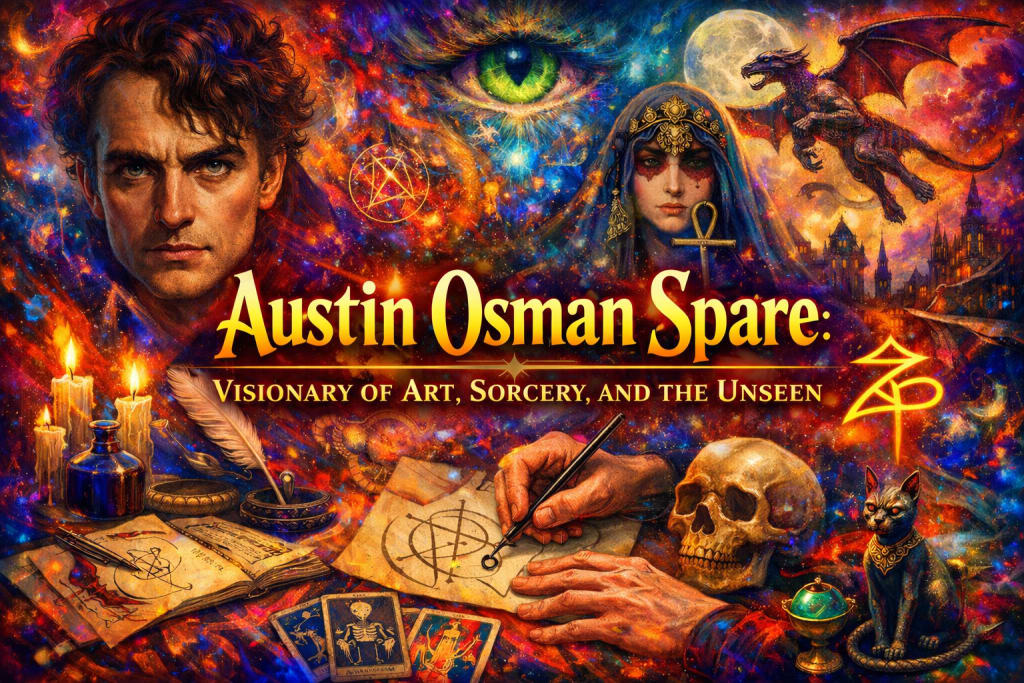
A Maverick of Vision and Magic
Few figures in the history of art and mysticism stand as distinctly as Austin Osman Spare. Born in London in 1886, at the close of the Victorian era, Spare entered a world caught between rigid social order and a fascination with the unseen. From a young age, his drawings displayed extraordinary skill and imagination, revealing an ability to render internal visions with a precision and intensity rarely seen in an artist so young. These early works conveyed both beauty and unease, hinting at an innate understanding of the subconscious mind and its symbolic potential.
The environment in which Spare matured was one of profound artistic and spiritual ferment. Traditional academic art was giving way to movements such as Symbolism and Art Nouveau, and new psychological ideas were beginning to explore the hidden workings of consciousness. Spiritualism and occult societies thrived in London, providing spaces where imaginative minds could probe the boundaries of perception. Within this context, Spare absorbed a wealth of influences, yet he pursued a path entirely his own, refusing to conform to any single artistic or mystical orthodoxy.
Spare’s work demonstrates a seamless fusion of artistic mastery and esoteric exploration. Drawing and painting became tools not only for aesthetic expression but also for engaging with deeper, unconscious currents of thought and desire. His imagery ranges from ethereal and dreamlike to grotesque and unsettling, reflecting an intimate engagement with instinct, fantasy, and hidden aspects of the psyche. Each line, curve, and shadow was carefully considered, often functioning as both artwork and instrument of personal and mystical investigation.
This integration of art and occult philosophy set Spare apart from contemporaries. His ideas anticipated aspects of surrealism and abstract expressionism, while his methods influenced later magical systems that emphasize psychological processes and results-oriented practice. Spare’s legacy endures in both visionary art and modern esoteric thought, a testament to a mind capable of navigating the unseen with clarity, courage, and imagination.
The life and work of Austin Osman Spare resist easy categorization. They invite rigorous observation, patient study, and engagement with the hidden forces that shape creativity and consciousness. Through his drawings, writings, and personal practice, Spare offers a rare glimpse into a world where art and magic coexist, illuminating paths that remain as compelling today as they were in his own time.
The Formative Years of a Visionary
Austin Osman Spare was born in London in 1886, a city vibrating with artistic experimentation, social transformation, and an expanding curiosity about the unseen. The closing decades of the Victorian era were marked by an interplay of strict moral structures and a simultaneous fascination with spiritual exploration. Into this world arrived Spare, whose early life displayed a remarkable intensity of vision and technical skill that immediately distinguished him from his peers. By childhood, his sketches revealed an extraordinary ability to capture the subtleties of human form, the tension of movement, and the interplay of shadow and light, often imbued with symbolic or uncanny qualities that hinted at a profound inner awareness.
Recognition came early. Scholarships and awards opened doors to formal artistic education, including admission to prestigious institutions. Within these structured environments, Spare mastered classical technique, perspective, and composition, yet his work constantly diverged from conventional instruction. Even at a young age, the imaginative force within his art insisted on exploring themes that were intensely personal, psychological, and occasionally unsettling. Traditional curricula could not contain the depth of his vision, and while he benefited from formal study, his path quickly moved beyond its limits.
Alongside artistic development, Spare’s formative years were steeped in a fascination with mystical and esoteric ideas circulating through London at the turn of the century. Spiritualism, emerging psychological theories, and occult philosophies offered frameworks for understanding the unseen and the workings of the mind beyond rational perception. These ideas attracted a generation of artists, writers, and thinkers seeking to expand human experience, yet Spare’s engagement was always selective. Brief connections with ceremonial magic figures were exploratory rather than formative, serving as initial encounters rather than sustained affiliation.
By adolescence, Spare had begun to fuse artistic mastery with mystical inquiry, recognizing that drawing and painting were not merely aesthetic pursuits but instruments for exploring consciousness and the unconscious. Early sketches and illustrations reveal a preoccupation with archetypal forms, dream imagery, and instinctual symbolism, suggesting a sophisticated understanding of the interplay between inner life and outward expression. This period established the foundation for a lifetime in which art and mystical practice were inseparable, each informing and amplifying the other.
In essence, Spare’s formative years combined rigorous technical training with a deep, independent exploration of the psyche and the unseen. He emerged not only as a prodigious artist but as a thinker and visionary whose work would later challenge and expand the boundaries of both artistic expression and mystical practice. These early experiences created a unique trajectory, one that refused convention and prepared a singular path that continues to inspire study, reflection, and creative exploration.
Art as a Portal: The Alchemy of the Unconscious
The work of Austin Osman Spare commands attention with a force that is both immediate and enduring. From delicate figurative drawings to intricate etchings and later visionary compositions, each piece engages the viewer on multiple levels—psychological, mystical, and aesthetic. Human forms often twist into shapes that suggest animal energy or archetypal symbolism. Lines, curves, and shadows pulse with a life beyond the visible, conveying currents of thought, instinct, and emotion. Every stroke carries weight, offering more than surface representation and inviting prolonged reflection on the hidden layers of perception and imagination.
Spare developed a vocabulary of form that was strikingly original. Faces and figures frequently emerge in states of transformation, caught between the tangible and the symbolic, the conscious and the instinctual. Distortions of proportion, elongated limbs, and contorted postures articulate tensions within the psyche, while recurring motifs—spirals, sigils, and abstract shapes—serve as visual keys to deeper currents of consciousness. The imagery is neither decorative nor purely narrative; it is functional, a bridge to realms beyond rational comprehension, a conduit for exploring internal and unseen realities.
A cornerstone of Spare’s innovation was the practice of automatic drawing and writing. This method was far more than an artistic exercise. By surrendering conscious control and allowing forms to emerge spontaneously, it became a means of direct engagement with the unconscious. Through repetition, focused attention, and immersion in the creative act, Spare entered states he described as “atavistic resurgence,” reconnecting with instinctual, pre-rational aspects of perception and awareness. In these moments, the boundary between artist and artwork, self and symbol, dissolved, producing creations that functioned as extensions of consciousness itself.
The process of automatic creation emphasized experimentation over formal outcome. Each line or form was a discovery, revealing hidden impulses, unspoken desires, and subtle forces within the psyche. Yet even within this unstructured method, technical mastery remained evident. Compositions maintain balance, rhythm, and elegance, reflecting a profound understanding of proportion, motion, and the interaction of light and shadow. The works resonate with a precision that merges instinct and intellect, imagination and skill.
Spare’s approach transformed drawing and painting into instruments of personal and mystical exploration. Art became a medium for investigating inner landscapes, accessing intuitive knowledge, and manifesting psychological and spiritual insights. Surrealist artists recognized parallels in his methods, though Spare’s work predates much of the movement and diverges in its emphasis on magical and subconscious purpose. Later occultists and practitioners of modern magical systems drew from his techniques, particularly the integration of automatic creation with the generation of intention, desire, and symbolic energy.
Through this synthesis of skill, imagination, and instinct, Spare demonstrated that art could serve as both mirror and catalyst, reflecting internal experience while shaping perception and awareness. Each work functions as a dialogue between conscious form and unconscious emergence, structure and spontaneity, beauty and the uncanny. In the alchemy of the unconscious, his art transcends representation, offering a path to understanding the hidden mechanisms of mind, desire, and the unseen forces that shape both creativity and consciousness.
Written Works as Vessels of Hidden Knowledge
The writings of Austin Osman Spare form a rare intersection of art, philosophy, and mystical practice. These texts are more than guides or treatises; they are experiential instruments designed to engage the mind, the imagination, and the unconscious simultaneously. Words and images coexist, each amplifying the other, creating a landscape in which the reader is invited to observe, reflect, and experiment. The works resist conventional classification, existing as a fusion of visionary art, psychological exploration, and esoteric instruction.
Earth Inferno, produced in Spare’s youth, demonstrates the early emergence of his singular vision. The work juxtaposes brief, incisive aphorisms with haunting illustrations that convey internal and external landscapes simultaneously. Themes of duality recur: light and shadow, conscious thought and hidden instinct, desire and restraint. Every figure, line, and form functions symbolically, inviting engagement with the unseen currents shaping perception and experience. Even at this early stage, Spare’s approach is both poetic and systematic, revealing an intuitive understanding of the psyche’s depth and complexity.
A Book of Satyrs builds on these foundations, exploring archetypal and instinctual forces through mythic imagery. Satyrs embody raw energy, desire, and untamed instinct, providing a symbolic framework for understanding unconscious drives. Illustrations accompany commentary that interprets these figures not literally, but as reflections of internal states. The work encourages the reader to confront and engage with primal aspects of mind and body, bridging conscious awareness and instinctual knowledge in ways that were unprecedented for its time.
The Book of Pleasure (Self-Love) represents a turning point in Spare’s integration of theory and practice. Central to this work is the technique of sigilization: the transformation of desire into a visual symbol implanted within the unconscious. This method illustrates a profound understanding of the relationship between intention, imagination, and action. Spare links ecstasy, creative will, and personal transformation, presenting a system in which self-knowledge becomes the foundation for mystical and practical experimentation. The text is structured to guide engagement, with illustrations and aphorisms serving as prompts for personal insight and exploration.
The Focus of Life expands the philosophical underpinnings introduced in earlier works, examining concepts such as Kia, ZOS, and Ikkah. Kia represents universal consciousness and creative potential. ZOS reflects the instinctual, embodied self, the locus of desire and vitality. Ikkah embodies the restless, wandering mind. Together, these ideas map a system in which intention, perception, and action intersect. The work emphasizes the integration of philosophical understanding with practical engagement, illustrating how consciousness can be directed, transformed, and expressed through deliberate practice.
Spare’s texts demand active participation. Reading alone is insufficient; engagement requires reflection, experimentation, and personal application. Illustrations function as visual exercises, guiding the reader’s perception and intuition, while the written word conveys principles of psychology, philosophy, and magic. This combination fosters an experiential understanding of the interplay between mind, desire, and the unseen forces that shape both perception and creative expression.
These works endure because they are invitations rather than prescriptions. They present tools for exploring the psyche and the mystical realms, encouraging direct engagement with ideas, symbols, and techniques. Through study and practice, readers encounter a system in which art, mind, and mystical experience converge, revealing the depth and coherence of Spare’s philosophy. Each text becomes a doorway, offering insight into the mechanisms of consciousness, the dynamics of desire, and the transformative power of imagination.
Sigils, Desire, and the Psychology of Magic
One of Austin Osman Spare’s most enduring contributions to modern occultism is the development of sigilization, a method for translating desire and intention into symbolic form. This approach marked a radical departure from the ceremonial and rigidly structured systems of magic prevalent in the early twentieth century. Rather than relying on formalized rituals, complex hierarchies, or prescribed invocations, Spare proposed a system in which personal will could be distilled, encoded, and directed through the unconscious mind.
Sigils are created by taking a statement of desire and reducing it to a unique glyph. Each letter is abstracted, transformed, and recombined into a singular visual symbol that functions as a compact, energetic expression of intent. The process is meticulous, blending creativity with psychological insight. Once the sigil is complete, it is mentally implanted into deeper consciousness and then deliberately forgotten, freeing it from the interference of conscious thought and allowing instinct, imagination, and unconscious forces to act upon it. This method positions magic as an internal, psychological process as much as a mystical one, bridging thought, perception, and manifestation.
The significance of sigilization lies in its fusion of desire, imagination, and focused attention. By engaging with symbols rather than literal statements, the practitioner taps into the subconscious, the part of the mind that operates beneath rational control. This process parallels certain psychological principles later explored in depth by studies of imagination, suggestion, and the subconscious. The act of creation, visualization, and release transforms the practitioner’s relationship to desire itself, converting abstract intention into energetic action without external ritual or intermediaries.
Spare’s approach also emphasizes experimentation and adaptability. Techniques are not rigidly fixed; each practitioner interprets and applies the method according to personal experience, temperament, and circumstance. The results-oriented nature of this practice encouraged practitioners to observe, refine, and innovate, fostering a system that privileges direct engagement over dogma. This flexibility allowed sigilization to transcend Spare’s own writings and influence later developments in modern magical practice, particularly within chaos magic, where similar principles of personal experimentation, symbolic intention, and subconscious engagement became central.
Beyond mechanics, sigilization represents a profound philosophical statement about the nature of consciousness, desire, and creative power. Desire is not merely wish or longing; it becomes a dynamic force that can be molded, directed, and integrated into perception and action. The unconscious is not a passive storehouse but an active participant in shaping reality. Imagination becomes the medium through which intention is translated into experience. This integration of mind, will, and symbolic form demonstrates Spare’s belief that magic operates as much within the psyche as it does in the external world.
Through the method of sigils, magic becomes a deeply personal, highly adaptive, and psychologically informed practice. The simplicity of the technique belies its profound effectiveness, combining artistry, intuition, and subtle understanding of human consciousness. Each sigil is a compact vessel of intent, a bridge between inner vision and external manifestation, illustrating the transformative potential of aligning desire with symbol, focus, and unconscious action.
The enduring influence of Spare’s sigilization is evident in the practices of later magical innovators, visionary artists, and psychically oriented practitioners. Its elegance, adaptability, and psychological insight have ensured that the method remains not only relevant but central to contemporary explorations of magical theory, personal transformation, and the intersection of imagination and reality.
A Lasting Legacy on Modern Occultism and Art
Austin Osman Spare’s influence on both occultism and creative practice is profound, extending far beyond the immediate circles of his lifetime. By demonstrating that magical practice could operate independently of rigid ceremonial systems, Spare provided a model for experimentation, personal empowerment, and direct engagement with the unconscious. This approach challenged established norms in magical practice, proving that the combination of imagination, will, and symbolic action could achieve results without hierarchical structures, prescribed rituals, or external authority.
Later practitioners have drawn directly from Spare’s methods, integrating them into modern magical systems while adapting them to individual experience. Chaos magicians, in particular, embraced his techniques of sigilization and automatic creation, seeing in them a practical means of accessing unconscious processes and shaping reality through intention and perception. Automatic drawing and writing, once experimental exercises for Spare, became recognized as tools for psychological exploration, visionary insight, and magical effect. The emphasis on personal adaptation, experimentation, and results-oriented practice has ensured that his work continues to inform contemporary occult philosophy and application.
Spare’s impact is not limited to magical technique; his artistic vision resonates across creative disciplines. Early automatic drawings prefigure aspects of surrealism, demonstrating a systematic exploration of the unconscious through spontaneous form. Abstract expressionists, though emerging decades later, similarly explored the release of instinctual energy into visual composition, echoing the principles Spare applied decades earlier. His integration of psychological insight and symbolic abstraction allows his work to operate on multiple levels simultaneously: aesthetic, conceptual, and transformative.
The fusion of artistic mastery with mystical philosophy in Spare’s work creates a template for those seeking to merge personal expression with inner exploration. His imagery conveys internal states, primal energy, and symbolic meaning in ways that continue to inspire artists, writers, and practitioners of modern magical systems. Symbol, line, and form function as instruments of self-reflection and personal evolution, demonstrating that the boundaries between art, consciousness, and mystical practice are not fixed but permeable.
Spare’s legacy endures because it operates at the intersection of personal experimentation, visionary imagination, and psychological insight. The principles he developed—direct engagement with unconscious processes, the translation of desire into symbolic form, and the integration of art with mystical practice—remain relevant to contemporary exploration of consciousness and creativity. Each subsequent generation that studies his work encounters a blueprint for independent inquiry, a model for transformative artistic and magical practice, and an example of a life devoted to the intersection of vision and experimentation.
Through the continuing study of his art, writings, and methods, the influence of Austin Osman Spare remains both subtle and profound. His approach encourages the merging of personal creativity with mystical inquiry, demonstrating that innovation, insight, and transformation are inseparable when imagination and intention are aligned. The legacy of Spare is a living one, guiding those who seek to explore the unseen, understand the unconscious, and channel inner vision into both artistic and magical creation.
Foundations of Consciousness: Core Philosophical Concepts
The philosophy underpinning Austin Osman Spare’s work rests on a small set of interrelated, highly original concepts. These constructs provide both a psychological map and a mystical framework, offering insight into consciousness, desire, and the mechanisms by which personal intention can shape perception and experience. Rather than prescribing dogma or formal ritual, these ideas function as tools for experimentation, guiding the practitioner through exploration of the mind, body, and symbolic imagination.
Kia represents universal awareness, the primal source from which all consciousness emerges. It is ineffable, formless, and beyond rational categorization, yet it underlies all acts of perception and creation. Kia is not an external deity or entity; it is the raw, limitless potential from which will, imagination, and psychic energy arise. In practice, engaging with Kia involves cultivating an awareness of consciousness itself, observing the flow of thought and sensation while recognizing the underlying unity of experience. Kia is the foundation of creativity, the origin of instinctual knowledge, and the unifying principle that links desire with manifestation.
ZOS is the embodied, instinctual aspect of the self. It represents the personal locus of energy through which creativity, desire, and magical power are expressed. ZOS encompasses the physical body, innate drives, and individual identity, serving as the interface between consciousness and action. In Spare’s practice, ZOS functions as the center of projection, the vessel through which intention is condensed and transformed into symbolic or practical expression. Mastery of ZOS requires attunement to bodily awareness, instinct, and personal rhythm, allowing energy to flow naturally into creative or magical endeavors.
Ikkah embodies the restless, wandering mind—the flux of thoughts, perceptions, and distractions that separate conscious awareness from deeper consciousness. Ikkah represents the constant mental chatter, the interference of intellectualization or over-analysis, and the instability of focus that can obstruct both creativity and magical operation. Understanding and mastering Ikkah involves learning to direct attention with precision, observing mental patterns without attachment, and channeling focus toward desired outcomes. By harmonizing Ikkah with ZOS and attuning to Kia, the practitioner creates a dynamic balance in which will, body, and consciousness operate in concert.
Together, Kia, ZOS, and Ikkah form an integrated framework that links the psychological and the mystical. Kia provides the universal source of energy, ZOS grounds this energy in the body and personal identity, and Ikkah governs the flow of thought and attention that shapes perception and manifestation. This triad allows for an approach to magic and creative practice that is both practical and deeply introspective, emphasizing direct experience and experimentation over formalized instruction.
Spare’s philosophical constructs emphasize the inseparability of mind, body, and consciousness in both artistic and magical work. They invite rigorous self-observation, careful experimentation with perception and intention, and active engagement with instinctual and subconscious forces. By internalizing these concepts, a practitioner gains tools for navigating inner landscapes, directing creative energy, and cultivating transformative states of awareness. These principles continue to influence contemporary approaches to both esoteric practice and visionary art, demonstrating the enduring relevance of Spare’s thought.
Recommended Reading: #commissionearned
The Writings of Austin Osman Spare: The Book of Pleasure and The Focus of Life by Austin Osman Spare
Published during different phases of Austin Osman Spare’s creative life, these two texts form the backbone of Spare’s magical and philosophical system. The Book of Pleasure introduces sigilization as a method of desire compression and subconscious activation, presenting magic as an internal psychological process rather than a ceremonial performance. The Focus of Life expands the theoretical framework by examining consciousness, identity, and perception through the concepts of Kia, ZOS, and Ikkah. The writing style blends aphorism, poetic reflection, and symbolic illustration, requiring slow and careful engagement. These works reject external authority in favor of direct experience and personal experimentation. Artistic creation and magical practice are presented as inseparable acts driven by instinct and awareness. Any serious exploration of Spare’s influence on modern occultism begins with these texts, as nearly all later interpretations draw directly from their ideas.
Austin Osman Spare, revised edition: The Life and Legend of London’s Lost Artist by Phil Baker
Historical clarity emerges through Phil Baker’s detailed biography, which situates Austin Osman Spare within early twentieth century London art and esoteric culture. Archival research traces Spare’s rise as a prodigious young artist, early exhibitions, and eventual withdrawal from public acclaim. The book explores interactions with figures connected to ceremonial magic while emphasizing Spare’s refusal to remain within organized systems. Artistic development, poverty, isolation, and late recognition receive careful treatment without romantic distortion. Baker documents how personal experience shaped Spare’s philosophy, including attitudes toward desire, discipline, and independence. Contextual analysis clarifies how Spare anticipated surrealist methods through automatic drawing and symbolic abstraction. The biography provides grounding for readers seeking factual structure behind the philosophical and magical material discussed throughout the blog.
Liber Null and Psychonaut: The Practice of Chaos Magic by Peter J Carroll
Modern chaos magic draws heavily from principles first articulated by Austin Osman Spare, and Peter J Carroll presents those principles in a systematic contemporary form. Liber Null outlines a stripped down magical framework centered on belief as a tool rather than a doctrine. Psychonaut examines altered states of consciousness, mental discipline, and symbolic engagement as methods for transformation. Sigil work receives direct attention, with emphasis on subconscious processing and deliberate forgetting. Theoretical explanations remain closely tied to practical experimentation, encouraging adaptability rather than tradition. Spare’s influence appears throughout the text, particularly in discussions of desire, will, and non dogmatic practice. Readers interested in the evolution of Spare’s ideas into late twentieth century occultism will find a clear intellectual lineage here.
Sigil Witchery: A Witch’s Guide to Crafting Magick Symbols by Laura Tempest Zakroff
Symbol creation takes center stage in this contemporary exploration of sigil practice within modern witchcraft. Historical roots trace directly back to Austin Osman Spare, whose method of symbolic desire compression forms the conceptual foundation. Artistic process receives equal emphasis alongside magical intention, reinforcing the role of creativity in effective practice. Visual design, repetition, and personal symbolism are presented as pathways to subconscious engagement. Psychological insight accompanies ritual structure, reflecting Spare’s original synthesis of mind and magic. Practical exercises demonstrate adaptability across traditions without rigid hierarchy. The book illustrates how Spare’s techniques continue to evolve while retaining core principles of instinct, focus, and transformation.
Lost Envoy, revised and updated edition: The Tarot Deck of Austin Osman Spare by Jonathan Allen
Austin Osman Spare’s tarot deck stands apart from conventional systems through its emphasis on instinctual symbolism and personal vision. Jonathan Allen provides historical context for the deck’s creation while offering detailed interpretation of each card’s imagery. Analysis connects visual motifs to Spare’s broader philosophy, including unconscious perception and embodied awareness. Divination appears as a dialog between symbol and intuition rather than a fixed predictive system. Artistic intent receives careful attention, revealing how line, form, and abstraction carry psychological meaning. The deck functions as both a magical tool and an artistic statement. This work demonstrates how Spare translated philosophical principles into a functional symbolic system.
Condensed Chaos: An Introduction to Chaos Magic by Phil Hine
Accessibility defines Phil Hine’s approach to chaos magic, presenting complex ideas through clear structure and practical application. Core concepts such as belief manipulation, symbolic action, and altered awareness reflect direct inheritance from Austin Osman Spare. Sigilization appears as a foundational practice grounded in psychological insight rather than superstition. Emphasis on experimentation encourages individual responsibility and critical thinking. Historical commentary situates chaos magic within a lineage of radical innovation rather than tradition. Exercises illustrate how imagination and intent interact within daily life. The book serves as a bridge between Spare’s early twentieth century innovations and contemporary occult practice.
Art, Tarot, and Experiential Practice
Austin Osman Spare’s work cannot be confined to text or theory. Visual art and embodied practice formed an essential extension of philosophical ideas, translating abstract concepts into lived experience. Drawing, painting, and symbolic design operated as active tools rather than decorative expressions, each mark functioning as a point of contact between consciousness and instinct. Art became a method of inquiry, capable of altering perception and opening access to deeper psychological strata.
The tarot deck created by Spare stands as a clear example of this approach. Developed early in his career, the deck departs sharply from established tarot systems. Conventional hierarchies and standardized symbolism give way to fluid, instinct driven imagery rooted in personal vision. Figures dissolve into archetypal forms, animal shapes, and ambiguous structures that invite intuitive interpretation rather than fixed meaning. Each card operates as a catalyst for unconscious engagement, encouraging direct interaction with symbol rather than reliance on inherited doctrine. The deck reflects Spare’s belief that divination arises from internal perception shaped through symbolic focus.
Experiential practice extended beyond visual symbolism into bodily technique. Spare developed ritual postures, controlled breathing, focused visualization, and trance states designed to bypass habitual thought patterns. These methods aimed to quiet intellectual interference while amplifying instinct and sensory awareness. Physical stillness and deliberate tension functioned as gateways to altered states, allowing symbolic images to arise spontaneously. Such techniques aligned closely with later developments in meditative discipline, ecstatic ritual, and depth psychology, though formulated independently through personal experimentation.
Central to these practices was the conviction that knowledge emerges through direct experience rather than theoretical accumulation. Ritual was not treated as performance or external invocation but as an internal act of alignment between body, attention, and desire. Artistic creation, divinatory work, and trance all served the same purpose: the reconfiguration of perception. Each practice reinforced the others, forming an integrated system in which symbol, sensation, and awareness operated together.
Spare’s approach anticipated modern experiential spirituality by emphasizing practice over belief and exploration over doctrine. Artistic intuition replaced rigid structure, while ritual became a method for engaging subconscious forces through disciplined attention. The fusion of art, tarot, and embodied technique demonstrates how Spare transformed creativity into a living practice. This integration remains one of the most enduring and influential aspects of his legacy, continuing to inspire those who seek knowledge through experience rather than abstraction.
Paths Opened, Not Prescribed
Austin Osman Spare occupies a rare position in modern cultural history, standing at the convergence of visionary art, early psychological insight, and experimental mystical practice. Classification resists application, as neither artist, occultist, nor philosopher fully contains the scope of the work. What remains consistent across drawings, texts, and techniques is an invitation rather than an instruction. Engagement is encouraged through exploration, testing, and reflection rather than adherence to belief or authority.
Serious study of Spare rewards direct contact with original material. Primary texts reveal nuance often lost through summary or interpretation, while original artwork communicates ideas that language cannot fully contain. Reading slowly, observing symbolism carefully, and allowing ideas to unfold over time aligns with the spirit of the work itself. Patience and curiosity form the foundation of meaningful understanding, especially when confronting unfamiliar concepts or challenging material.
Public libraries provide an essential gateway for this exploration. Many libraries hold editions of Spare’s writings, biographies, and related studies in art history, psychology, and esotericism. Librarians can assist in locating physical copies, interlibrary loans, or archival material that offers reliable context. Engaging with curated collections helps ensure accuracy and preserves the integrity of historical sources. Scholarly editions and museum publications often clarify timelines, terminology, and artistic development more effectively than fragmented online material.
Caution remains necessary when navigating free digital resources. Online texts and images frequently circulate without attribution, verification, or fidelity to original editions. Misquotations, altered scans, and speculative interpretations can distort understanding and obscure original intent. Cross checking information against published sources strengthens discernment and deepens comprehension. Responsible research honors the complexity of the subject and protects against oversimplification.
Exploration of Austin Osman Spare’s legacy thrives on independence of thought balanced by careful study. Art, magic, and consciousness meet most powerfully when inquiry remains active and informed. The work encourages investigation beyond surface impressions, guiding seekers toward original sources, thoughtful analysis, and lived experience. Such exploration keeps the legacy alive, not as a fixed system, but as a continuing dialogue between imagination, awareness, and discovery.
About the Creator
Marcus Hedare
Hello, I am Marcus Hedare, host of The Metaphysical Emporium, a YouTube channel that talks about metaphysical, occult and esoteric topics.
https://linktr.ee/metaphysicalemporium
Keep reading
More stories from Marcus Hedare and writers in BookClub and other communities.
The Five Exit Points a Soul Plans Before Birth
The Architecture of Arrival and Departure Across civilizations separated by geography and century, a striking continuity appears in spiritual philosophy and metaphysical inquiry. Consciousness enters physical form through deliberate structure rather than accident. Birth is framed not as a blind beginning, but as a negotiated crossing shaped by intention, memory, and limitation. Ancient thinkers described embodiment as a descent through layers of awareness, each layer narrowing perception while preserving essential purpose. Within that descent, departure was never absent from consideration.
By Marcus Hedarea day ago in BookClub
Self Help: Grifters' Gospel
On Self-Help, Snake Oil, and the Illusion of Change Psychology professionals and students can be imagined on two opposite sides of a line called self-help books: likely a larger group opposes pop-science and step-by-step manuals filled with talk of success, journaling, and not giving a f**k; others love them, but they aren’t many.
By Avocado Nunzella BSc (Psych) -- M.A.P 4 days ago in BookClub
8 Amazing Books You'll Actually Love Reading
Reading has the power to transform us. It can transport us to distant worlds, challenge our perspectives, and ignite ideas we never knew existed. Whether you’re looking to spark your imagination, gain practical wisdom, or simply lose yourself in a story that sticks with you, this list has something for every reader. Below is a list of 8 amazing books you'll actually love reading.
By Diana Meresc2 days ago in BookClub
A Letter to the Firestarter
Dear Firestarter, We can all see you, we've been watching you since you began. In case you didn't know we were here before you and we will be here after. We witnessed your rise, your setbacks, your guilt and your lies. We witnessed you start the fire.
By Donny Foley7 days ago in Poets


Comments
There are no comments for this story
Be the first to respond and start the conversation.