
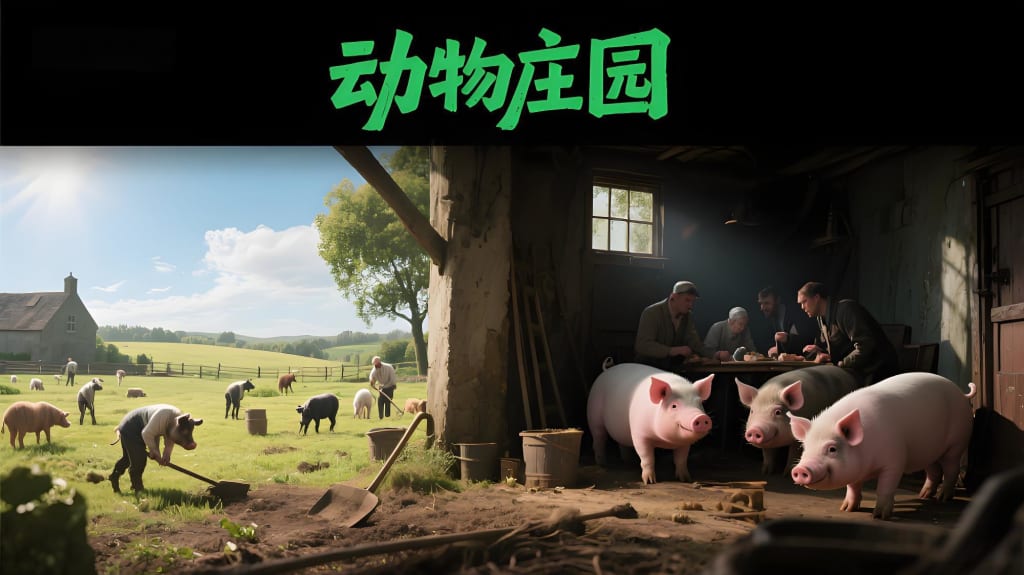
Ladies and gentlemen, boys and girls, pigs and chickens, welcome to tonight's barn-burning edition of "Literary Roast Night," where we take the world's most depressing political allegories and turn them into farm-fresh stand-up material.
Tonight’s star of the show? None other than George Orwell’s Animal Farm—the only place where pigs walk like men, horses work like robots, and everyone is equally miserable, but some are just a little more miserable than others.
Let’s dive into it.
Chapter 1: Old Major’s TED Talk
The story kicks off with Old Major, the Marxist pig with the charisma of Morgan Freeman and the teeth of a 1930s tractor. He gives a barnyard TED Talk so powerful, half the animals quit their jobs the next day. He basically says, “Humans suck. We do all the work, they take all the food, and we’re too dumb to unionize. Let’s fix that.”
Old Major dies almost immediately after this speech—probably from the stress of realizing the only hope for revolution is a bunch of sheep who think chanting is deep political thought.
Chapter 2: Viva la Revolu—Wait, Who’s in Charge?
The animals rise up, overthrow Farmer Jones (whose job performance was somewhere between ‘alcoholic’ and ‘comatose’), and suddenly find themselves free.
Cue awkward silence.
No one knows how to run a farm. The pigs step up because, apparently, being chubby and literate makes you qualified to manage labor.
They write Seven Commandments on a wall. Spoiler alert: They don’t age well.
Chapter 3: Napoleon and Snowball—Farm Bros Gone Wild
Enter our dynamic duo: Snowball, the idealistic overachiever who reads books like a nerd, and Napoleon, a pig with Machiavellian dreams and probably a burner Twitter account.
Snowball wants windmills, education, and Sunday brunch debates.
Napoleon wants power, puppies, and to gaslight the entire farm.
Eventually, Napoleon calls in his secret puppy militia and yeets Snowball off the island like he’s on Animal Farm Survivor.
Goodbye democracy, hello dictatorship.
Chapter 4: The Spin Doctor Is In
Enter Squealer, the porky PR machine. This guy could convince you that hay tastes like bacon and that your pay cut is actually a promotion.
Every time Napoleon does something shady, Squealer is right there like, “Actually, comrades, less food is more revolutionary.”
And the animals? They eat it up. Literally. Because that’s all they have to eat.
Chapter 5: Boxer the Horse—Workaholic of the Year
Boxer is the MVP of the farm. He’s strong, loyal, and dumber than a bag of bricks soaked in vodka. His motto?
“I will work harder.”
Even when things go south—like, famine-level south—Boxer just keeps working. When he collapses from exhaustion, the pigs promise he’s being taken to a “vet.”
Turns out “vet” is short for “glue factory.”
They send this guy off in a van and keep the change. That’s not socialism—that’s Amazon Prime: Equestrian Edition.
Chapter 6: The Rewriting of History (Now With Extra Lies!)
You thought fake news was a 21st-century invention? Orwell beat Facebook to it by 70 years.
The pigs keep rewriting the Seven Commandments. First, it’s “No animal shall drink alcohol.” Then it’s, “No animal shall drink alcohol… to excess.”
Next up: “No animal shall kill another animal… unless it’s a Tuesday.”
By the end, all the rules are replaced by one:
“All animals are equal, but some animals are more equal than others.”
A phrase so iconic, politicians tattooed it on their brains.
Chapter 7: The Humans Are Back—And They Brought Booze
Fast forward to the end. The pigs have gone full corporate. They’re wearing clothes, walking upright, drinking whiskey, and playing poker with humans.
The other animals peer through the window and can’t tell the difference between pigs and men. Which is probably the most British way ever to say: “Meet the new boss, same as the old boss.”
Final Thoughts: Moo, Baa, and Vive la Resistance
So what did Orwell teach us?
Revolutions start with dreams and end in spreadsheets.
Pigs make bad politicians but excellent propaganda artists.
And if someone says, “We’re doing this for the greater good,” run. Especially if they’re oinking.
Remember, Animal Farm isn’t just a book—it’s a mood, a warning, and a one-way ticket to realizing your office politics might just be barnyard politics with better coffee.
That’s it for tonight’s roast. Stay skeptical, stay sassy, and if your manager starts calling you “comrade,” update your resume.
Goodnight and may your pigs always stay in the pen!
About the Creator
Rachel Reviews: Lakefront Wolves by Joseph Deegan
Meet Finn. He's an 18 year old kid who has potential. He's bright with great school scores and he's also an athlete, a footballer of some prowess. He has it all going for him, it would seem, and yet, he's determined to send what could be a well-planned, stable existence firmly off the rails. He drinks, he smokes, he takes drugs, he has violent tendencies and he's in danger of losing not only his mind but all that he holds dear.
By Rachel Deeming13 days ago in BookClub




Comments
There are no comments for this story
Be the first to respond and start the conversation.