

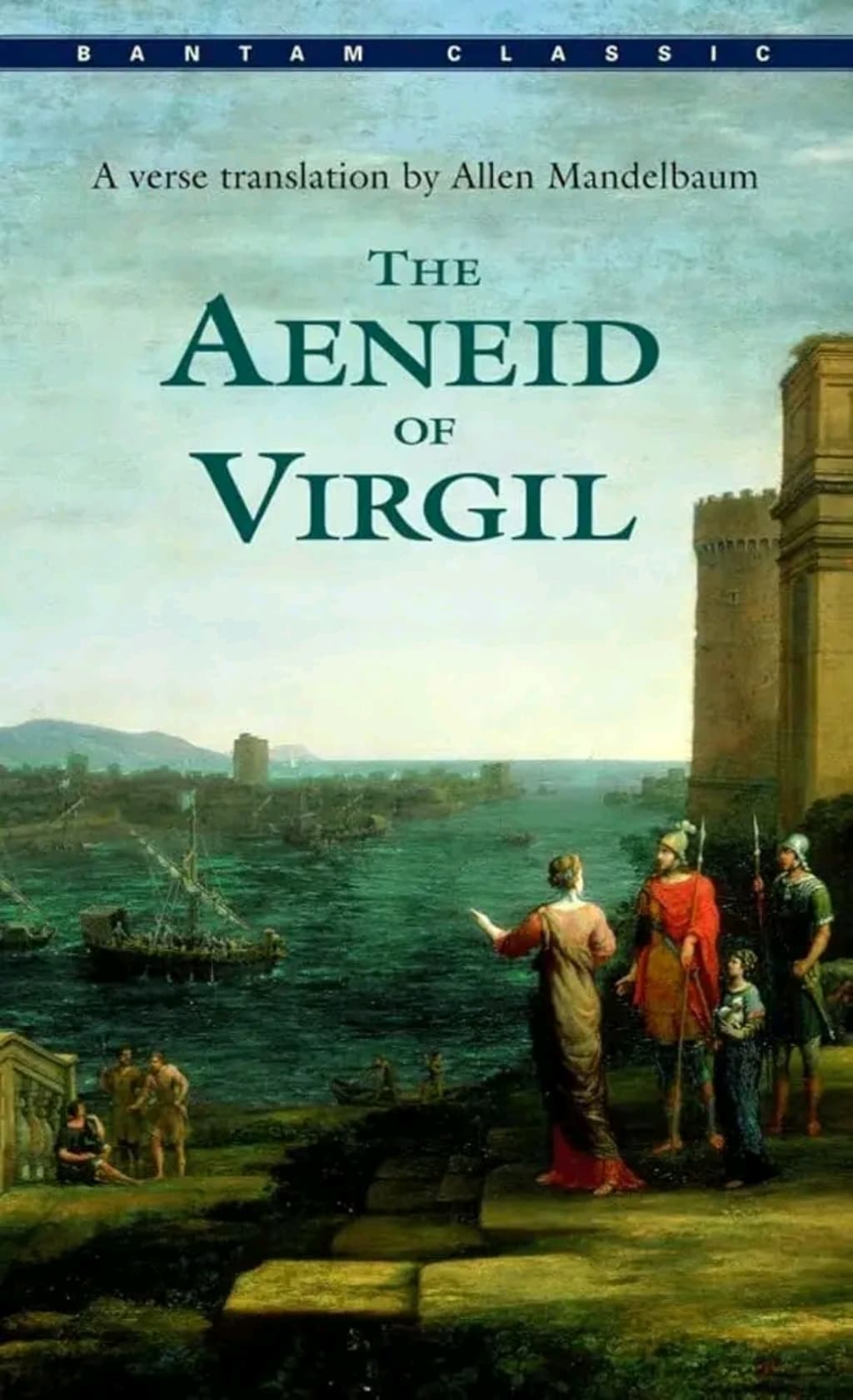
"The Aeneid" is a Latin epic poem written by the Roman poet Virgil. It is considered one of the most significant works of Roman literature and is often seen as the Roman counterpart to Homer's "Iliad" and "Odyssey." Here's a summary and analysis of "The Aeneid":
Summary:
"The Aeneid" follows the journey of Aeneas, a Trojan hero, after the fall of Troy. The poem is divided into twelve books. Aeneas, guided by the gods, flees Troy with his son Ascanius, father Anchises, and a group of Trojan survivors. Their aim is to find a new homeland, as Troy has been destroyed by the Greeks.
The narrative takes Aeneas and his group through a series of adventures and challenges, including encounters with gods and mythical creatures. They travel to various places, including Carthage, where Aeneas has a passionate affair with Queen Dido, and ultimately to Italy, where he is destined to establish the foundations for the future Roman Empire.
The epic highlights Aeneas' unwavering devotion to his destiny and the challenges he faces in fulfilling his divine mission, which is to found Rome and ensure its glory. The poem concludes with a climactic war between Aeneas and Turnus, an Italian prince, over the right to marry Lavinia, the local princess. Aeneas emerges victorious and the poem ends with the destiny of Rome secured.
Analysis:
1. The Aenean Hero: Aeneas is portrayed as a noble and pious hero, fulfilling his duty and destiny, which is to establish the Roman race. His character represents Roman virtues and values, such as duty, sacrifice, and the importance of family.
2. Divine Intervention: Similar to Homer's epics, the gods play a significant role in "The Aeneid." They guide and influence the events of the story, reflecting the Roman belief in the connection between the divine and human realms.
3. The Augustan Message: Virgil's epic was commissioned by Emperor Augustus and can be seen as a propaganda piece to legitimize his rule and the origins of the Roman Empire. The poem promotes peace, order, and the importance of a unifying leader.
4. Epic Tradition: Virgil draws upon the epic tradition established by Homer, with heroic adventures, mythical elements, and the hero's journey as key components of the narrative.
5. National Identity: "The Aeneid" played a significant role in shaping the Roman national identity and mythology. It connects the Romans to their Trojan origins and sets the foundation for Rome's greatness.
"The Aeneid" is a masterful epic that combines elements of mythology, history, and prophecy to create a rich narrative. It has had a profound influence on Western literature and culture and remains a cornerstone of classical literature.
About the Creator
ReadShakurr
Start writing..Hey ,I'm shakurr, welcome and glad to have you here , I'm a professional writer ,poet ,and historian, I write love stories and scientist and philosophers history and inventions of the past .kindly hold your wine and enjoy
Reader insights
Nice work
Very well written. Keep up the good work!
Top insights
Expert insights and opinions
Arguments were carefully researched and presented
Heartfelt and relatable
The story invoked strong personal emotions
On-point and relevant
Writing reflected the title & theme
Easy to read and follow
Well-structured & engaging content
Eye opening
Niche topic & fresh perspectives
Excellent storytelling
Original narrative & well developed characters
Keep reading
More stories from ReadShakurr and writers in BookClub and other communities.
ODE to Autumn treatise
ODE TO AUTUMN BY JOHN KEATS INTRODUCTION: “Ode To Autumn” is a very remarkable poem, which has been composed by the great romantic poet John Keats. It was composed in September 1819 and published in the next year 1820. In this poem, Keats explored his critical thinking about the Autumn season. Nature highly influenced Keats, therefore, he always tried to find a chance season that usually created a type of sensation in the hearts of poets. John Keats in this ode exaggerates the beauty of the Autumn season. This poem is full of passion and excitement. He is very much delighted after seeing nature around him in the autumn. ‘Walter Everette’ called him
By ReadShakurr2 years ago in BookClub
Self Help: Grifters' Gospel
On Self-Help, Snake Oil, and the Illusion of Change Psychology professionals and students can be imagined on two opposite sides of a line called self-help books: likely a larger group opposes pop-science and step-by-step manuals filled with talk of success, journaling, and not giving a f**k; others love them, but they aren’t many.
By Avocado Nunzella BSc (Psych) -- M.A.P 26 days ago in BookClub
7 Spiritual Awakening Books You Should Read In 2026
At some point in life, many of us feel an unmistakable inner pull — a quiet but persistent sense that there must be more to existence than routines, achievements, and external validation. This moment often marks the beginning of a spiritual awakening: a shift in awareness that changes how we perceive ourselves, others, and reality itself.
By Diana Meresc5 days ago in BookClub
No Word Comes Near Enough
The English language has its limits. I learned this when I became a student of the Bible and looked up the Greek and Hebrew definitions behind the Scriptures I loved. Some languages have so much more depth and power than the one I use to convey my thoughts. But, even so, I don't think any word could ever come close to describing this void and pain I am journeying through. I don't know how to swim through its murky waters.
By Shirley Belk4 days ago in Poets



Comments (14)
I have read this epic novel/epic poem in college and then again on my own and it was a great read. One can learn a lot from these kinds of classics.
Thank you for sharing.
insightful summary and analysis of Virgil's "The Aeneid,"
Interesting history and a fun read. Thank you! 😊💕
I feel very cultured now!
Latin novels find it hard to give in depth translation of their novels, if you don't understand latin, you will find it hard to understand
Has anyone ever got the hindu edition of this book?
Awesome
Amazing novel
Amazing work from vigil ❤
This sounds like a good read. Thanks for the review.
Amazing cultural novel and influence
This shows destiny can't be challenged and we should embrace Itt
The 4th lesson is what I like most