
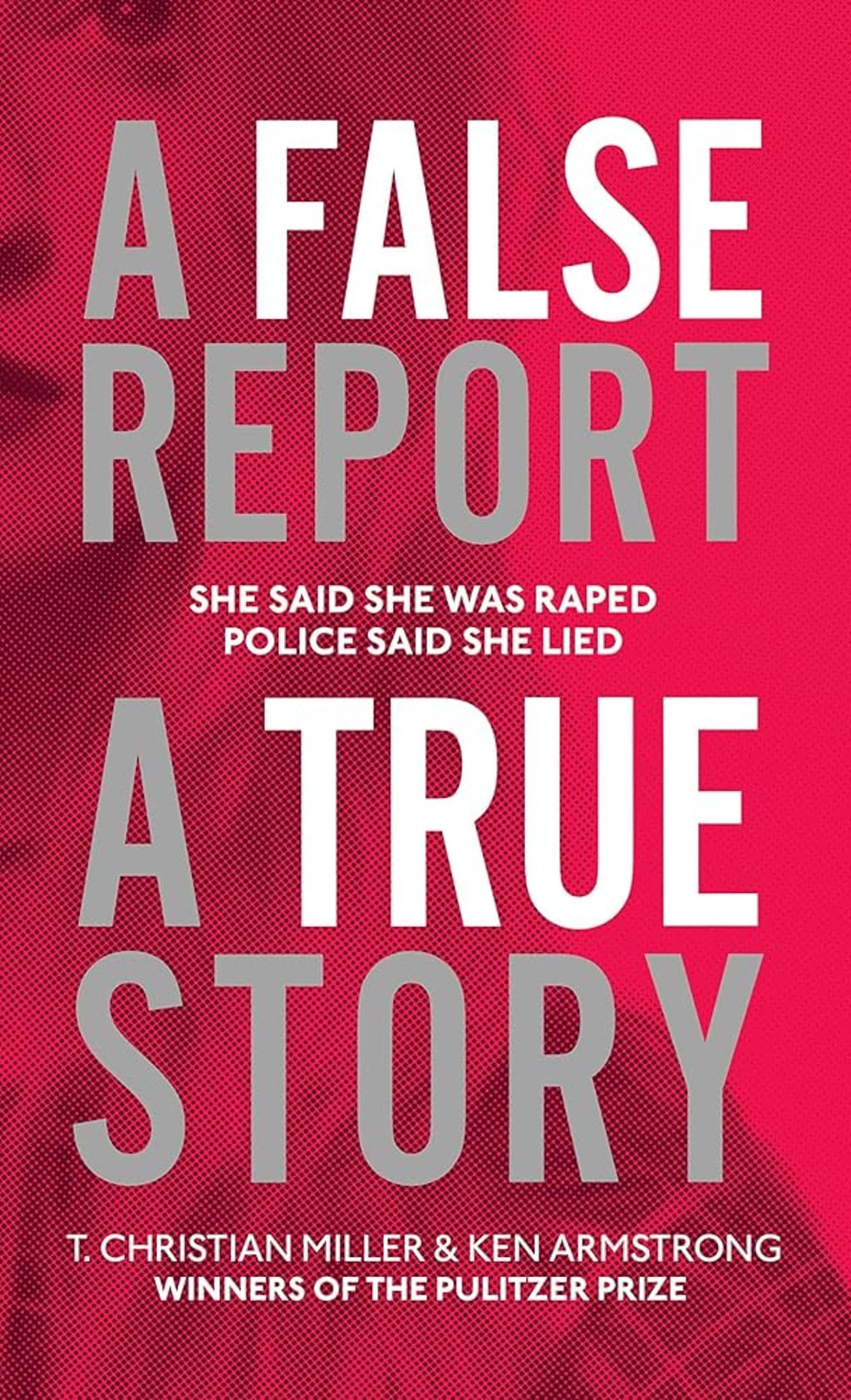
"A False Report" by T. Christian Miller & Ken Armstrong (Book Club Research)
Trigger Warnings!

To
Synopsis:
On August 11, 2008, eighteen-year-old Marie reported that a masked man broke into her apartment near Seattle, Washington, and raped her. Within days police and even those closest to Marie became suspicious of her story. The police swiftly pivoted and began investigating Marie. Confronted with inconsistencies in her story and the doubts of others, Marie broke down and said her story was a lie--a bid for attention. Police charged Marie with false reporting, and she was branded a liar. More than two years later, Colorado detective Stacy Galbraith was assigned to investigate a case of sexual assault. Describing the crime to her husband that night, Galbraith learned that the case bore an eerie resemblance to a rape that had taken place months earlier in a nearby town. She joined forces with the detective on that case, Edna Hendershot, and the two soon discovered they were dealing with a serial rapist: a man who photographed his victims, threatening to release the images online, and whose calculated steps to erase all physical evidence suggested he might be a soldier or a cop. Through meticulous police work the detectives would eventually connect the rapist to other attacks in Colorado--and beyond. Based on investigative files and extensive interviews with the principals, A False Report is a serpentine tale of doubt, lies, and a hunt for justice, unveiling the disturbing truth of how sexual assault is investigated today--and the long history of skepticism toward rape victims.
Discussion Questions:
- How does the title "A False Report" shape your expectations for the book? In what ways does it accurately reflect the content and themes explored?
- How does the book portray the experiences of women who report sexual assault? What societal and systemic challenges do they face?
- Discuss the ethical dilemmas faced by the journalists in the book. How did their approach to reporting impact the narrative and the individuals involved?
- Explore how the book addresses victim-blaming and the stereotypes associated with sexual assault. In what ways do these impact the investigation and public perception?
- Analyze the police investigation depicted in the book. What strengths and weaknesses do you observe in the investigative process? How might these factors contribute to the prevalence of false reports?
- Consider the intersectionality of the characters involved. How do factors such as race, socio-economic status, and gender influence the outcomes and responses of the people in the book?
- What does the book reveal about the flaws and strengths of the criminal justice system in handling sexual assault cases? Are there systemic changes that could improve the system?
- Discuss the impact of trauma on memory, both for victims and witnesses. How does the book explore the challenges of recalling and recounting traumatic events?
- Explore the reactions of the communities involved when a sexual assault is reported. How does the community influence the experiences of the victims and the outcomes of the investigations?
- What lessons can be drawn from the events and stories in "A False Report"? How can individuals, communities, and institutions work towards preventing and addressing sexual assault more effectively?
About the Authors:
T. Christian Miller joined ProPublica in 2008 as a senior reporter. He spent the previous 11 years reporting for the Los Angeles Times. His work included coverage of the 2000 presidential campaign and three years as a bureau chief for the Times, responsible for 10 countries in South and Central America.
Ken Armstrong is a Pulitzer Prize-winning investigative reporter who previously worked at The Seattle Times and Chicago Tribune, where his work helped prompt the Illinois governor to suspend executions and later empty death row. He has been the McGraw Professor of Writing at Princeton and a Nieman Fellow at Harvard.
Netflix:
Statistics:
- "Nearly 1 in 3 women and 1 in 5 men in Massachusetts have experienced rape, physical violence and/or stalking by an intimate partner in their lives. More than half (51.1%) of female victims were raped by an intimate partner and 40.8% reported being raped by an acquaintance." (YWCA North Shore Rape Crisis Center).
- "Only 310 out of every 1,000 sexual assaults are reported to police. That means more than 2 out of 3 go unreported. Individuals of college-age : Female Students: 20% report & Female Non-Students: 32% report . The elderly: 28% report . Members of the military: 43% of female victims and 10% of male victims reported. Of the sexual violence crimes reported to police from 2005-2010, the survivor reporting gave the following reasons for doing so: 28% to protect the household or victim from further crimes by the offender, 25% to stop the incident or prevent recurrence or escalation, 21% to improve police surveillance or they believed they had a duty to do so, 17% to catch/punish/prevent offender from reoffending, 6% gave a different answer, or declined to cite one reason, 3% did so to get help or recover loss." (RAINN)
- "Of the sexual violence crimes not reported to police from 2005-2010, the victim gave the following reasons for not reporting: 20% feared retaliation, 13% believed the police would not do anything to help, 13% believed it was a personal matter, 8% reported to a different official, 8% believed it was not important enough to report, 7% did not want to get the perpetrator in trouble, 2% believed the police could not do anything to help, 30% gave another reason, or did not cite one reason." (RAINN)
- To learn more, check out these sites:
- https://rainn.org/statistics/perpetrators-sexual-violence
- https://rainn.org/articles/addressing-rape-kit-backlog
- https://www.nsvrc.org/statistics
- https://www.ussc.gov/sites/default/files/pdf/research-and-publications/quick-facts/Sexual_Abuse_FY18.pdf
- https://victimsofcrime.org/child-sexual-abuse-statistics/
- https://ucr.fbi.gov/crime-in-the-u.s/2018/crime-in-the-u.s.-2018/topic-pages/rape
- https://www.cdc.gov/sexual-violence/about/index.html
About the Creator
Kristen Barenthaler
Curious adventurer. Crazed reader. Librarian. Archery instructor. True crime addict.
Instagram: @kristenbarenthaler
Facebook: @kbarenthaler
Keep reading
More stories from Kristen Barenthaler and writers in BookClub and other communities.
“Homicide: The Graphic Novel, Part One” by Philippe Squarzoni (4 stars)
Here’s how we got here: I run a True Crime Book Club, so I’m always looking for new and interesting ways to represent the subject matter. We’ve read interpretations, watched documentaries, and researched the typical true crime literature. Someone on a message board suggested this graphic novel (which is broken into two parts, but we’ll get to that later). Intriguing that I’d never heard of a graphic novel rendition of a true crime book. Apparently there are a few and I’m looking forward to giving a few of them a try with the club in the future. I figured I’d give this one a try since it came so highly recommended. So I ordered a copy from my public library and away I went.
By Kristen Barenthaler11 months ago in BookClub
THE EMBER AND THE ECHOES
EPISODE 3: THE VALE OF WHISPERS Leaving the Marches felt like shedding a skin. The loud, bloody chaos faded into a damp, watchful silence as Kaelen entered the Blackwood Vale. The air grew cold and carried the scent of pine and deep, rotten earth. This was Lord Theron Vance’s domain, and his influence was a chill that seeped into the bones.
By Akua Anitaabout 4 hours ago in BookClub



Comments
There are no comments for this story
Be the first to respond and start the conversation.