
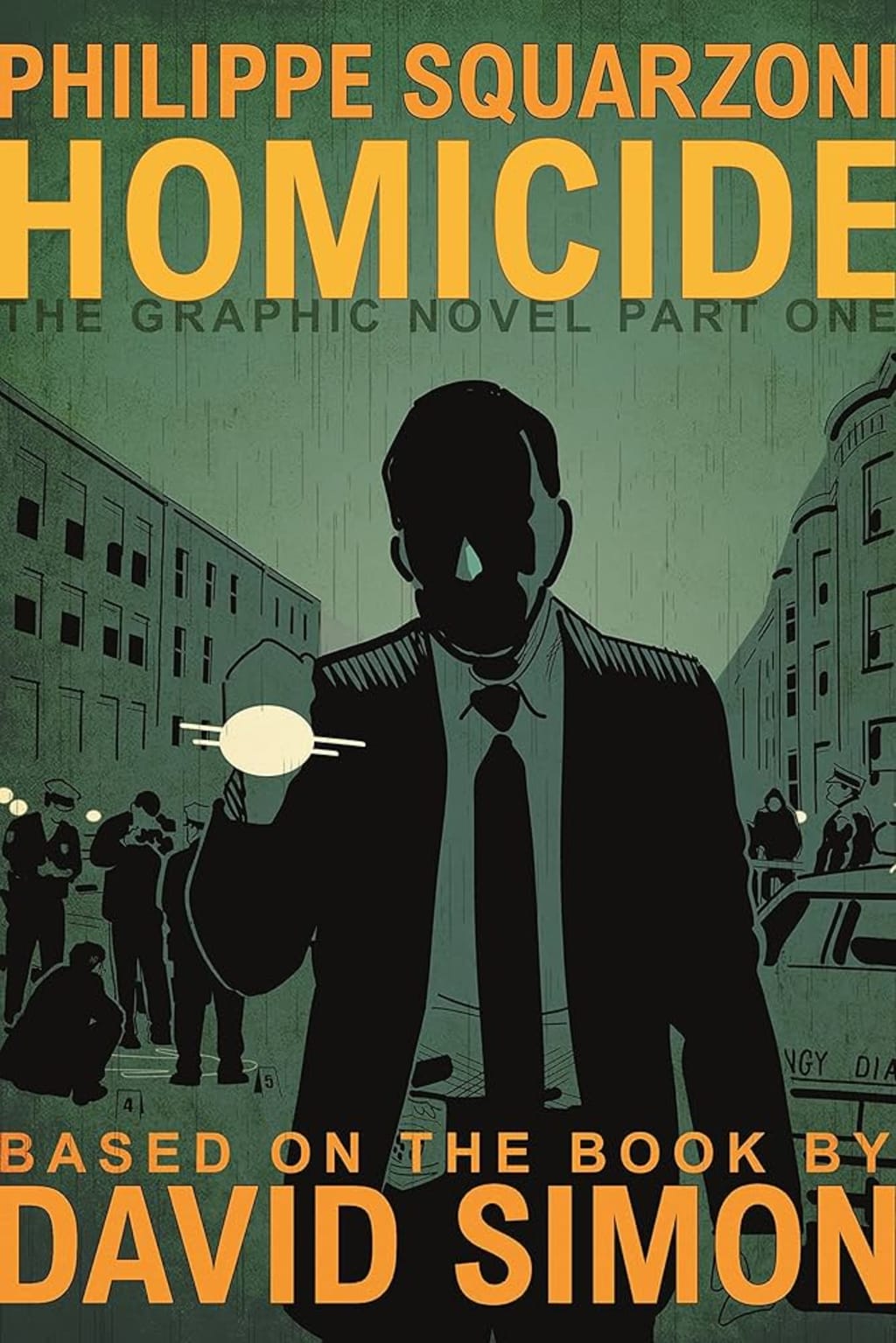
“Homicide: The Graphic Novel, Part One” by Philippe Squarzoni (4 stars)
It’s an interesting take on true crime. There’s not many graphic novelizations that I know of. The images are striking, the stories engaging. However, it is a bit crass in some places, so beware of that beforehand.

Here’s how we got here:
- I run a True Crime Book Club, so I’m always looking for new and interesting ways to represent the subject matter. We’ve read interpretations, watched documentaries, and researched the typical true crime literature.
- Someone on a message board suggested this graphic novel (which is broken into two parts, but we’ll get to that later). Intriguing that I’d never heard of a graphic novel rendition of a true crime book. Apparently there are a few and I’m looking forward to giving a few of them a try with the club in the future.
- I figured I’d give this one a try since it came so highly recommended. So I ordered a copy from my public library and away I went.
Now that we’re caught up on how I came to read this book, let’s dive in. Homicide: The Graphic Novel is a retelling of Homicide: A Year on the Killing Streets by David Simon. In the original book, we learn that “David Simon was the first reporter ever to gain unlimited access to a homicide unit, and this electrifying book tells the true story of a year on the violent streets of an American city. The narrative follows Donald Worden, a veteran investigator; Harry Edgerton, a black detective in a mostly white unit; and Tom Pellegrini, an earnest rookie who takes on the year's most difficult case, the brutal rape and murder of an eleven-year-old girl” (Amazon.com).
Now doesn’t that sound like the perfect book to turn into a serialized graphic novel? Clearly, Squarzoni thought so and now here we are; seeing murder, police brutality, and so much more depicted in stark detail with very few examples of explanation (because you can’t have a million words in a graphic novel, right?). Upon starting to read, I quickly realized that readers weren’t going to get a lot of detail on each case. You either knew the case already or didn’t need to know it to follow along with the detectives. Either way, readers weren’t getting as clear of a picture of the crimes as you’d get in a longer-scale work. This at times made the cases seem unimportant to the arc of the story, but why have a work focused on detectives if you weren’t going to expand on their jobs.
Honestly, I was a bit skeptical of how the graphic novel would be able to balance the crime with the act of compassion I’ve come to expect from true crime literature. That apparently wasn’t an issue Simon or Squarzoni were concerned with. There’s no hiding the brutality. It’s splashed across each page in bright red ink as the black and gray world around the detectives is slowly marched across each page.
I made it through part one and was honestly a bit disappointed. I’d expected something with more umph to make such a groundbreaking bit of true crime literature. However, by part two, I was bored, unsure of the direction, and confused by the cases and characters portrayed.
I’ll also give a trigger warning that there are depictions of blood, murder, and more (obviously), but as that the small bit of dialogue that Squarzoni copied over is extremely crass and politically incorrect for today’s standards. The original publication was in 1991, so keep that in mind if you decide to venture into this world.
Overall, I enjoyed reading part one and I wish it had been better executed so that I would have continued with part two. It’s something I’d tell readers to approach with caution and be sure you’re capable of handling the violent nature of what is being depicted.
About the Creator
Kristen Barenthaler
Curious adventurer. Crazed reader. Librarian. Archery instructor. True crime addict.
Instagram: @kristenbarenthaler
Facebook: @kbarenthaler
Keep reading
More stories from Kristen Barenthaler and writers in BookClub and other communities.
“Lay Them to Rest: On the Road with the Cold Case Investigators Who Identify the Nameless” by Laurah Norton (5 stars)
I have to start off by saying that Laurah Norton is my new superhero! She is a “Writer and former academic with 15 years in the fields of literary fiction, creative nonfiction, and archival and primary research.Practiced podcast showrunner and host with experience in serial and single-episode formats. Work includes creation, writing, research, and hosting of podcasts One Strange Thing and The Fall Line” (Laurah Norton). She has collaborated on many of these projects with top-ranking scientists, artists, and forensic anthropologists.
By Kristen Barenthaler11 months ago in BookClub
My New Book is Finally Here
My poetry collection Beautiful and Brutal Things is done. It's actually done and finally published over 270 pages. Over a year of my life went into this book. More than a year, really. Long days at my computer, sometimes seven days a week because I couldn't stop even when I probably should have. Then two months of editing that felt harder than the writing itself. But it's finished, and I'm still standing, and the book is real.
By Tim Carmichael2 days ago in BookClub



Comments (1)
Great graphic novel! Fantastic