
This Ghali Controversy Wasn’t a Protest. It Was a Marketing Play.
How a viral cultural moment became a textbook case of attention jacking and modern branding

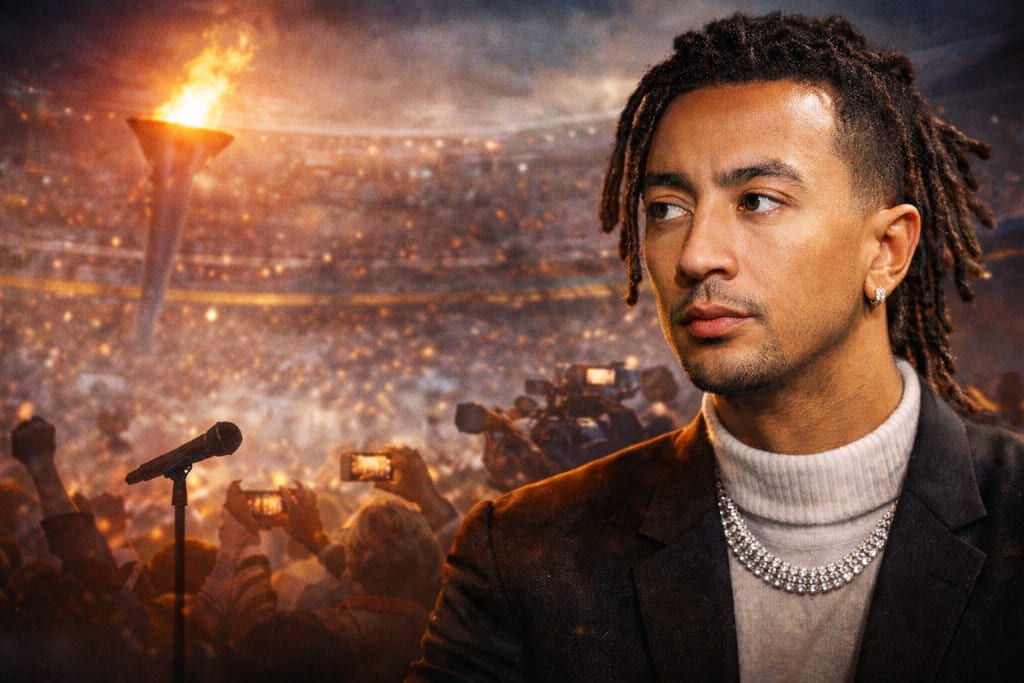
Everyone is arguing about Ghali.
Censorship.
Free speech.
Peace.
Politics.
But almost no one is asking the question that actually matters:
What if this wasn’t a protest at all?
What if the entire Ghali controversy was a carefully timed marketing strategy, designed to hijack attention during one of the biggest cultural moments of the year?
When you stop reading this story emotionally and start reading it like a marketer, the narrative changes completely.
This isn’t a story about rebellion.
It’s a story about attention engineering.
And it’s a very good one.
By the time the debate around Ghali exploded across Italian media and social platforms, the outcome was already decided.
That’s usually the giveaway.
When something is truly spontaneous, confusion comes first, and meaning follows later. Here, the meaning arrived perfectly packaged, almost suspiciously fast. The sequence was too clean. Too efficient. Too intentional.
This wasn’t a moment of protest that accidentally turned into publicity.
It was publicity that borrowed the language of protest.
And it worked.
The dominant narrative framed Ghali as an artist constrained by institutions, limited on a visible stage, standing in tension with power. But if you zoom out and look at the timeline with a marketer’s eye, a simpler explanation emerges.
Late at night, just hours before one of the most-watched cultural events in the country, a new single appears. No buildup. No teaser. No traditional rollout. Just a sudden, cold drop.
That alone guarantees curiosity.
But curiosity doesn’t travel far anymore. To dominate the conversation, you need tension. You need a story people can argue about.
So the next morning, the framing arrives.
A long Instagram letter. Multiple languages. Carefully written. Personal without being explosive. The message is subtle but effective: I was limited. I wasn’t allowed to fully express myself.
There’s a cultural reference to signal depth.
A restrained tone to avoid backlash.
And a closing line that does all the work: See you tomorrow.
At that point, the algorithm is already awake.
Journalists start circling. Social media starts speculating. The audience is primed before anything has actually happened. That’s not activism: that’s pre-heating attention.
Then comes the moment everyone treats as the heart of the story: the stage.
Ghali shows up.
This is the detail most people gloss over, but it’s the most important one. Refusing the stage would have been a real act of dissent. It would have cost visibility. It would have forced a clear, uncomfortable position.
Instead, the performance happens. Smoothly. Professionally. Safely.
No rupture.
No escalation.
Nothing that couldn’t be interpreted ten different ways.
Because when the goal is reach, not disruption, you don’t reject the platform. You use it.
Only after the visibility peak comes the final act: another post. Sharper in tone. Easier to quote. Released when attention is already at its highest.
Four moves.
Roughly thirty-six hours.
Zero randomness.
What makes this strategy especially effective is the clean separation between message and product.
The song itself is short, algorithm-friendly, and non-political. It doesn’t take strong positions. It doesn’t risk playlists or platform reach. It’s built to travel.
All the “meaning” people are debating lives elsewhere: in captions, posts, interviews, and controversy.
Two different outputs.
Two different audiences.
Released at the same time.
That’s not inconsistency. That’s segmented distribution.
Here’s the uncomfortable truth: this controversy didn’t just “happen.”
It was engineered.
This is what attention jacking looks like in today’s media economy: using a massive cultural moment as a distribution channel rather than as a place to take real risks.
And to be clear, there’s nothing inherently wrong with that.
It’s his job.
And he executed it very well.
The real problem isn’t the strategy. It’s the interpretation.
Half the country framed Ghali as a martyr for free speech.
The other half treated him as a national enemy.
Almost no one stopped to say the obvious thing:
This wasn’t a moral stand.
It was a branding exercise.
No real risk.
Maximum visibility.
Perfect timing.
And that’s why this story was never really about peace, censorship, or rebellion.
It was about attention.
And in today’s media ecosystem, attention, not outrage, not virtue, is the only currency that consistently converts.
Everything else is just the story we tell ourselves after the numbers are in.
About the Creator
Anthony Neal Macri
I write about AI, marketing, and technology, with a focus on how emerging tools shape strategy, communication, and decision-making in a digital-first world.
Keep reading
More stories from Anthony Neal Macri and writers in Beat and other communities.
I've Just Realized
The President doesn't understand music. There. It felt very good to write that; it's some thing I just realized today. Oh , yes; he plays it. He TRUMPets it in rallies and meetings, pumps it across the airwaves when he gathers up our minutes waiting for his late arrival.
By Judey Kalchik 4 days ago in Beat
Despacito by Luis Fonsi and Daddy Yankee:a cover by Rikki La Rouge
here in this cover is a Cumbia cover I did of Luis Fonsi and Daddy Yankee‘s song Despacito. It just sounds really good as a a Cumbia, the kind of Cumbia that Selena and Selena y Los Dinos used to do.
By Revista Miko:XCIabout 10 hours ago in Beat
Bartender
On the heels of grief, pain bears down hard. On the heels of death, pain awakens the quiet place between the end of our own life and now. Feeling anything is like seeing a film and in black and white, slow motion, all sound turned off. Just watching. Gritting teeth, awkward smiles and bloody red eyes move around, scanning the others who are feeling something I don't want to feel, but I do. Escapism is all I have ever known. ~
By ROCK aka Andrea Polla (Simmons)2 days ago in Poets



Comments
There are no comments for this story
Be the first to respond and start the conversation.