
Italian Television Didn’t Just Entertain Us. It Trained Us for the Attention Economy.
A short history of Italian television, from state broadcasting to the birth of the attention economy

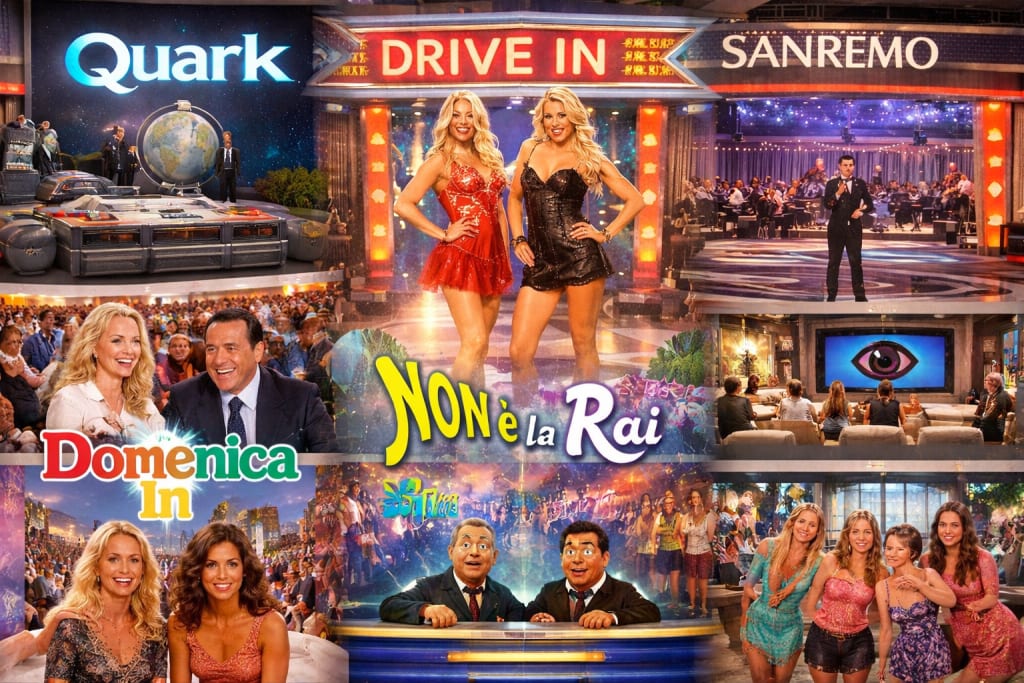
When people talk about the attention economy today, they usually point to social media.
TikTok. Instagram. Influencers. Algorithms.
But long before platforms turned attention into currency, television had already done most of the cultural work.
And in Italy, this process was unusually visible.
Not because Italy was unique, but because it experienced, very clearly, a collision between two opposite ideas of what media should be.
When Television Was a Public Institution
To understand Italian television, you need to start with RAI.
RAI is Italy’s public broadcaster. For decades, it was effectively the voice of the nation. State-owned, publicly funded, and deeply intertwined with political and cultural institutions, RAI did not see itself as an entertainment company.
It saw itself as a civil one.
Television wasn’t there to reflect society as it was, but to help shape it into something better, more educated, more unified. Programs were formal, presenters spoke with authority, and cultural legitimacy mattered more than popularity.
Watching television meant entering a shared national space:
- Language was standardized
- Cultural references were curated
- Relevance was mediated
In short, television explained the country to itself.
Visibility was not something you chased.
It was something you were granted.
The Arrival of Commercial Television
This model began to crack when commercial television entered the picture — most notably through Mediaset, which would grow into Italy’s largest private media group.
Mediaset was built on a completely different logic.
It wasn’t publicly funded.
It lived on advertising.
And advertising depends on attention.
Instead of asking what viewers should watch, Mediaset asked what they already wanted to watch.
The result was television that felt louder, faster, closer to everyday life. Less formal. Less filtered. Less interested in cultural elevation and more interested in emotional engagement.
For many viewers, it felt liberating.
For many critics, it felt vulgar.
But something important was happening beneath the surface.
From Authority to Proximity
Where RAI spoke to the audience, commercial television spoke with it.
Programs became more chaotic. More imperfect. More human.
People on screen didn’t look exemplary — they looked familiar.
This shift changed the relationship between viewer and screen.
Television stopped being a place where experts explained reality.
It became a place where ordinary behavior was observed, rewarded, and repeated.
Gradually, a new idea took hold:
Being visible could be valuable on its own.
You didn’t need institutional approval.
You didn’t need expertise.
You didn’t even need a clear achievement.
You just needed attention.
Reality TV and the Normalization of Being Watched
Reality television completed this transformation.
People doing mundane things.
Arguing, waiting, being bored.
Watched not because of what they did — but because they were there.
This wasn’t just entertainment.
It was cultural training.
Audiences learned that:
- Exposure could become relevance
- Visibility could become power
- Attention could substitute legitimacy
Television became a rehearsal space for a world where being seen mattered more than being qualified.
From Television to Platforms
When social media arrived, it didn’t introduce a new logic.
It removed the remaining filters.
The behavior was already familiar:
- Perform yourself
- Seek attention
- Optimize visibility
- Accept exposure as currency
Italian television, years earlier, had already normalized these dynamics.
Platforms didn’t disrupt television’s logic.
They scaled it.
A Shift in Mediation, Not Morality
It’s tempting to frame this story as cultural decline.
But that misses the point.
What changed wasn’t taste.
It was mediation.
Television stopped acting as an interpreter of society and started acting as a mirror.
It stopped shaping desire and began reflecting it.
That reflection wasn’t always flattering — but it was revealing.
Why This Still Matters
Understanding this shift matters because it helps explain why:
- Institutions struggle for attention today
- Platforms outperform traditional authorities
- Visibility often feels more powerful than expertise
Italian television offers an early, compressed version of a transformation that many societies are now experiencing in digital form.
A Deeper Layer
There’s another way to read this story — not just as cultural history, but as a strategic one.
As a question about what happens when media systems stop instructing audiences and start listening to them.
About why demand-driven systems outperform value-driven ones.
About what this teaches us about modern marketing, platforms, and attention itself.
I explored that angle — explicitly and without nostalgia — in a longer piece on my personal site, where I analyze Italian television as a case study in product–market fit and attention economics.
👉Mediaset Didn’t Lower Italian Culture. It Market-Fit It
Sometimes the fastest way to understand the present is to look carefully at the media that trained us for it.
About the Creator
Anthony Neal Macri
I write about AI, marketing, and technology, with a focus on how emerging tools shape strategy, communication, and decision-making in a digital-first world.
Keep reading
More stories from Anthony Neal Macri and writers in FYI and other communities.
A Failed Artist, A Disillusioned Poet, An Underpaid Game Show Host
I took my son and niece to Gori, a small town in Georgia where Joseph Stalin was born. They talked me into visiting the Stalin's Museum, the largest in the post-Soviet space. I had resisted going there because I just can't stand the monster and know enough about him, or so I thought.
By Lana V Lynx27 days ago in FYI


Comments
There are no comments for this story
Be the first to respond and start the conversation.