
I Won't Be Ashamed of Love on The Streets of Philadelphia
The Two Horse Race for The 1994 Best Song Oscar

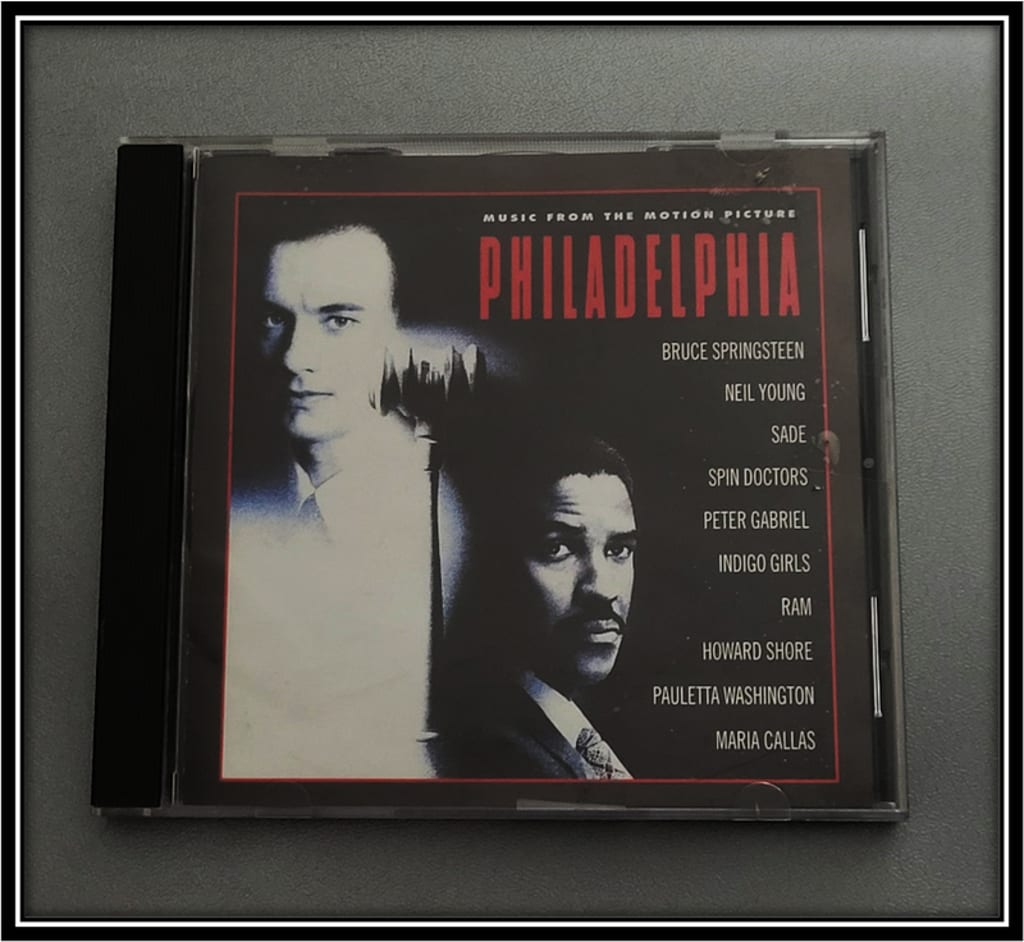
With absolutely no disrespect to any fans of “The Day I Fell in Love” (Beethoven’s 2nd), Janet Jackson’s “Again” (Poetic Justice), and “A Wink and A Smile” from the romantic blockbuster Sleepless in Seattle, we will need to start by placing each tune off to the side for the sake of this piece.
Even though those three songs mentioned were in the running, at the end of the day, there were only two choices the Academy of Motion Picture Arts & Sciences faced back in 1994, and both were from the same movie.
How fortunate, in more ways than one, that Neil Young took a different direction than what Johnathan Demme wanted when he approached the rock legend to contribute music for 1993’s Philadelphia. As the late director told the story in a behind-the-scenes documentary ("People Like Us") on the movie, Demme had wanted Young to write a rock-edged power ballad for the film’s opening sequence, as Demme takes the audience through the streets of the “City of Brotherly Love”, helping the audience feel a sense of the familiar that the movie's provocative subject matter would counter.
During the filming, Demme had repeatedly listened to Neil’s 1970 indicting anti-racism classic “Southern Man”, getting a charge from the rock/punk charge of the music, and the fact that it was a message song that didn't seem blatant in decrying American racism. Following that cue, Demme asked Young to write a song resembling “Southern Man” for Philadelphia, both in the rock and roll style and anti-bigotry aims. Similar to the effect of casting mainstream stars Tom Hanks and Denzel Washington in the key roles of his AIDS drama (and, before Denzel, imaging a big comic actor like Robin Williams or Bill Murray in the role of homophobic lawyer Joe Miller), Demme wanted a good rock number to help get the audience in a relaxed sense of comfort for the dramatic ride they were going to take involving not only AIDS but bigotry and homophobia.
Instead of a “Southern Man”-type rocker, Young went on to deliver the haunting and moving title ballad, stripped down to only piano and a quietly ghostly female chorus accompanying Young’s trademark nearly cracked falsetto. Demme was moved by “Philadelphia” (the ballad) but felt that it wouldn’t work for the opening. Instead, as fans of the movie know, Demme placed “Philadelphia” in the film’s bittersweet finale as images of the now-late Andrew Beckett (Hanks) in his youth move across the screen, emotionally charged by the two hours viewers had spent with the dying lawyer who fought back against the law firm that had betrayed him due to his diagnosis but ultimately couldn’t win against the disease itself.
Still wanting a rock number to get the picture rolling, Demme next got in touch with one Bruce Springsteen. The director had, years earlier, filmed a music video (“Sun City”) for the organization Artists Against Apartheid, combatting systemic racism in South Africa (AAA was co-founded by the E-Street Band’s Steven Van Zandt.) If Neil Young was already a certified legend in 1993, Springsteen was at the top of the current rock pantheon, thanks to the monster success of Born In The U.S.A., singles like “Dancing in The Dark” and “Hungry Heart”, and his wild and energetic sold-out concerts. Also, like Young, Springsteen was not shy about using his music to touch on subjects that cut to the core of struggling Americans, shining a light on some of the flaws and cracks that are as much part of the American experience as the achievements.
(How many people have rocked out to "Born in The U.S.A." without really understanding the message and the story at its center?)
Once again, Demme asked The Boss for a hard rock number to open Philadelphia, and once again, Demme was led in a different direction when Springsteen delivered “Streets of Philadelphia.” It had a slightly more pop-flavored style and a faster tempo than Young’s ballad, but it was not what Demme was looking for.
Demme later realized that maybe the two rock legends, by providing songs that aimed more for emotion than adrenaline, had more confidence in Philadelphia’s impact than even Demme may have had. With a Demme-directed music video that saw Springsteen singing live over the streets of the city, “Streets” was placed at the opening of Philadelphia, and Demme’s planned hard rock introduction was quickly forgotten.
Springsteen’s “Streets” captured the mainstream hold, landing a nice top-10 spot in the Billboard pop charts, giving Bruce one of his biggest (solo) hits away from the then-disbanded E-Street Band. The song also scored high globally (topping the pop charts in countries like Norway and Germany), despite the song's distinctively American theme. Meanwhile Young’s “Philadelphia” has often been cited, both then and now, as the overall emotional highlight of both Philadelphia (the movie) and the subsequent soundtrack, which included tracks from Peter Gabriel, Sade, and even Denzel Washington’s wife Pauletta. It was no surprise to anyone when both Neil and Bruce landed Oscar nominations for Best Original Song at the 1994 Academy Awards. Apart from Hanks’ nearly certain win for Best Actor, the Best Song award was pegged as the other best chance Philadelphia had for grabbing gold, despite the likelihood that two nominees from the same movie could have canceled each other out.
Critics Gene Siskel and Roger Ebert, who both often decried Best Original Song as one of the most frequently disappointing Oscar categories in terms of nominees and winners, both chose “Streets of Philadelphia” as their respective picks for Best Song in their annual “If We Picked The Winners” edition of their syndicated TV show, even though Siskel also praised Young’s ballad as the only other worthy nominee in that year’s category, as did Ebert.
When Whitney Houston announced Springsteen’s name as the winner at the Oscar ceremony on March 21, 1994, it was a triumphant moment for The Boss, who along with Neil had already delivered two of the evening’s high points in their respective live performances on the telecast. However, when Tom Hanks got up to accept his Best Actor award, the actor seemed to indicate that it was Springsteen’s fellow Philadelphia nominee whose music was in the actor’s mind as he was preparing not only for his certain win but as he was planning what would be one of the most moving Oscar acceptance speeches in the Academy’s history.
Today, when I read contemporary considerations of Philadelphia’s soundtrack, Young has slipped into underdog status, with “Philadelphia” overtaking “Streets” in most people’s minds as the more powerful of the two songs.
As for this writer, I have always held Young’s ballad as one of my favorite pieces of music in any form. Watching Young’s live Oscars performance (as well as a live 2000 performance made during his Silver & Gold tour), reminded me of how underrated his emotional pull is when he performs on piano instead of his trademark acoustic/electric guitars. NPR critic Tom Moon, reviewing one of Young’s live albums in 2013, noted that even though Young isn’t an accomplished pianist, he still thinks carefully about how to transfer his simple but effective guitar melodies into the piano. ‘Philadelphia”, I dare say, is not a song that could have had the same impact if Young had performed it on guitar, any more than “Bridge Over Troubled Water” would have had the same force if Paul Simon had maintained his trademark guitar sound instead of the gospel-style piano.
(It’s hard to imagine that Simon had written “Bridge” on his acoustic guitar.)
Compared to Young’s emotional impact, Bruce, with "Streets", is effective but in a more approachable style that translated into the mainstream better than Young, likely due to Springsteen being at the height of his career in 1993. It would take several years for me to feel Springsteen’s song carried a kind of power anywhere close to the same level as Young's.
However, a few years ago, I was watching a CBS special on Grammy’s Greatest Performances. Springsteen’s “Streets”, opening the 1995 ceremony where it would snatch three Grammy awards, was among those performances featured, with Melissa Etheridge and Elton John (two music icons who knew something about facing homophobic bigotry) praising the emotional effect of the song overall. A mainstream artist like The Boss was singing on behalf of not only those suffering from AIDS but, as Springsteen noted in his Grammy acceptance speech, the families who had lost someone to the disease who said that the song meant something to them.
To make a long story short, that TV moment started something in me so that by the time I heard Sir Elton perform a moving cover of “Streets” as part of a MusiCares tribute to Springsteen in March 2014, I started to feel the same feelings stir in me as with “Philadelphia.” After hearing John’s cover, whatever push and pull rested with me regarding Young and Springsteen (with Young often emerging as the victor) ended. I now place both “Streets of Philadelphia” and “Philadelphia” on an equal emotional value, as I believe they should be.
Whatever aspects of Philadelphia (the movie) have held up or have become dated in the 30+ years since its release back in 1993, one thing can remain unifying, especially for the movie's fanbase.
The undeniable power Philadelphia still holds would have been less without the gifts provided to Johnthan Demme, courtesy of two music icons who, in their respective ways, gently challenged the director himself. In delivering ballads in place of up-tempo rock and roll, Neil and Bruce not only brought what they had to offer to the movie but made Demme realize that he had to come up to their level in trusting that Philadelphia didn’t need extra spice.
In his Oscar acceptance speech for Philadelphia, Tom Hanks singled out his co-star Denzel Washington for, perhaps as much as Hanks, putting his film career at risk by taking on the flawed but compelling Joe Miller, who not only sheds his prejudices but forces his fellow Philadelphians to face theirs through Andrew Beckett. As a result, Hanks noted that he felt he had to share his Oscar with Washington. I’d like to imagine that, if he had been asked, Hanks would probably have also been happy to save some of that Oscar gold for Neil Young and Bruce Springsteen.
(Actually, thinking it over, since Springsteen already has his Oscar, the AMPAS could split the gold between Denzel and Neil for each being, in their respective ways, the two secret weapons of Philadelphia even 30 years later.)
Sincerely: Random Access Moods
About the Creator
Michael Kantu
I have written mostly pop culture pieces for Medium, Substack, and on a short-lived Blogspot site (Michael3282). I see writing as a way for people to keep their thoughts, memories, and beliefs alive long after we depart from the world.
Keep reading
More stories from Michael Kantu and writers in Beat and other communities.
Who Eased Minds Best?
There are many things about being a kid that one never forgets. For example, I will never forget being 11 years old in the spring of 2001 and sitting in the passenger seat of my aunt’s black Nissan, eating my medium-sized cup of French Vanilla ice cream mixed with gummy bears. We were parked in front of a now long-gone Baskin-Robbins shop almost hidden inside a shopping center near Desert Inn and Sandhill, not far from the Boulder Station Hotel & Casino in the southeast corner of Las Vegas. The CD playing on the car radio was 1972’s Simon & Garfunkel’s Greatest Hits. Even 15 years later, I remember the powerful and dramatic crash that hit the la-la-lie chorus of “The Boxer.” I also recall setting my teenage romantic angst to the psychedelic sound and melody of “The Sound of Silence.” Finally, I still remember a wonderful kind of fear flowing down my spine while hearing the dramatic “Wall of Sound” force of “Bridge Over Troubled Water”. It was a kind of power only matched by Art Garfunkel belting those infamous high notes in the song’s crescendo.
By Michael Kantuabout a year ago in Beat
Ludacris and Nelly draw backlash over bookings at MAGA-coded music festival
Ludacris and Nelly headlining a mostly right-wing event is good for them. It’s also great for the genre of hip hop. The two rap veterans have showcased their talents on other stages. Why can’t they perform for mostly MAGA folks and grab that bag?
By Skyler Saunders5 days ago in Beat
Landman Season 3 Fan Theory: The Dark Truth Beneath the Oil
Landman Season 3 Fan Theory: When Oil Stops Being Power and Starts Becoming a Curse If Landman has taught us anything so far, it’s this: oil doesn’t just make men rich—it reveals who they really are. Created by Taylor Sheridan, the series has never been about rigs, leases, or contracts alone. It’s about control, ego, and the quiet violence of ambition. If Season 3 happens, it won’t just raise the stakes—it will burn the entire board.
By Junaid Shahid a day ago in Beat


Comments
There are no comments for this story
Be the first to respond and start the conversation.