
Europe Sizzles Under Record-Breaking Heat as Wildfires Rage Across the Continent
Temperatures soar past 43 °C in parts of France as red alerts, mass evacuations, and climate concerns grip southern and eastern Europe
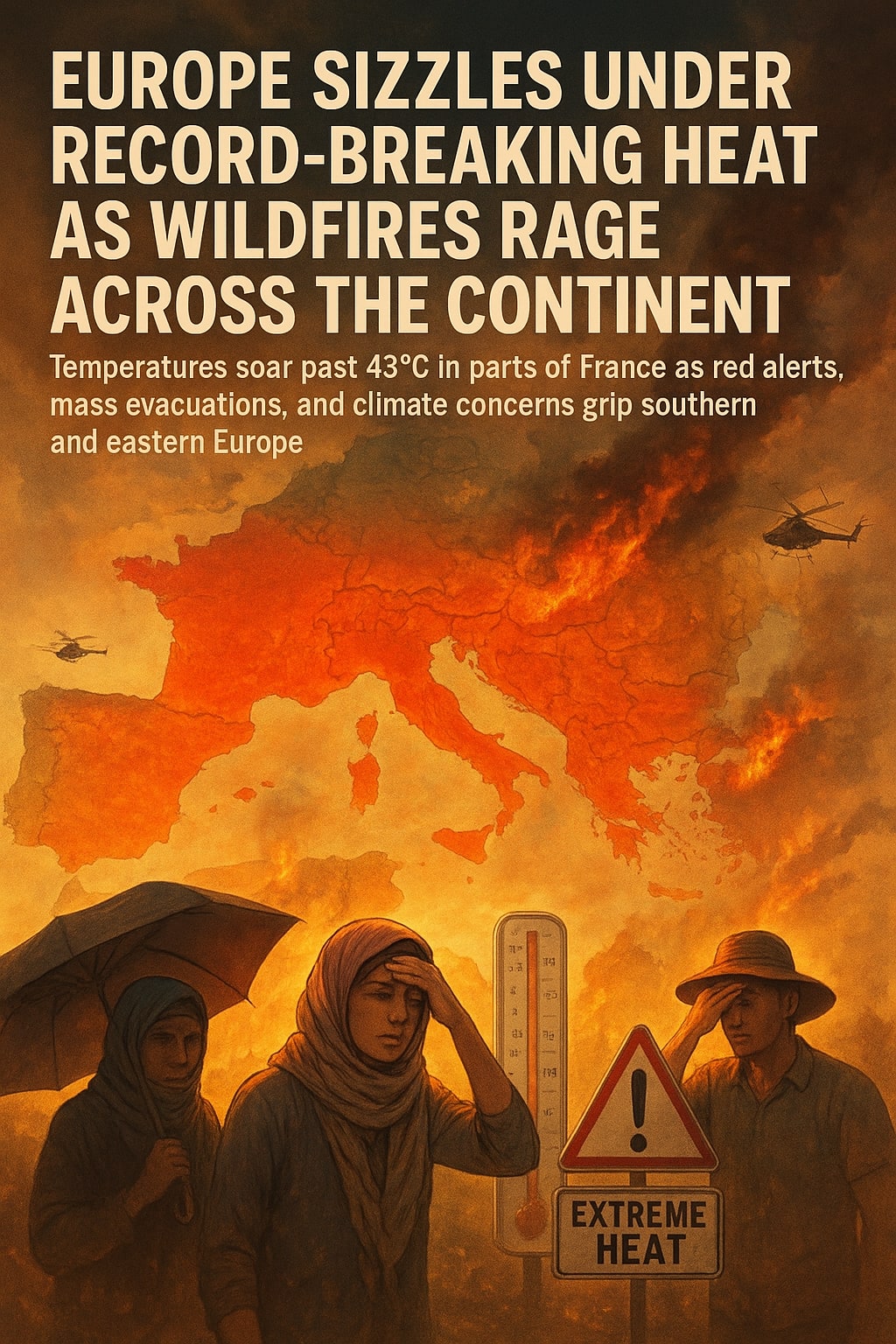
Europe Sizzles Under Record-Breaking Heat as Wildfires Rage Across the Continent
Temperatures soar past 43 °C in parts of France as red alerts, mass evacuations, and climate concerns grip southern and eastern Europe
Southern and eastern Europe are in the grip of a punishing heat wave that meteorologists say is among the most extreme in modern records. The blistering conditions, which have pushed thermometers beyond 43 °C (109 °F) in parts of southern France, have triggered dangerous wildfires, strained energy supplies, and left emergency services racing to protect lives and property.
Red Alerts and Emergency Warnings
France’s national weather service has placed 12 departments—primarily in the south and along the Mediterranean coast—under red weather alerts, the highest tier in the country’s system. The warnings come as hot, dry winds sweep across the region, lowering humidity levels and creating what firefighters describe as “explosive” wildfire conditions.
Spain, Italy, Greece, Bulgaria, and Turkey are also grappling with extreme heat, with some inland areas enduring days of uninterrupted temperatures above 40 °C (104 °F). In several countries, authorities have closed schools, postponed public events, and advised residents to stay indoors during the hottest hours.
Wildfires From the Western Mediterranean to the Balkans
The combination of scorching heat, prolonged drought, and gusty winds has fueled wildfires across multiple fronts. In France’s Var region, flames tore through thousands of hectares of woodland, forcing residents and tourists to evacuate campsites and seaside villages. Smoke plumes were visible for miles, and water-bombing aircraft have been deployed in an attempt to halt the spread.
In Spain, fires in Catalonia and Andalusia have displaced hundreds, while Greek authorities are battling new flare-ups in the Peloponnese and the islands, just weeks after earlier blazes devastated communities. Bulgaria and Turkey have reported multiple rural villages under threat, with local firefighters struggling against shifting wind patterns that make containment difficult.
Officials warn that the current weather pattern—dominated by a high-pressure system trapping hot air over the continent—shows no sign of breaking for several days, heightening fears that new fires could ignite at any moment.
Impact on Health and Infrastructure
Hospitals in affected regions are reporting a surge in heat-related illnesses, particularly among the elderly, young children, and outdoor workers. Cases of heatstroke, dehydration, and respiratory distress linked to smoke inhalation have been climbing steadily since the heat wave began late last week.
Power grids are under strain as millions of residents rely on air conditioning and fans to cope with the sweltering conditions. In parts of Italy and Spain, rolling blackouts have been introduced to ease demand, while water utilities in several cities have asked residents to conserve supplies amid low reservoir levels.
Agriculture has also taken a hit. Vineyards, olive groves, and wheat fields are showing signs of stress, with some farmers warning of reduced yields if high temperatures persist into the harvest season.
Voices From the Ground
In Marseille, local resident Claire Dubois described an almost surreal heat: “It’s like opening an oven door and stepping inside. You can’t be out for more than ten minutes without feeling dizzy.” Firefighter teams working near the coastal town of Hyères spoke of “walls of flame” and the difficulty of coordinating efforts across rugged terrain.
In Spain’s Catalonia, evacuee Javier Morales said his family had only minutes to leave: “We saw smoke over the hill in the morning. By the afternoon, the flames were at the edge of our property. We grabbed what we could and left.”
Climate Context and Long-Term Concerns
Scientists emphasize that while heat waves are a natural weather phenomenon, their intensity and frequency are increasing due to climate change. Warmer average temperatures mean heat waves are starting earlier in the year, lasting longer, and producing more dangerous extremes.
“Europe is warming faster than the global average, and this event is a stark reminder of the urgent need to adapt,” said Dr. Elisa Romano, a climate researcher at the European Centre for Medium-Range Weather Forecasts. “We are seeing the kind of compound events—heat, drought, and fire—that our models have been predicting for decades.”
The European Union has pledged more resources for cross-border firefighting coordination, including shared aerial fleets and rapid deployment teams. However, environmental groups argue that stronger climate policies are needed to address the root causes of rising temperatures.
Looking Ahead
Forecasters predict that the current heat wave could persist for the rest of the week, with little relief at night—a factor that increases health risks. Authorities in multiple countries are urging residents to check on vulnerable neighbors, stay hydrated, and avoid strenuous outdoor activity.
Firefighters continue to battle blazes from the Algarve in Portugal to the Black Sea coast, while aerial surveillance monitors high-risk zones for new outbreaks. With tinder-dry vegetation and wind gusts forecast to increase mid-week, officials caution that the situation could worsen before it improves.
As Europe confronts yet another summer of climate extremes, the images of scorched landscapes, exhausted firefighters, and displaced families have become all too familiar. For many, this week’s crisis is not just a weather event—it is a warning signal of what the continent must prepare for in the years ahead.
About the Creator
Ahmad Mustafa
i am Ahmad Mustafa Mangal from Hangu kpk Pakistan. our postal code is 26190 .
Keep reading
More stories from Ahmad Mustafa and writers in Beat and other communities.
Jermaine Jenas Accuses BBC of Destroying His Career After Sexting Scandal
When Words Wound: Jermaine’s Reckoning The blue lights danced over the skyline of Marbella, where Jermaine Jenas was trying—halfheartedly—to escape the turmoil back in the UK. The sun dipped beyond the horizon, casting long shadows over his holiday refuge, but his mind was anything but serene.
By Ahmad Mustafa5 months ago in Criminal
Ludacris and Nelly draw backlash over bookings at MAGA-coded music festival
Ludacris and Nelly headlining a mostly right-wing event is good for them. It’s also great for the genre of hip hop. The two rap veterans have showcased their talents on other stages. Why can’t they perform for mostly MAGA folks and grab that bag?
By Skyler Saunders4 days ago in Beat


Comments
There are no comments for this story
Be the first to respond and start the conversation.