
Eleven Essential Pieces Of Krautrock
Amon Düül II,Kraftwerk,Can,Cluster,Nektar,Neu!,Faust,Popol Vuh,La Dusseldorf and Tangerine Dream
The term Krautrock is sometimes questioned as offensive or racist, and will the term Kraut is metonymic occupational name for a market gardener or a herbalist, from Middle High German krut 'herb', 'plant','cabbage' it was used as a derogatory term for Germans especially during the war.
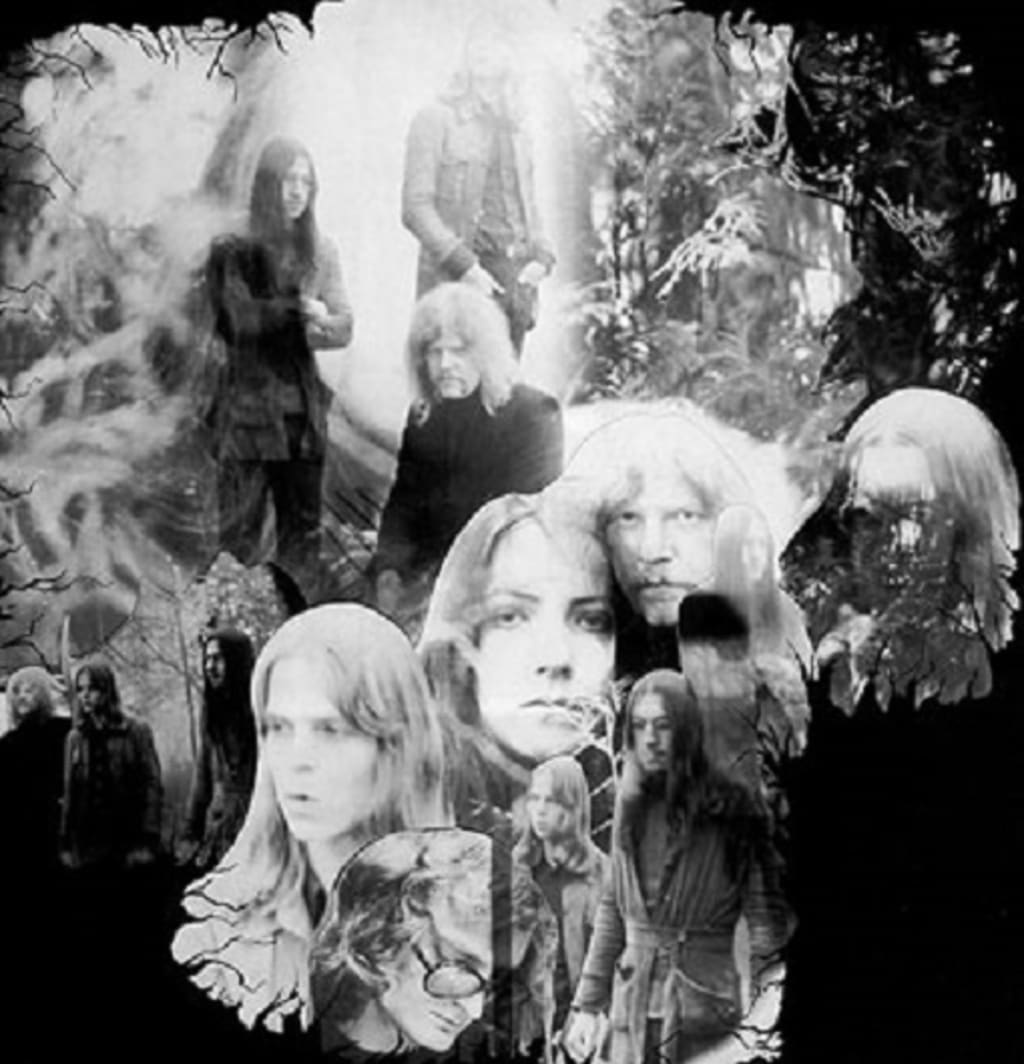
In the late sixties, early seventies the term Krautrock was applied to German bands who were making rock similar to but not the same as the UK and USA mainstream. Bands like the Grateful Dead and Pink Floyd were influences and I wrote a brief article on this many years ago that you can read below.
So I have chosen ten (well actually eleven) songs that fall under the umbrella term Krautrock, one per band although Kraftwerk get two to illustrate how different some of their earlier work was to how most people hear them.
The YouTube playlist is here and there are some very long pieces on there, but all deserving of their place.
So without further ado we will launch into this latest playlist of mine.
Race From Here To Your Ears by Amon Düül II
I was introduced to Krautrock in my teens at school and I think I heard this song on a United Artists compilation called "All Good Clean Fun". The thing that struck me was the strange phasing effect on the guitar sound and the almost just shouted rather than sung words. This led me to buy the album "Dance of the Lemmings" and was dropped into an alternate universe of space rock to roughly quantify it, but I was impressed and wanted more.
There was lots of improvisation and some amazing unexpected sounds.
Hollywood by Cluster
A duo consisting of Hans-Joachim Roedelius and Dieter Moebius this in unusual because it uses two different time signatures playing at the same time as each other and was a major influence on David Bowie's "Low". The band also later worked with Brian Eno.
Krautrock by Faust
I will admit I bought their first album because it was in a clear sleeve the a hand X-Ray and on clear vinyl, and is in my vinyl collection. I was suprised with the first song opened with radio interference and faded in and out on a couple of beatles and Rolling Stones songs.
They often use heavy duty tools and drills on stage often threatening to bring buildings down.
This twelve minute slab of industrial Krautrock is from the album "Faust IV" and takes no prisoners.
Negativeland by Neu!
This is the first time I had heard an example of "motorik" that is a relentless, unchanging mechanical beat. For some reason my dad had heard this somewhere and really liked it and wanted me to get him a copy.
Commencing with heavy duty drilling you are then dropped into a ponderous mechanical beat for the next ten minutes by another duo, Klaus Dinger and Michael Rother.
Desolation Valley / Waves by Nektar
Nektar are actually English but were formed in Hamburg in 1969 and very influenced by both Pink Floyd and contemporary German rock, and so that is why they are in this Krautrock playlist.
They were fond of concept albums with cosmic themes and this song fits in with with German progressive scene, but you can hear the Pink Floyd influence in the overal sound.
Gomorrha by Can
Can are about absolute hypnotic rhythm. Coming from backgrounds in the avant-garde and jazz, the members of Can blended elements of psychedelic rock, funk, and noise.
The band formed in Cologne in 1968 by the core quartet of Holger Czukay (bass, tape editing), Irmin Schmidt (keyboards), Michael Karoli (guitar), and Jaki Liebezeit (drums).
The group cycled through several vocalists, most prominently the American-born Malcolm Mooney (1968–70) and the Japanese-born Damo Suzuki (1970–73).
Ruckzuck and Autobahn by Kraftwerk
The only band on this playlist who I have included two songs from to illustrate two differnt approaches while maintaing a very strict rhythm.
Ruczuck is flute driven backed by electronics while Autobahn is purely electronic.
They formed in Düsseldorf in 1969 by Ralf Hütter and Florian Schneider. They began as part of West Germany's experimental krautrock scene in the early 1970s before fully embracing electronic instrumentation, including synthesizers, drum machines, and vocoders. Wolfgang Flür joined the band in 1974 and Karl Bartos in 1975, expanding the band to a quartet.
La Düsseldorf by La Düsseldorf
La Düsseldorf was a German band, consisting of one time Kraftwerk drummer and Neu! multi-instrumentalist Klaus Dinger and occasional Neu! collaborators Thomas Dinger and Hans Lamp.
Their music was described by David Bowie as the soundtrack to the eighties.
Atem by Tangerine Dream
Although Tangerine Dream started with guitars and drums they moved to a total electronic lineup during their most successful and influential period in the mid seventies.
Tangerine Dream is a German electronic music band founded in 1967 by Edgar Froese. The group has seen many personnel changes over the years, with Froese having been the only continuous member until his death in January 2015. The best-known lineup of the group was its mid-1970s trio of Froese, Christopher Franke, and Peter Baumann.
Aguirre pt I, II, III by Popol Vuh
Popol Vuh produced very atmospheric guitar soundscapes and these pieces were written for the Werner Herzog film "Aguirre Wrath of God" which is well worth watching.
A Krautrock Conclusion
This playlist has barely scratched the surface but I hope your appetite has at least been whetted. The two albums below are good introductions as well.
About the Creator
Keep reading
More stories from Mike Singleton 💜 Mikeydred and writers in Beat and other communities.
Review of 'Man on the Run'
My wife and I saw Man on the Run, a nearly 2-hour documentary on Amazon Prime, about Wings, Paul McCartney's group that flew around the world from shortly after The Beatles broke up in early 1970 to shortly after John Lennon was murdered at the end of 1980, making a Beatles reunion forever impossible.
By Paul Levinson12 days ago in Beat
Orbit Radiate Pulse: The Videos
In October 2025, I discovered an app called Grok. It added a whole new layer to my creativity. At first, I used it for silly things, like making photos of my mom and me screaming at each other. It was really funny. But pretty quickly, I realized I could use Grok to bring my Gloria stories to life.
By Rick Henry Christopher 7 days ago in Beat



Comments
There are no comments for this story
Be the first to respond and start the conversation.