
Daf in the Music and Culture of Afghanistan: From Pre-Islamic Rituals to Sufi Gatherings and Festive Celebrations
An instrument of devotion and celebration shaping Afghanistan’s cultural identity across centuries.
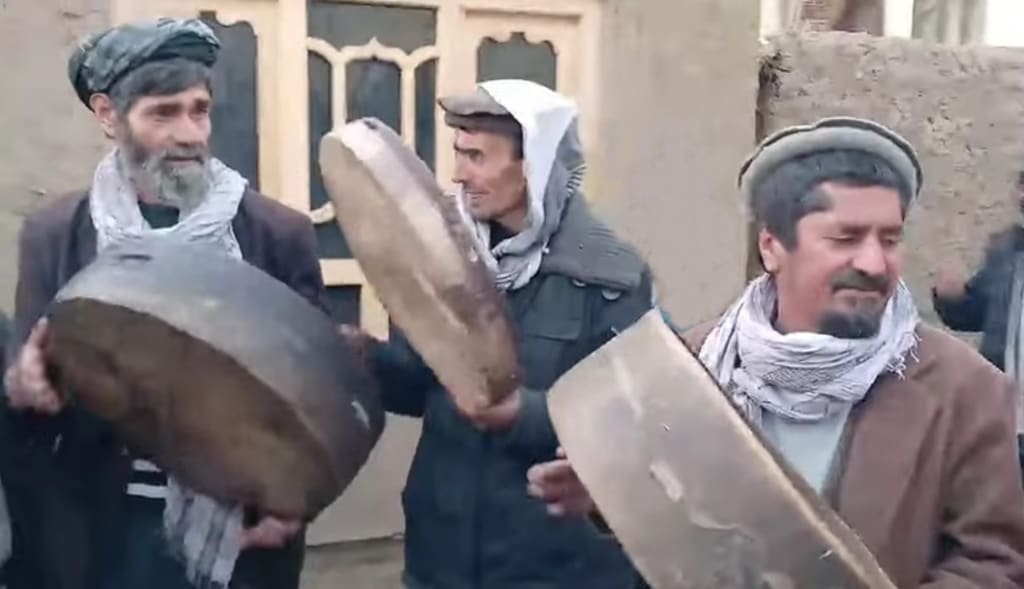
Daf in the Music and Culture of Afghanistan: From Pre-Islamic Rituals to Sufi Gatherings and Festive Celebrations
Author: Islamuddin Feroz, Former Professor, Department of Music, Faculty of Fine Arts, University of Kabul
Abstract
This article provides a comprehensive examination of the role, history, and ritual, social, and artistic functions of the daf in Afghanistan. The research adopts a descriptive–analytical approach and is based on historical, ethnomusicological, and ethnographic sources. The findings indicate that the daf was used in ancient shamanic and pre-Islamic rituals as an instrument for worship, healing, and communication with spirits, and in later periods it gained a prominent position in Sufi, religious, and festive music. Moreover, Afghanistan’s ethnic and linguistic diversity has led this instrument to appear under various names, forms, and functions among different ethnic groups, including Hazara, Pashtun, Tajik, Nuristani, Baloch, Uzbek, Turkmen, Kyrgyz, and others. In addition to its ritual aspects, the daf plays a dynamic and influential role in family gatherings and popular celebrations, particularly among women, serving as a means of social cohesion and the continuation of musical traditions. Ultimately, the study of the daf’s structure and terminology reflects the cultural richness and multilayered nature of Afghanistan’s local music.
Keywords: Afghanistan, Daf, Ritual Music, Festive Music, Shahnameh.
Introduction
Percussion instruments have long held a special place in the music of Afghanistan and have played a significant role in rituals, celebrations, and everyday life. Among these instruments, the daf, as one of the most prominent and ancient instruments, has maintained a strong presence in Afghanistan’s ritual, Sufi, and festive music. Studying this instrument not only reveals its musical and structural dimensions but also provides a window into a deeper understanding of the beliefs, values, and cultural traditions of Afghanistan’s diverse ethnic groups.
Considering Afghanistan’s ethnic and linguistic diversity, the daf exists in various forms, sizes, and names across the country, with each group employing the instrument according to its own style and tradition. Moreover, the daf holds significant social importance; from religious and ritual ceremonies to festivals and family gatherings, it serves as a tool for fostering unity, joy, and social cohesion.
The aim of this article is to provide a comprehensive study of the daf in three main areas: first, the historical background of the instrument in Afghanistan and its ritual applications in ancient cultures; second, its social role and presence in family gatherings and popular celebrations; and third, the cultural diversity and terminology associated with this instrument among different ethnic groups. From this perspective, studying the daf offers a multi-layered and scholarly view of Afghanistan’s music and culture and clarifies its role in preserving and sustaining musical and cultural traditions.
The History of the Daf in Afghanistan
The daf, an instrument with a long-standing history in Afghanistan, is one of the most significant percussion instruments in the musical tradition of this land. Regarding the name of this instrument, it seems to have originated from the Old Persian word dap or dop. After the spread of Islam and the influence of the Arabic language in the Khorasan region, the word dap was transformed into daf in Arabic. This change in pronunciation occurred due to the phonetic characteristics of the Arabic language (Goibnazarov, 2023, p. 8). With the expansion of Islamic culture, the term daf also entered other languages. For example, in Turkish, Kurdish, and Central Asian languages, this word is used with similar pronunciations. However, in different regions, this instrument is known by various names such as dayereh, dafli, chamba, gawol, and doira (Nasehpour, 2025).
The history of Afghanistan indicates that during the ancient Aryan period, frame drums were likely used alongside other drums. Swami writes on this matter: “By the 6th and 5th centuries B.C., music in ancient Ariana was a part of both secular and religious life, and the Vedic civilization and culture in the south and east of the Hindu Kush existed with a musical system involving singing, drumming, and dancing” (Swami, 1973, p. 28). Therefore, it can be assumed that singing and dancing were performed not only with other types of drums but also with the daf or dayereh.
In addition to historical writings, Afghanistan’s archaeological evidence can also attest to the use of the daf throughout its history. The most important archaeological evidence in this regard is the ancient site of Hadda, located in Nangarhar Province in eastern Afghanistan, built upon the ruins of a pre-Islamic city. This archaeological area, one of the most significant artistic and religious centers of the Kushan period (2nd–3rd centuries CE), was first excavated by a French archaeological mission led by Jules Barthoux between 1926 and 1928, yielding numerous artifacts. Among this collection, several sculptures depict scenes of musical gatherings and devotional ceremonies featuring musicians playing various instruments such as the rubab, harp, and frame drums (Vanleene, 2019, p. 143). Stylistic analyses of these works, created in the Greco-Buddhist Art of Gandhara style, testify that the musical traditions of the Ariana region (present-day Afghanistan and its surroundings) were a blend of Greek, Indian, and Aryan elements. Among these, the presence of frame percussion instruments resembling modern dafs provides valuable evidence of the several-thousand-year-old antiquity of this instrument in Afghanistan. Today, some of these musical statues are preserved in the Musée Guimet in Paris. Thus, the archaeological collection of Hadda is significant not only for the history of Buddhist and Gandharan art but also as an unparalleled source for studying the historical roots of the daf and other musical instruments in Afghanistan and Central Asia (Osmani, 2014, p. 130).
Furthermore, the Shahnameh of Ferdowsi, considered the greatest epic work of the Persian language, also provides information from its narratives regarding the use of the daf in ancient times. Among the historical and ritual references in this epic, Ferdowsi mentions musical instruments such as the oud, barbat, daf, chang (harp), and ney (flute) of ancient eras. One such example appears in a verse where the poet describes a royal celebration:
A roar arose from the depths of tones high and low,
Joy grew abundant, and sorrow sank low.
The fair ones sat, masters of the barbat’s art,
One tending the lute, another crafting its part.
A singer composed a sweet, graceful lay,
Blending daf, harp, and reed in harmonious play.
For today is a day of glory and grace,
As Rostam sits beside Kay Qobad in his place.
In these verses, Ferdowsi depicts a magnificent scene of courtly music in which the instruments daf, chang (harp), ney (reed flute), and barbat (lute) are played together. Since this scene is associated with the mythological figures Rostam and Kay Qobad—two central characters in the culture of Sistan and Zabulistan—it can be concluded that the tradition of playing the daf in the region of Afghanistan and its neighboring countries has very ancient roots. The simultaneous mention of the daf alongside string and wind instruments in this poem indicates its established position within the formal and ritual musical structure of that era. Especially considering that Sistan and Zabul, in ancient times, were part of the cultural domain of Ariana, this reference can be regarded as a literary testimony to the historical continuity of the daf in Afghanistan—an instrument that even today holds a significant presence in the religious, mystical, and folk music of this land.
Thus, Ferdowsi’s Shahnameh is not only a mirror reflecting the grandeur of national myths but also, from the perspectives of musicology and ethnography, one of the key sources for reconstructing the historical background of the daf in ancient Afghanistan—an artistic document that shows how the resonance of the daf was heard in the festivals and rituals of this land centuries before the Islamic era, a melody that still lives on vibrantly in Afghanistan’s culture (Ferdowsi, 2008, p. 679).
Ritual Use of the Daf
The ritual use of the daf in Afghanistan dates back to ancient times — eras in which music fundamentally served ritualistic and devotional purposes. During religious ceremonies and sacrificial rites, hymns of praise were performed. The Aryans of the Vedic period, who believed in forces beyond the material world, used simple and repetitive melodies to express emotions and communicate with the gods. The purpose of these melodies was to induce trance, tranquility, and spiritual relief. These chants were often accompanied by monotonous and percussive rhythms that played a crucial role in synchronizing ritual movements and religious dances.
According to Swami, Aryan music of the Vedic period was initially primitive and accompanied by simple instruments such as wooden drums and bamboo, wooden, or bone flutes. These instruments were not only used to produce sound but also served as ritual tools in devotional ceremonies. Since frame drums are among the oldest types of percussion instruments in ancient cultures, it can be assumed that the primitive form of the daf also existed in that period (Swami, 1973, p. 38). Therefore, the structure of the wooden Vedic drums — consisting of a circular frame and a stretched skin surface — is similar to the construction principles of the daf. This resemblance indicates that the roots of the modern daf can be traced back to those earliest ritual instruments.
Moreover, in ancient times, specific individuals or families performed ritual music — they were called Rishis. The Rishis were those who possessed knowledge of all the contemporary sciences; they were spiritual figures who were simultaneously poets, orators, scholars, and musicians. Rishis existed in both male and female classes, and the names of both are frequently mentioned in the hymns. The role of women in Vedic society was quite prominent — they did not always stay at home but freely participated in feasts, dances, and other public ceremonies of that kind, and they could also sing (Dhanalakshmi, 2021, p. 72). Similarly, during the Zoroastrian era, as recorded in history, the Magi — Zoroastrian priests — played a key role in performing religious ceremonies and rituals. Through the use of music and hymns, they conveyed spiritual and religious messages to society (Diakonoff, 1966, p. 465).
It is said that the frame drum (daf) in Badakhshan, Afghanistan, and Tajikistan has deep roots in ancient pre-Islamic rituals and beliefs, and it was considered an instrument for healing, divination, and communication with spirits. By playing the frame drum, chanting ritual hymns, and performing specific dances, the shaman or bakhshi, according to their belief, would enter “spiritual worlds.” Scholars of shamanism regard the drum as “the central symbol of this ritual.” In these traditions, the sound of the daf played a key role in inducing trance and mystical experiences (Goibnazarov, 2023, p. 5). Likewise, the Turkmen of Afghanistan, who historically held shamanic beliefs, have preserved aspects of those beliefs interwoven with Islamic faith. The shamans of Turkestan would play drums during their rituals and enter deep trance states (Sidky, 1990, p. 276). Other ethnic groups in Afghanistan — such as the Kyrgyz, who call their shamans Bakh, and the Uzbeks, who call them Bakhshi — also shared similar practices. These individuals, in addition to performing divination and healing illnesses, would play the drum to enter trance states and invoke God, Adam, Noah, and other religious figures for assistance. Likewise, shamanism accompanied by trance has long existed among the non-Muslim peoples of the Hindu Kush. In the ancient traditions of Nuristan, which have roots in pre-Islamic beliefs (particularly in rituals related to fertility and ancestral spirits), the boombok (frame drum) was used to accompany devotional chants and ritual dances. The performer—often a woman or an elderly person with a spiritual role—would, through steady rhythmic beats, induce a trance-like state among the participants. In some accounts, the sound of the boombok was interpreted as “the voice of the mountain spirits” (Snoy, 1962, p. 89). According to contemporary ethnographic reports, in remote villages of Nuristan (especially in Bashgal), the boombok is still used to ward off spirits and to heal mental illness or fright. The player (usually an elderly woman or local spiritual guide) strikes the drum in a steady rhythm while reciting prayers or chants. This tradition is, in fact, a continuation of the ancient shamanic aspects of Nuristani music (Elworthy, 2015, pp. 148–149).
Similarly, Janet Topp Fargion, in her ethnomusicological research examining the Gwati ritual among the Baloch of southern Afghanistan and Balochistan, describes the Gwati ceremony as a form of healing shamanism in which singing, percussion instruments, and dance serve as means of communication with supernatural spirits (called Gwat or “wind”). For healing purposes, the shaman or pir-e Gwati induces the patient into a trance state by performing specific music on the doholak or dohol and sometimes on the daf or dayereh. Fargion explains that during the ceremony, the musician and singer gradually increase the intensity of rhythm and repetition of melodies to create a psychological and spiritual connection between the patient and supernatural forces. This process takes place in the presence of women and the patient’s family and is often performed collectively. She notes that these rituals have been prevalent in many parts of Balochistan and southern Afghanistan—especially around Kandahar, Nimruz, and Zabul—and are still practiced to a limited extent in some rural areas (Topp Fargion, 1991, pp. 238–239).
Today, in Badakhshan, the daf continues to be used in a form of ritual and epic-religious music such as qasida-khwani (qasida recitation), performed together with the Pamiri rubab and other local instruments. The qasida is usually performed to praise, commemorate spiritual figures, and create a collective spiritual atmosphere. Likewise, maqam-khwani in Panjshir music is also performed with the daf. This type of music retains a spiritual quality and follows specific melodies, tones, and rhythms. In maqam-khwani, the song or poem is performed within the framework of a particular maqam, creating a distinct emotional and spiritual atmosphere. This music is often religious, epic, or narrative in nature, and at times is also used for celebration. In Kandahar, the daf is used in Sufi gatherings and khanqahs during dhikr (remembrance of God) and samaʿ sessions. The use of fingertips and palms, sometimes accompanied by rhythmic turning movements, serves to intensify collective trance or spiritual ecstasy. The musical ensemble often includes the rubab and occasionally collective singing. In gatherings of dhikr and Sufism, the slow, synchronized rhythms of the daf create an atmosphere filled with spiritual tranquility, helping seekers attain inner focus and deepen their mystical experiences (Feroz, 1399, p. 624). In the music of Herat, Ghor, and Badghis—as well as among the Uzbeks and Turkmen of Afghanistan—the daf accompanies the singing of religious hymns in Sufi and samaʿ ceremonies, sometimes along with instruments such as the nay, dutar, and rubab. In more remote areas like Shinwar and Laghman, traditions still persist in which the daf is used to drive away spirits and mental afflictions. Elderly women or local clerics play the daf while reciting verses or prayers, believing that impure spirits leave the patient’s body. However, in Sufi gatherings and khanqahs, the daf is played by men, who sometimes sing along with it.
The Daf in Festive Music
The daf holds a broad and dynamic position throughout Afghanistan and is used across various musical genres, including festive music and social ceremonies, both in domestic settings and public gatherings. With its rhythmic and flexible character, this instrument brings new life to Afghan folk and traditional music and plays a vital role in maintaining and strengthening cultural and social bonds among the people. In festive music, the lively sound and vibrant beats of the daf amplify the excitement of celebrations and create an atmosphere filled with joy.
The dayereh (frame drum) is played across all regions of Afghanistan by both professional and amateur musicians, but most commonly by women and girls during family celebrations and other festive gatherings. Almost all daf players in Afghanistan are local, and in nearly every household, one or more dafs can be found. Both men and women are familiar with songs accompanied by the daf. In women’s gatherings, the daf or dayereh is among the most important instruments.
In Persian-speaking communities, songs such as Āsta Boro (“Go Slowly”), Henna Biyārīn (“Bring the Henna”), Shakoko Jān, and Samanak Dar Josh (“Boiling Samanak”) are performed during joyful and celebratory occasions. Pashtun women, accompanied by daf-playing, sing songs known as Landi or Wada Sendrey. These performances are usually held during the Henna Night, weddings, and other joyous occasions. The daf rhythm in such ceremonies is typically fast and dance-like, and sometimes two singers perform songs in a call-and-response style. However, there are cultural and linguistic differences among ethnic groups that affect the types of songs and rhythms performed. For instance, songs common among Turkmen and Uzbek communities are rarely sung among other ethnic groups, while communities such as the Nuristanis, Pashai, Shughni, Baloch, and others each have their own distinctive songs. Even regional variations exist within the same ethnic group across Afghanistan. In many Afghan provinces, men also play the daf, including Badakhshan, Sar-e Pol, Badghis, Ghor, Kandahar, Zabul, Nimruz, Paktia, Khost, and Panjshir. Qarsak is a popular musical form in Panjshir that is performed with the daf and nay, usually during festive events and weddings. The daf also gained prominence in Afghan radio music after the establishment of Radio Afghanistan in 1941. Many local musicians who played this instrument were able to perform numerous songs through this platform. Later, with the introduction of National Television in Afghanistan, some of these musicians were also introduced to wider audiences through televised performances.
Construction of the Daf in Afghanistan
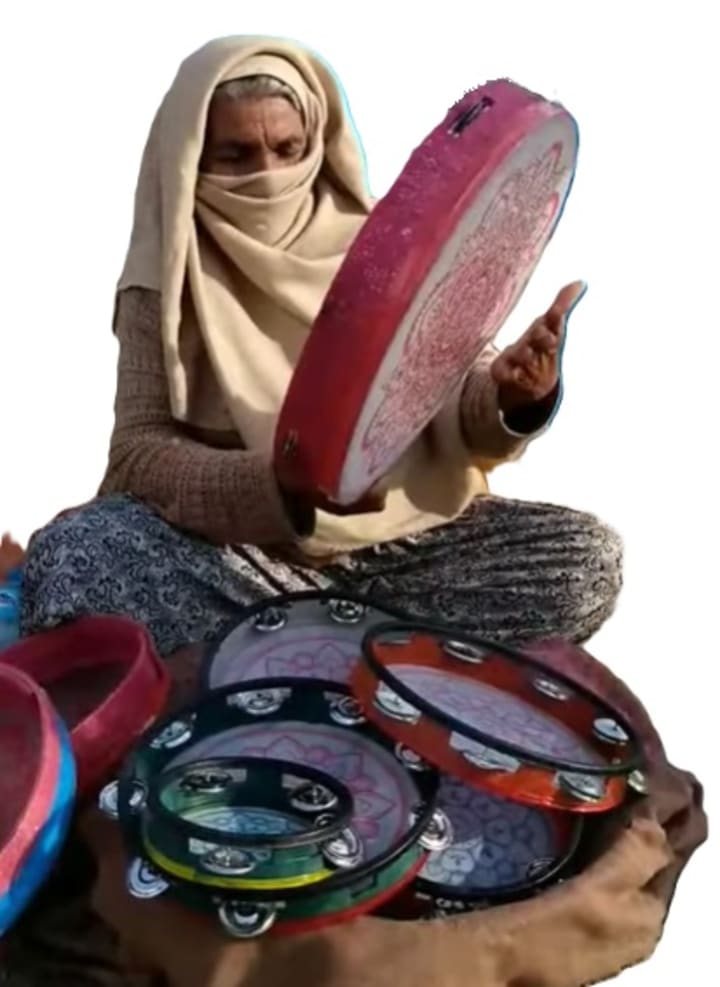
The daf is a frame drum that exists in various sizes and is popular throughout Afghanistan. In some types, metal rings are attached around the entire inner rim of the wooden frame, which is covered with goatskin (Gay, 2019, p. 2). This instrument in Afghanistan is made of willow wood and goatskin, shaped circularly in both small and large sizes. To make the dayereh (frame drum), a piece of willow wood is sawed according to the required thickness, width, and length. The obtained plank is then placed in water for twenty-four hours and subsequently bent into a circular shape. The two ends are nailed together, and the skin of a sheep or goat—after being dehaired and stretched—is glued onto the frame using sirish (adhesive). Sometimes, small bells—formerly called jalajel or zanguleh—are attached around the rim to make the sound brighter. The dayereh usually measures 40 centimeters in diameter and 6 to 10 centimeters in depth (Slobin, 1976, p. 264). However, its size varies across different regions of Afghanistan. When played, it is held with the left hand and struck with the right, though sometimes it is placed on the knees and played with both hands.
Terminology of the Daf Among Different Ethnic Groups and Regions of Afghanistan
Since Afghanistan is a country composed of diverse ethnicities and languages, the daf is referred to by different names in various regions and among different peoples. Each term reflects the musical identity of that ethnic group or locality.
In the music of Kabul, Herat, Badghis, Ghor, and other major cities, the daf is called dayereh or dariyeh and is considered one of the most important instruments for women’s festive gatherings, though men also play it in some of these cities and provinces.
Among the Hazaras, the daf is known as dariyeh and has a primarily social and celebratory function. Women often play the dariyeh or daf in family ceremonies, although in some regions this instrument is still used in religious dhikr and na‘t performances (Mousavi, 2012, pp. 42–45).
In Nuristani music—particularly in the regions of Kamdesh, Mandish, and Bashgal—a type of local frame drum called boombok is used, which closely resembles the daf or dayereh. Sometimes small bells are attached inside the frame, and the instrument is then called boombok desangi (Jones, 1974, pp. 122–124).
In Badakhshan, Panjshir, Takhar, and the northern areas of Kabul, during festive and especially Sufi gatherings (dhikr ceremonies), this instrument is known by the same names: daf, dayereh, or dariyeh.
Among the Pashtun ethnic groups of Afghanistan, the daf is called chambeh. It is considered the most common instrument in Pashtun family music and, in provinces such as Kandahar, Paktia, Khost, and Nangarhar, it is also played by men.
Among the Baloch of Afghanistan, frame drums are categorized according to their size and function: the large daf is called sama, and the smaller one is kasel. The sama is mainly used in Sufi gatherings, religious ceremonies, and sama‘ rituals. It produces a deep and resonant tone and provides the main rhythm of the event. The kasel is typically played at joyful occasions, dances, and local singing events. It has a lighter and sharper tone and is more flexible for musical accompaniment.
In Uzbek music, although the term daf is known, the word dayereh is the one most commonly used for this type of instrument.
Similarly, among the Gujjars living in Nangarhar and Laghman, the words dayereh or dariyeh are commonly used, while in Kunar and the border areas with Pakistan, chambeh is the prevalent term. Most Gujjars are pastoral and semi-nomadic, and music and dance form an important part of their cultural life.
In Turkmen music—especially among ashiqs (minstrels) and ritual groups—the words dep or däf are used to refer to the frame drum or jingled tambourine. Sometimes the term gopuz dep (gopuz + dep) is used, referring to the daf and gopuz (or qopuz), two traditional instruments that are usually played together in festive events, folk dances, and epic performances.
The Kyrgyz of the Afghan Pamirs call playing the daf dop chaluu. Here, dop means daf, and chaluu means “to play.” Kyrgyz women perform ritual dances during tuy (wedding) ceremonies with dop chaluu (Levin & Süzükei, 2006, p. 162).
Overall, the various ethnic groups of Afghanistan know this instrument by names such as dariyeh, dayereh, dariye, boombok, chambeh, dop, and daf, and both men and women play it during different ceremonies and occasions.
Conclusion
Based on the historical, ethnomusicological, and ethnographic analyses presented in this article, it is evident that the daf has played a multidimensional and vital role in the musical, ritual, and social life of the Afghan people throughout history. The findings indicate that this instrument was used during pre-Islamic periods as a tool for worship, healing, and communication with the supernatural, and its ritual functions continued into later periods in Sufi and religious music. Moreover, Afghanistan’s ethnic and linguistic diversity has resulted in the daf appearing in various forms, sizes, and names among different ethnic groups, with each group utilizing it according to its own style and tradition. The social role of this instrument, particularly in family gatherings, public celebrations, and women’s ceremonies, highlights its significance in fostering social cohesion, transmitting culture, and sustaining musical traditions. Beyond its practical applications, the study of the daf’s structure, local terminology, and playing techniques demonstrates the cultural richness, musical flexibility, and dynamism of Afghanistan’s local music. Accordingly, the daf is not merely a musical instrument but a symbol of the interconnectedness of music, ritual, ethnic identity, and cultural sociology in Afghanistan, providing an essential framework for understanding the interaction between music and culture.
References
Diakonoff, Mikhailovich. (1966). The History of Media (Medes). Translated by Karim Keshavarz. Tehran: Bongah-e Tarjomeh va Nashr-e Ketab Publishing.
Dhanalakshmi Dr. N. (2021). History of Ancient India (From the Earliest Times to 1206 AD). Tamil Nadu Open University.
Elworthy, S. (2015). The Sacred Drum: Origins and Ritual Use of Frame Drums in the Islamic World. Oxford.
Elworthy, Jane. (2015). The Ancient Path of the Frame Drum. https://janeelworthy.com.au/wp-content/uploads/2015/09/ancient-path-of-the-frame-drum.pdf?utm_source=chatgpt.com.
Feroz, Eslamuddin. (2019). Ethnomusicology of Afghanistan. Kabul University Press: Kabul.
Ferdowsi, Abulqasim. (2008). Shahnameh of Ferdowsi. Edited and revised by Fereydoun Joneidi. First edition. https://drmajidakrami.com/wpcontent/uploads/2021/04/%D8%B4%D8%A7%D9%87%D9%86%D8%A7%D9%85%D9%87-%D9%81%D8%B1%D8%AF%D9%88%D8%B3%DB%8C.pdf
Goibnazarov, Chorshanbe. (2023). The Daf and Its Role in the Badakhshan Region of Tajikistan. Cultural Heritage and Humanities Unit’s Research Paper #20. University of Central Asia. Pp 1-18
Gay, Breyley. (2019). An Exhibition of Musical Instruments and Artifacts from Iran and Afghanistan — The Music Archive of Monash University. Pp 1-20. https://www.monash.edu/__data/assets/pdf_file/0005/2443802/2019a-Exhibition_Iran-and-Afghanistan-Catalogue.pdf?utm_source=chatgpt.com
Jones, R. (1974). The Kalash and Nuristani: Songs and Instruments of the Hindu Kush. Oxford University Press.
Levin, T. & Süzükei, V. (2006). Where Rivers and Mountains Sing: Sound, Music, and Nomadism in Tuva and Beyond. Indiana University Press.
Mousavi, Sayyid Asim. (2012). The Hazaragi Music Culture. Kabul: Academy of Sciences of Afghanistan.
Nasehpour, Peyman. (2025). Names of Frame Drums. https://www.nasehpour.com/names-frame-drums?utm source=chatgpt.com
Osmani, Esmatullah. (2014). General Archaeology of Afghanistan. Kabul: Lajaward Publications.
Snoy, H. (1962). Music and Ritual among the Kafirs of Nuristan. Journal of Asian Folklore, 14(2), 89–102.
Slobin, Mark. (1976). Music in the Culture of Northern Afghanistan. Wesleyan: Wesleyan University.
Swami, Prajnanananda. (1973). Music of the Nations. Calcutta: Munshiram Manoharlal Publishers.
SlDKY, M . H. (1990). Malang Sufis, and M ystics: An Ethnographic and Historical Study of Shamanism in Afghanistan. https://asianethnology.org/downloads/ae/pdf/a802.pdf?utm_source=chatgpt.com Asian Folklore Studies, Volume 49,1990: pp 275-301.
Topp Fargion, Janet. (1991). “The Healing Performance of the Baloch Gwati Ritual.” In: Music and Trance: A Theory of the Relations between Music and Possession, edited by Gilbert Rouget, pp. 233–250. Cambridge University Press, Cambridge.
Vanleene, Alexandra. (2019). Differences and similarities in Gandhāran art production: the case of the modelling school of Haḍḍa (Afghanistan). Archaeopress Publishing LTD. Summertown Pavilion 18-24 Middle Way Summertown Oxford OX2 7LG. pp 143-163.
About the Creator
Prof. Islamuddin Feroz
Greetings and welcome to all friends and enthusiasts of Afghan culture, arts, and music!
I am Islamuddin Feroz, former Head and Professor of the Department of Music at the Faculty of Fine Arts, University of Kabul.
Keep reading
More stories from Prof. Islamuddin Feroz and writers in Beat and other communities.
Frame Drum (Daf): History, Culture, and Spirituality in Ancient and Islamic Societies
Frame Drum (Daf): History, Culture, and Spirituality in Ancient and Islamic Societies Author: Eslamuddin Feroz, Former Professor, Department of Music, Faculty of Fine Arts, University of Kabul
By Prof. Islamuddin Feroz3 months ago in Beat



Comments
There are no comments for this story
Be the first to respond and start the conversation.