
Frame Drum (Daf): History, Culture, and Spirituality in Ancient and Islamic Societies
The ِDaf, a historic frame drum connecting music and spirituality across cultures.

Frame Drum (Daf): History, Culture, and Spirituality in Ancient and Islamic Societies
Author: Eslamuddin Feroz, Former Professor, Department of Music, Faculty of Fine Arts, University of Kabul
Abstract
Frame drums, especially the daf, are considered among the earliest sound-ritual instruments in human history, and their presence across various civilizations reflects the fundamental role of this instrument in shaping collective and spiritual human experiences. This study aims to examine the historical trajectory and the cultural and religious functions of the frame drum in different societies from ancient times to the Islamic era. The research method is based on description and analysis of written sources, archaeological studies, and musicological research. The findings indicate that the frame drum in ancient civilizations symbolized worship, fertility, and connection with divine forces, and in the Islamic world, particularly among Sufi orders, it continued as a tool for self-purification, healing, and creating trance-centered spiritual experiences. In conclusion, the daf can be regarded not merely as a local instrument but as a cross-cultural and historical heritage that has preserved the enduring link between music and spirituality in Eastern and Islamic cultures.
Keywords: Music, Daf, Frame Drum, Religious Rituals, Sufism
Introduction
Throughout human history, music has played a fundamental role in transmitting collective beliefs, organizing rituals, and expressing inner human experiences. Among these, frame drums or dafs, due to their simple structure yet extensive functions, have always held a prominent place in ritual and religious music. Archaeological findings indicate that this instrument was used in the earliest organized societies, including Mesopotamia, Anatolia, Egypt, and Aryan lands, as a means of communicating with the divine, performing fertility rituals, and healing. The expansion of religions and transformations in social structures caused the role of this instrument to become limited in certain regions, but in the Islamic world, especially within Sufi circles, it acquired new meaning and became a tool for enhancing spiritual presence and inducing collective trance states. Therefore, the study of the frame drum is not only a review of the history of an instrument but also an analysis of the path through which music has served to shape cultural identity and human spiritual experience. This research attempts, through a comparative examination of historical and cultural sources, to explore the place of the daf in the continuity of Eastern ritual and musical traditions.
Historical Roots and Development of the Daf
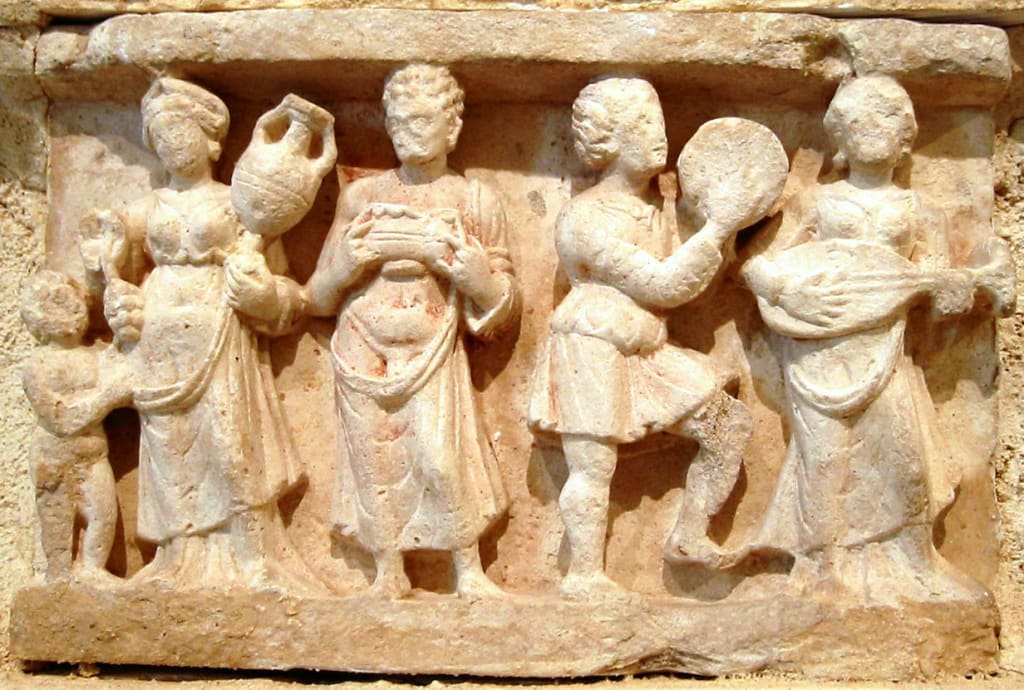
The daf, doireh, dayereh, chambe, and other similar instruments all belong to the ancient family of frame drums—musical instruments with a history spanning several millennia, which have long played a powerful, mysterious, and often feminine role in various cultures. These instruments have been used not only in music but also in healing, ritual worship, and the transformation of the human spirit, and have always been recognized as a bridge between humans and the spiritual world. In its simplest definition, a frame drum consists of a round wooden frame over which an animal skin is stretched. The player usually strikes it with the fingers of both hands, although in some cultures, sticks are also used. It is believed that the shape and structure of the frame drum were inspired by ancient grain sieves and evolved from that form. Unlike drums such as the conga or djembe, which have a hollow resonating chamber, the frame drum contains air within the frame, a factor that produces natural resonance. Despite its apparent simplicity, this instrument is capable of producing a wide range of sounds and notes; the performer can sustain a sound, bend a note, or enliven the drumhead through scratching and stroking. Thus, the skin of this instrument, which was once part of a living being, is reborn and responds to the performer’s intention and technique. For this reason, the daf is considered not only a musical instrument but also a sacred tool and a symbol of human connection with the spirit, the earth, and the heavens (Mauricio, 2006, p.67). On the other hand, the frame drum is usually covered with skin on only one side, though in some examples both sides are covered. Additionally, bells or rattling devices may be attached to the inner rim of the frame, as in ancient times it was believed that these instruments enhanced purification, repelled negative forces, and invoked spirits. Moreover, many drums were painted red, the color of blood, or green, colors that symbolized life, vegetation, and the beginning of life (Redmond, 1997, p.126). Archaeological evidence also attests to the long history of frame drums. The oldest known depiction of a percussion instrument dates back to approximately 5600 BCE and comes from a Neolithic site in Anatolia (modern-day Turkey). This mural, painted on the wall of a worship room, depicts a group of dancing humans in a trance-like state, some of whom are playing percussion instruments. In this scene, several figures wearing leopard skins hold various percussion instruments; one of them holds a horn in one hand and a frame drum in the other, while other musicians hold instruments similar to shakers, rattles, and those with bow-like structures. This historical antiquity is also confirmed by Sumerian written records. Between 3000 and 2500 BCE, Sumerian texts identify the goddess Inanna as the creator of the frame drum, and show that her priests sang and chanted to the rhythms of square and frame drums. Alongside these texts, numerous statues of women playing small frame drums have been discovered (Ibid, 1997, p.127). In addition to historical texts, tangible examples of frame drums are preserved in the Cairo Museum. For instance, there is a real two-headed rectangular frame drum dating to around 1400 BCE, discovered in the tomb of a woman named Hatshepsut. Also, from the Ptolemaic period, the skin head of a frame drum survives, featuring an image of a woman playing the drum before the goddess Isis. However, the connection of the frame drum to religious rituals is not limited to ancient Egyptian artifacts. In the book of Exodus—the second book of the Torah and the Old Testament—there is an illustration of the prophet Miriam, sister of Aaron, celebrating God with singing, dancing, and playing frame drums alongside the women of Israel after safely crossing the Red Sea. In this depiction, four women are shown, each holding a round frame drum (Mauricio, 2006, p.67). Evidence of the frame drum’s use has also been found in eastern Afghanistan, at the archaeological site of Hadda in Nangarhar Province. This site, built on the ruins of a pre-Islamic city, was one of the most important artistic and religious centers during the Kushan period (2nd–3rd century CE). The remains of this complex were excavated by a French archaeological team led by Jules Barthoux between 1926 and 1928. Among hundreds of discovered plaster and stone statues, several plaques and figurines depict scenes of musical gatherings and ritual ceremonies, with musicians playing various instruments, including the rabab, harp, and frame drums. These artifacts indicate that music in ancient eastern Afghanistan was not only part of art and religious rituals but also a fundamental element of the cultural and social life of the community. In particular, frame drums in this region, through their role in ritual ceremonies and collective events, constituted a part of the musical and spiritual traditions of the people of eastern Afghanistan, demonstrating the antiquity and significance of this instrument in local culture (Vanleene, 2019, p.143).
Based on the available historical and archaeological evidence, it cannot be stated with certainty that the frame drum first appeared in a specific region, because artifacts and traces of this instrument have been found in various parts of the world and during ancient periods: the Neolithic sites of Anatolia (modern-day Turkey), where depictions dating back to around 5600 BCE show percussion instruments, including the frame drum; Sumerian texts in Mesopotamia, which between 3000 and 2500 BCE provide written evidence of drumming rituals and the role of the frame drum in worship; ancient Egypt and the Ptolemaic period, where real drums and depictions of women playing frame drums have been discovered; ancient Israel (the Book of Exodus), where the frame drum was present in religious ceremonies; and eastern Afghanistan (the Hadda site, Kushan period), where musical and ritual scenes featuring the frame drum are observed in archaeological remains. This spatial and temporal diversity clearly indicates that the use of the frame drum throughout human history and across different cultures—whether independently or through cultural transmission—was widespread. Ultimately, no single region can be identified as its point of origin, and the frame drum should be regarded as a global phenomenon that developed over time in various societies and served diverse functions.
Frame Drums and Their Role in Sacred and Secular Rituals
The drum has been one of humanity’s oldest tools for communication with the metaphysical world, and our ancestors used it not only to create rhythm and music but also to summon deities and communicate with supernatural forces. In this context, the priestess-drummer served as an intermediary between the human realm and the divine domain; by synchronizing drumbeats with sacred rhythms, she invoked divine energy and transmitted it to the community (Redmond, 1997, p.127). Similarly, throughout history and across centuries, the frame drum or daf undertook a cultural journey spanning a vast geographical area—from the Sumerian and Babylonian civilizations to the Aryan lands, India, Rome, and ultimately the Islamic world. Initially, this instrument symbolized worship, fertility, and feminine powers in ancient rituals and held a central role in the healing traditions and ritual music of early peoples. In Aryan cultures and the Vedic period, percussion instruments similar to the daf were used to accompany religious hymns and sacrificial ceremonies, and later continued in Zoroastrian and Avestan rituals in a renewed form. With the advent of the classical era and the expansion of Christianity in the Roman Empire (2nd–3rd centuries CE), a fundamental transformation occurred in ritual music. During this period, the frame drum—which had once symbolized joy and feminine presence in temples—was removed from official church ceremonies, and its role in the Christian West was marginalized.
In contrast, in pre-Islamic Arab culture, the frame drum was widely used among pilgrims, court musicians, and female slave singers (qiyan), accompanying singing. With the emergence of Islam, as had happened in Christianity, some religious leaders opposed the ritual use of music, and the daf became subject to restrictions. This opposition was based on particular interpretations of the Qur’an and Hadith that regarded music as a means of Satanic seduction. Nevertheless, the daf’s legitimacy was accepted in some rituals and is even mentioned in early Islamic writings, such as the works of Jabir ibn Hayyan. Moreover, numerous Muslim scholars throughout history affirmed the status of the daf. For example:
• Al-Samarqandi (983–1002 CE) permitted the use of the daf in celebrations, provided it did not include bells.
• Ibn Taymiyyah (1263–1328 CE), in Mas’alah fi al-Sama‘, considered the use of the daf in spiritual ceremonies legitimate.
• Al-Tifashi (1184–1253 CE), in Mat‘at al-Asma‘, introduced the daf as one of the noblest instruments of the Islamic world (Mauricio, 2006, p.87).
These affirmations ensured that the daf was not eliminated; rather, it found renewed life in the Arab world, Khorasan (modern Afghanistan), Persia (modern Iran), Central Asia, and parts of India, particularly in mystical rituals, where it was interpreted as the voice of the soul and divine rhythm. As Elworthy notes, the continued playing of the daf in the East is a sign of the persistence of humanity’s oldest form of spiritual music, which still resonates in the spiritual rituals of the Orient (Elworthy, 2015, p.1). Alongside this ritual status, the daf was also attributed therapeutic properties and was employed in many Sufi orders to reach spiritual trance. Terms such as tar and gharbāl were also used to describe different types of frame drums, though their use was limited (Mauricio, 2006, p.85). Henry George Farmer notes that the daf was used in Arab religious rituals and in the tahlil dance performed during circumambulation of the Kaaba, and during the Prophet’s time (PBUH), women and slaves celebrated his presence with the daf. Hadith narrations also confirm this; for example, when the Prophet entered Medina, girls sang:
"We are the daughters of the carpenter tribe; what a blessing it is to be neighbors of the Prophet!"
And the Prophet did not prevent them from doing this.
Thus, the daf was not eliminated but rather formed a strong connection with Islam, and from the fifteenth century, it was established in Sufi rituals, producing trance-like spiritual states with its complex rhythms. The spread of daf-playing among Sufis is one reason why this art is still common today in Iran, Afghanistan, Mesopotamia, India, northern Pakistan, and Xinjiang, China. The daf is made of a wooden frame (often apricot or walnut) and a skin of goat or sheep (Goibnazarov, 2023, p.3). Subsequently, the frame drum gained a key position in Sufi orders such as the Qadiriya and Rifa‘iyya. Abdul Qadir Gilani (1077–1166 CE), the founder of the Qadiriya, is mentioned in Acehnese legends as holding a daf at birth. After him, Ahmad Rifa‘i (d. 1182 CE) made playing the daf part of the spiritual practice of his followers. By around 1320 CE, the Rifa‘i order had spread throughout Aceh (a province in northern Sumatra, Indonesia), and the word Rapai in this region likely derives from the name Rifa‘i. In dhikr circles, Sufis reached a state of divine presence and unity by playing the daf and rhythmically repeating the names of God (Margaret, 2010, p.97). The ritual significance of the daf is also reflected in art and imagery. Several valuable Ottoman paintings from the sixteenth century depict sama‘ ceremonies in Konya. The oldest of these, Meeting with Mawlana in Konya (1581 CE) in Mustafa Ali’s Nusratnameh, shows twelve whirling dervishes and a musical ensemble including flutists and a daf player (mirror drum) (Walter, 2022, p.66).
Ultimately, the history of frame drums demonstrates that this instrument has always functioned beyond a mere sound-producing tool. The daf embodies the connection between music, ritual, and collective human identity—a connection that began with early worship ceremonies and communication with deities and continues in the dhikr and sama‘ rituals of Sufis. Although its ritual role was limited in some periods, particularly in the Christian West, in the Eastern world it acquired a renewed spiritual significance and became part of enduring cultural traditions. In other words, the daf is not a local tradition but a human and cross-cultural heritage—an instrument that has crossed borders, religions, and historical periods, adapting and maintaining a dynamic character. Its continued presence in Islamic and Eastern cultures is proof that sacred rhythms remain one of the primary languages of human spiritual experience.
Conclusion
The study of the history and functions of frame drums, especially the daf, shows that this instrument is more than a mere musical tool; it is a symbol of the connection between humans, music, and the divine. Archaeological evidence—from Neolithic depictions in Anatolia to tangible examples in Egypt and eastern Afghanistan—as well as historical texts, from Sumerian and Babylonian civilizations to Islamic sources, demonstrate the role of this instrument in ritual ceremonies, fertility rites, healing, communal celebrations, and social rituals. The use of the frame drum across various cultures, from Aryan and Vedic societies to Islamic communities and Sufi circles, indicates that the instrument not only developed independently but also functioned throughout history as a flexible and spiritual tool in cultural interactions and the transmission of traditions. In the Islamic world, particularly in Afghanistan, Central Asia, Iran, and Mesopotamia, the daf, through its complex rhythms and capacity to induce trance states, became a central element in mystical and Sufi ceremonies, acquiring spiritual and therapeutic significance. The continued use of this instrument in rituals and communal ceremonies—from Sufi gatherings to local music—demonstrates its endurance and cultural adaptability over thousands of years. Furthermore, the variety of names and forms of frame drums in the Islamic world, including terms such as daf, tar, and gharbal, reflects both the instrument’s flexibility and its cultural significance. Therefore, frame drums, especially the daf, can be regarded as a cross-cultural and historical symbol of the connection between music, ritual, and human spirituality—a phenomenon that, while preserving local and cultural characteristics, reflects humanity’s spiritual and musical experience throughout history. Studying this instrument, in addition to understanding the history of music and art, allows for insight into the cultural, ritual, and spiritual development of human societies and the role of the instrument in collective and individual life.
References
Elworthy, Jane. (2015). The Ancient Path of the Frame Drum. https://janeelworthy.com.au/wp-content/uploads/2015/09/ancient-path-of-the-frame-drum.pdf?utm_source=chatgpt.com.
Goibnazarov, Chorshanbe. (2023). The Daf and Its Role in the Badakhshan Region of Tajikistan. Cultural Heritage and Humanities Unit’s Research Paper #20. University of Central Asia. Pp 1-18.
Margaret, Kartomi. (2010). The development of the Acehnese sitting song-dances and frame-drum genres as part of religious conversion and continuing piety. Bijdragen tot de Taal-, Land- en Volkenkunde Vol. 166, no. 1 (2010), pp. 83–106.
Mauricio, Molina. (2006). Frame Drums in the Medieval Iberian Peninsula. A dissertation submitted to the Graduate Faculty in Music in partial fulfillment of the requirements for the degree of Doctor of Philosophy, The City University of New York.
Osmani, Esmatullah. (2014). General Archaeology of Afghanistan. Kabul: Lajaward Publications.
Redmond, Layne. (1997). When the Drummers Were Women: A Spiritual History of Rhythm. اثر Women Drummers. Three Rivers Press. Newyork: Three Rivers Press. pp 127- 132
Vanleene, Alexandra. (2019). Differences and similarities in Gandhāran art production: the case of the modelling school of Haḍḍa (Afghanistan). Archaeopress Publishing LTD. Summertown Pavilion 18-24 Middle Way Summertown Oxford OX2 7LG. pp 143-163.
Walter, Feldman. (2022). From Rumi to the Whirling Dervishes: Music, Poetry and Mysticism in the Ottoman Empire. Published in Association with the Aga Khan University Institute for the Study of Muslim Civilisations and the Aga Khan Music Programme.
About the Creator
Prof. Islamuddin Feroz
Greetings and welcome to all friends and enthusiasts of Afghan culture, arts, and music!
I am Islamuddin Feroz, former Head and Professor of the Department of Music at the Faculty of Fine Arts, University of Kabul.
Keep reading
More stories from Prof. Islamuddin Feroz and writers in Beat and other communities.
Al-Farabi and the Establishment of the Scientific Tradition of Music in the Islamic Golden Age
Al-Farabi and the Establishment of the Scientific Tradition of Music in the Islamic Golden Age Author: Islamuddin Feroz, Former Professor, Department of Music, Faculty of Fine Arts, University of Kabul
By Prof. Islamuddin Feroz3 months ago in Beat
Ludacris and Nelly draw backlash over bookings at MAGA-coded music festival
Ludacris and Nelly headlining a mostly right-wing event is good for them. It’s also great for the genre of hip hop. The two rap veterans have showcased their talents on other stages. Why can’t they perform for mostly MAGA folks and grab that bag?
By Skyler Saunders6 days ago in Beat
Anna Christie
Anna Christie" at St. Ann's Warehouse play written by Eugene O'Neil and for the most part is good. The acting by Brian D'Arcy James and Tom Sturridge is excellent; as is Mare Winningham, although she is not on stage for very long in this two hour-thirty minute show.
By Robert M Massimi. ( Broadway Bob).3 days ago in Beat



Comments
There are no comments for this story
Be the first to respond and start the conversation.