
The Boy Who Chased Light
In a city shadowed by silence, one lost boy discovers the glow that was always inside him.


I had forgotten what sunlight felt like—until the diary reminded me that hope never truly dies.
---
I fell to the streets of my broken city, the buildings around me hunched like tired giants. Silence had claimed every alley, every corner. I walked with my hands in my pockets, pretending that the darkness outside didn’t match the one inside my chest. Each step echoed on the cracked pavement, a reminder that the world had moved on while I remained frozen in shadows.
Then I found it—a small, leather-bound diary tucked between the rubble of a burnt bookstore. Its pages smelled of rain and forgotten dreams. On the first page, in neat handwriting: “Find the light, even if the world forgets how to shine.”
I laughed bitterly. The world had forgotten. I had forgotten. And yet, somehow, these words pierced through the weight in my lungs, awakening something I thought I had lost forever. My fingers traced the edges of the diary as if it were fragile glass, and maybe it was—fragile, but full of possibility.
Every day after that, I returned to the diary. It spoke of sunsets that never ended, of stars that whispered secrets to anyone who would listen. Each page was a step out of darkness, a push toward something I had thought impossible: hope. The words described moments I had felt in passing but never fully remembered—the warmth of morning sunlight on my face, the quiet laughter shared with strangers in a park, the feeling of wind brushing against my hair like it was trying to tell me something.
I began noticing small things. A flower stubbornly growing through cracked pavement. A bird daring to sing from a broken branch. Even my own reflection seemed a little less tired. I paused to watch the sky, noting how the clouds shifted and bled into pink and gold as if the world were painting just for me. The city didn’t feel entirely dead anymore; it felt like it was waiting, like it had been holding its breath, waiting for me to notice.
But the diary wasn’t just poetry—it was a map. A map of memories I didn’t know I had lost. Pictures of streets I once ran through as a child, laughter echoing in places long forgotten. And at the end, a photograph slipped between the pages: a girl smiling, her eyes like sunlight breaking through clouds.
I froze. I knew her. I didn’t, yet I did. And then it hit me—the diary was mine. I had written it when I was younger, before life taught me how to fold up my heart and hide it under the weight of the world. The realization brought tears to my eyes, and I held the diary close, feeling the weight of every forgotten day and every unspoken dream I had ever carried.
Tears blurred my vision as I realized something powerful: the light I had been chasing was never outside me. It had been inside all along. The diary had reminded me who I was, who I could still be.
The city didn’t change overnight. The streets were still broken, the silence still heavy. But I walked differently now. My steps had rhythm, my eyes held fire. I was not running from darkness—I was carrying my own flame. I began speaking to people I passed in the streets, sharing small smiles, small gestures. The city responded. Slowly, almost imperceptibly, life returned to the alleys, the parks, the abandoned corners.
I began writing again, in the same diary. Words spilled like rivers I had dammed for years. And for the first time, I didn’t write for anyone else. I wrote to myself, for myself, and somehow, that was enough. I wrote about the morning sun, about strangers who smiled back, about the music in the rain, about the way the world could hurt and heal you at the same time.
By the time people noticed me again, I was no longer the boy who fell into shadows. I was the boy who chased light, who carried it in his chest, who knew that even in the quietest, loneliest places, hope could still speak. And maybe, just maybe, someone else would find the diary one day—and remember that they too could find their own light.
About the Creator
Keep reading
More stories from Shahab Khan and writers in Fiction and other communities.
Letters to the Forgotten Lake
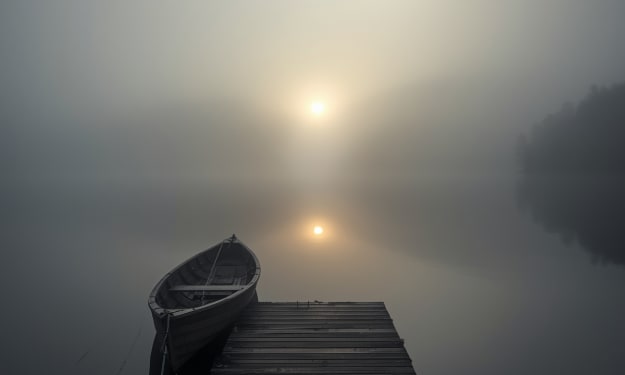
The sun had barely risen when Elara found herself standing at the edge of Willow Lake, its surface smooth and silver like a mirror reflecting the sorrow in her heart. The fog clung to the water like a secret, hiding what had been lost. Ten years had passed, but the weight of that summer still lingered in her chest.
By Shahab Khan4 months ago in Fiction
Lightning Never Strikes Twice
The distant rumble, the sudden deluge, the crescendo of sound, the flash of light, the explosive energy — it never gets old. I became an amateur storm chaser about two years ago. My wife, Cindy suggested it. Sort of. She said, "Alex, you know this cancer is killing me. I've come to terms with that, but you're smothering me. Go join a band, write a book, or become a storm chaser, for all I care. I love you, but you need a hobby."
By Julie Lacksonen4 days ago in Fiction
me, me, me
when i read back my poetry it screams “me, me, me” on my screen in bold letters and i can’t shut it up — most days, i cannot make any other words out; i want to throttle a thousand versions of the me gone by, i want to throw myself from a figurative balcony, i want to sink a sword into every pen i’ve held
By angela hepworth6 days ago in Poets

Comments (1)
Yo