Nisarg Bhavsar
Bio
I'm a tech enthusiasts skilled in SEO and content creation. I bridge the tech gap with engaging content on Flutter, Node.js, Salesforce & mobile landscape.
Stories (55)
Filter by community
Flutter for Food Delivery App Development: Benefits, Costs, and Key Takeaways
Over the past few years, food ordering apps have become a part of our regular lives. From online ordering of fast foods to complete meals, customers now want their favorite food to be at their doorstep with a couple of taps. Food delivery solutions increased during the pandemic and are growing even more due to people giving high preference to convenience and speed. But selecting the appropriate technology is essential in creating a scalable, user-friendly, and high-performing food delivery platform. Among the technologies available, one framework that has been increasingly popular among the startups and big players is Flutter.
By Nisarg Bhavsar7 months ago in 01
Golang for Backend Systems: From Microservices to Scalable APIs
In today’s fast-paced software development world, backend systems are very important and they play a very crucial role in performance and efficiency of software systems. The backend systems need to be fast, scalable, concurrent, and maintainable and one such framework which makes backend systems unbeatable is Golang. It is developed by Google and it has become a go-to language for organizations that want to develop a robust backend due to its simplicity, performance, and concurrency model.
By Nisarg Bhavsar8 months ago in 01
Why You Should Use Ruby on Rails with Kubernetes for Scalable Web Applications
Ruby on Rails is a web application development framework that has been in use for over twenty years. Its CoC principle allows organizations to build faster and robust applications. However, due to various custom requirements and increase in user base it is very challenging to ensure scalability, performance, and reliability. This is where Kubernetes, which is a container orchestration platform, becomes important. Combining the capabilities of Ruby on Rails with Kubernetes enables the development of scalable, high-performance applications tailored to meet the needs of today's digital landscape.
By Nisarg Bhavsar8 months ago in 01
Benchmarking Node.js Applications: How Different Types Deliver Performance Benefits
In today’s performance driven world, the speed and efficiency of the applications play a very important role in the success of the application. For building such applications one of the most powerful and high-performing frameworks is NodeJS. It is recognized for its event-driven architecture and non-blocking nature, which ensures that web applications remain both scalable and easy to maintain. If you want to truly maximize the capabilities of Node.js, thorough benchmarking is a must.
By Nisarg Bhavsar9 months ago in 01
Top Benefits of Zoneless Change Detection in Angular for Scalable Apps
Change detection is a core part of Angular’s rendering engine. Traditionally, Angular relies on Zone.js to automatically track asynchronous operations like setTimeout, Promise, or HTTP requests, and trigger the change detection process accordingly. This has worked well for many applications, but as complexity increases and demand for performance also increases simultaneously then the developers have to start looking for finer control and better performance which leads to rise of Zoneless change detection in Angular.
By Nisarg Bhavsar9 months ago in 01
React Native to Flutter: Is It Time to Make the Switch?
Nowadays, most of the businesses or startups have their own mobile applications as they play a key role in improving the user engagement, building brand loyalty, and also in providing convenient access to product and services. But for developing mobile applications you have to choose an ideal tech stack as per your requirements. Currently, cross platform application development frameworks like Flutter and React Native are very popular as it helps to develop applications that can be deployed on both iOS and Android platforms.
By Nisarg Bhavsar9 months ago in 01
Memory Management in Golang: Best Practices for Scalable Applications
When you start developing applications with the help of the Golang framework, you will soon understand that performance and efficiency are very important parameters central to its design. Among these two parameters one of the major things to consider is Memory management. Memory management in Golang plays a crucial role in performance of applications irrespective of whether you are building web services, CLI tools, or concurrent systems.
By Nisarg Bhavsar11 months ago in 01
Managing Dependencies in Angular: Types and Best Practices
In Angular, dependencies are services, libraries, or modules that a component, directive, or service relies on to function correctly. This dependency helps to enable reusability, modularity, and maintainability which ensure that Angular applications remain scalable and efficient. They are managed using Angular’s DI system which provides a way to supply components and services with the necessary resources while promoting code reusability and testability.
By Nisarg Bhavsar12 months ago in 01
Why Choose Node.js for Headless CMS Development?
In the modern digital landscape, organizations require flexible, scalable, and high performance solutions for managing content across multiple platforms.Traditional monolithic platforms come with inherent limitations in customization, scalability, and performance, making them less flexible for modern application needs. This is where a headless CMS proves beneficial, providing a decoupled architecture that enables seamless content delivery across websites, mobile applications, and IoT devices through APIs. There are many technologies available with the help of which you can develop Headless CMS. But, Node.js for Headless CMS is a top choice due to its various benefits such as speed, efficiency, and developer-friendly ecosystem. In this article, we are going to explore key reasons to choose Node.js for Headless CMS development.
By Nisarg Bhavsarabout a year ago in 01
Top Best Practices for Migrating to Flutter in 2025
In today's world, mobile applications are essential for business success. However, developing mobile applications for separate platforms can be very costly for organizations as lots of resources are required. Therefore, consider cross-platform app development frameworks like Flutter rather than maintaining separate codebases for different platforms. You can choose Flutter if you want to develop a new app, or you can also migrate your existing application to Flutter.
By Nisarg Bhavsarabout a year ago in 01
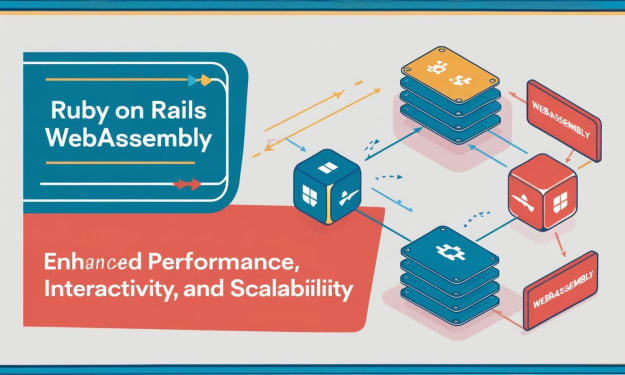
Ruby on Rails and WebAssembly: Enhance Performance, Interactivity, and Scalability
Ruby on Rails has long been a preferred framework for decades for building scalable and maintainable web applications. It is known for its Convention-Over-Configuration principle, which allows developers to create powerful applications with minimal effort. However, with time, users' requirements keep increasing, such as enhanced performance, seamless execution across different environments, and new possibilities for client-side execution, which have led developers to explore WebAssembly.
By Nisarg Bhavsarabout a year ago in 01
Top 9 Rails Version Migration Checklist to Follow in 2025
Migrating your Ruby on Rails application to a newer version can bring enhanced features, better performance, and improved security. However, it is essential to follow a well-defined process to ensure a smooth and successful migration. Whether you are managing the migration with your in-house or working with a professional Ruby on Rails development company, the following is a detailed explanation of each Rails version migration checklist that you should consider.
By Nisarg Bhavsarabout a year ago in 01