
Ruby on Rails and WebAssembly: Enhance Performance, Interactivity, and Scalability
Rails and WebAssembly

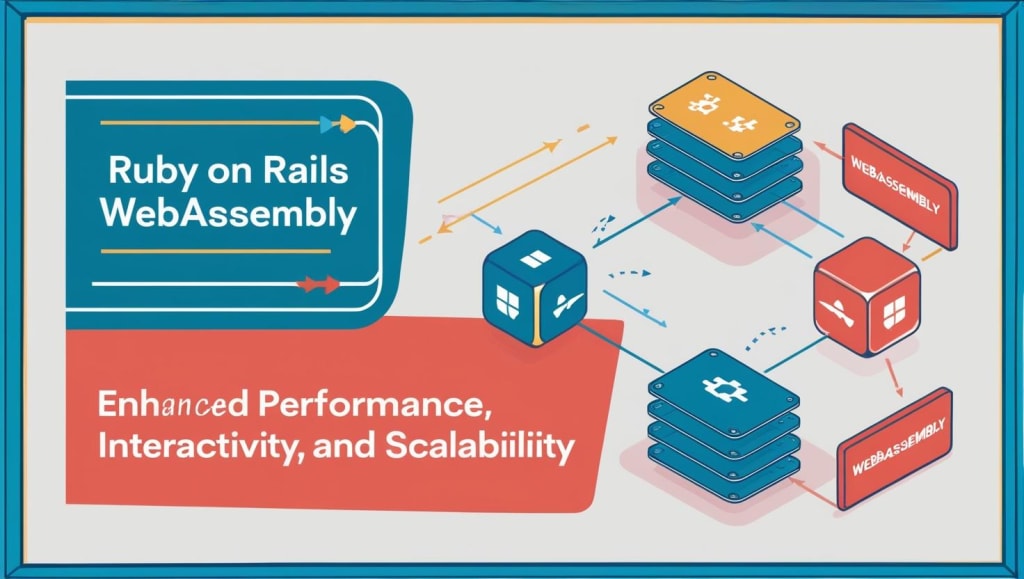
Ruby on Rails has long been a preferred framework for decades for building scalable and maintainable web applications. It is known for its Convention-Over-Configuration principle, which allows developers to create powerful applications with minimal effort. However, with time, users' requirements keep increasing, such as enhanced performance, seamless execution across different environments, and new possibilities for client-side execution, which have led developers to explore WebAssembly.
Why Combine Ruby on Rails with WebAssembly?
Ruby on Rails applications used to be server-centric, meaning that the backend handles most logic and processing, ensuring that clients handle minimal execution. However, the combination of Ruby on Rails and WebAssembly offers the ability to offload some of the processing to the client side, which helps to improve performance, enhance interactivity, wider accessibility, and lower latency. If you want to integrate WebAssembly into your Rails application, hire Ruby on Rails developer with expertise in modern web technologies to ensure seamless implementation and optimal performance.
Benefits of Ruby on Rails and WebAssembly
Integrating Ruby on Rails with WebAssembly will help to bring several advantages, such as performance, scalability, and flexibility. Here are some of the main advantages.
- Improved Performance and Speed
One of WebAssembly's most significant benefits is its native-like execution speed. In traditional JS-based client-side execution, WebAssembly compiles in an optimized binary format, enabling faster processing of complex computations. This allows Rails applications to delegate performance-intensive tasks, such as image processing or data manipulation, to the client side, reducing server dependency.
- Reduced Sever Load and Cost Efficiency
By shifting some of the computational tasks from the server to the client, Ruby on Rails and WebAssembly can help significantly reduce the server load. This will surely lower infrastructure costs and allow applications to handle concurrent users without additional server resources.
- Enhanced User Experience with Low Latency
Applications requiring real-time interactions, such as gaming platforms, live analytics dashboards, and interactive web applications, can benefit from WebAssembly’s ability to execute computational logic in the browser. This reduces the time required for the requests to travel between the client and the server, which results in a smoother and faster user experience.
- Cross-Browser and Platform Compatibility
WebAssembly is supported by modern browsers such as Chrome, Firefox, Edge, and Safari. This means that a combination of Ruby on Rails and WebAssembly applications can run efficiently across multiple platforms without any additional configuration. Developers can build more portable applications that work seamlessly in web and serverless environments.
- Security Advantages
WebAssembly provides a sandboxed environment, which means that WebAssembly modules run in a contained and secure environment. This prevents unauthorized access to system resources and ensures that only intended functionality is executed, improving the overall application security.
- Easier Integration
In earlier times, Rails developers relied on JavaScript for front-end logic. However, by combining Ruby on Rails and WebAssembly, integrating other programming languages like Rust or C++ directly within a Rails project is possible. This will enable developers to leverage multiple languages within a single Rails application, making it more versatile and efficient.
- New Use Cases
WebAssembly expands the capabilities of Ruby on Rails beyond conventional web applications, unlocking a range of innovative use cases, such as:
➞ Running Ruby Code directly in the browser
➞ Developing hybrid applications
➞ Supporting Edge Computing and Serverless Architectures
Conclusion
Integrating Ruby on Rails and WebAssembly introduces an exciting new paradigm in web development. It enables high-performance execution of Ruby code in the browser, which reduces server dependency while improving speed, security, and scalability. By leveraging WASM, Rails applications can achieve better client-side performance, lower latency, and broader cross-platform compatibility. Partnering with a specialized Ruby on Rails Development Company can be invaluable for expert guidance and seamless integration of these technologies.
About the Creator
Nisarg Bhavsar
I'm a tech enthusiasts skilled in SEO and content creation. I bridge the tech gap with engaging content on Flutter, Node.js, Salesforce & mobile landscape.
Keep reading
More stories from Nisarg Bhavsar and writers in 01 and other communities.
Top 9 Rails Version Migration Checklist to Follow in 2025
Migrating your Ruby on Rails application to a newer version can bring enhanced features, better performance, and improved security. However, it is essential to follow a well-defined process to ensure a smooth and successful migration. Whether you are managing the migration with your in-house or working with a professional Ruby on Rails development company, the following is a detailed explanation of each Rails version migration checklist that you should consider.
By Nisarg Bhavsarabout a year ago in 01
Shadow Fist: An Underground MMA Drama About Survival and Redemption
Set against the gritty backdrop of Mexico City’s underground fighting scene, the film tells the story of Maya Cross, a woman forced to rebuild her life in the most unexpected way — inside an illegal mixed martial arts ring.
By Andreas Szakacsa day ago in 01
How Long Does App Development Take in St. Louis 2026
St. Louis has solidified its reputation as a "Silicon Prairie" powerhouse. The city has moved beyond its historical manufacturing roots. It is now a sophisticated tech hub. Activity centers around Cortex and the 39 North innovation district. Entrepreneurs and established enterprises have one pressing question. How long does app development take in St. Louis 2026?
By Del Rosario4 days ago in 01
The First Rainbow Baby
Pitter-patter, pitter-patter. The rain fell in rhythmic splatters, slowly slowing, but still constant. Mira rolled onto her side pulling the blanket tight against her ears, but still she could hear chitter-chatter and scurrying feet of the creatures that refused to sleep in the lower decks.
By A. J. Schoenfelda day ago in Fiction




Comments
There are no comments for this story
Be the first to respond and start the conversation.