make life beautiful
Bio
Life
Stories (4)
Filter by community
The Most Misunderstood Concept in Physics
the most important, yet least understood concepts in all of physics. It governs everything from molecular collisions to humongous storms. From the beginning of the universe through its entire evolution, to its inevitable end. It may, in fact, determine the direction of time and even be the reason that life exists. To see the confusion around this topic, you need to ask only one simple question. What does the Earth get from the sun? - What does the earth get from sun? - Well, it's light rays? - What do we get from the sun? - Heat. - Warmth. - Warmth, light. - Vitamin D, we get vitamin D from- - We do get vitamin D from the ultraviolet rays. - Well, a lot of energy. - What does the earth get from this, energy? - Yeah, energy. - Energy. - Nailed it. Every day, the earth gets a certain amount of energy from the sun. And then how much energy does the earth radiate back into space relative to that amount that it gets from the sun? - Probably not as much, I, you know, I don't believe it's just radiating right back. - I'd say less. - Less. - Less. - I say less. - I guess about 70%? - It is a fraction. - I'd say 20%. - Because... - Because we use some of it. - We use some of the energy. - Mm-hmm. - We consume a lot, right? - But the thing about energy is it never really goes away. You can't really use it up. - It would have to break even, wouldn't it? Same amount, yeah. - You know, cause and effect. It'd be equal in some ways, right? - For most of the earth's history, it should be exactly the same amount of energy in from the sun as earth radiates into space. - Wow. - Because if we didn't do that, then the earth would get a lot hotter, that'd be a problem. - That'd be a big problem. - So, if that is the case... - Yeah. - Then what are we really getting from the sun? - That's a good question. - Hmm. - It gives us a nice tan. - It gives us a nice tan, I love it. We're getting something special from the sun. - I don't know, what do we get without the energy? - But nobody talks about it. To answer that, we have to go back to a discovery made two centuries ago. In the winter of 1813, France was being invaded by the armies of Austria, Prussia, and Russia. The son of one of Napoleon's generals was Sadi Carnot, a 17-year-old student. On December 29th, he writes a letter to Napoleon to request to join in the fight. Napoleon preoccupied in battle, never replies. but Carnot gets his wish a few months later when Paris is attacked. The students defend a chateau just east of the city, but there're no match for the advancing armies, and Paris falls after only a day of fighting. Forced to retreat, Carnot is devastated. Seven years later, he goes to visit his father who's fled to Prussia after Napoleon's downfall. His father was not only a general, but also a physicist. He wrote an essay on how energy is most efficiently transferred in mechanical systems. When his son comes to visit, they talk at length about the big breakthrough of the time, steam engines. Steam engines were already being used to power ships, mine ore, and excavate ports. And it was clear that the future industrial and military might of nations depended on having the best steam engines. But French designs were falling behind those of other countries like Britain. So, Sadi Carnot took it upon himself to figure out why. At the time, even the best steam engines only converted around 3% of thermal energy into useful mechanical work. If he could improve on that, he could give France a huge advantage and restore its place in the world. So he spends the next three years studying heat engines, and one of his key insights involves how an ideal heat engine would work, one with no friction and no losses to the environment. It looks something like this. Take two really big metal bars, one hot and one cold. The engine consists of a chamber filled with air, where heat can only flow in or out through the bottom. Inside the chamber is a piston, which is connected to a flywheel. The air starts at a temperature just below that of the hot bar. So first, the hot bar is brought into contact with the chamber. The air inside expands with heat flowing into it to maintain its temperature. This pushes the piston up, turning the flywheel. Next, the hot bar is removed, but the air in the chamber continues to expand, except now without heat entering, the temperature decreases. In the ideal case, until it is the temperature of the cold bar. The cold bar is brought into contact with the chamber and the flywheel pushes the piston down. And as the air is compressed, heat is transferred into the cold bar. The cold bar is removed. The flywheel compresses the gas further increasing its temperature until it is just below that of the hot bar. Then the hot bar is connected again and the cycle repeats. Through this process, heat from the hot bar is converted into the energy of the flywheel. And what's interesting to note about Carnot's ideal engine is that it is completely reversible. If you ran the engine in reverse, first the air expands lowering the temperature, then the chamber is brought into contact with the cold bar, the air expands more, drawing in heat from the cold bar. Next, the air is compressed, increasing its temperature. The chamber is placed on top of the hot bar and the energy of the flywheel is used to return the heat back into the hot bar. However many cycles were run in the forward direction, you could run the same number in reverse, and at the end, everything would return to its original state with no additional input of energy required. So by running an ideal engine, nothing really changes. You can always undo what you did. So what is the efficiency of this engine? Since it's fully reversible, you might expect the efficiency to be 100%, but that is not the case. Each cycle, the energy of the flywheel increases by the amount of heat flowing into the chamber from the hot bar, minus the heat flowing out of the chamber at the cold bar. So to calculate the efficiency, we divide this energy by the heat input from the hot bar. Now the heat in on the hot side is equal to the work done by the gas on the piston, and this will always be greater than the work done by the piston on the gas on the cold side, which equals the heat out. And this is because on the hot side, the hot gas exerts a greater pressure on the piston than that same gas when cold. To increase the efficiency of the engine, you could increase the temperature of the hot side, or decrease the temperature of the cold side, or both. Lord Kelvin learns of Carnot's ideal heat engine and realizes it could form the basis for an absolute temperature scale. Imagine that the gas is allowed to expand an extreme amount, so much that it cools to the point where all the gas particles effectively stop moving. Then they would exert no pressure on the piston, and it would take no work to compress it on the cold side, so no heat would be lost. This is the idea of absolute zero, and it would make for a 100% efficient engine. Using this absolute temperature scale, the Kelvin scale, we can replace the amount of heat in and out with the temperature of the hot and cold side respectively, because they are directly proportional. So we can express efficiency like this, which we can rewrite like this. What we have learned is that the efficiency of an ideal heat engine doesn't depend on the materials or the design of the engine, but fundamentally on the temperatures of the hot and cold sides. To reach 100% efficiency, you'd need infinite temperature on the hot side or absolute zero on the cold side, both of which are impossible in practice. So even with no friction or losses to the environment, it's impossible to make a heat engine 100% efficient. And that's because to return the piston to its original position, you need to dump heat into the cold bar. So not all the energy stays in the flywheel. Now, in Carnot's time, high pressure steam engines could only reach temperatures up to 160 degrees Celsius. So their theoretical maximum efficiency was 32%, but their real efficiency was more like 3%. That's because real engines experience friction, dissipate heat to the environment, and they don't transfer heat at constant temperatures. So for just as much heat going in, less energy ends up in the flywheel. The rest is spread out over the walls of the cylinder, the axle of the flywheel, and is radiated out into the environment. When energy spreads out like this, it is impossible to get it back. So this process is irreversible. The total amount of energy didn't change, but it became less usable. Energy is most usable when it is concentrated and less usable when it's spread out. Decades later, German physicist, Rudolf Clausius, studies Carnot's engine, and he comes up with a way to measure how spread out the energy is. He calls this quantity, entropy. When all the energy is concentrated in the hot bar, that is low entropy, but as the energy spreads to the surroundings, the walls of the chamber and the axle will entropy increases. This means the same amount of energy is present, but in this more dispersed form, it is less available to do work. In 1865, Clausius summarizes the first two laws of thermodynamics like this. First, the energy of the universe is constant. And second, the entropy of the universe tends to a maximum. In other words, energy spreads out over time. The second law is core to so many phenomena in the world. It's why hot things cool down and cool things heat up, why gas expands to fill a container, why you can't have a perpetual motion machine, because the amount of usable energy in a closed system is always decreasing. The most common way to describe entropy is as disorder, which makes sense because it is associated with things becoming more mixed, random, and less ordered. But I think the best way to think about entropy is as the tendency of energy to spread out. So why does energy spread out over time? I mean, most of the laws of physics work exactly the same way forwards or backwards in time. So how does this clear time dependence arise? Well, let's consider two small metal bars, one hot and one cold. For this simple model, we'll consider only eight atoms per bar. Each atom vibrates according to the number of energy packets it has. The more packets, the more it vibrates. So let's start with seven packets of energy in the left bar and three in the right. The number of energy packets in each bar is what we'll call a state. First, let's consider just the left bar. It has seven energy packets, which are free to move around the lattice. This happens nonstop. The energy packets hop randomly from atom to atom giving different configurations of energy, but the total energy stays the same the whole time. Now, let's bring the cold bar back in with only three packets and touch them together. The energy packets can now hop around between both bars creating different configurations. Each unique configuration is equally likely. So what happens if we take a snapshot at one instant in time and see where all the energy packets are? So stop, look at this. Now there are nine energy packets in the left bar, and only one in the right bar. So heat has flowed from cold to hot. Shouldn't that be impossible because it decreases entropy? Well, this is where Ludwig Boltzmann made an important insight. Heat flowing from cold to hot is not impossible, it's just improbable. There are 91,520 configurations with nine energy packets in the left bar, but 627,264 with five energy packets in each bar. That is the energy is more than six times as likely to be evenly spread between the bars. But if you add up all the possibilities, you find there's still a 10.5% chance that the left bar ends up with more energy packets than it started. So, why don't we observe this happening around us? Well, watch what happens as we increase the number of atoms to 80 per bar and the energy packets to 100, with 70 in the left bar and 30 in the right. There is now only a 0.05% chance that the left solid ends up hotter than it started. And this trend continues as we keep scaling up the system. In everyday solids, there are around 100 trillion, trillion atoms and even more energy packets. So heat flowing from cold to hot is just so unlikely that it never happens. Think of it like this Rubik's cube. Right now, it is completely solved, but I'm gonna close my eyes and make some turns at random. If I keep doing this, it will get further and further from being solved. But how can I be confident that I'm really messing this cube up? Well, because there's only one way for it to be solved, a few ways for it to be almost solved, and quintillions of ways for it to be almost entirely random. Without thought and effort, every turn moves the Rubik's cube from a highly unlikely state that of it being solved to a more likely state, a total mess. So if the natural tendency of energy is to spread out and for things to get messier, then how is it possible to have something like air conditioning where the cold interior of a house gets cooler and the hot exterior gets hotter? Energy is going from cold to hot, decreasing the entropy of the house. Well, this decrease in entropy is only possible by increasing the entropy a greater amount somewhere else. In this case, at a power plant, the concentrated chemical energy and coal is being released, heating up the power plant in its environment, spreading to the turbine the electric generators, heating the wires all the way to the house, and producing waste heat in the fans and compressor. Whatever decrease in entropy is achieved at the house is more than paid for by an increase in entropy required to make that happen. But if total entropy is constantly increasing and anything we do only accelerates that increase, then how is there any structure left on earth? How are there hot parts separate from cold parts? How does life exist? Well, if the earth were a closed system, the energy would spread out completely, meaning, all life would cease, everything would decay and mix, and eventually, reach the same temperature. But luckily, earth is not a closed system, because we have the sun. What the sun really gives us is a steady stream of low entropy that is concentrated bundled up energy. The energy that we get from the sun is more useful than the energy we give back. It's more compact, it's more clumped together. Plants capture this energy and use it to grow and create sugars. Then animals eat plants and use that energy to maintain their bodies and move around. Bigger animals get their energy by eating smaller animals and so on. And each step of the way, the energy becomes more spread out. - Okay, interesting. - Yeah. - Oh wow, I did not know that. - There you go. Ultimately, all the energy that reaches earth from the sun is converted into thermal energy, and then it's radiated back into space. But in fact, it's the same amount. I know this is a- - You do know this is... - I'm a PhD physicist. - Oh, okay, but anyway, so... - I trust you. The increase in entropy can be seen in the relative number of photons arriving at and leaving the earth. For each photon received from the sun, 20 photons are emitted, and everything that happens on earth, plants growing, trees falling, herds stampeding, hurricanes and tornadoes, people eating, sleeping, and breathing. All of it happens in the process of converting fewer, higher energy photons into 20 times as many lower energy photons. Without a source of concentrated energy and a way to discard the spread out energy, life on earth would not be possible. It has even been suggested that life itself may be a consequence of the second law of thermodynamics. If the universe tends toward maximum entropy, then life offers a way to accelerate that natural tendency, because life is spectacularly good at converting low entropy into high entropy. For example, the surface layer of seawater produces between 30 to 680% more entropy when cyanobacteria and other organic matter is present than when it's not. Jeremy England takes this one step further. He's proposed that if there is a constant stream of clumped up energy, this could favor structures that dissipate that energy. And over time, this results in better and better energy dissipators, eventually resulting in life. Or in his own words, "You start with a random clump of atoms, and if you shine light on it for long enough, it should not be so surprising that you get a plant." So life on earth survives on the low entropy from the sun, but then where did the sun get its low entropy? The answer is the universe. If we know that the total entropy of the universe is increasing with time, then it was lower entropy yesterday and even lower entropy the day before that, and so on, all the way back to the Big Bang. So right after the Big Bang, that is when the entropy was lowest. This is known as the past hypothesis. It doesn't explain why the entropy was low, just that it must have been that way for the universe to unfold as it has. But the early universe was hot, dense, and almost completely uniform. I mean, everything was mixed and the temperature was basically the same everywhere, varying by at most 0.001%. So how is this low entropy? Well, the thing we've left out is gravity. Gravity tends to clump matter together. So taking gravity into account, having matter all spread out like this, would be an extremely unlikely state, and that is why it's low entropy. Over time, as the universe expanded and cooled, matter started to clump together in more dense regions. And in doing so, enormous amounts of potential energy were turned into kinetic energy. And this energy could also be used like how water flowing downhill can power a turbine. But as bits of matter started hitting each other, some of their kinetic energy was converted into heat. So the amount of useful energy decreased. Thereby, increasing entropy. Over time, the useful energy was used. In doing so, stars, planets, galaxies, and life were formed, increasing entropy all along. The universe started with around 10 to the 88 Boltzmann constants worth of entropy. Nowadays, all the stars in the observable universe have about 9.5 times 10 to the 80. The interstellar and intergalactic medium combined have almost 10 times more, but still only a fraction of the early universe. A lot more is contained in neutrinos and in photons of the cosmic microwave background. In 1972, Jacob Bekenstein proposed another source of entropy, black holes. He suggested that the entropy of a black hole should be proportional to its surface area. So as a black hole grows, its entropy increases. Famous physicists thought the idea was nonsense and for good reason. According to classical thermodynamics, if black holes have entropy, then they should also have a temperature. But if they have temperatures, they should emit radiation and not be black after all. The person who set out to prove Bekenstein wrong was Stephen Hawking. But to his surprise, his results showed that black holes do emit radiation, now known as Hawking radiation, and they do have a temperature. The black hole at the center of the Milky Way has a temperature of about a hundred trillionth of a Kelvin, emitting radiation that is far too weak to detect. So still pretty black. But Hawking confirmed that black holes have entropy and Bekenstein was right. Hawking was able to refine Bekenstein's proposal and determine just how much entropy they have. The super massive black hole at the center of the Milky Way has about 10 to the 91 Boltzmann constants of entropy. That is 1,000 times as much as the early observable universe, and 10 times more than all the other particles combined. And that is just one black hole. All black holes together account for 3 times 10 to the 104 Boltzmann constants worth of entropy. So almost all the entropy of the universe is tied up in black holes. That means, the early universe only had about 0.000000000000003% of the entropy it has now. So the entropy was low, and everything that happens in the universe like planetary systems forming, galaxies merging, asteroids crashing, stars dying, to life itself flourishing, all of that can happen because the entropy of the universe was low and it has been increasing, and it all happens only in one direction. We never see an asteroid uncrash or a planetary system unmix into the cloud of dust and gas that made it up. There is a clear difference between going to the past and the future, and that difference comes from entropy. The fact that we are going from unlikely to more likely states is why there is an arrow of time. This is expected to continue until eventually, the energy gets spread out so completely that nothing interesting will ever happen again. This is the heat death of the universe. In the distant future, more than 10 to the 100 years from now, after the last black hole has evaporated, the universe will be in its most probable state. Now, even on large scales, you would not be able to tell the difference between time moving forwards or backwards, and the arrow of time itself would disappear. So it sounds like entropy is this awful thing that leads us inevitably towards the dullest outcome imaginable. But just because maximum entropy has low complexity does not mean that low entropy has maximum complexity. It's actually more like this tea and milk. I mean, holding it like this is not very interesting. But as I pour the milk in, the two start to mix and these beautiful patterns emerge. They arise in an instant and before you know it, they're gone back to being featureless. Both low and high entropy are low in complexity. It's in the middle where complex structures appear and thrive. And since that's where we find ourselves, let's make use of the low entropy we've got while we can. With the right tools, we can understand just about anything, from a cup of tea cooling down to the evolution of the entire universe. And if you're looking for a free and easy way to add powerful tools to your arsenal, then you should check out this video sponsor, brilliant.org. With Brilliant, you can master key concepts in everything from math and data science to programming and physics. All you need to do is set your goal, and Brilliant will design the perfect learning path for you, equipping you with all the tools you need to reach it. Want to learn how to think like a programmer? Then Brilliant's latest course, "Thinking in Code" is a fast and easy way to get there. Using an intuitive drag and drop editor, it teaches you what you really need to know, including essential concepts like nesting and conditionals. You can start by jumping right in to program a robot and then learn how to apply your new tools to your everyday life, like automating reminders on your phone or building a bot that filters your matches on a dating app. What I love about Brilliant is that they connect what you learn to real world examples. And because each lesson is hands-on, you'll build real intuition, so you can put what you've learned to good use. To try everything Brilliant has to offer free for a full 30 days, visit brilliant.org/veritasium. I will put that link down in the description. And through that link, the first 200 of you to sign up will get 20% off Brilliant's annual premium subscription. So I wanna thank Brilliant for sponsoring this video, and I wanna thank you for watching.
By make life beautiful2 years ago in Earth
Why Germany Hates Nuclear Power
This is Germany in the 1980s. Before the Berlin Wall came down. Still fractured in two between two world superpowers, and this is the map of Nuclear Power plants that powered the country. The 1980s was an eventful time period for this recovering nation. Chernobyl, located here, just north of Kiev, exploded. Showering Europe in radioactive material. The severity of the incident can be hard to grasp in hindsight. Iodine tablets were distributed across Europe. An emergency preventative medicine to ensure that the thyroid gland is saturated in non-radioactive iodine, preventing it from absorbing the radioactive iodine present in nuclear fallout. Where it could fester and cause cancer. The fallout from Chernobyl spread on westerly winds across Europe. And the news spread even faster. The people of Europe were afraid. “Local people received 7.4 milligrays an hour of radiation Radioactive cesium is recycling in the moss Because I have been thinking all day about this radiation radiation and nothing more The chernobyl disaster could reap a bitter harvest for the peasant farmers of Poland's far north east If the worst has already happened, the first cases of leukemia should be appearing now.” Chernobyl was given the highest ranking on the International Nuclear Event Scale. A 7, a major accident with a large release of radioactive materials. Or, in less technical terms, Europe was crop dusted in cancer dust. [1] This event, understandably, put a massive dent in support for nuclear energy across the world. But, this wasn’t the genesis of the anti-nuclear movement in Germany. In 1975, 30,000 protestors occupied the construction site of a new nuclear power plant in south western Germany, on the border with France. In 1979, 7 years before chernobyl, 200,000 protestors took to the streets of Germany after the 3 Mile Island nuclear disaster in the United States. The anti-nuclear movement in Germany was a grassroots movement, led by the people, and driven by fears of the very real danger nuclear energy poses. There was a tremendous amount of political pressure to begin phasing out these plants, and these protests led directly to the creation of Germany’s Green Party in 1980. The Chernobyl accident of 1986 simply strengthened the support for the Greens political ideology. To phase out nuclear energy completely. In 1998, the Green Party came into power for the first time, and the true end of nuclear power in Germany was all but secured. It was decided that no new nuclear power generators would be built in the country from then forward, and in 2002 a law banning new nuclear energy was passed. With two nuclear power plants being taken offline prematurely in Germany soon after. Angela Merkel, and her opposition party the CDU, called these deactivations “destruction of national property” However, in the wake of the Fukushima Disaster, even Merkel's opposition to the anti-nuclear movement began to falter. Fukushima is the only other incident in the history of nuclear power that was ranked on par with Chernobyl, receiving the highest ranking possible due to its impact on the environment and the people of Japan. The Green Party’s power in Germany was now at an all time high, winning control in influential and powerful states in the south of Germany for the first time. The anti-nuclear movement was too large a political football, or perhaps nuclear football, to ignore, and Merkel’s CDU party joined the anti-nuclear movement. Nuclear Energy had lost this war, and the final nuclear power plants in Germany began to flicker out. On April 15th 2023. The final nuclear power plant was shut down. Holding on through the energy crisis caused by Russia’s invasion on Ukraine, it finally met its planned end. The images of protestors, celebrating the end of their 50 year war on nuclear energy, were met with anger and disgust by pro-nuclear activists online. Mirroring Merkal’s “destruction of national property” outrage in the early 2000s. How could you celebrate something that so clearly harms Germany’s goals of clean energy. Shutting its nuclear facilities has caused Germany to be far more dependent on fossil fuel than its neighbor France. This is what a typical day in France looks like. Baseload is provided by nuclear energy. Providing 65-75% of the country's power depending on the time of day. Wind, Solar and Hydro play their part too, with a small amount of flexible gas powered plants available to quickly ramp up when called upon. Releasing just 30-40 grams of carbon dioxide per kilowatt hour generated. France is in a group of few. An industrial giant. Energy independent. Not reliant on foreign imports of fossil fuels. And not just powering its own country on low carbon energy, It also supports its own economy by exporting massive quantities of this power to its neighbors through high voltage interconnections. A rare example of a country with few fossil fuel resources of its own becoming an energy exporter. Germany couldn’t be any more different. Germany emits 440 grams of carbon dioxide per kilowatt hour generated. Due to the fact that 20-25% of Germany’s power comes from environmentally disastrous coal. With a further 10-15% coming from gas. With the remaining power coming from wind, solar and biomass. While Germany does receive a large percentage of its power from renewables, without adequate energy storage or a nuclear base load, the country has become extremely dependent on fossil fuels. This dependance became all the more apparent as natural gas imports from Russia were cut off, causing electricity prices to skyrocket across Europe. This feels like a blatant own goal. A 10 fold increase in carbon emissions. German’s aren’t ignorant of the damage coal is having on their environment either. Expansions of coal mines have been protested too, and the Green Party of Germany has been under fire for its vote of approval for an expansion of an open pit mine. If there has ever been an icon of industry driven climate change it has to be the colossal bucket excavators that roam this mine. [2] The German government has expressed a desire to phase out coal power soon, but their only realistic option to do that currently is to import even more natural gas. One thing needs to be acknowledged in this debate. Both sides of this argument ultimately want the same end goal. Clean, safe sustainable energy. We are on the same team. The disagreement is on what is considered clean and safe. This exact argument went to the European Parliament in 2022, where France fought for EU legislation to label Nuclear Energy and Natural Gas to be labeled green. That second part will sound strange, but natural gas does play a vital role in expanding renewables in the absence of suitable energy storage. That subject needs an entire video to itself to explain. This legislation divided the European Union, with 328 votes for and 278 against. The success of the legislation angered many, with politicians labeling it as “an odious greenwashing attempt with Macron (the French President) as conductor” [3] Clearly this is a divisive issue, and GreenPeace is currently trying to sue the EU over it, but this legislation paves the way for more countries to emulate what France has done and invest more money into nuclear energy while meeting EU mandated sustainable energy targets. [4]. France, on the surface, feels like the gold standard of climate policy. [5] But, let’s take a deeper look at how this came to be, and the challenges France is facing in maintaining this energy policy. For that we need to rewind 50 years. It’s 1973. Egyptian and Syrian forces have launched a surprise attack on Israel on the Jewish holiday of Yom Kippur in an attempt to recapture land on the Sinai peninsula, taken from Egypt in 1967 during the Six Day War. Western allies of Israel rushed to support their counter offensives, and in retaliation the union of Arab oil exporters embargoed exports to these countries, causing oil prices worldwide to skyrocket. Despite France not being a target of these embargoes, it was a wakeup call for the powerful country. With few energy resources of its own, its economy was extremely vulnerable to outside manipulation. Nuclear Energy was the answer, and from 1974 onwards nuclear energy capacity rapidly grew. cutscene of nuclear power plants coming online and capacity rising. [6] Over the course of these 23 years France increased its nuclear capacity at an impressive rate building 56 reactors in 19 different locations. However, new builds stopped abruptly in the wake of Chernobyl, with only two new reactors beginning construction in the aftermath of this disaster. Civaux 1 and 2, taking 8 and 9 years to complete. They came online in 1997 and 1999. These are the youngest nuclear power plants in France. 24 and 26 years old. The oldest nuclear power plant currently is the Bugey 2 reactor. Brought online in 1978, it is now 45 years old. Its older sibling, Bugey 1 began operation in 1972, and was decommissioned in 1994. It was an obsolete design, graphite moderated and cooled with carbon dioxide. It needed to be decommissioned for safety reasons. Nuclear power plants typically have a life expectancy between 20 and 40 years, which poses a problem to the French national grid, and the European grid at large, I listed every nuclear power reactor in France on this excel sheet, and was honestly shocked when I hit the averaging function. The average age of nuclear reactors in France is now 39 years old, and these aging reactors are beginning to cause some major headaches. In 2022, in the midst of an energy crisis triggered by Russia’s invasion of Ukraine, France’s energy utility provider, the EDF, was ordered by the country's nuclear watchdog to inspect all plants after a 23 millimeter deep crack was found in a 27 mm thick cooling pipe which circulates low level radioactive cooling water to the reactor.[7]The cracks formed as a result of thermal fatigue in a weld seam, where heating and cooling cycles caused the pipe to expand and contract. This crack could have ruptured the pipe at any moment, and its presence raised alarm bells for the state of nuclear energy in the country, and subsequent cracks were found at other reactors. In the aftermath of these discoveries nuclear energy output for the country fell to a 34 year low while these plants were taken offline for inspection and repairs. This problem was a result of decades of under investment and mismanagement of nuclear energy in France, and to make matters worse, the technical skills needed to fix the issue have faded from existence in France as a result of the 30 year gap in nuclear energy investments and construction. France is now rushing to invest and support welding schools to bring back this important skill. [8] And they need it desperately. Now, just as the Yom Kippur war woke France up to its energy situation, the war in Ukraine and these power outages are encouraging political movement. France has begun a frantic reinvestment cycle into nuclear energy. Just a few days after narrowly escaping an ousting from Government through an unsuccessful no-confidence vote, a new nuclear energy investment plan won a landslide victory. Gaining bipartisan support, the plan will see 56 billion dollars be poured into building 6 next generation EPR2 nuclear reactors. [9] The first generation EPR began construction in north western France in 2007. Over 16 years ago. When the average age of French nuclear reactors was just 21 years old. It still hasn’t delivered any power, and is nearly 5 times over budget at 13.2 billion dollars. A far cry from the 3 billion dollars and 8 year construction time originally quoted. [10] The second generation design has been specifically redesigned to address these cost and construction issues. The design challenge of making these nuclear reactors safe, with all the knowledge we have gained from accidents over the years, is immense. This is not an isolated incident. This study states that out of 180 nuclear construction projects, 175 of them overran cost estimations. Costing on average 117 percent more than estimated, and taking 64 percent more time than projected. [11] The latest delay of this new reactor was due to simple welding issues again. When even your welds require specialized heat treatments, requiring specialized skilled laborers, and stringent safety checks, it’s going to cause headaches. The reality is, Nuclear Energy keeps getting more expensive as new safety standards are realized with each accident that occurs. While renewable energy keeps getting cheaper. The first of the six next generation EPR2 reactors will not begin construction until May 2027. Optimistically, they will take about 8 years to construct at which point the average age of nuclear reactors in France will be 49 years old. Aging nuclear reactors, to say the least, are not ideal. Posing major reliability issues as we have already seen, but a potentially disastrous safety hazard too. France is staring down the barrel of major electrical grid instabilities due to decades of under investment in nuclear energy. Nuclear energy, when done right, is clearly the best solution to reduce carbon dioxide emissions that we have right now, but the problem is, it frequently isn’t done right. So, we have to ask ourselves. Does Germany have a point? Were they right to close these nuclear reactors down? Or perhaps a middle ground between France and Germany was needed. Slowly ramping down nuclear energy while developing new renewable energy resources with the energy storage needed to create a stable grid Or perhaps we need to acknowledge the fact that nuclear energy as it stands is not viable long term, and we need to invest in future technologies that make it safer, cleaner and cheaper. The reactor still under construction in France, as it stands, has a cost of 8 million dollars per Megawatt. While wind turbines cost between 1 and 2 million dollars per megawatt, and critically, they can be installed gradually without having to commit billions to a single project. In a sense, wind turbines are modular. Smaller, cheaper, easy to replace. One future tech being worked on right now aims to give nuclear energy this same advantage. Small modular nuclear reactors aim to make smaller reactors that generate less power, but can have additional modules added over time to increase capacity. Reducing initial capital investment, making it easier to replace aging modules, and allowing the reactors to be placed in locations not suitable for larger traditional power plants. There are several companies working on these designs now, and in the next episode of Real Engineering we deep dive into these technologies. Until then you may want to get ahead of the game. I get asked by engineering students pretty frequently if I have any advice for how to do well in college. And I only really have two bits of advice that I think is applicable to every person. First, get to know your teachers, they want to help you and experienced and well connected friends are how you get opportunities in life. Second, get ahead of your peers. Students get a huge amount of time off in the summer and most, including myself, wasted it. I spent my summers enjoying my free time, but I mostly wasted it playing computer games and partying. Until I struggled to get a job after college I didn’t realize how much time I wasted. Once I got accepted into my masters program and decided to change how I approach life. I asked the head of the aeronautical program what the most difficult subjects were, and if I could get a copy of the textbooks early. He sent them out and I came into my stability and control classes ahead of everyone else. It enabled me to help my classmates and make friends and allowed me to concentrate on projects when time was tight in exam season. Teaching yourself isn’t easy though, however I have a solution to that. Brilliant. An excellent platform that can help you brush up on the essentials of engineering. It uses interactive courses that test your knowledge along the way. A platform designed to teach you difficult subjects in the most efficient way possible. Using visual interactive examples, and they don’t impede your progress when you struggle. If you can’t figure out an answer, you can open an in depth explanation and move onto the next section. You can try it out for free to see whether you like it, but the first 500 people to sign up with my link will get 20% off Brilliant's annual premium subscription I would highly recommend completing every course on the advanced mathematics syllabus on Brilliant. Every single one of these will give you an edge in understanding engineering concepts. If you aren’t comfortable diving in this deep, there is a mathematics fundamentals syllabus that will get you there. Second, learn python. It can help you automate things to make your life easier and it is used in a lot of engineering software. I used it in my master thesis to create plugins for abaqus, an engineering modeling software for testing designs. I struggled to teach it to myself when I needed it, and I wish I just came into my masters already knowing it. If you’ve never done any coding before, you can check out their new course Thinking in Code, which will help you understand the basics of how computer programs work. Then once you’ve mastered the basics, Brilliant has more advanced python courses too. These are likely the most universally useful courses to present and future engineers, but there are plenty of other courses on Brilliant. AI, data science, neural networks and more. You can get access to that course right now, and all of Brilliant's other curated interactive courses, by clicking the link in the description and on screen now. You can get started for free, and the first 500 people to do so will get 20% off Brilliant's annual premium subscription
By make life beautiful2 years ago in Proof
plants are the most common and important in life
plants are the most common and important in life .. plants are the most common and important in life form you see every day but if you think of the angiosperms with their fruits that range from the cuticles of wheat seeds to the bulky juicy watermelons to the gymnosperms like the conifers with their needle leaves and hard pine cones protecting their naked seeds to the simple bryophytes that bathe in the sun on the surfaces of rocks or the bark of trees you're so familiar with these organisms we often forget they play an important role in chemically changing our atmosphere and keeping us and our ecosystems running mainly because we are so fixated on the delicious flavor of their corn and watermelon and the fauna they raise so we simply see them as an anime as the rest of the scenery no different to the Rocks we simply toss aside as we hike and this is especially apparent when it comes to building fictional worlds as an example think of an alien world you are familiar with whether it's a fantasy world from pop culture like Avatar or the realistic takes on an alien world like bipolarians alien biospheres what kind of life forms do you think of typically the fauna like the human pterosaur or horse analogs of Avatar or the arachnid-like fun of biblardine's alien biospheres but do you ever consider the Flora but you might think the evolution of plants should be easy and boring first you start off with unicellular algae then it becomes multicellular algae and then it becomes terrestrial and diversifies into trees so the cell plants evolved and will evolve on alien planets right in actuality the evolution of embryo fight plants was much longer and complicated involving the Divergence of viridi plantae into strepto fighta and chlorophyta the evolution of a fragmoplast increasing multicellular complexity and streptophytes evolution of a vascular system and graphite-like ancestors Etc so for this series I will only focus on the evolution of alien plants or just algae in general using the evolutionary history of virida plantae on Earth hollar algae first originate I will lay diversify in our planet's oceans how they become multicellular will their percussion do land be gradual or sudden how will they affect the planet's climate before we explore everything else let's take small baby steps and answer each of these questions one at a time starting with the origin of algae or the planet in general a small disclaimer when I say only focus on plant Evolution I mean only on plant Evolution I won't put too much detail or attention on everything about the biosphere so anything involving the astronomy of the planet or the phone of the planet will be simplified or briefly touched upon at best if you want to see a speculative Evolution project that flushes out the astronomy or the final evolution of an alien planet go watch Project Rose's planet nescue or rubia project or any other biosphere for that matter I will only focus on plant Evolution for now so let's get started a star wheat orbit is a type G Star which lost about 10 billion years and that several Zone will be between 0.9 to 1.2 astronomical units our planet is located one astronomical unit away from the Sun just to keep things safe and to prevent things from becoming too convoluted this Alien Planet will also rotate around the type G Star the habitable zone in this solar system will also be between 0.9 to 1.2 astronomical units however our Alien Planet will be just near the star of The hateral Zone around 0.95 astronomical units the confrontational pull of our planet is about 10.70 meters per second squared and its axial tail is 24.2 degrees this planet's moon is about the same size as ours if not smaller being around 7.9 times 10 to the 19th power tons we'll call this planet La Tomas hortus a third for short now for the history of the planet a Thor and its moon were fully formed around 6.2 billion years ago at this time letharp mostly lacks an atmosphere only consisting of hydrogen and helium the most common gases in our galaxy but due to the plant's gravity most of the elements will dissipate into space however on this planet they're even higher concentrations of uranium and thorium almost double the amount but there being 92 trillion tons of uranium underneath this planet's surface compared to the 40 trillion on Earth however uranium and thorium release helium as it decays thus all hydrogen bubbles they dissipate helium a silver being slightly concentrated in this atmosphere thanks to radioactive decay at last helium will not be the only product released by volcanic activity other Gases such as ammonia hydrogen sulfide nitrogen and carbon dioxide will populate this planet's atmosphere but later on during this planet's chaotic beginning Millions upon millions of asteroids will crash into the planet's surface the asteroids carried water Frozen in its interior So eventually water vapor joined in as the dominant gases in the atmosphere chaos lasted until 4.7 billion years ago when the plant surfaced cooled water vapor condensed and later formed the planet's oceans the formation of the planet's oceans will cause an array of chemical reactions between atmospheric gases and water carbon dioxide will dissolve into carbonic acid increasing the ocean's pH it also reacted calcium at the sea floor forming calcium carbonate methane on the other hand will start forming methane clathrate in the ocean's deeper depths where pressures are high and temperatures are low but thanks to helium being more concentrated in the atmosphere than on Earth helium collaterates will also start forming with the methane Clefairy life itself came about not too long after its oceans formed the exact origins of life is still being debated as we don't have an entirely clear image as of now we do however have a clear image On the Origin of Species life around 4.6 billion years ago will mainly consist of prokaryotic life as there is no oxygen to support any mitochondria like prokaryotes to support eukaryotic cells so life will mainly be anaerobic however conditions will change rapidly as the evolution of photosynthetic prokaryotes cause the planet's first mass extinction event photosynthetic Life we'll use ficlobins for photosynthesis meaning they'll mostly be red or they can also be blue brown light green and pink similar to rotophytes on Earth initially oxygen will mostly be absorbed by Iron mostly by the planet's new continents but after all the iron has been oxidized oxygen started polluting the atmosphere it became reacting to methane in the atmosphere to produce the weaker greenhouse gases water and carbon dioxide this Ledger runaway greenhouse cooling event glaciers formed over the continents populations were reduced to the cold temperatures and most of the prokaryotic life being anaerobic was killed off by the oxygen however eventually conditions will stabilize as the glaciers melt away they leave behind Pits on the continents caused by their weight this will form great freshwater lakes fed by mountains at the center of the continent this is actually how our Lakes were formed by the tree of our last ice age 20 000 years ago after the mass extinction event passed around 4 billion years ago we see the appearance and diversification of eukaryotic organisms thanks to the oxygen in the atmosphere just like eukaryotes on Earth they most likely descended from prokaryotic cells involved a nucleus and membrane-bound organelles one of them being derived from an endosymbiotic relationship with an aerobic prokaryote that produces adenosine triphosphate for its host just like the prokaryotes include a wide array of heterotrophs chemotrophs and eventually autotrophs the clade we'll be focusing on is called rubrum fighta they most likely evolve from eukaryotic cells that formed an endosymbiotic relationship with prokaryotes that perform photosynthesis other synapomorphies of this clade are cell walls made of cellulose flagella valcol and starch vessels ancestral rubrum fighter would have had haploid genes and thrived at the uppermost part of the photic zone but thanks to the freshwater lakes formed by melting glaciers Rib Room fighter would diverge into two lineages the freshwater dwelling pre-terrophyta and the Marine dwelling tetariza these two lineages will form the most diverse algal lineages on this planet taking on a variety of unicellular multicellular aquatic and even terrestrial forms well I think that should do it for now thanks for watching in the next episode we dive into the synapomorphies and diversification of Tetris and compared to the evolution of chlorophytes on Earth well see you soon bye [Music]
By make life beautiful2 years ago in Earth
When one envisions a plant, what comes to mind?
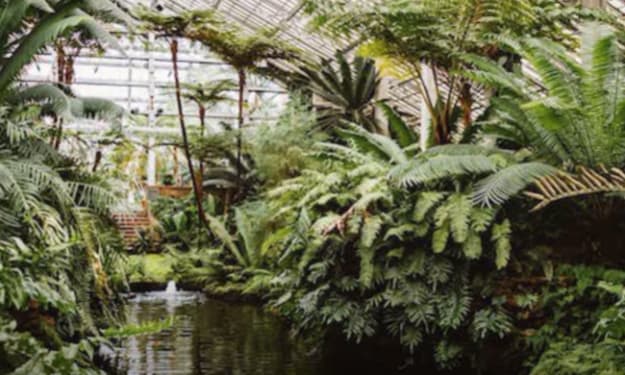
When one envisions a plant, what comes to mind? Perhaps an exquisite orchid blossom or a majestic willow tree? Or maybe a trendy houseplant like a Monstera or a succulent? However, it is time to update and broaden that picture. Plants are not only flashy and flowering. Today, attention is being given to the unsung heroes of the botanical world - those essential plants that were the first to join the party but tend to lie low. They help ecosystems thrive, offer us knowledge about plant evolution, and make great tree accessories. The categories that include mosses and ferns, liverworts, and more, bryophytes and seedless vascular plants, are being discussed.
By make life beautiful2 years ago in Art