Keyas Khan
Bio
Stories (3)
Filter by community
When Love Fades: A Story of Letting Go,
Love—so often celebrated as the most powerful and transformative force in our lives—is also one of the most fragile. It starts with fire, burns bright, and in many cases, slowly cools into embers. There are times when the fire is rekindled, and there are times when it dies quietly and unnoticed, leaving us to wonder how something that was once so vibrant became so distant. This is the story of how love faded between two people who once thought they were inseparable. It is a story of loss, of realization, of pain—but also of healing, growth, and acceptance. For in letting go, we sometimes find ourselves. Chapter 1: The Beginning – A Love That Felt Endless We met in a time when everything felt infinite. The nights were warm, filled with laughter, long conversations, and eyes that never stopped searching one another. We were inseparable—not because we had to be, but because we wanted to be. Every day was a discovery. Every flaw was adorable. Every silence was comforting. We built dreams together. From small ones like where we’d travel next, to bigger ones like a shared future. “Forever” was a word we said often and believed deeply. But no one warns you that forever is fragile, and sometimes, love isn’t enough to hold it all together. Chapter 2: The Shift – When the Small Things Became Big Love rarely ends with a bang. It fades, slowly. It drifts away like mist in the morning sun. We didn’t notice at first. Life got busy. The number of responsibilities grew. The calls became shorter. The dates became rare. And the silences? They turned uncomfortable. What used to be sweet quirks began to annoy. Conversations turned into arguments, and arguments turned into cold wars. We still said “I love you,” but now it sounded like a habit, not a feeling. We both changed—but not together. And that was the beginning of the end. Chapter 3: Denial – Holding On to Shadows Even as we felt the distance grow, we refused to let go. We kept trying to fix what we couldn’t understand. We thought if we just tried harder, gave more, compromised more—we could find our way back. But love, once it begins to fade, doesn't always respond to force. Sometimes, the harder you try, the more obvious it becomes that you're chasing a version of the past that no longer exists. And so, we clung to the memory of what we used to be. We stayed longer than we should have. We told ourselves it was just a phase. But deep down, we both knew—we were holding on to a ghost. Chapter 4: The Realization – The Moment You Know There is always a moment. A moment when one of you looks at the other and realizes: "I don’t know this person anymore." Not in anger, not in hate—but in sadness. It’s like looking into the eyes of someone who once held your whole world and realizing they’re a stranger now. That moment came quietly. We were sitting in silence, not because we were comfortable, but because there was nothing left to say. The connection, once so electric, had gone flat. Despite the fact that we were both in it, the space felt empty. And then came the words—soft, trembling, but honest: “I think we both know this isn’t working anymore.” Chapter 5: The Separation – Letting Go with Grace Breakups don’t always have to be ugly. Ours wasn’t. There were tears, yes. There were long hugs and whispered apologies. But there was no blame, no shouting. Just two people choosing to stop hurting each other. We divided our things. We deleted old pictures—some we kept, because memories don’t always deserve to be erased. We walked away, not as enemies, but as people who once loved deeply and chose to respect that love, even in goodbye. Letting go wasn’t a one-time act. It was a process. It was waking up and not reaching for the phone. It was seeing their name and not calling. It was learning to breathe without their presence. Chapter 6: The Pain – Healing Isn’t Linear Healing doesn’t follow a straight line. Some days, I was fine. I laughed, I worked, I felt free. Other days, the grief hit me like a wave. A song, a scent, a memory—anything could bring it all back. People told me time would heal everything. But time doesn’t heal—it simply gives space. What really heals is acceptance. Accepting that the love was real. That the end was necessary. And that moving forward isn’t betrayal—it’s survival. I let myself feel everything: the guilt, the regret, the sadness. Because numbness isn’t healing. Only when I stopped avoiding the pain did I begin to let it go. Chapter 7: The Growth: Regaining Your Wholeness In the absence of them, I found myself. I rediscovered passions I’d forgotten. I traveled alone, learned new things, met new people. I realized that my identity wasn’t defined by a relationship, and my happiness didn’t depend on another person’s presence. I forgave myself. I was kind to them. Not because it was easy, but because it was necessary. Carrying bitterness only poisons the future. I learned that love isn’t always meant to last forever. Some people come into your life to teach you lessons, to help you grow, to show you what you need—and then they leave. And that’s okay. Conclusion – When Love Fades, You Don’t Have To Love fading doesn’t mean failure. Sometimes, it’s the bravest thing you can do—to let go of something that once made you happy because it no longer does. It is not weakness to let go. It’s an act of strength. It's choosing peace over pretending. It’s saying: “I deserve more than almost.” And when you walk away from a love that no longer serves you, you open the door to something new. Maybe not right away. But someday. Because when love fades, it doesn’t mean your story ends. It just means a new chapter begins
By Keyas Khan10 months ago in Humans
Indian Air Strikes: How Will Pakistan Respond? Four Crucial Inquiries
India and Pakistan, two nuclear-armed neighbors, have shared a turbulent and often hostile relationship since their partition in 1947. While diplomatic dialogues have occasionally created brief windows of peace, the relationship is predominantly defined by territorial disputes, cross-border terrorism, and mutual suspicion. One of the most volatile flashpoints in this relationship is the issue of Kashmir, which has led to multiple wars and countless skirmishes. In this tense environment, the occurrence of Indian air strikes inside Pakistani territory is an issue of grave concern, capable of triggering a wider regional conflict.
By Keyas Khan10 months ago in Humans
Israeli Proposal to Take Control of Gaza Strip Raises Global Concerns and Deepens Regional Tensions
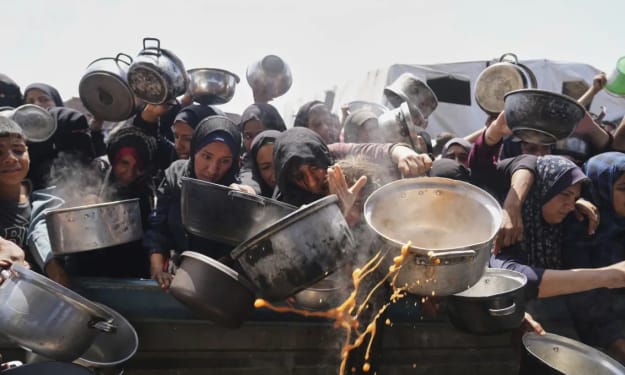
The more recent proposal by the Israeli government to take long-term control of the Gaza Strip has sparked global outrage and rekindled discussions about the ongoing Israeli-Palestinian conflict. This controversial plan, which emerged in the aftermath of intensified military operations in Gaza, is viewed by many international observers, human rights organizations, and governments as a potential escalation that could severely destabilize the region and derail any remaining hopes for a two-state solution. Background of the Gaza Conflict The Gaza Strip, a narrow piece of land bordering Israel, Egypt, and the Mediterranean Sea, has been a central flashpoint in the Israeli-Palestinian conflict for decades. Following Israel’s withdrawal from Gaza in 2005, the region fell under the control of Hamas, an Islamist political and militant group considered a terrorist organization by Israel, the United States, and the European Union. The region has gone through several cycles of violence since then, including several full-scale wars, thousands of civilian deaths, and a humanitarian crisis that has been exacerbated by an Israeli-Egyptian blockade. Gaza’s two million residents live under dire conditions, with limited access to clean water, electricity, and medical supplies, exacerbated by years of conflict and siege. The Israeli proposal: Security justification for control In early 2025, following a protracted and deadly military campaign in Gaza, Israeli Prime Minister Benjamin Netanyahu’s administration floated a plan suggesting that Israel may need to establish a long-term military and administrative presence in Gaza “to ensure security and prevent future terrorist threats.” Officials in Israel say that the move is needed to take down Hamas' infrastructure and stop more attacks on Israeli soil. Netanyahu and Defense Minister Yoav Gallant have made it clear that "ironclad security guarantees" are needed before "uncontrolled" Gaza after the war can be handed over to the Palestinian Authority. The proposal includes ideas such as the deployment of Israeli forces across the Gaza Strip, control of border crossings, and potentially, the establishment of a buffer zone inside Gaza. Legal Implications and Reactions on a Global Scale The proposal has been met with immediate and fierce criticism from across the world. The Arab League, the European Union, the United Nations, and a number of humanitarian organizations have voiced their deep concern, describing it as a dangerous precedent and a violation of international law. UN Secretary-General António Guterres stated, “Any attempt to reoccupy Gaza would constitute a serious breach of international law and further jeopardize the prospects of peace in the Middle East.” Many legal experts contend that Israel's plan would be de facto annexation because it violates the Geneva Conventions, which forbid the permanent occupation of war-acquired territory. Israel's traditional ally, the United States, has also voiced reservations. Secretary of State Antony Blinken warned that a reoccupation of Gaza would be "counterproductive" and "not aligned with long-term peace goals," despite the fact that the Biden administration has supported Israel's right to self-defense. Calls for unity and condemnation from the Palestinian response The Israeli proposal was strongly condemned by the West Bank-based Palestinian Authority (PA). President Mahmoud Abbas denounced the idea as “a return to colonialism” and called for international intervention to prevent what he termed a "war crime in the making." Despite Hamas's decline as a result of the ongoing Israeli offensive, it pledged to continue its resistance. Spokesman Hazem Qassem stated, “Any Israeli attempt to take control of Gaza will be met with unwavering resistance from our people. Israel does not use Gaza as a pawn in its political games. Across Palestinian territories and the wider Arab world, there have been mass protests against the Israeli plan. The governments of Ramallah, Cairo, Amman, and Beirut have been urged to take diplomatic and economic action against Israel by demonstrators there. Humanitarian Crisis Deepens Meanwhile, the humanitarian situation in Gaza continues to deteriorate. According to the United Nations Relief and Works Agency (UNRWA), more than 60% of Gaza’s population is displaced, and essential services are on the brink of collapse. Hospitals are overwhelmed, food and water shortages are critical, and the blockade continues to restrict the flow of aid. Aid organizations are concerned that Israel will further restrict humanitarian access and exacerbate civilian suffering if it implements its control plan. Jan Egeland, Secretary-General of the Norwegian Refugee Council, warned, “If Gaza becomes an occupied territory again, humanitarian operations will face even greater hurdles, and the civilian population will pay the price.” Contribution to the Peace Process The Israeli proposal threatens to dismantle decades of international efforts to achieve a two-state solution. Now more than ever, the Palestinian vision of an independent state that would include the West Bank and Gaza as well as East Jerusalem as its capital is in doubt. The plan, according to a lot of experts, may encourage Israeli far-right groups that have long called for permanent Palestinian control. Dr. Hanan Ashrawi, a Palestinian politician and peace negotiator, commented, “This is a blatant attempt to kill the two-state solution and replace it with an apartheid regime of permanent occupation and subjugation.” Security Concerns and Implications for the Region The proposal has also raised alarm bells in neighboring Arab countries. Egypt, which shares a border with Gaza and has played a crucial mediating role in past ceasefires, warned that any Israeli move to control Gaza would “threaten regional stability and provoke widespread unrest.” Jordan, Qatar, and Turkey also voiced strong opposition. The Arab League convened an emergency session in Cairo, urging unified action against what it called “Israeli expansionism.” Security analysts predict that such a move could provoke a wider regional conflict, drawing in Iran-backed militias in Lebanon, Syria, and Iraq, and possibly leading to escalations with Hezbollah on Israel’s northern front. Israeli Opposition Voices The proposal has its detractors within Israel. A growing number of Israeli citizens, former military officials, and left-leaning political parties have spoken out against the idea of reoccupying Gaza. Ehud Barak, a former prime minister, stated, "It is a strategic trap to reenter and control Gaza." It will drain our resources, cost countless lives, and damage Israel’s standing in the world.” Protests have also erupted in Tel Aviv and Haifa, with demonstrators calling for a diplomatic resolution and renewed negotiations with the Palestinians rather than military dominance. Conclusion The international community has been shaken by Israel's proposal to take control of the Gaza Strip. It could be a turning point in the Israeli-Palestinian conflict that will change the Middle East's political landscape for years to come. While Israel cites security concerns as its primary motivation, the general consensus appears to be that such a plan would exacerbate the humanitarian crisis, violate international law, and stifle the already bleak hope of a peaceful resolution. The world is keeping a close eye on the situation, hoping that diplomacy and not force will prevail in this long-suffering nation.
By Keyas Khan10 months ago in The Swamp