John Welford
Bio
John was a retired librarian, having spent most of his career in academic and industrial libraries.
He wrote on a number of subjects and also wrote stories as a member of the "Hinckley Scribblers".
Unfortunately John died in early July.
Stories (501)
Filter by community
A Boy in a Sailor Suit
I suppose it was really my mother Dorothy’s embarrassment rather than mine, given that I was probably too young to feel that way at the time. But, given that I remember it so vividly after all these years, maybe that was the first occasion – out of so many since! – when the spark of embarrassment was kindled in me.
By John Welford5 years ago in Confessions
Exit, Pursued by a Bear
In Act 3 Scene III of The Winter’s Tale, by William Shakespeare, there is an interesting and unexpected stage direction. A character named Antigonus exits the stage “pursued by a bear”. Antigonus’s role has been to take the baby daughter of Queen Hermione to – would you believe – the coast of Bohemia and abandon her to the wild beasts of the region. What actually happens is the baby survives but Antigonus does not, and we are given to believe that it is the bear in the stage direction that is the cause of Antigonus’s demise.
By John Welford5 years ago in Geeks
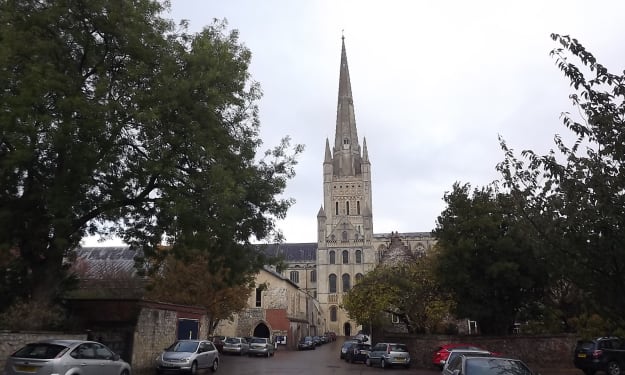
Historic places of worship in Norfolk
Norfolk is a large county that contains one modestly-sized city (Norwich), a port town (Great Yarmouth), a number of small seaside resorts (e.g. Cromer and Sheringham), a scattering of market towns (e.g. Kings Lynn and East Dereham), and a huge number of small villages that bear witness to the main industry of the county, which is agriculture of the rich soils that cover much of the terrain.
By John Welford5 years ago in Wander
The Hindenburg Disaster, 1937
During the years preceding World War II there were two choices on offer to those who wished to travel by air. There were fixed-wing, propeller-driven aircraft, and there were airships. Given that the former were primitive by modern standards, being noisy, cramped and uncomfortable, not to mention dangerous, it is understandable that people who could afford to travel long distances by air were attracted to the much greater comfort offered by airships, although safety was still an issue.
By John Welford5 years ago in FYI
Hereford Cathedral
The beginnings of Hereford Cathedral Hereford has had a cathedral since the 8th century, although the Saxon building that contained the remains of St Ethelbert (a murdered king of the East Anglians) was destroyed in 1055. Bishop Robert de Lotharingia built a small chapel on the site in 1079, but very little of this remains. It was not until Bishop Reinhelm came along (bishopric 1107-1115) that anything substantial in the way of a cathedral was built, in the Romanesque style, although that was by no means the end of the story.
By John Welford5 years ago in Wander
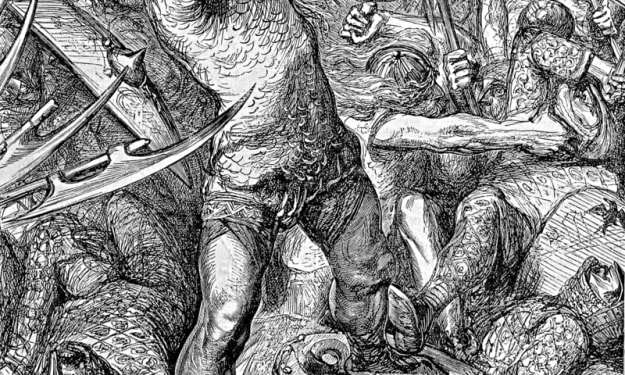
Hereward the Wake
England after the Conquest After his victory at the Battle of Hastings in 1066, Duke William of Normandy knew that he would not be a popular King of England. He had no real claim to the throne other than by force, so he could hardly have expected to be welcomed with open arms.
By John Welford5 years ago in FYI
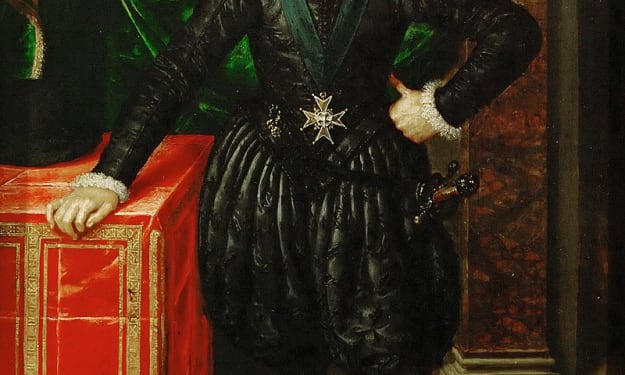
Henry IV, King of France
Henry IV occupies a similar niche in the history of France to that of Henry VIII in England, and there are a number of parallels between the two monarchs. They were certainly both “larger than life” characters who left important and far-reaching legacies in their respective countries.
By John Welford5 years ago in FYI
Head racing in rowing
A head race in rowing is in effect a time trial rather than a race to see who is first to cross the finish line. It is the sort of race that is more suitable for a narrow stretch of river, and it requires different skills from those of sprint racing. Basically, in a head race the crews start the course at different times and race against the clock rather than each other.
By John Welford5 years ago in Unbalanced
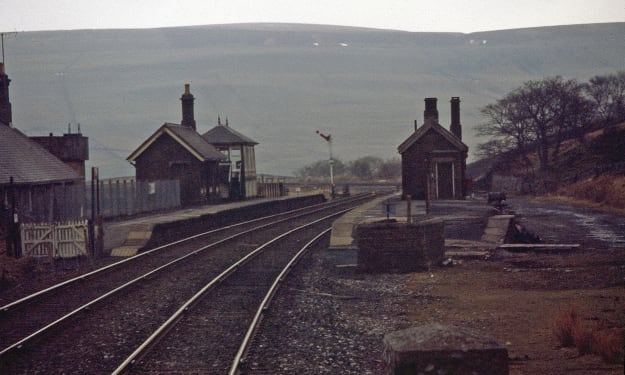
The Hawes Junction rail crash, 1910
The Settle and Carlisle railway is one of the most dramatic and scenic rail routes in the United Kingdom, as it proceeds from south to north along the spine of northern England, namely the Pennine Hills. The Victorian builders of the line had many difficulties to overcome in keeping the route as level as possible, with long tunnels and high viaducts, but the gradients that trains must tackle are still considerable.
By John Welford5 years ago in FYI
Hawaiian goose (nene)
I have never been to Hawaii, but I have a vivid memory of a close encounter with a Hawaiian goose, or nene. The Slimbridge Reserve on the Severn Estuary (Gloucestershire, England) was instrumental in helping to save the species from extinction in the 1950s and 1960s, and there is still a population of these impressive looking geese there today.
By John Welford5 years ago in Wander