Everyday Junglist
Bio
About me. You know how everyone says to be a successful writer you should focus in one or two areas. I continue to prove them correct.


Stories (709)
Filter by community
How To Build an AI
First Comes the Background and Introduction Part I don’t spend nearly as much time as I probably should reading people’s comments. To be honest it is mostly because I have a very fragile ego. The slightest criticism can ruin my night and possibly my entire week if it hits the mark a little too close for comfort. When I do work up the nerve to have a peek I am usually rewarded as mostly the people who do take the time to read and comment are thoughtful and intelligent and often make some really brilliant points, sometimes this happens even after they lay into me for wasting five minutes of their life with a post or two or three they found most definitely not to their liking. Holy run-on batman! Is that really a grammatically sound sentence? I mean look how long it is, try and diagram that sucker, I dare you.
By Everyday Junglist4 years ago in Futurism
Thinking About Nash’s Equilibrium
Maybe somebody out there can help me understand something I never understood about the prisoners dilemma. Why exactly is confess and betray considered a bad (the worst) decision for the collective? Neither member is stuck with a year in jail. Sure it’s not the best outcome of just 1 month but 3 months is a hell of a lot better than a year.
By Everyday Junglist4 years ago in Futurism
The End of Biology
The power, influence, and perceived importance of the three horsemen (ML, DS, and AI) has continued to grow apace. This, despite the fact that machines can’t learn, data science is not science, and artificial intelligence (still) does not yet actually exist, and may never. The ascendance of these three technologies, I argue, has come at a cost. Part of this cost, has been the diminishing of the importance of biology. By that I do no mean to say the importance of the biological sciences or interest in biology even, but rather its uniqueness or, to make up a word, its differentness.
By Everyday Junglist4 years ago in Futurism
Three Reasons Research Scientists Should Avoid Programming and Data Analytics
Intro and caveats I recently read an article in which and engineer extolled the virtues of learning to program, and the value of advanced data analytics to his career. The article was persuasive and I have little doubt the advantages he mentioned were real. However, he was an engineer, not a scientist and what holds true for the one does not hold true for the other in this case. In fact I argue that learning to program or spending your valuable time building expertise in advanced data analytics is to the overall detriment of your career in research science. Obviously what I am about to say here will not apply in 100% of cases. No doubt there will be some exceptions, particularly in the “hard sciences” [e.g. experimental or theoretical physics (programming and data analytics)] or even the social “sciences” [e.g. psychology or behavioral science (data analytics)] there may be advantages or even a need for said skill sets, but I would suggest the standard training provided in the curriculum for those fields would already provide to the extent needed and therefore these comments would not apply. Therefore I will restrict my comments to research in the sciences in fields where the standard education/training programs would not normally include programming or advanced data analytics (except in a few special cases). Mainly of course I am thinking of the biological/life sciences though there are certainly others. With those caveats in mind, there are three reasons why I believe this is the case.
By Everyday Junglist4 years ago in Education
The Man Who Never Fell
There did once live a man who never fell. When I say he never fell I do not mean that in a metaphorical sense, as in he never failed or screwed up. He definitely did plenty of that, but he never actually fell, as in he never once fell down physically so that both his knees and both his hands touched the ground against his will. Perhaps you suspect that this man must have been wheelchair bound his entire life or maybe he was a super star athlete with incredible balance. Actually he had no physical handicaps to speak of, nor did he have any great physical abilities. Just like everything else about the man, his motor skills were average. It was purely circumstance, luck, fate, whatever you want to call it that set things up for him so he never fell. He was in fact very average in all respects physically including in the looks department which (partly) explains why he only married once, and it lasted only two years. She left him shortly after cheating on him with his best friend. Not too surprising as reportedly she often denigrated the man to her friends calling him "boring" "slow" and "a nobody who would never amount to anything." Mentally he was much the same, average. Not too smart but not exactly dumb either. He lived for 82 years in various location around the United States and even spent 1 year ‘living’ abroad after he graduated from college with his degree in sociology. Remember what I said about him not being too smart. He worked four different full time (forty hour per week) jobs over the course of his career until he retired at age sixty two and a half. None were particularly interesting, or made him very much money, but none were terrible either. It would be fair to say that much like everything else in the mans life they were average. In any case this man who was average in every way that matters was well, well above average in one unusual area. He never once fell down. Not one time in his entire average life from when he first mastered how to walk at age three until the day he died. In case you were wondering he died in his sleep, laying down, of a heart attack, so he did not even fall then. It is believed that this man was the only man or woman in the history of the human race to have accomplished this particular feat, and most experts predict there will never be another.
By Everyday Junglist4 years ago in Fiction
Patience is For Suckers and Fools
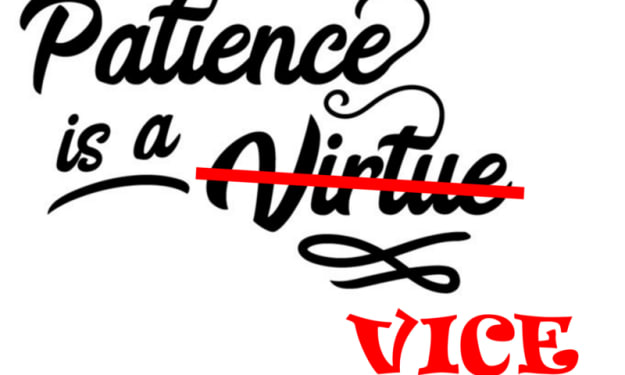
Who hasn’t heard the long cliched aphorisms that “patience is a virtue” and “good things come to those who wait.” The (supposed) fact that patience is a virtue, a good thing, something to be cultivated, and strived for is one of the few things that both eastern and western religious traditions agree on. That should be a warning sign in and of itself. Anything so obviously agreed upon without hesitation by religions as diverse as Christianity and Judaism to Buddhism and Islam suggests the highest skepticism is in order. That said, at one time I happen to think the major religions, and just about everybody else, was correct in their position on the general goodness of patience. However, that time has passed and patience today has evolved into an escape hatch for the lazy, a way to avoid doing anything, and an easy excuse for absolving oneself and everyone else of any responsibility for the way things are. Let me be the first to say it, what was once a virtue is now a vice. And rather than a lack of patience I contend that we have become too patient as a society. We have become complacent, always thinking that someone else will fix our problems if we just wait long enough. Someone or something, other than ourselves of course, will come and rescue us. If we only wait a little bit longer, have a little more patience.
By Everyday Junglist4 years ago in Motivation
An AI Takes an IQ Test
If you wanted to measure something, but you could not define what that thing was, or how it worked, or what it did, what would you do? What if you “knew” the thing you were measuring existed, were absolutely sure of it, and completely believed that it was something very important? Moreover, all of your friends and family and every other person in the world thought the same way. They all truly believed this undefinable thing really existed and that it was something very, very important. How exactly would you measure it?
By Everyday Junglist4 years ago in Futurism
Guilt as Motivator
There are many ways to convince someone to do something or not do something. You can ask politely, gently plead, beg, demand, threaten, tempt, among many others. Finally, of course, you can use guilt, possibly the oldest (see Book of Genesis story of Adam & Eve for several excellent examples), and arguably the least effective means of getting another person or group of persons to do the thing or things which you would like them to do, or stop doing the thing or things you would like them to stop doing. Why do we constantly do this? Why do seemingly rationale and sane individuals, many of whom our are very own friends and family, play the guilt card so often when attempting to convince us to do something (or not), especially when many times there are plenty of other options such as some of the ones listed above that would seem to be available as better choices?
By Everyday Junglist4 years ago in Psyche
How Long Does it Take to Shave a Mouse?
When you are a nerd like myself, you have a whole bunch of (more accurately 1 or 2) nerd friends. Occasionally these nerd friends hit you up for advice, or ideas, or just to say hello, or to update you on all the nerdy things they have been up to since the last time you nerded out together. Sometimes these nerd contacts take a form that borders on the bizarre. Case in point the latest missive I received by text message from my nerd micro/macro biologist friend Sam (not her real name). Sam works in some sort of high(ish) level biosecurity position somewhere and for some entity that she refuses to elaborate on no matter how hard I push. Keep in mind I had not heard a peep from Sam in close to a year. Not one single phone call, or email, or text message. Complete and total silence for 1 full year. Until today when, out of the blue, I received the following message “Do you have any idea how long it might take to shave 30 mice?” Short answer, no. Also the long answer.
By Everyday Junglist4 years ago in Journal