Don Rogers
Stories (35)
Filter by community
Unveiling the Power of AI in Cloud Storage: What You Need to Know
Hey there! Have you ever wondered how Artificial Intelligence (AI) and Cloud Storage come together to shape the future? If you’re curious about what these two powerful technologies can do for you, you’re in the right place. We all know that both AI and cloud storage are game-changers in today’s world, but what happens when we put them together?
By Don Rogersabout a year ago in Writers
How AI Singularity Might Shape the Path to Technological Singularity
Have you ever wondered how artificial intelligence (AI) could evolve beyond our current understanding? It's a concept that often comes up when we talk about the future of technology—AI Singularity. But what does this really mean for us and where could it lead?
By Don Rogersabout a year ago in Writers
Is Conscious AI Possible? Exploring the Future of Self-Aware Machines
Artificial intelligence has grown exponentially over the last few decades, with AI applications becoming a part of everyday life. However, the possibility of AI developing consciousness remains a topic of intense debate among experts. While AI has achieved remarkable feats in mimicking human behavior, the question remains: Can AI become self-aware?
By Don Rogersabout a year ago in Writers
Key Elements of an Outstanding Marketing Agency Homepage
A marketing agency homepage is a digital storefront that serves as the first impression for potential clients. To stand out, agencies need to ensure their websites showcase their expertise while engaging users effectively. Below are some essential elements that make a great marketing agency homepage.
By Don Rogersabout a year ago in Writers
Boosting Sales Through Effective Customer Email Marketing: Essential Metrics to Track
Email marketing remains one of the most effective tools for businesses looking to boost customer engagement and sales. However, success in email campaigns goes beyond just sending messages to customers—it’s all about understanding which metrics matter most. By analyzing key performance indicators (KPIs), businesses can optimize their strategies, ensuring each email campaign delivers the maximum return on investment (ROI).
By Don Rogersabout a year ago in Writers
The Basic Cybersecurity Checklist For Small Businesses
In today's digital world, small businesses face an increasing number of cybersecurity threats, with 43% of cyber-attacks targeting them. A single breach can lead to financial loss, damaged reputations, and legal trouble. To protect against these risks, small businesses must take proactive steps. Start by conducting a risk assessment to identify valuable data and vulnerabilities, then prioritize actions based on threat severity. Strengthen security with multi-factor authentication, regular software updates, firewalls, and secure devices. Regular employee training on cybersecurity best practices, including recognizing phishing attempts and using strong passwords, is crucial for maintaining security.
By Don Rogersabout a year ago in Writers
The 7 Phases Of The Impulse Purchase Cycle Explained!
Impulse buying is a fascinating psychological journey where consumers make spontaneous purchases, often without intending to. This cycle, which accounts for about 40% of purchases, involves seven key phases. It starts with a trigger, such as an emotional or environmental cue, followed by curiosity and interest as the product captures attention. Desire builds as consumers imagine how the item will improve their lives, often amplified by emotional marketing and relatable scenarios.
By Don Rogersabout a year ago in Writers
Unmasking Pharming and Phishing in Cybersecurity
In the digital age, staying safe online is as crucial as wearing a seatbelt in a car. Cyber threats like phishing and pharming are designed to steal sensitive information but operate in different ways. Phishing involves cybercriminals sending deceptive emails or messages, tricking users into clicking malicious links or sharing personal details. Pharming, on the other hand, is a more stealthy attack, redirecting users to fake websites without any interaction. It manipulates DNS settings, making it harder to detect.
By Don Rogersabout a year ago in Writers
Memory Virtualization: A Key Concept in Cloud Computing
Memory virtualization in cloud computing works similarly to how Loki manages the multiverse in the Disney+ series Loki—ensuring everything operates smoothly and without interference. It allows multiple applications to share the same physical memory while keeping them isolated from each other. This mechanism ensures efficient memory allocation, optimal performance, and prevents crashes or conflicts. The technology dynamically allocates resources based on demand, enabling cloud providers to scale efficiently and reduce costs. By using hypervisors to manage memory, cloud environments can run multiple virtual machines (VMs) seamlessly, without resources being overburdened.
By Don Rogersabout a year ago in Writers
The Hierarchy of Virtualization in Cloud Environments
Virtualization in cloud computing is like a digital world where systems, applications, and environments can be manipulated for efficiency and flexibility. Just like Flynn in Tron, who controls the virtual Grid, cloud virtualization allows businesses to optimize resources without limitations. There are five levels of virtualization, each offering unique benefits. The first level, ISA virtualization, enables compatibility with older software on new hardware. HAL virtualization creates a virtual hardware layer, allowing multiple virtual machines to run on a single physical server. Operating system-level virtualization isolates users within a shared OS environment, providing scalability and efficiency. Library-level virtualization connects applications to system resources through APIs, enhancing portability across platforms. Finally, application-level virtualization allows users to run applications on various devices without installing them directly.
By Don Rogersabout a year ago in Writers
A Learner's Guide To Neuro Linguistic Programming In Machine Learning (ML)
Neurolinguistic Programming (NLP) and Machine Learning (ML) are revolutionizing how technology interacts with humans, much like a service dog instinctively understanding its owner's needs. NLP teaches AI to not only comprehend language but also grasp the emotions and context behind it, allowing for more natural interactions. Imagine asking your smart speaker for music that matches your mood, and it instinctively plays the right tunes. This synergy of NLP and ML enables devices to learn from user preferences, improving their responses over time.
By Don Rogersabout a year ago in Writers
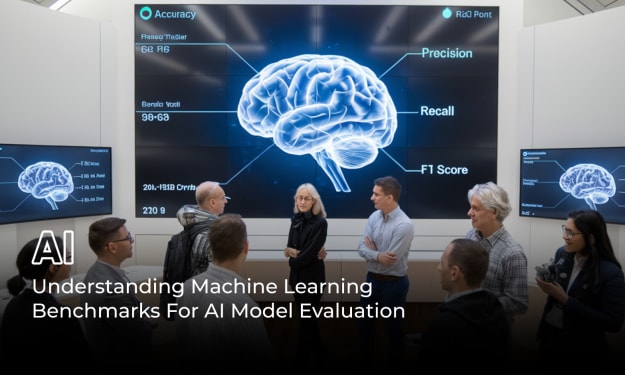
Understanding Machine Learning Benchmarks For AI Model Evaluation
Benchmarking in Artificial Intelligence (AI) is essential for evaluating model performance, much like movie critics assess films. Effective evaluation methods are crucial, especially considering that 70% of AI projects fail to meet expectations, according to McKinsey. Benchmarks provide consistency, transparency, and opportunities for improvement, helping developers compare models and understand their capabilities. Key metrics include accuracy, precision, recall, and the F1 score, all of which inform decision-making and model refinement.
By Don Rogersabout a year ago in Writers